Vitamin Capsule Manufacturing Process: 2026 Guide
With the UK supplement market projected to reach nearly £19.5 billion in 2026, the gap between a visionary brand and a failed venture often resides within the precision of the factory floor. Have you ever wondered if your production line is a catalyst for growth or a hidden bottleneck? Mastering the vitamin capsule manufacturing process is no longer a luxury for the scientifically minded; it's a fundamental requirement for commercial viability in an increasingly regulated landscape.
It's natural to feel a sense of trepidation when faced with complex technical jargon or the latest UK regulatory shifts, such as the Nutrition Regulations coming into force on 12 August 2026. You need more than just a supplier; you require a strategic ally who understands that your reputation rests on every single capsule. This guide provides a transparent look at the technical journey from raw ingredient to finished supplement. We'll explore the encapsulation workflow in detail, whilst offering the insights you need to move from a successful prototype to a dominant mass-market presence.
Table of Contents
The Strategic Journey of Vitamin Capsule Manufacturing
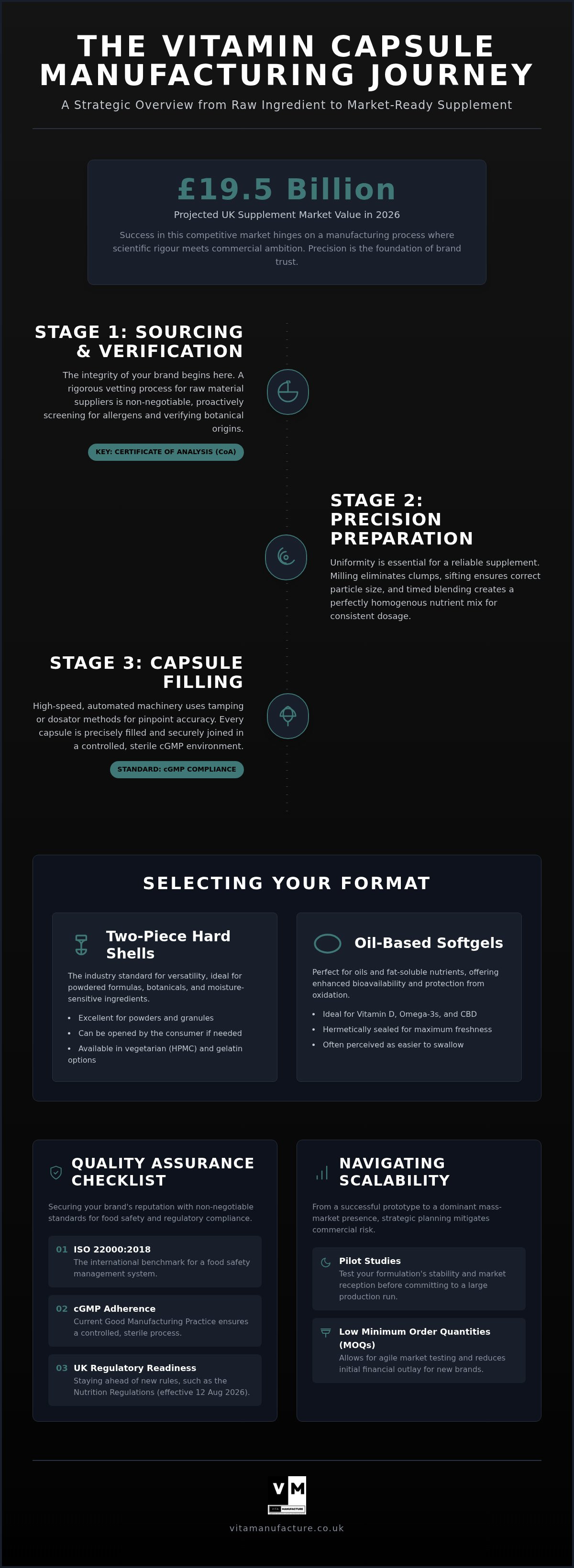
Success in the supplement industry isn't accidental. It's the result of a meticulously planned vitamin capsule manufacturing process that treats every milligram as a critical data point. For founders, viewing production as a mere utility is a strategic mistake. It should be seen as a precision-engineered journey where scientific rigour meets commercial ambition. This journey begins with New Product Development (NPD). This phase is where abstract ideas are refined into stable, bioavailable, and marketable formulations that can actually survive the requirements of mass production.
Understanding the nuances of capsule dosage forms is foundational for any brand owner. Whether you're developing a complex multivitamin or a single-ingredient herbal supplement, the manufacturing workflow dictates your product's efficacy and, ultimately, its market longevity. When you align your vision with a partner who prioritises this technical depth, you aren't just buying a service. You're securing a competitive advantage that protects your investment from the laboratory to the shelf.
Why the Process Matters for Brand Growth
Does your manufacturer treat your formula with the same respect you do? Consistency is the bedrock of customer retention. If a consumer notices a change in colour, smell, or effect between orders, trust evaporates instantly. A robust process ensures absolute dosage accuracy, which is vital for ingredients like Vitamin D where precise levels are necessary for safety and health claims. When "clean label" is a standard expectation, manufacturing transparency becomes your most potent marketing tool. Using tools like a transparent customer portal allows you to track your product's progress, providing the peace of mind that every step meets your high standards.
Sourcing and Ingredient Identity
Purity is non-negotiable. The integrity of your brand depends entirely on what's inside the shell. This requires a rigorous vetting process for raw material suppliers that goes beyond a simple price check. Manufacturers must proactively screen for allergens and prohibited substances whilst verifying the botanical origin of every extract. You can't afford to leave your reputation to chance. This is where the strategic choice of a partner becomes clear.
How do you prove your product contains what the label claims? Every batch of raw material must be accompanied by a Certificate of Analysis (CoA). This document is your first line of defence against adulteration and ensures the potency of your active ingredients. By maintaining strict ingredient identity protocols, you ensure that your final product isn't just compliant with UK standards, but superior in a crowded marketplace. This level of detail is what separates a fleeting trend from a legacy brand.
Step-by-Step: The Core Encapsulation Process
The engineering of a supplement is a high-stakes endeavour. Once your formulation is finalised, the physical vitamin capsule manufacturing process begins in earnest. This isn't just about mixing powders; it's about managing complex physical properties to ensure every dose is identical. From the moment raw materials enter the facility, they undergo a series of transformations designed to guarantee stability and efficacy. We treat every batch with the scientific rigour required to move your brand from a successful prototype to a market leader.
Precision Blending and Milling
Have you considered how particle size influences your product's performance? Uniformity is essential for a reliable supplement. Milling breaks down any stubborn clumps, whilst sifting ensures only the correct particle size moves forward. If particles are too varied, the blend won't flow correctly through the encapsulation machinery, leading to inconsistent filling. Precision blending then ensures a homogenous mixture of all nutrients. This step must be timed perfectly. Over-blending can cause stratification, where ingredients separate based on weight or density, which compromises the formula's integrity.
The Mechanics of Capsule Filling
Modern encapsulation is a marvel of industrial automation. High-speed machines typically use "tamping" or "dosator" methods to achieve pinpoint accuracy. The machine delicately separates the two-piece capsule, injects the precise amount of blend, and joins the halves securely. This level of speed and precision is vital for brands looking to scale their operations. It ensures that whether you are producing 5,000 units or 500,000, the quality remains unwavering. Adherence to Current Good Manufacturing Practice (cGMP) ensures these mechanical steps are performed in a controlled, sterile environment that protects your brand's reputation.
The process doesn't end once the capsule is filled. Every batch undergoes polishing to remove residual dust and a rigorous physical inspection to catch any surface defects. We then employ statistical inspection methods to monitor the vitamin capsule manufacturing process in real-time. By analysing weight data across the entire run, we verify that every capsule meets the strict requirements of your specification. This data-driven approach is what allows you to scale with confidence. If you are ready to see how these standards apply to your next project, you can explore our contract manufacturing services to start your journey.
Selecting Your Format: Hard Shell vs. Softgel Capsules
Choosing the right delivery format is a pivotal moment in the vitamin capsule manufacturing process. It's a decision that balances chemical stability with consumer preference. Have you considered how the physical form of your supplement aligns with your brand's values? Whether you are launching a dry herbal extract or a lipid-based nutrient, the choice between a traditional two-piece hard shell and a hermetically sealed softgel is critical. Each path offers distinct advantages in terms of ingredient protection, bioavailability, and market positioning.
Hard Shell Capsules (Two-Piece)
Two-piece capsules are the industry standard for dry, powdered ingredients. They are exceptionally versatile, making them ideal for formulations like Vitamin D or complex multivitamins. One of their primary benefits is the minimal heat exposure during production. Because the powder is simply tamped into the shell, sensitive nutrients remain protected from the thermal stress often associated with other formats. This ensures the potency of your product remains intact from the factory floor to the customer's hands.
Branding is another area where hard shells excel. They are easy to customise with specific colours and logos, allowing you to create a visual identity that resonates with your target audience. When following WHO guidelines on capsule manufacturing, manufacturers ensure these shells meet rigorous standards for disintegration and uniformity. This reliability is why many founders prioritise hard shells during the early stages of new product development.
Softgel Technology and Vegan Alternatives
Softgels are the superior choice for oil-based nutrients, such as Omega-3 or Vitamin E. The manufacturing involves a sophisticated process of ribbon formation, where two layers of shell material are fused around a liquid centre. This creates a tamper-evident, airtight seal that prevents oxidation and extends shelf-life. Whilst traditional softgels rely on bovine or porcine gelatin, the industry is shifting rapidly towards plant-based alternatives to meet the demands of the vegan-conscious consumer.
HPMC (Hydroxypropyl Methylcellulose) has emerged as the gold standard for vegan capsules. These plant-derived shells offer excellent stability across various climates and are less prone to cross-linking than gelatin. As you evaluate your scalability, consider how these material choices impact your global reach. Choosing HPMC isn't just a dietary preference; it's a strategic move to ensure your brand is inclusive and future-proof. Whether you are sourcing ingredients in bulk or refining a custom formulation, the material of your capsule is just as important as the nutrients inside.
The Quality Assurance Checklist for UK Founders
Navigating the UK regulatory landscape can feel like a daunting task for any entrepreneur. However, quality assurance is where your brand's promise meets reality. In the vitamin capsule manufacturing process, rigorous testing isn't just a hurdle; it's the foundation of your commercial viability. When you choose a partner, you're entrusting them with your reputation. Ensuring they adhere to the highest international standards is the only way to safeguard your growth and protect your customers.
Regulatory Compliance and ISO Standards
Is your manufacturing partner truly qualified to handle your vision? In the UK, adherence to Good Manufacturing Practices (GMP) and food safety laws is the bare minimum. To compete globally, you should look for the ISO 22000:2018 certification. This is the gold standard for food safety management systems. It demonstrates a proactive approach to hazard control that goes far beyond basic compliance. At our Littleport facility, this certification ensures every batch is produced under the strictest conditions.
Transparency should be a tangible part of your partnership. You shouldn't have to guess the status of your compliance documents or batch records. A transparent customer portal allows you to view essential certifications and project tracking in real-time. This level of openness builds the trust necessary for a long-term strategic alliance. It ensures that whilst we handle the technicalities, you have the data needed to reassure your investors and customers alike.
Testing and Finished Product Assurance
Quality control continues long after the capsules are filled. In-process testing includes moisture analysis and weight checks to ensure every unit is within specification. One of the most critical steps is disintegration testing. This verifies that the capsule will break down correctly in the body, ensuring the nutrients are actually absorbed as intended. If a capsule doesn't dissolve properly, your product's efficacy is compromised, regardless of how high-quality the ingredients were at the start.
Before any product leaves the facility, it must pass finished product assurance. This involves three key layers of laboratory analysis:
Microbiological Testing: Confirms the batch is free from harmful contaminants and pathogens.
Potency Testing: Verifies that the active ingredients match the claims on your label exactly.
Physical Inspection: Checks for capsule integrity, colour consistency, and polish quality.
This comprehensive approach to the vitamin capsule manufacturing process is what allows you to scale with absolute confidence. You don't have to navigate these complexities alone. If you're looking for a partner who prioritises these standards, you can request a consultation with our quality team today to discuss your specific project requirements.
Navigating Scalability: From Pilot Studies to Mass Production
Scaling a supplement brand is a test of both scientific precision and business agility. Many founders stumble when moving from a small-scale prototype to high-volume production because they lack a clear roadmap for expansion. Success requires a strategic approach to the vitamin capsule manufacturing process that prioritises risk mitigation and commercial viability. Are you prepared to transition your brand from a niche offering to a household name?
The Role of Low MOQ and R&D
How do you validate a new formulation without committing to massive inventory? Pilot studies are the answer. These smaller production runs allow you to identify potential manufacturing hurdles or stability issues before you enter mass production. By investing in dedicated New Product Development (NPD), you ensure your formula is unique and legally compliant. R&D fees shouldn't be viewed as a barrier; they are the price of entry for a product that actually performs in a saturated market.
Low Minimum Order Quantities (MOQs) are a vital tool for ambitious founders. They allow you to organise your cash flow effectively whilst testing real-world consumer demand. This agile approach means you can refine your marketing strategy based on actual sales data rather than projections. Once you've proven your concept, scaling up to high-volume contract manufacturing becomes a logical, data-driven step rather than a financial gamble.
End-to-End Logistics and Distribution
A visionary growth partner does more than just fill capsules. They manage the complexities of the global supply chain so you can focus on brand building. This includes everything from the initial sourcing of bulk ingredients to the final stages of logistics and distribution. When your manufacturing is integrated with storage and third-party logistics (3PL) services, you eliminate the friction that often stalls growing businesses. This seamless flow ensures your product moves efficiently from the Littleport factory floor to your customers across the globe.
Reliability in your supply chain is just as important as the quality of the ingredients inside your capsules. By consolidating your operations under one strategic ally, you gain total visibility over your inventory and shipping timelines. This proactive management prevents stockouts during critical growth periods. Ready to scale? Partner with Vita Manufacture for end-to-end support and transform your manufacturing process into a powerful engine for commercial success.
Transforming Vision into Market Reality
The journey from a raw formulation to a market-leading product is defined by technical precision and strategic foresight. By mastering the vitamin capsule manufacturing process, you've moved beyond the confusion of industry jargon to a position of informed authority. You now understand that selecting the right format, whilst ensuring rigorous adherence to ISO 22000:2018 standards, is the only way to secure long-term commercial viability. These aren't just operational steps; they are the fundamental safeguards for your brand's reputation and your customers' safety.
Success in 2026 requires a partner who thinks like a business owner and acts with scientific rigour. At our UK-based facility in Littleport, we specialise in the custom formulations and low MOQ options that empower founders to launch with confidence. Whether you're refining a pilot study or preparing for mass-market expansion, your vision deserves a strategic ally invested in your success. Launch your supplement brand with Vita Manufacture today to begin your journey. Your future as an industry leader starts with a single, perfectly engineered capsule.
Frequently Asked Questions
What are the main steps in the vitamin capsule manufacturing process?
The vitamin capsule manufacturing process involves several critical stages: New Product Development, raw material sourcing, and precision milling. Once the ingredients are sifted to ensure uniform particle size, they undergo homogenous blending to guarantee a consistent mix. This is followed by the core encapsulation phase where the blend is filled into shells. Finally, the capsules are polished and subjected to rigorous quality checks, including disintegration and potency testing, before they are cleared for distribution.
What is the difference between hard-shell and softgel capsules?
Hard-shell capsules consist of two pieces that are joined together, making them the ideal choice for dry, powdered formulations. In contrast, softgels are one-piece hermetically sealed shells designed specifically for liquid or oil-based ingredients like Omega-3. Whilst hard shells offer greater customisation for branding and colours, softgels provide a superior barrier against oxidation for lipid-based nutrients. Your choice depends entirely on the chemical stability and delivery requirements of your specific formula.
How does ISO 22000:2018 certification affect supplement quality?
ISO 22000:2018 is a comprehensive food safety management system that ensures a manufacturer identifies and controls food safety hazards. This certification goes beyond basic compliance by requiring a proactive, data-driven approach to quality throughout the entire supply chain. For your brand, this means every batch produced in an ISO-certified facility meets international safety standards. It provides the high-level assurance needed to build consumer trust and scale your venture into competitive global markets.
Can I manufacture vegan-friendly vitamin capsules in the UK?
Yes, you can easily manufacture vegan-friendly supplements in the UK by utilising HPMC (Hydroxypropyl Methylcellulose) shells. These plant-derived alternatives have become the industry standard for brands targeting the vegan-conscious market. They offer excellent stability across various storage conditions and are suitable for a wide range of dry ingredients. By choosing HPMC, you ensure your product is inclusive and aligns with the modern consumer's preference for clean-label, plant-based delivery formats that avoid animal derivatives.
What is a pilot study in supplement manufacturing?
A pilot study is a small-scale production run designed to test the viability of a new formulation before committing to mass production. It allows you to identify any physical or chemical issues, such as poor powder flow or ingredient separation, in a controlled environment. This stage is a critical part of the vitamin capsule manufacturing process because it mitigates financial risk. It provides the data needed to refine your formula for commercial success before scaling.
How long does the encapsulation process typically take?
The duration of the encapsulation process varies based on the complexity of your formulation and the total batch size. Whilst the actual filling stage on high-speed machinery is efficient, you must account for the time required for precision blending and rigorous post-production testing. Typical lead times for a standard production run can range from several weeks to months, depending on current facility capacity and the depth of the quality assurance protocols required for your SKU.
Do I need my own formulation before contacting a manufacturer?
No, you don't need a finalised formula before reaching out to a strategic manufacturing partner. Many founders start with a broad concept or a list of desired health benefits. Through dedicated New Product Development (NPD) services, we can help you refine your ideas into a stable, bioavailable, and marketable formulation. This collaborative R&D process ensures your supplement is scientifically sound and ready for mass production, allowing you to focus on your brand's vision.
What are MOQs, and why do they matter for new supplement brands?
MOQs, or Minimum Order Quantities, represent the smallest number of units a manufacturer will produce in a single run. For new brands, low MOQs are vital as they allow you to organise your cash flow whilst testing the market with a new product. High MOQs can create a significant barrier to entry, whereas flexible options enable you to launch quickly and scale your production as consumer demand grows, reducing your overall commercial risk during the launch.