What Is Citric Acid? Uses in Supplement Formulation
Citric acid does more than give citrus its sharp edge. To understand what citric acid is, start with its chemistry: it is an organic acid found naturally in citrus fruits, and its molecule has three carboxylic acid groups that can release hydrogen ions. That structure explains its acidity and helps make sense of why the ingredient has a place in formulations.
If you’ve seen citric acid on food labels or in supplement ingredients, its name may seem self-explanatory. But its function depends on the finished product. This guide explains its molecular structure, acidity and pKa values, where it occurs in citrus and other sources, and how these properties relate to supplement formulation. You’ll learn how citric acid can affect taste and acidity, giving you a clearer basis for understanding the ingredient and making formulation decisions. The focus is first on the chemistry, then on its practical role in product development.
Table of Contents
What is Citric Acid?
Citric acid is an organic acid found naturally in citrus fruit and used in foods, drinks and other products. MDPI reports it by dry weight at 4-8% in lemons, 1.5-3.0% in blackberries and 1.2-2.1% in grapefruits.
Flavour enhancement and preservation
Citric acid gives foods a tart, sharp flavour and can balance sweetness in products such as fruit drinks and sweets. By increasing acidity, it can also help preserve food quality and slow some forms of spoilage.
This combination matters in formulation because acidity affects both flavour and product stability. In a lemon-flavoured drink, for example, citric acid can provide the expected tang without relying on citrus juice alone.
Uses in food and drinks
Food and drink makers use citric acid to add acidity or adjust flavour in soft drinks, jams, sweets and canned fruit. It can also help keep taste consistent between batches, especially when recipes contain fruit ingredients that naturally vary.
In the UK, E330 is the food-additive identifier for citric acid. Its use must follow applicable food-additive requirements, including conditions that can depend on the food category.
Citric acid and vitamin C
Citric acid and vitamin C are different compounds: vitamin C is also known as ascorbic acid. Their names and presence in citrus fruit can cause confusion, but citric acid is not a substitute for vitamin C.
A lemon’s sourness comes from acids such as citric acid, while its vitamin C content is a separate nutritional property. On a supplement label, distinguish the ingredient’s chemical name from any vitamin claim.
Uses in cleaning and cosmetics
In household cleaning products, citric acid can help dissolve mineral deposits such as limescale. Cosmetic formulations may use it to adjust acidity, so its purpose depends on the product, not just the ingredient name.
Food-grade citric acid is intended for use in food, not automatically for application to skin. Concentrated acidic solutions can irritate the skin or eyes, so avoid direct contact and follow the product directions.
For home handling, store citric acid in a tightly closed container in a cool, dry place, as advised by the U.S. Environmental Protection Agency. Use a clean, dry utensil, and close the container after measuring to limit exposure to moisture.
Although food-grade citric acid is used as a food ingredient, concentrated powder is not necessarily suitable to eat on its own. Its acidity can cause irritation, especially in concentrated form. Avoid swallowing cleaning products or applying them to skin.
Acidity and pKa values
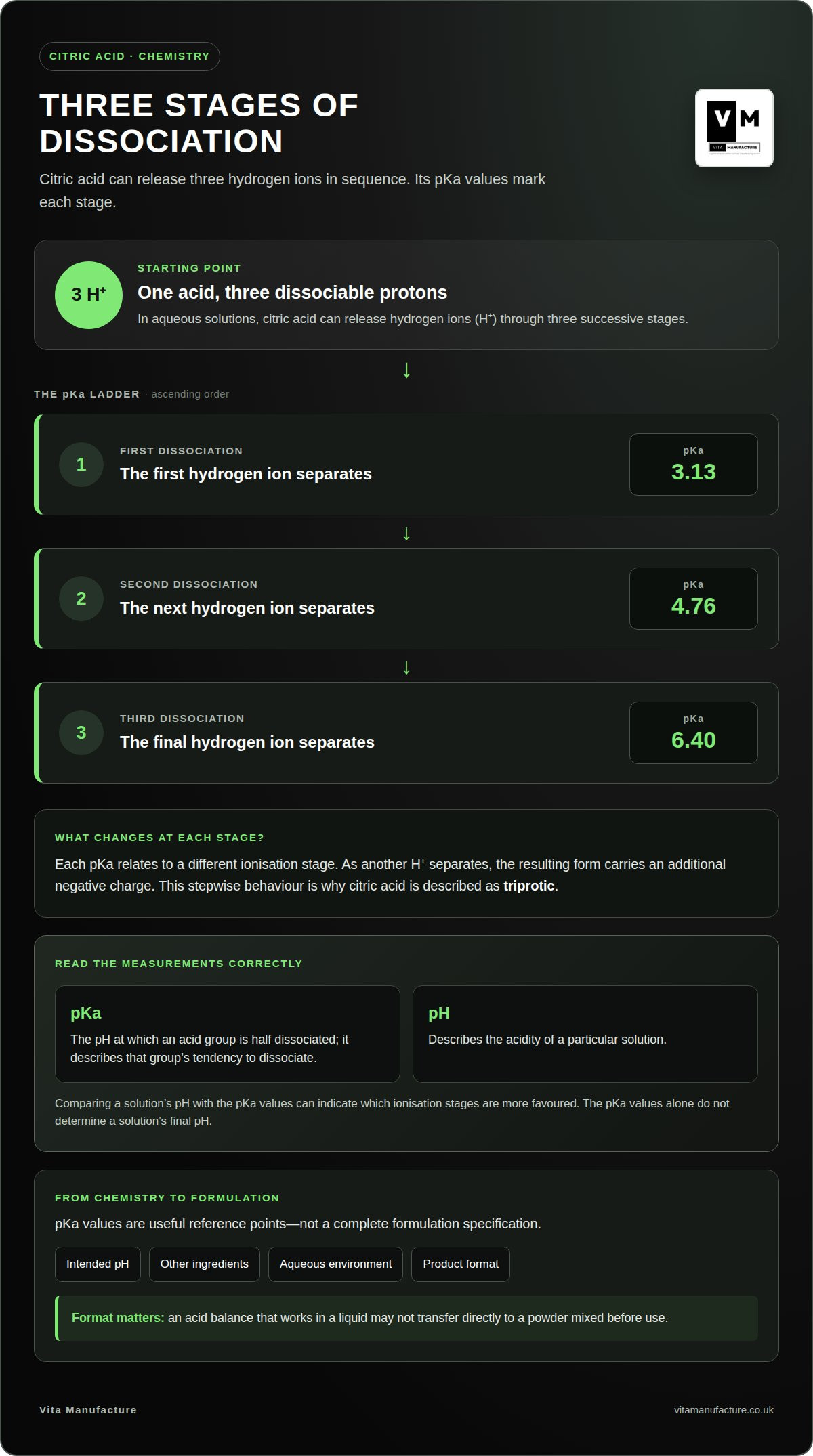
Citric acid has three dissociable protons, meaning it can release hydrogen ions in three stages. Its pKa values describe how readily each proton dissociates, helping explain its behaviour in aqueous solutions and formulations.
A pKa is the pH at which an acid group is half dissociated. Citric acid’s three approximate pKa values are 3.13, 4.76 and 6.40. Each value relates to a different stage of ionisation, rather than describing the acidity of every citric acid solution. The pH of a particular solution depends on its composition and concentration, so the pKa values alone don’t determine its final pH.
The values are usually presented in ascending order:
3.13 is the first pKa, for the first dissociation stage.
4.76 is the second pKa, for the next dissociation stage.
6.40 is the third pKa, for the final dissociation stage.
At each stage, another hydrogen ion can separate from the citric acid molecule. The resulting forms carry different charges because each lost proton leaves an additional negative charge. This stepwise behaviour makes citric acid triprotic: it has three dissociable protons, not just one.
In supplement formulation, pKa values help explain acidity. The intended pH, other ingredients and the product’s aqueous environment all affect how much citric acid is ionised. A formulation team considers these interactions alongside taste and product format. For example, an acid balance that works in a liquid may not transfer directly to a powder mixed before use.
pH and pKa are related, but answer different questions. pH describes the acidity of a particular solution; pKa describes an acid group’s tendency to dissociate. Comparing a solution’s pH with citric acid’s pKa values helps indicate which ionisation stages are more favoured. On its own, this comparison does not establish the finished product’s taste or performance.
These three values are useful reference points, not a complete formulation specification. A formulator uses them to understand how citric acid may behave as conditions change, then considers the full ingredient system and product format. This chemistry-led approach connects acidity measurements with decisions about a real supplement product.
Citric acid content in citrus fruits
Citrus fruits are a familiar natural source of citric acid, but their content isn’t identical. Across citrus fruits, citric acid content is about 5-7%. That broad figure helps explain the ingredient’s association with citrus flavour, but it isn’t a precise measurement for every fruit or every piece of fruit.
Fruit composition varies with citrus type and growing conditions. Lemons and oranges have different flavour profiles, and fruit of the same type can also vary. Variety, ripeness and climate can all affect the acids present. A single percentage therefore describes a broad category, not a guaranteed value for every fruit.
The basis of a percentage matters, too. Water content affects the proportions measured in fresh fruit. A dry-weight value excludes water, so it cannot be compared directly with a value calculated from whole fresh fruit. Keep this distinction in mind when reading ingredient information or scientific descriptions of citrus composition.
Taste offers a practical clue, but not a measurement. A strongly sour lemon suggests an acidic profile, while an orange’s sweetness can make its acidity seem less prominent. Perceived sourness depends partly on the balance between acids and sugars. It does not reveal an exact citric acid concentration, so flavour alone cannot establish a fruit’s percentage.
In food and drink development, natural fruit and added citric acid serve different purposes. Lemon juice brings a mixture of fruit components and a recognisable flavour, while citric acid can provide a defined way to adjust acidity. A lemonade, for example, may use juice for its lemon character and citric acid to adjust acidity.
This distinction matters when turning a citrus-inspired idea into a consistent recipe. Fruit-based ingredients contribute flavour and composition that can vary with the raw material. Added citric acid offers another way to adjust acidity, though its effect still depends on the complete recipe. The choice depends on the intended taste, texture and ingredient profile.
For supplement developers, citrus content is useful context rather than a dosage guide. The approximate 5-7% figure describes citrus fruits broadly; it doesn’t tell you how much citric acid a finished product should contain. Product format, flavour target and the behaviour of other ingredients all shape formulation decisions. Separating fruit composition from ingredient specification helps keep a concept grounded in the actual product being developed.
Citric acid sources
Citric acid occurs naturally in citrus fruits, including lemons, limes, oranges and grapefruits. Blackberries also contain it, so its natural occurrence is not limited to citrus.
Foods and drinks that naturally contain citric acid include citrus fruits, their juices and berries such as blackberries. Products made with lemon or lime juice can also contain naturally occurring citric acid alongside other fruit components.
Citric acid as an ingredient is distinct from the whole fruit it can come from. Lemon juice, for example, provides fruit flavour and other constituents, while an ingredient listing for citric acid identifies the acid itself. This matters when a product needs a precise acidity adjustment without relying only on fruit juice.
Commercial citric acid is commonly produced through fermentation using carbohydrate feedstocks. This is another way to produce the same compound found in fruit. The molecule does not change because it was made through fermentation rather than extracted from a lemon; the source describes how it was produced, not a different acid.
The production source can still matter when choosing ingredients. Natural fruit and manufactured citric acid may serve different roles in a recipe. Lemon juice contributes a recognisable citrus flavour, while citric acid can adjust acidity. The right choice depends on the product’s intended taste and ingredient profile.
Citric acid itself contains no animal-derived ingredients, so the molecule is compatible with vegan diets. Allergy suitability depends on the complete product, including its other ingredients and manufacturing context. The name “citric acid” alone does not establish that a finished food is suitable for someone with an allergy.
For example, a lemon drink could contain juice for its fruit character and citric acid as a separate ingredient. These are not interchangeable: juice provides a mixture of fruit substances, while the acid has a defined role in the recipe. Read the full ingredients list to distinguish them.
For supplement formulation, choosing a source is one part of a wider product decision. A citrus-derived ingredient can support a fruit-led concept, while fermentation-produced citric acid offers a direct way to include the compound. Product format, desired flavour and the roles of other ingredients all shape how that choice fits.
Understanding the source also helps avoid assumptions based on familiar names. “Citric” does not mean an ingredient must come directly from a lemon, and a product containing citric acid is not necessarily equivalent to one containing citrus juice. The ingredient’s identity, production route and function in the finished formulation are separate considerations.
Citric acid's chemical formula and structure
Citric acid’s molecular formula is C₆H₈O₇. It shows that the molecule contains carbon, hydrogen and oxygen atoms, arranged into a structure with three carboxylic acid functional groups. These groups are central to its chemical behaviour, making the structure more informative than the name alone.
Each carboxylic acid group contains a carbonyl group and a hydroxyl group attached to the same carbon. In citric acid, the three groups provide sites where hydrogen ions can dissociate. The molecule also has a hydroxyl group on its central carbon. Together, these features give citric acid several sites that can interact with the surrounding solution.
A simplified structural description can help with formulation work. Citric acid has a central carbon bearing a hydroxyl group, two carbon-containing arms and a carboxylic acid group attached directly. Its three carboxylic acid groups are more than labels on a diagram: they help explain its acidity and its different charged forms in solution.
The molecular formula and structural formula show different things. C₆H₈O₇ gives the number of atoms, but not how they connect. A structural representation shows the arrangement of the three carboxylic acid groups and the other parts of the molecule. That arrangement helps distinguish citric acid from compounds with the same elemental composition.
For a supplement concept, this structure provides a foundation for understanding how citric acid may behave alongside other ingredients. Its carboxylic acid groups can participate in acid-base interactions, while other features affect how the molecule interacts within the formulation. The final effect depends on the full ingredient system, product format and intended properties, not the formula alone.
Structure also explains why a familiar fruit source and an ingredient specification are not interchangeable descriptions. A lemon contains a complex mixture; citric acid refers to one defined molecule within that mixture. Naming the molecule identifies its chemical structure, while describing a fruit ingredient refers to a combination of substances.
When communicating a product concept, accurate ingredient naming connects the chemistry with the finished formulation. Label wording should reflect the ingredient used and its role, rather than suggesting that the pure compound is equivalent to whole citrus fruit. Clear presentation helps people understand the product’s composition.
To develop a supplement concept around ingredient function and product format, explore supplement formulation support.
Vita Manufacture
Vita Manufacture helps turn supplement concepts into products through New Product Development, Contract Manufacturing and Private Label Supplements. If you’re considering citric acid’s flavour, acidity or role as an ingredient, Vita Manufacture can help connect those properties with your product’s intended format and formulation.
Bring your concept into focus by defining the product type, intended use and role of citric acid. Vita Manufacture supports supplement development and manufacturing as your project moves from an initial idea towards a finished product.
Contact Vita Manufacture to discuss your supplement concept.
Turn ingredient knowledge into a product direction
Understanding what citric acid is gives you a useful foundation, but a product concept also needs a clear purpose. Define the experience you want the finished supplement to deliver, then consider how each ingredient supports it. Taste, format and the wider formulation should work together; one ingredient is only part of the solution.
Moving from ingredient knowledge to product planning makes technical insight more useful. A clear brief can define the intended audience, product format and role of each ingredient. It also provides a framework for assessing formulation choices as part of a coherent concept, with the finished product in mind from the outset.
As your idea develops, keep the product’s intended use at the centre of your decisions. This helps connect ingredient selection with the experience you want to create and gives development work a clearer direction. You do not need every detail resolved before taking the next step. Start with the concept and the questions that matter most.
Discuss your formulation plans with Vita Manufacture and take the next step towards developing your idea with purpose.
Frequently Asked Questions
What is citric acid and what is its chemical formula?
Citric acid is an organic acid with the chemical formula C6H8O7. The formula counts the atoms in one molecule: six carbon, eight hydrogen and seven oxygen atoms. It’s useful to distinguish the formula from a product’s ingredient list: a supplement may contain citric acid alongside other ingredients, but the formula describes citric acid itself. In chemistry references, the same compound may also be identified by its molecular structure.
How is citric acid made, naturally and commercially?
Plants produce citric acid as part of their normal metabolism, which is why it occurs in fruits such as lemons. Commercial citric acid is generally made through fermentation, where microorganisms convert sugars into the acid. The resulting material is then separated and purified for use as an ingredient. Its source may be fruit or fermentation, while its role in a finished product depends on the formulation.