Saffron Diet Food Supplements: UK Manufacturing Guide
Daily saffron use isn’t automatically right for everyone. Healthy individuals can consume up to 1.5 grams of saffron per day, but this figure shouldn’t be treated as a recommended dose for a saffron diet food supplement: extracts and capsules can differ, and higher doses may cause harm. Evidence on long-term safety is also limited.
It’s understandable to want a clear answer before adding a supplement to your routine. This guide explains what research suggests about saffron’s potential benefits, which side effects and medication interactions to consider, and why dose and formulation matter. You’ll also learn how saffron supplements are developed for the UK market, helping you assess daily use with a clearer understanding of both the evidence and the product behind the label.
Table of Contents
Does saffron have any side effects?
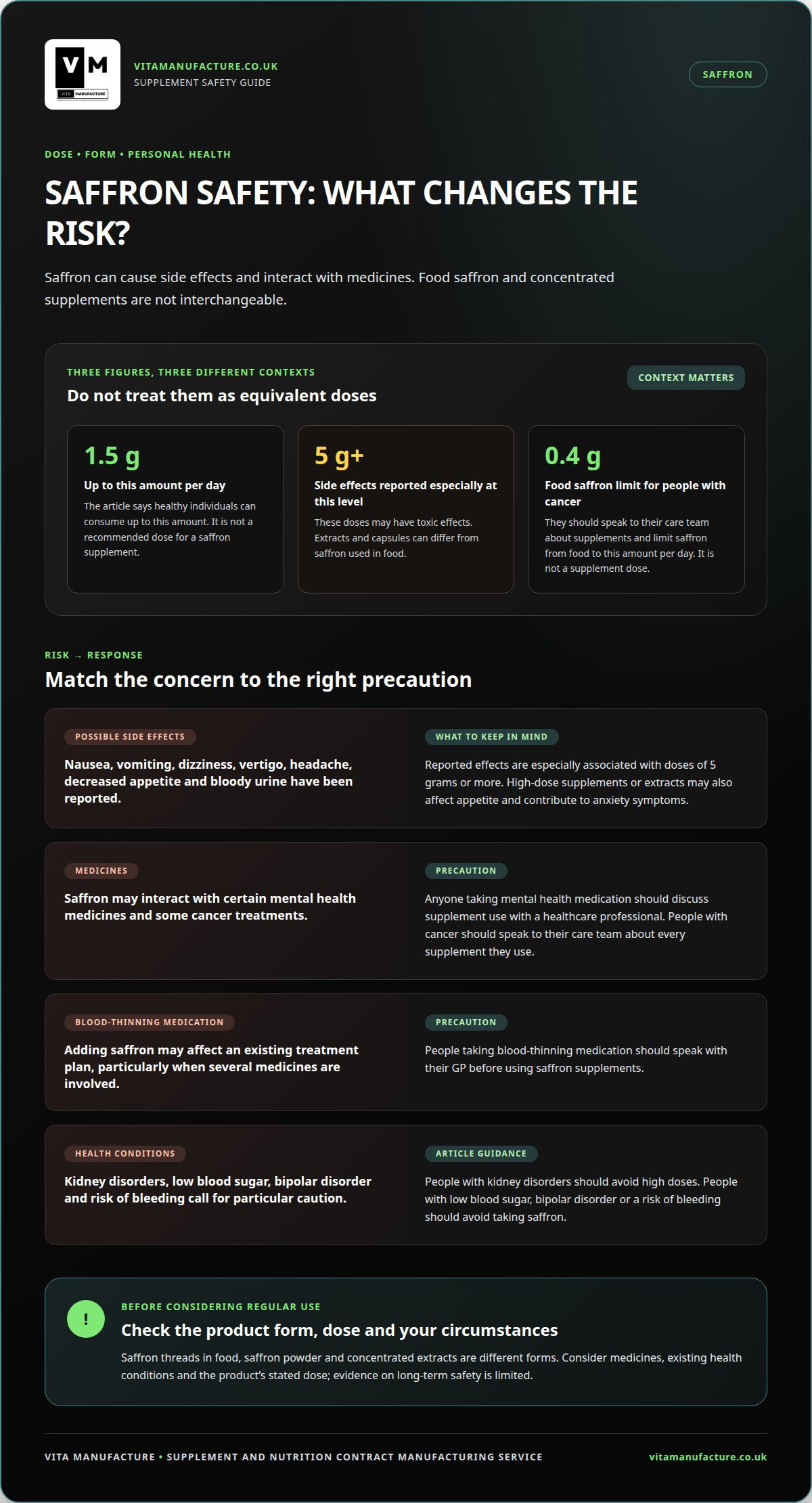
Yes. Saffron can cause side effects and interact with medicines, particularly at high doses. The form matters too: saffron threads in food and concentrated supplements are not interchangeable.
Possible side effects and interactions
Saffron side effects include nausea, vomiting, dizziness, vertigo, headache, decreased appetite and bloody urine. These effects have been reported especially at doses of 5 grams or more, which may have toxic effects. High-dose saffron supplements or extract may also affect appetite and contribute to anxiety symptoms. The dose and product form therefore matter when considering regular use.
Interactions are another consideration. Saffron may interact with some medicines, including certain mental health medicines and some cancer treatments. People taking blood-thinning medication should speak with their GP before using saffron supplements. This is especially relevant when taking several medicines, as adding a supplement may affect an existing treatment plan.
Depression and anxiety require careful distinction. Research into saffron’s possible effects on depression does not mean it can replace prescribed treatment. High doses may contribute to anxiety symptoms, and saffron may interact with some medicines used for mental health. Anyone taking such medication should discuss supplement use with a healthcare professional before adding it.
Other possible health effects
Some health conditions make decisions about saffron especially important. People with kidney disorders should avoid high doses. People with low blood sugar, bipolar disorder or a risk of bleeding should avoid taking saffron. These cautions apply to supplement use, so a person’s health history matters regardless of how a product’s label is worded.
Cancer-related precautions involve both food and supplements. People with cancer should speak to their care team about every supplement they use, because saffron can interact with some cancer treatments. They should limit saffron from food to 0.4 grams per day. This food limit isn’t a supplement dose; concentrated extracts and capsules have different formulations.
Although saffron’s constituents may be presented as a simple botanical addition, that does not remove these cautions. A product’s form, dose and combination with other ingredients can all affect exposure. For example, someone taking a blood thinner faces different considerations from someone using saffron in a meal. Reported effects such as dizziness or nausea also matter when assessing tolerability. These examples show why supplement decisions should account for medicines, existing conditions and the product’s intended dose, rather than relying on saffron’s reputation as a traditional ingredient.
What does the latest research say about saffron as a dietary supplement?
Research offers early findings, but it does not establish that saffron supplements prevent disease or reliably cause weight loss. Product identity, ingredients and the limits of each study all matter when assessing claims.
For UK buyers, choose products with a clear ingredient list, a stated saffron form and serving directions. Check whether the label identifies saffron extract or powder, and consider every additional ingredient in light of your dietary needs. A certification logo alone does not explain what was assessed, so look for information about its scope and relevance to the finished product.
How can you choose a quality saffron supplement in the UK? Start with a transparent label that names saffron’s form, the amount per serving and any other ingredients. Then assess whether the available evidence supports the product’s specific claims, rather than relying on a general promise.
Saffron comes from the flower of Crocus sativus. About 75,000 flowers are needed to produce a pound of saffron, which helps explain why authentic saffron is vulnerable to substitution. Products may be adulterated with cheaper ingredients, including beetroot, red-dyed silk fibres, safflower, paprika and turmeric. A label and ingredient declaration are therefore central to assessing what a product contains.
Safranal is one of saffron’s constituents, but naming it does not prove a finished supplement’s effect. Research summaries describe an eight-week study in which a saffron extract supplement helped reduce appetite, BMI, waist circumference and total fat mass. That is a study finding, not a guarantee for an individual product or user.
How do saffron supplements compare with other weight-loss supplements? The available saffron study does not directly compare saffron with other ingredients, so it cannot establish that saffron works better or worse. Compare claims by looking for evidence on the specific ingredient, dose and outcome described.
Are saffron weight-loss supplement claims regulated in the UK? Product claims must comply with applicable UK food and advertising requirements. A study involving saffron does not, by itself, substantiate every weight-loss claim made for a product.
Dietary suitability depends on the complete ingredients list, not saffron alone. For example, if a capsule combines saffron with other ingredients, review each one against the intended consumer’s needs. Research into a single extract does not automatically apply to a blend with a different composition.
For brands turning ingredient evidence into a product concept, new product development can help shape decisions about formulation and claims. Keep the evidence, ingredient identity and label wording aligned from the outset.
What are saffron’s potential benefits?
Studies have explored saffron’s possible effects on mood, sleep and premenstrual symptoms. Findings are promising in some areas, but they do not establish that every supplement produces the same result.
Research into potential health benefits
Research has examined saffron for depression, PMS and Alzheimer’s disease, with studies using a dose of 20 milligrams. Reviews also report possible reductions in depression symptoms with extract doses of 20-100 milligrams, taken for 10 days to several weeks. Larger, better-designed trials are needed to clarify these findings and their relevance to different products.
Sleep is another area of interest: saffron may support sleep and increase evening melatonin levels. These possible benefits do not establish saffron as a treatment for depression, anxiety, stress or cognitive conditions. Study results concern particular preparations and participants, so they are not proof that every saffron product has the same effect.
Using saffron supplements for weight loss
A saffron food supplement contains saffron, commonly as an extract or powder, in a measured serving. Weight-management research has explored appetite and body-composition outcomes, but a supplement is not a standalone weight-loss method. Its ingredients, formulation and directions also determine what product is being studied.
Can saffron be taken alongside diet and exercise for weight management? These can form part of the same routine, but saffron shouldn’t replace balanced eating or physical activity. The NHS advises adults to aim for at least 150 minutes of moderate activity weekly, or 75 minutes of vigorous activity.
Combining saffron with diet and exercise
Diet and activity provide the broader context for assessing any supplement’s role. For example, someone using saffron alongside regular exercise still needs a varied diet; adding capsules does not make an unbalanced eating pattern effective. Consider a supplement’s intended role alongside the person’s overall routine.
For a product developer, this distinction matters too. A claim about appetite differs from a claim about fat loss, and each needs evidence relevant to that outcome. Study findings can inform product decisions, but they do not automatically support stronger claims about a finished formulation.
Saffron tea is another way to use the spice. Soak saffron threads in hot, not boiling, water to draw out their flavour. Tea offers a food-based way to enjoy saffron, but it is not equivalent to a concentrated capsule extract. Research on supplements should not be assumed to establish the same effects for tea.
PMS research has reported a specific finding: in one study, 60% of women taking saffron supplements reported a 50% or higher reduction in 17 PMS-related symptoms. This suggests a possible benefit for some participants, not a guaranteed outcome for everyone. The reported result relates to that study’s supplement use and symptom measure.
Saffron has several areas of research interest, from sleep to PMS, but the evidence varies by outcome and preparation. Read clinical findings in context, especially when a product combines saffron with other ingredients. This distinction helps separate a potential benefit from a promise of an effect.
Supplement dosage and safety
There is no single capsule dose that applies to every saffron product. The extract, serving size and label directions all shape how much a person takes.
Supplement dosage guidance
Dosage guidance is the amount and frequency set for a particular product, rather than a universal saffron allowance. Healthy individuals can consume up to 1.5 grams of saffron per day, but this figure isn’t a recommended capsule dose. Supplement extracts and food threads are different forms, so the amount used in food shouldn’t be transferred directly to capsules.
Research doses also don’t set a standard for daily use. Studies on depression, PMS and Alzheimer’s disease used 20 milligrams, while shops typically sell saffron in amounts of 30 milligrams. Those figures describe study or product amounts, not a single dose suitable for everyone. An expensive spice’s traditional use and nutritional properties don’t determine an appropriate supplement serving.
Check the label for the amount per capsule and the recommended daily serving. For example, directions may specify one capsule daily with food, or one capsule twice daily after a meal. These are different instructions, not directions to combine. Follow the specific product’s stated dose rather than borrowing a schedule from another saffron product.
Safe use and directions
Safe use means following the product directions and considering personal circumstances before taking saffron regularly. Product directions advise adults not to exceed the stated dose unless a healthcare practitioner recommends otherwise. This matters because increasing a serving can raise exposure without matching the dose used in relevant studies.
Short-term use of less than 100 milligrams of saffron extract generally appears to be well tolerated. However, evidence about safety beyond 26 weeks is insufficient. This makes duration relevant alongside daily amount: a short study period does not establish the safety of continued use over a longer period.
Pregnant women should avoid high doses of saffron. Anyone considering regular use should also account for medicines and health conditions, which may change the safety considerations. A clinician can review the product’s ingredients and directions alongside the person’s circumstances. Saffron supplements are not regulated in the same way as prescription medicines, so clear labelling and measured use matter.
Food threads and capsules serve different purposes. Saffron threads can be used as an ingredient in meals, while a capsule delivers a measured supplement serving. Neither should replace good nutrition. Follow the product’s own directions, especially if it combines saffron with other ingredients or lists a serving frequency different from another product’s instructions.
Saffron extract capsule formulation
Saffron supplements commonly contain extract or powder, either alone or combined with other ingredients. Choosing between them shapes the product brief. An extract is a prepared saffron ingredient, while powder uses ground saffron material. The finished label should identify which form a capsule contains. This clarity matters if a study examined an extract but the proposed product uses powder.
Saffron comes from the stigma of the Crocus sativus flower. In a capsule, the formulation turns this botanical material into a defined serving. Developers consider how much saffron material goes into each serving and whether to include other ingredients. These choices influence the ingredient description and directions consumers see. A saffron diet food supplement should clearly distinguish saffron content from the complete blend.
Research can inform extract selection, but its relevance depends on the preparation studied. Findings about one saffron extract do not automatically apply to every extract or powder. A different preparation or a blend with other ingredients changes the product’s composition. Research is needed to clarify how such variations affect outcomes, making accurate ingredient identification important during early formulation planning.
Powder and extract also raise different practical questions for capsule design. Physical form affects how ingredients are combined and how much space the blend occupies. A saffron-only capsule has a different ingredient profile from a blend containing additional nutrients. For example, adding another ingredient means the label should explain both components clearly, rather than implying saffron accounts for the entire serving.
Weight is one consideration when defining a capsule serving. Total fill weight includes all ingredients, so the blend’s composition informs the format and serving description. It is not the same as the weight of saffron threads used in a recipe. Separating saffron content from total blend weight helps consumers understand what each serving contains and keeps product descriptions consistent across packaging.
Evidence and presentation need to align. If a study examined one saffron preparation, product wording should not imply that every preparation has identical properties. A claim about appetite, mood or another outcome needs evidence relevant to that ingredient and formulation. Clear labelling can explain what the product contains, but it cannot establish effects beyond the available evidence.
For a brand developing a saffron diet food supplement, formulation choices can be considered alongside a pilot study or market research. These activities can help assess the concept, intended audience and evidence base before a finished product is planned. Explore saffron supplement market research to develop those decisions with greater clarity.
Vita Manufacture
Vita Manufacture can help turn a saffron supplement concept into a product ready for development and manufacture. If you are weighing extract, capsule format and intended use, its New Product Development service can support formulation decisions, while Contract Manufacturing can bring a defined product into production.
For founders seeking an established product route, Private Label Supplements offer another option. The right approach depends on your concept, evidence base and commercial goals. Clear decisions about ingredients, serving directions and product positioning give the project a stronger foundation without treating early research as proof of a specific outcome.
If you are ready to discuss your saffron supplement concept, contact Vita Manufacture.
Turn your saffron concept into a clear product plan
A commercially considered saffron supplement starts with a focused brief: who it is for, which format suits the concept, and how its positioning aligns with the available evidence. Defining these priorities early can help move an interesting ingredient towards a purposeful product direction.
Vita Manufacture offers New Product Development, Contract Manufacturing and Private Label Supplements to support different stages of that journey. Whether you are shaping an early idea or planning production for an established brand, discuss how your saffron diet food supplement concept could take shape.
Contact Vita Manufacture about saffron supplements to start a conversation about your plans. With a clear brief and the right development route, you can take your next step with confidence.
Frequently Asked Questions
Is saffron safe to take daily?
Daily use is not suitable for every person or every product. Before deciding, read the full label, including serving instructions and any combined ingredients, and consider how long you plan to use it. A capsule’s stated serving is more relevant than general assumptions about saffron in food. If you take regular medication or have a health condition, discuss the specific product with a healthcare professional.
Who shouldn’t take saffron?
People whose health circumstances are covered by saffron’s safety warnings should avoid it or seek individual advice before use. Review the full ingredient list and serving directions against your circumstances rather than relying on a product’s front label. This is especially useful if you already take supplements, as a combined product may contain ingredients beyond saffron. A pharmacist or GP can consider the actual product alongside your medicines and health history.
What evidence supports saffron supplements for appetite control or weight loss?
Evidence comes from studies of particular saffron preparations and measured outcomes, not every product sold for weight management. To assess a claim, distinguish appetite changes from changes in body measurements, and check whether the product’s formulation matches the preparation studied. A claim about one outcome is not proof of another. Findings also do not establish that saffron performs better than other weight-management ingredients.
What is the recommended saffron supplement dose and how long can it be taken?
Follow the directions for the specific product rather than applying a dose from another label or study. Check how much saffron each serving provides, how many capsules make up that serving, and whether the directions specify food or timing. These details help prevent mismatches between capsule count and serving size. For continued use, discuss the product and intended duration with a healthcare professional.
What are the side effects and risks of saffron supplements?
Possible risks depend on the product, amount taken and person using it. Check the complete ingredients list, follow the serving directions and avoid combining products without understanding their contents. If you notice an unexpected change after starting a supplement, stop using it and seek appropriate medical advice. Keep the packaging available so a healthcare professional can assess the exact formulation and serving information.
Who should avoid saffron supplements, including during pregnancy or when taking medicines?
People who are pregnant or take regular medicines should discuss the exact supplement with a healthcare professional before use. Bring the packaging or a clear copy of its ingredients and directions, rather than describing it only as “saffron”. This helps the professional assess the full formulation and intended serving. The same approach is useful for anyone managing a health condition or considering a supplement alongside existing treatment.
How much do saffron diet supplements cost in the UK?
Retail prices vary according to the saffron form, serving size, pack quantity and additional ingredients. Compare the stated amount per serving and number of servings, alongside the ingredients list, rather than judging by pack price alone. Costs for supplement development or manufacturing projects depend on the requirements and are provided after a quote request. These commercial project costs are separate from retail supplement prices.