Vitamin Gummies: Formulation & Manufacturing Guide
The most appealing vitamin gummies aren’t automatically the best fit. Compare the nutrients in the stated serving, the recommended daily dose, sugar per dose and age suitability. Serving size matters because it determines how much of each nutrient you get each day.
It’s easy to focus on a prominent nutrient amount or a flavour you like, but neither tells the whole story. The serving instructions, full nutrient panel and age guidance help you decide whether vitamin gummies suit the person taking them and their daily routine.
This guide explains how to compare those details, assess sugar and nutrient amounts, and understand why taking more than the recommended dose isn’t a shortcut to a better result. If you’re developing a product, the same choices shape its formulation: balancing ingredients, serving size and intended audience can help create a gummy that’s practical as well as appealing.
Table of Contents
What Makes a Great Multivitamin Gummy?
A good choice starts with the person’s goal, not the flavour or packaging. A multivitamin gummy may combine vitamins and minerals, but formulas vary. Compare the full nutrient panel with the intended use. For example, a formula for general daily coverage differs from one focused on vitamin C.
Match ingredients to a specific wellness goal. Vitamin C contributes to the reduction of tiredness and fatigue. Vitamin D supports the normal function of the immune system. Inositol is used for metabolic syndrome and polycystic ovary syndrome (PCOS). These examples show why it matters to check each ingredient.
Consider the dose as well as the nutrient name. Adults should compare vitamin D and vitamin C amounts with their individual needs. Women planning pregnancy can compare folate against a 400 µg target. These figures describe different needs, so one formula won’t suit every goal.
Women and men shouldn’t choose vitamin gummies based only on gendered packaging. Compare the listed nutrients with the intended user’s needs. A woman planning pregnancy, for example, may prioritise folate. A man seeking broad daily coverage may prefer a multivitamin without a specialised focus. The actual amounts on the label matter more than its audience wording.
Intended use narrows the selection further. An adult seeking general coverage can compare a multivitamin with a more focused option, such as vitamin C. For children, age guidance is essential: some products are intended for ages 3-12. A children’s formula isn’t automatically suitable for every child in that range.
Choose vitamin gummies whose stated purpose, nutrient amounts and age guidance suit the person taking them. This comparison is more useful than choosing by a high percentage for one nutrient alone.
Before comparing two multivitamin gummies, check the serving size. Nutrient amounts apply to the stated serving, which may include more than one gummy. A product with an appealing nutrient panel may provide that amount across several pieces. Compare equivalent daily servings, not individual gummies.
Finally, check ingredients that affect suitability and preference. Gummy bases can use gelatin or pectin, and colours and flavours may be artificial. Someone avoiding animal-derived gelatin may prefer a pectin-based option. For a product designed for a specific audience, ingredient selection and label design should make its purpose clear.
Do vitamin gummies contain a lot of sugar?
Sugar content varies by formula and serving, so compare the nutrition information for the complete recommended dose. Some products use sugar or glucose syrup; others are labelled “no added sugar” or use natural sweeteners. If limiting added sugar is a priority, aim for under 3 g per daily dose. A per-gummy figure can understate the total if the serving includes several pieces.
In the UK, vitamin supplements are food supplements, not medicines. Their packaging and health claims must comply with applicable food rules, and claims must not present a product as treating or curing disease.
Ingredient lists also show whether a product suits your preferences. Gummy bases may contain gelatin or pectin, and some formulas use artificial colours and flavours. Gelatin is animal-derived; pectin is an alternative setting ingredient. Sorbitol and maltitol are polyols, and excessive consumption of products containing them may have a laxative effect. Some people also experience digestive discomfort after consuming them in excess.
There are benefits and limitations to consider. A chewable format may suit someone who dislikes swallowing tablets, but gummies don’t guarantee a complete nutrient profile. Gummy multivitamins may lack iron and calcium. Review the full panel rather than judging a formula by one prominent nutrient percentage or flavour description.
For adults, compare the listed nutrient amounts with relevant targets. According to the European Commission, the daily vitamin B12 target for adults is at least 2.5 µg. According to the European Commission, the zinc target for adults is 10 mg. Read each amount alongside its serving instructions, since some adult multivitamins provide one gummy per serving, while some immune support products require two daily.
Compare products consistently: assess the full serving, nutrient panel, sugar per dose and number of servings in the pack. Pack price alone doesn’t show how a product compares, and this guide doesn’t rank brands or provide product prices. Adult formulas may be intended for people aged 18 and above, so read the age guidance as well.
Depending on your goal and preferred format, alternatives include a focused supplement, tablet or capsule. Compare the ingredients and daily dose rather than assuming one type is automatically better. For example, someone focused on one nutrient may prefer a targeted formula over a broad multivitamin. Compare the stated purpose and actual composition.
Compare added sugar across the complete daily dose.
Review the whole nutrient panel, including iron and calcium.
Follow the serving and age instructions on the pack.
Check gelatin, pectin, colours, flavours and polyol sweeteners.
These checks help you decide whether vitamin gummies suit your dietary preferences and daily routine. Look beyond the front label: the ingredient list, serving instructions and full nutrition panel show how the product is formulated. Vitamin gummies should complement, not replace, a varied, balanced diet.
Sugar varies by formula and serving; if limiting added sugar, aim for under 3 g per daily dose.
Can you take more than the recommended dose of vitamin gummies?
No. Taking more than the recommended daily dose can lead to excessive vitamin and mineral intake, which may be harmful. Follow the serving instructions, including the number of gummies in one dose. Taking extra because they taste pleasant won’t make the formula more effective.
Take supplements according to their label directions. If you use medicines or other supplements, speak to a healthcare professional or pharmacist before combining them. They can consider the ingredients, your medicines and your health circumstances when advising you.
Keep the pack closed and out of children’s reach. Excessive consumption can be particularly harmful with products containing iron or fat-soluble vitamins. Gummies can look like sweets, so safe storage matters. If a child may have eaten more than the recommended dose, seek urgent professional advice.
There’s no single sugar or calorie amount for every popular product. Both depend on the recipe and serving size, so compare the nutrition declaration for the full daily dose. The amount per gummy may not reflect how much you consume when the label recommends several.
For a lower-sugar choice, compare the sweetener and carbohydrate information with the ingredient list. Sugar-free vitamin gummies may contain polyols, including sorbitol or maltitol. Excessive consumption of products containing polyols may have a laxative effect. Some people also experience digestive discomfort after consuming sorbitol or maltitol in excess.
Vegan suitability depends on the full ingredient list, not just the gummy base. Pectin can replace gelatin as a setting ingredient, but other components matter too. Check the label for animal-derived ingredients, flavourings and stated dietary suitability. For allergies, read allergen information and warnings rather than relying on a vegan claim.
Use this label check before choosing a product:
Find the recommended daily dose and gummies per serving.
Compare sugar, calories and sweeteners for the full serving.
Review ingredients, including pectin, gelatin and flavourings.
Read allergen information and dietary suitability statements.
Store the product away from children and follow its stated dose.
These checks help you assess suitability and transparency. Clear directions connect nutrient amounts to the daily dose, while a full ingredient list helps identify dietary preferences and potential allergens. No front-of-pack claim can replace those details.
Vitamin gummies are supplements, not substitutes for a varied, balanced diet. If pregnancy, breastfeeding, a medical condition or medication affects your choices, discuss the ingredients with a healthcare professional or pharmacist before use.
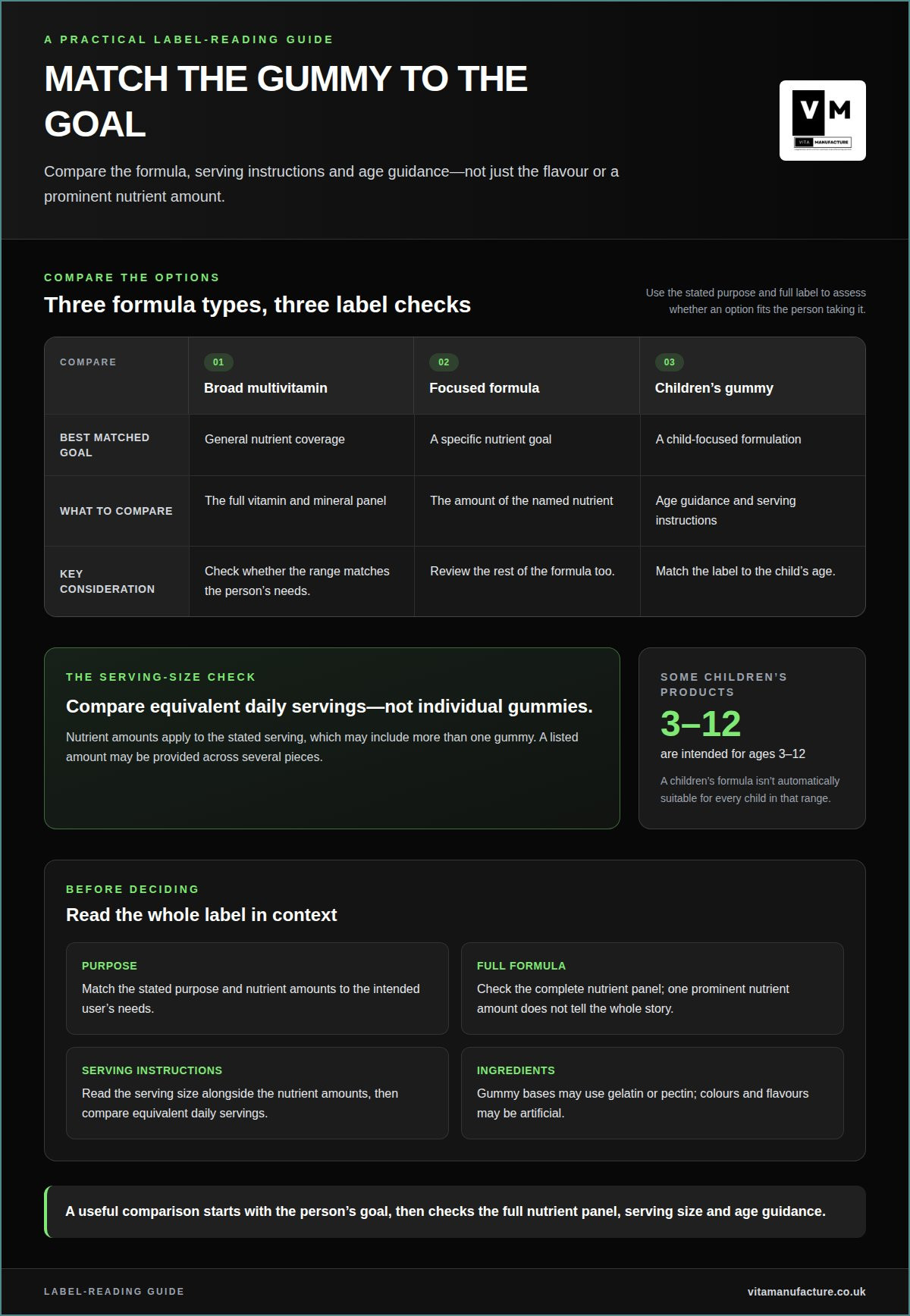
Comparing serving sizes and nutrient amounts
Compare nutrients across the complete serving, not one gummy at a time. A children’s product may provide four gummies per serving, while an adult formula may use fewer. The amount shown for each nutrient applies to the stated serving, so check the serving instructions before judging strength or value.
Nutrient Reference Values (NRVs) provide a benchmark for comparing amounts on nutrition labels. A gummy showing 200% or 500% NRV for one nutrient isn’t automatically more suitable for everyday use. Compare the full profile with the intended user and purpose; a large percentage can distract from modest amounts elsewhere.
For general adults, the comparison targets include 80 mg of vitamin C, 200 μg of folate, 150 μg of iodine and 12 mg of vitamin E. The adult vitamin A target is 700-800 μg. These figures help you interpret a label, but they don’t make every nutrient equally relevant to every person.
For immune support, vitamin D supports the normal function of the immune system. Compare its amount per serving with other listed nutrients rather than relying on an “immune” name or front-of-pack claim. A product’s purpose should be clear from its nutrient profile and serving instructions.
When assessing a Nuchu immunity gummy, use the same comparison: serving size, amounts of each nutrient and percentage of NRV. Don’t infer the formula from the word “immunity”. The label shows which nutrients it contains and how much each serving provides.
A beauty gummy also needs a label-led assessment. When comparing a Nuchu beauty gummy, identify the ingredients and amounts related to its stated purpose. Check whether the nutrition panel gives amounts per gummy or per full serving. Sweeteners and other ingredients can also distinguish a beauty-focused product from a broad multivitamin.
Make a useful comparison in three steps: note each serving size, compare equivalent nutrient amounts, then review sweeteners and the wider nutrition panel. For example, an immune-focused formula and a beauty-focused gummy may share ingredients but differ in their intended balance. Compare each product with its stated purpose, not just its highest NRV percentage.
Which vitamin gummies are best for adults, children, pregnancy or specific dietary needs
The right choice depends on the intended user, life stage and dietary requirements. Start with the age guidance and stated purpose, then assess whether the formula suits that person. A product made for adults isn’t automatically suitable for children, even if both labels list familiar nutrients.
For adults, match the product’s intended age range and nutrient profile to your goal. Some adult formulas are intended for people aged 18 and above. A broad multivitamin may suit someone seeking general coverage, while a focused supplement may be more relevant to a particular nutrient interest. Check that the serving instructions fit the way you plan to use it.
For children, read the age range carefully because products differ. Some are intended for ages 3-12, others for ages 7-11, and some are suitable from age 4. Those ranges aren’t interchangeable. Choose a product whose stated guidance includes the child’s age, and keep the container out of reach. Vitamin gummies can resemble sweets, so storage deserves attention.
Pregnancy planning calls for particular care with supplement selection. The folate target for women planning pregnancy is 400 µg. Compare that amount with the full daily serving, not a single gummy. Anyone who is pregnant or breastfeeding should ask a healthcare professional or pharmacist before using supplements, especially when considering more than one product.
Dietary needs require more than a front-label claim. For vegan suitability, check the full ingredient list for animal-derived components such as gelatin, and look for an alternative such as pectin. For allergies, read the allergen information and warnings. A vegan statement alone doesn’t establish that vitamin gummies are suitable for a particular allergy.
Medication and health conditions can also affect the decision. If you take medication or manage a medical condition, ask a healthcare professional or pharmacist before starting a supplement. They can consider the formula alongside your circumstances. Don’t combine products simply because their labels refer to different goals.
Use this decision guide to narrow the options:
Adult use: match age guidance and nutrient profile to the intended goal.
Children: follow the product’s age range and serving directions.
Pregnancy planning: compare folate per daily serving with the stated target.
Vegan or allergy needs: review every ingredient and relevant warning.
Medication or medical conditions: seek professional advice before use.
For brands developing a product for a defined audience, label clarity matters. Age guidance, serving instructions and dietary information should be easy to find and understand. Explore supplement label design to support a clear product presentation.
Vita Manufacture
Vita Manufacture helps turn gummy concepts into products for their intended audiences. New Product Development supports the direction of a new formula, including decisions about ingredients, serving size and who it’s designed for. Brands planning production under their own identity can consider Private Label Supplements or Custom Supplement Manufacturing.
These services are useful when you’ve defined the product goal and need support with development or manufacturing. Clear decisions about age suitability, nutrient amounts and dietary preferences give the project a focused starting point.
If you’re ready to discuss your supplement project, contact Vita Manufacture.
Turn your concept into a focused product plan
A commercially credible gummy starts with a clear reason to exist. Decide who it’s for, what need it addresses and how its formulation will support that purpose. These choices can guide the ingredients, serving format and label priorities, giving development a stronger direction than following a passing flavour trend.
For your next step, prepare a concise product brief. Set out the intended audience, dietary considerations, desired nutrient profile and the experience you want the product to offer. These decisions help turn a broad idea into a practical development conversation, whether you’re building a brand or extending an existing range.
The opportunity is to create a product that feels distinctive while remaining clear about its purpose and use. With the right decisions made early, your concept can move forward with greater focus. Contact Vita Manufacture to discuss your gummy needs and take the next step towards developing your product.
Frequently Asked Questions
Why Are Multivitamin Gummies So Popular?
Their chewable format and familiar flavours can make supplements easier to fit into a daily routine. For someone who dislikes swallowing tablets, a gummy offers another way to take vitamins. The format also supports different product concepts, from broad multivitamins to formulas for a particular audience. Popularity alone doesn’t show whether vitamin gummies suit you: ingredients, serving instructions and intended users remain central to choosing a product.
Are vitamin gummies as effective as traditional vitamin pills?
Effectiveness depends on the nutrients, their amounts, the formulation and how the product is taken. A gummy and a pill can have different nutrient profiles, so compare their labels instead of assuming they provide equivalent doses. For example, a gummy serving may contain fewer nutrients than a broad tablet. The format doesn’t determine suitability; composition and your reason for taking the supplement matter.
Are vitamin gummies suitable for everyday use?
Vitamin gummies can be taken as directed on the label if the formula suits the person taking them. Follow the stated serving rather than treating a daily supplement as a sweet. “Everyday use” doesn’t mean a product is appropriate in every situation: pregnancy, breastfeeding, medication or a medical condition can affect supplement choices. Vitamin gummies shouldn’t replace a varied, balanced diet.
How long does a bottle of vitamin gummies last?
Divide the number of gummies in the bottle by the number taken each day. A bottle containing 60 gummies lasts 60 days at one gummy daily, or 30 days at two daily. A 30-gummy pack taken once daily lasts approximately 30 days. Check the serving directions first, since the number of gummies per daily dose determines how long the supply lasts.
What should I look for in kids immune support gummies?
Start with the child’s age and the product’s stated age range. Then review the serving instructions, nutrient amounts and full ingredient list. An “immune support” description doesn’t establish that every formula suits every child, and it isn’t a promise to prevent illness. Store the pack out of children’s reach, since consuming more than the recommended serving can be harmful.
What should you look for on the label?
Look for the serving size, recommended daily dose, nutrient amounts and percentage of Nutrient Reference Value shown for each nutrient. Then read the ingredients, nutrition declaration, allergen information and age guidance. For example, a label may show amounts per serving rather than per gummy, which affects how you compare products. Check storage directions and warnings too, especially if the supplement is for a child.
What are vitamin gummies and which vitamins and minerals do they contain?
Vitamin gummies are chewable food supplements containing selected vitamins, minerals or both, set in a gummy base. Formulas vary: one may include vitamins C and D, while another lists folate, iodine or zinc. Some provide a broad multivitamin profile; others focus on a smaller selection of nutrients. Read the ingredient and nutrition panels to identify the actual contents rather than relying on the product name.
Do vitamin gummies work as well as tablets or capsules?
There’s no single answer for every product because ingredients and nutrient amounts vary between formats and brands. Compare the same nutrient across the full recommended serving, then consider whether that format fits your routine. If you’re comparing a gummy with a capsule, check whether both contain the nutrient you want and how much each serving provides. A familiar format alone doesn’t establish equivalent nutrient content.