UK Private Label Sports Nutrition Strategy Guide 2026
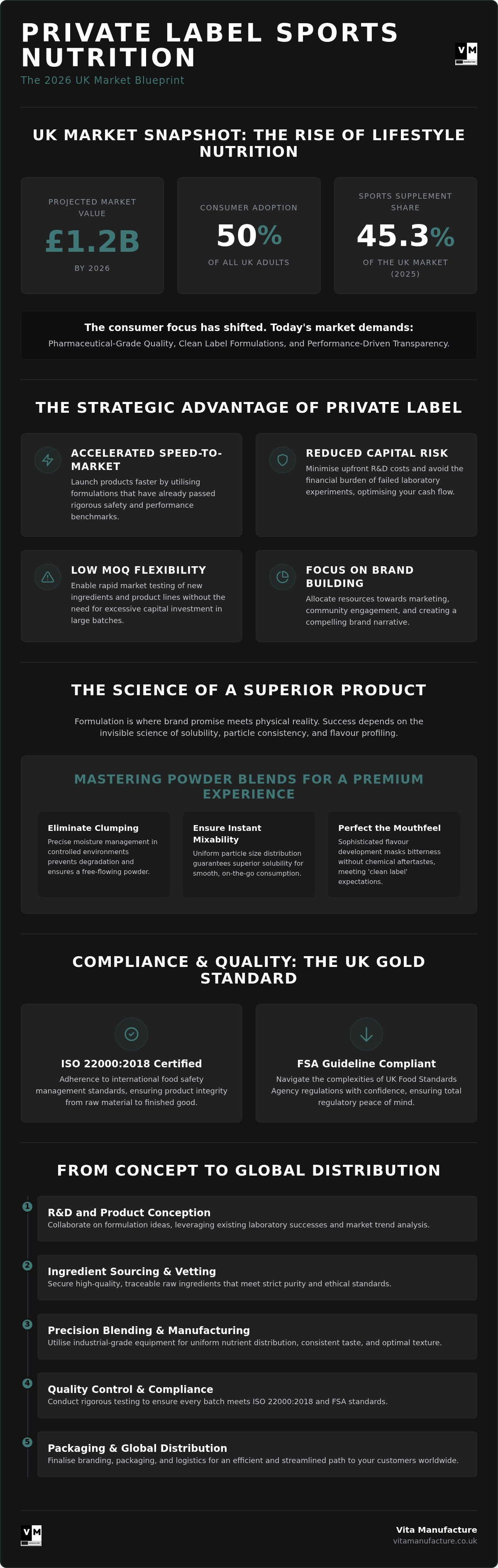
Did you know that half of all UK adults now use sports nutrition products, driving a market projected to exceed £1.2 billion by 2026? You've likely noticed the shift. It's no longer just about elite athletes; it's a lifestyle movement where consumers demand pharmaceutical-grade quality and clean labels. Scaling a brand in the competitive private label sports nutrition UK sector requires more than just a great idea. It demands a strategic ally who understands the high stakes of commercial viability and international standards.
You're probably feeling the pressure of sourcing high-quality raw ingredients whilst staying ahead of evolving Food Standards Agency regulations. We understand that achieving consistent taste and texture in powder blends can feel like an uphill battle. This guide promises to clear that path, offering a comprehensive roadmap from product concept to global distribution. We'll examine how ISO-certified quality and low MOQ flexibility can protect your margins, ensuring your formulations lead the market through 2026 and beyond.
Table of Contents
The Evolution of Private Label Sports Nutrition in the UK
Success in the modern fitness market isn't dictated by who owns the factory, but by who possesses the most intelligent supply chain. Private label sports nutrition UK is a collaborative partnership where proven, high-performance formulations are branded for exclusive retail. The Evolution of Private Label has transitioned from generic alternatives to sophisticated, science-led products that often outperform traditional market leaders. Today's consumers demand "clean labels" and performance-driven transparency, moving away from opaque proprietary blends toward total ingredient clarity. UK-based manufacturing is now the global gold standard because it offers total regulatory peace of mind through strict adherence to British standards. We believe your manufacturer shouldn't be a mere vendor; they should be a strategic ally invested in your brand's commercial viability.
Why Wellness Brands are Choosing Private Label
Launching a new supplement line is traditionally fraught with R&D risk and heavy capital expenditure. Choosing a private label model allows you to maintain high speed-to-market whilst utilising formulations that have already passed rigorous safety benchmarks. This agility is vital when testing trending ingredients, such as nootropics in pre-workout blends or the recently approved magnesium L-threonate monohydrate. By leveraging existing laboratory successes, you can allocate your resources toward marketing and community building instead of technical trial and error. It enables founders to pivot based on real-time market data without the sunk costs of failed laboratory experiments. This model is particularly effective for businesses looking to enter the sports supplement segment, which accounted for 45.3% of the UK market in 2025.
Market Positioning in the 2026 Fitness Sector
Differentiating your product in a saturated market requires a blend of premium branding and a compelling narrative. Modern athletes look for ethical sourcing and sustainability as much as they look for protein content. Your brand's story must reflect these values to build long-term loyalty amongst a discerning UK audience. Are your ingredients traceable? Is your packaging recyclable? These questions define your commercial success in 2026. High-quality private label partnerships provide the technical foundation, but your brand's unique positioning provides the emotional connection. Private label models allow boutique brands to challenge global conglomerates through agility and quality.
The Science of Formulation: Performance, Taste, and Texture
Formulation is where a brand's promise meets physical reality. In the high-stakes world of private label sports nutrition UK, a product's success depends on the invisible science of solubility and particle size consistency. If particle sizes vary significantly, ingredients settle during transit, leading to uneven dosages and compromised efficacy. This is a critical stage in the "Concept to Capsule" journey, where technical precision prevents commercial failure. If you don't prioritise these scientific details, you risk losing consumer trust before your brand even gains momentum. Maintaining the potency of active ingredients requires rigorous moisture-controlled environments, as even minor humidity fluctuations can degrade sensitive vitamins or cause premature clumping in powder blends.
Taste remains the primary driver for repeat consumer behaviour. Recent UK Sports Nutrition Market Analysis indicates that modern athletes no longer tolerate the chalky textures or chemical aftertastes of the past. Developing a sophisticated flavour profile involves masking the natural bitterness of amino acids without over-relying on artificial sweeteners that might alienate "clean label" seekers. Our process focuses on creating a balance that feels premium and natural, ensuring your brand stands out in a crowded marketplace.
Mastering the Art of Powder Blends
Blended formulas like BCAAs or multi-ingredient pre-workouts require industrial precision to ensure micronutrients are uniformly distributed throughout a large-scale batch. Achieving a "favourite" consumer texture involves:
Eliminating clumping through precise moisture management.
Ensuring instant mixability for on-the-go consumption.
Maintaining a smooth mouthfeel across different water temperatures.
This technical rigor ensures that the final user experiences the same performance benefits from the first scoop to the last.
R&D and Pilot Studies for Performance Products
Before committing to mass production, pilot studies serve as a vital checkpoint to validate your private label sports nutrition UK concept. These small-batch runs allow for real-world testing of solubility and flavour stability, reducing the risk of a costly full-scale failure. Market research informs our ingredient selection, ensuring your product appeals to specific demographics, whether they are elite endurance runners requiring electrolyte precision or recreational gym-goers seeking high-quality protein. This data-driven approach ensures your brand is commercially viable from day one. R&D centres ensure that every capsule or scoop meets its declared nutritional profile. If you are ready to test a new concept, a pilot study and market research phase can provide the data needed for a confident launch.
Strategic Economic Analysis: Private Label vs. Bespoke
Capital is the lifeblood of any scaling venture. Choosing between a private label model and a bespoke formulation is a fundamental economic decision that dictates your brand's trajectory. A private label sports nutrition UK strategy offers a significantly lower barrier to entry. It bypasses the heavy upfront investment required for custom research and development. By using proven formulas, you protect your cash flow. This "margin cushion" allows you to redirect capital toward intensive marketing and customer acquisition. Professional logistics and distribution services further streamline your operations. They eliminate the hidden overheads associated with warehousing and complex supply chain management.
Your manufacturing partner should act as a financial catalyst. When you reduce the capital tied up in slow-moving inventory, you increase your business's agility. High-performance brands don't just win on product quality; they win on efficient capital allocation. Outsourcing the technical complexities allows you to focus on the commercial activities that drive revenue. This lean approach is why many successful founders start with a private label model before venturing into custom R&D.
Maximising Profitability with Low MOQ Models
Starting with low Minimum Order Quantities (MOQs) is a tactical advantage. Industry standards often see white label MOQs as low as 150 to 500 units, whilst private label typically starts around 1,000 units. This contrasts sharply with custom formulations, which often require 2,500 to 5,000 units or more. Lower volumes allow you to test market appetite without committing to excessive stock. You can reinvest profits from these initial sales back into the business, facilitating organic growth. A transparent manufacturing portal provides real-time oversight of your inventory. This data-driven approach reduces waste and ensures your stock turn remains healthy.
When to Transition to Custom Formulation
Your brand will eventually reach a commercial trigger point where bespoke R&D becomes necessary. This usually happens when you've identified a unique market gap or require a specific USP that off-the-shelf formulas cannot provide. You've built a community; now you need a product that is entirely unique to them. You should leverage the data gathered from your private label sales to inform this development. Which flavours performed best? Which price points resonated? Use these insights to build a custom product with a higher probability of success. It's vital to partner with a manufacturer who can facilitate both models under one roof. This ensures a seamless transition as you scale from a lean startup to a dominant market player.
Compliance and Quality: Navigating UK Regulatory Standards
Compliance isn't a hurdle; it's your brand's ultimate competitive advantage. In the high-stakes environment of private label sports nutrition UK, regulatory failure doesn't just result in fines; it erodes the consumer trust you've worked tirelessly to build. The Food Standards Agency (FSA) maintains rigorous oversight of supplement claims and ingredients, ensuring that every product on a British shelf meets the standards of the Food Safety Act 1990. Working with a UK-based manufacturer provides a vital insurance policy against these risks. It ensures your brand remains agile whilst navigating the complexities of post-Brexit regulatory frameworks, where Great Britain and Northern Ireland may follow differing protocols.
ISO 22000:2018: The Gold Standard for Sports Brands
Trust is the currency of the fitness community. ISO 22000:2018 represents a comprehensive food safety management system that covers your entire supply chain, from raw material procurement to final packaging. This certification isn't merely a badge; it's a commitment to scientific rigor that reassures your partners and customers alike. It proves that your production environment is capable of identifying and controlling food safety hazards before they reach the consumer. ISO 22000:2018 provides a documented and auditable trail for every ingredient sourced. This level of transparency is essential when scaling a professional venture in a market projected to exceed £1.2 billion by 2026.
Labelling Requirements for Performance Supplements
Accurate labelling for your private label sports nutrition UK range is where technical compliance meets consumer education. You must provide clear breakdowns of active ingredients, dosages, and potential allergens to honour the transparency modern athletes demand. Navigating the fine line between performance claims and unauthorised medical claims is a delicate art. For instance, to claim a product is a "source of protein" in the UK, at least 12% of the product's energy value must come from protein; this threshold rises to 20% for "high protein" claims. Your manufacturer should act as a consultant during the design phase, ensuring your narrative remains compliant without losing its marketing impact. This proactive approach prevents costly recalls and legal challenges. If you're ready to secure your brand's future with a partner who understands these complexities, explore our contract manufacturing services to ensure total regulatory peace of mind.
Scaling Your Brand: From Initial Concept to Global Distribution
Scaling a venture in the private label sports nutrition UK market requires a shift from entrepreneurial vision to operational excellence. It isn't enough to have a superior formulation; you need a manufacturing partner capable of synchronising bulk sourcing with global distribution. A professional partnership is defined by four critical milestones: Consultation, R&D, Production, and Logistics. Each stage must be handled with precision to ensure your brand's reputation remains untarnished as you enter new territories. Evaluating a partner's ability to handle international shipping and customs documentation is vital. For instance, shipping from the UK to EU consumers now involves a temporary €3 customs duty on low-value items. You need a partner who manages these complexities whilst you focus on market penetration.
We believe transparency is the foundation of trust. High-level founders seek partners who offer real-time oversight via a customer portal. This tool allows you to track production cycles and manage inventory levels from any device, providing the clarity needed to make informed business decisions. When you have total visibility over your supply chain, you can scale with the confidence that your operations are as robust as your formulations.
The Onboarding Journey: Concept to Capsule
The transition from a pilot study prototype to a commercially viable product line is a delicate phase. It begins with an intensive formulation review where we refine your concept for large-scale production, ensuring that solubility and stability are maintained at volume. Once the R&D phase is complete, your first mass-production run serves as the launchpad for your brand. Transparent communication is essential during this journey. It prevents supply chain disruptions, especially during peak seasons when demand for sports supplements typically surges. By managing the end-to-end process, we ensure that the quality of your first batch is identical to your thousandth, protecting your brand's integrity during rapid growth.
Future-Proofing Your Sports Nutrition Brand
Market dominance is never static. Staying ahead in the private label sports nutrition UK sector requires constant innovation and a commitment to ongoing R&D. You must keep pace with athletic trends, such as the rising demand for plant-based performance products and clean-label transparency. Leveraging your manufacturer’s bulk sourcing power is the most effective way to maintain healthy margins as your order volumes grow. This strategic alliance ensures that your brand remains both innovative and commercially viable in the long term, allowing you to challenge established conglomerates with agility and superior product quality.
Building Your 2026 Sports Nutrition Legacy
The UK fitness market is evolving at a rapid pace, with consumers demanding higher standards of transparency and performance than ever before. Success in the private label sports nutrition UK sector requires a sophisticated blend of scientific precision and commercial agility. By prioritising ISO 22000:2018 food safety standards and leveraging low MOQ flexibility, you can navigate the complexities of the Food Standards Agency whilst protecting your brand’s cash flow. Your manufacturing partner should serve as a visionary growth ally, managing everything from bulk sourcing to global logistics.
Are you ready to transform your concept into a market-leading reality? We provide the technical expertise and operational depth needed to scale your venture with absolute confidence. Our ISO 22000:2018 certified UK facility ensures that every batch meets the highest safety standards, whilst our scalable production models support your brand's growth at every stage. Partner with Vita Manufacture to build your performance brand from concept to capsule. The future of sports nutrition belongs to those who combine pharmaceutical-grade quality with strategic precision. It’s time to claim your place at the forefront of the industry.
Frequently Asked Questions
What is the difference between private label and white label sports nutrition?
White label products are pre-manufactured, "off-the-shelf" formulas that multiple brands can sell under their own labels. Private label sports nutrition UK involves a deeper partnership where you use proven, high-performance formulations that are branded exclusively for your retail channels. Whilst white label is faster for market entry, private labelling often allows for greater brand differentiation and control over the final product story without the full R&D costs of a bespoke formulation.
How much does it cost to launch a private label supplement brand in the UK?
Initial investment varies based on your choice between white label, private label, or custom formulations. Generally, white label options are the most cost-effective for new entrants, whilst private label models require a higher commitment due to branding and slightly larger batch sizes. You should also account for marketing, regulatory compliance checks, and initial stock holding when calculating your total launch budget. We focus on ensuring your venture is commercially viable through strategic planning.
What are the typical minimum order quantities (MOQs) for sports nutrition?
Minimum order quantities depend on the complexity of the manufacturing process. For white label supplements, MOQs can be as low as 150 to 500 units. Private label sports nutrition UK typically requires a minimum of 1,000 units per SKU. If you choose a completely bespoke or custom formulation, you should expect MOQs ranging from 2,500 to 5,000 units. These thresholds ensure production efficiency whilst maintaining the high quality required for professional sports brands.
How do I ensure my sports supplements are compliant with UK FSA regulations?
Compliance starts with accurate ingredient sourcing and prioritising rigorous labelling. You must ensure that every ingredient is permitted under current UK law, such as the recently approved magnesium L-threonate monohydrate. Labels must clearly state allergens and avoid unauthorised medicinal claims. Partnering with a UK-based manufacturer provides a strategic advantage, as they navigate the evolving Food Standards Agency landscape to ensure your brand remains fully compliant and ready for the British market.
Can I customise the flavour profile of a private label protein powder?
Yes, customising the flavour profile is a vital step in differentiating your brand. Whilst the core high-performance formulation remains proven, you can work with our R&D team to develop unique taste profiles that resonate with your target demographic. This process involves masking the natural bitterness of active ingredients and achieving a smooth, consistent texture. We use pilot studies to validate these flavours, ensuring your final product provides a premium experience that drives repeat purchases.
How long does the manufacturing process take from concept to delivery?
The timeframe varies depending on whether you choose an existing formula or require new product development. A typical onboarding journey, including formulation review and pilot testing, can take several weeks before the first mass-production run. Once the design is finalised and raw ingredients are secured, production and logistics move efficiently. We recommend planning for lead times that account for regulatory checks and quality assurance to ensure your launch stays on schedule and meets professional standards.
What certifications should a UK sports nutrition manufacturer hold?
A reputable manufacturer must hold ISO 22000:2018 certification for food safety management. This international standard ensures a rigorous, auditable trail throughout the entire supply chain. It’s also essential that the facility follows Good Manufacturing Practice (GMP) and adheres to the standards set by the Food Standards Agency. These certifications provide the documented proof of quality that builds consumer trust and protects your brand from the risks of contamination or regulatory non-compliance.
Does a private label manufacturer handle global logistics and shipping?
An end-to-end manufacturing partner manages the entire supply chain, including global distribution. This service covers bulk ingredient sourcing, production, and the preparation of complex customs documentation for international markets. We provide real-time oversight through a transparent customer portal, allowing you to track shipments and manage inventory globally. This integrated approach reduces operational overheads and ensures your products reach athletes in Great Britain, Northern Ireland, and international markets without significant logistical delays.