Supplements to Reduce Cortisol and Belly Fat Explained
A supplement that supports stress management isn’t automatically a way to lose belly fat. Supplements to reduce cortisol and belly fat shouldn’t be treated as a direct fat-loss solution; a study found that 250 to 600 mg daily of standardised ashwagandha root extract may help relieve stress. That’s different from showing that it reduces abdominal fat.
It’s understandable to look for a simple option when stress, sleep and weight feel connected. But “cortisol blocker” is a broad marketing label, and evidence for one supplement cannot be applied to all of them.
This article explains what cortisol-blocker supplements can and can’t do, then compares ashwagandha, L-theanine and B vitamins for cortisol support. B vitamins deserve a closer look: they are involved in the body’s processes for making cortisol, so their role is not simply to block it. The aim is to help you decide whether a supplement fits your approach, rather than expect it to replace a broader plan.
Table of Contents
1. Ashwagandha dosage and extract types
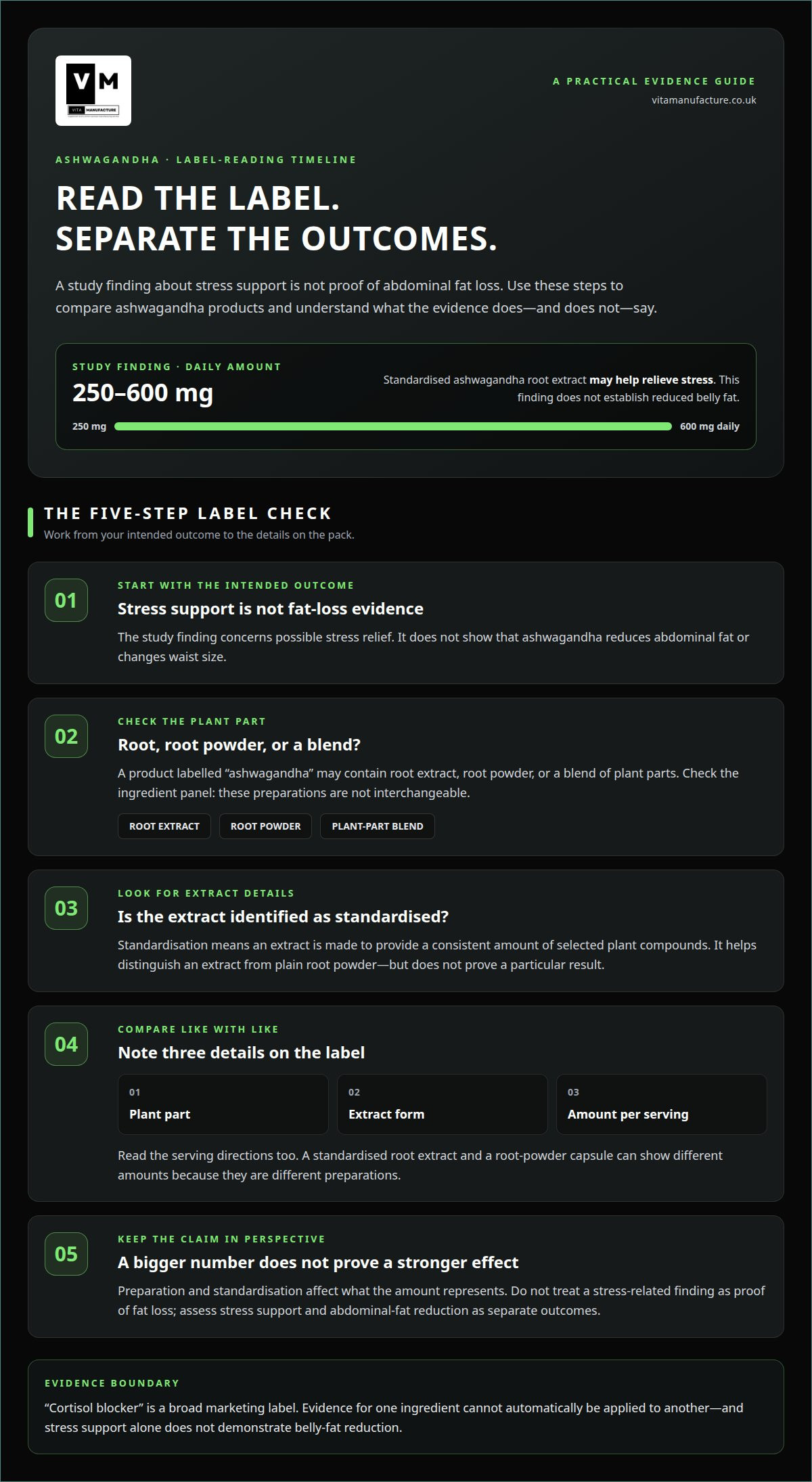
Ashwagandha is a plant-derived supplement, not a direct treatment for abdominal fat. The study authors found that daily doses of 250 mg to 600 mg of standardised ashwagandha root extract may help relieve stress. That finding concerns stress support; it does not establish that ashwagandha reduces belly fat.
Extract type matters when comparing products. A capsule labelled “ashwagandha” may contain root extract, root powder or a blend of plant parts. These are not interchangeable. Check the ingredient panel for the plant part and whether the extract is identified as standardised. This gives you a clearer basis for comparing like with like, whether you are assessing mainstream retailers or dedicated wellness brands such as Nutrahara.
Standardisation means an extract is made to provide a consistent amount of selected plant compounds. It helps distinguish a concentrated extract from plain root powder, but does not prove a particular result. Read the whole label, including the amount per serving and serving directions, rather than comparing only the number on the front of the pack.
For a practical comparison, note three details: the plant part, the extract form and the amount in one serving. A standardised root extract and a root-powder capsule may show different amounts because they are different preparations. Don’t assume a larger number means a stronger effect on stress: preparation and standardisation affect what the figure represents.
Stress is a more relevant reason to consider ashwagandha than reducing belly fat. If stress disrupts your routines, addressing it may form part of a broader approach to wellbeing. However, the study finding above concerns possible stress relief, not a measured change in waist size. Treat these as separate outcomes when assessing the evidence.
A supplement also isn’t the only route to weight-management support in the UK. According to NHS, adults with a BMI of 28 kg/m² or above and weight-related risk factors may be considered for orlistat, subject to clinical assessment and ongoing monitoring. Orlistat is a separate medicine, not an ashwagandha extract or cortisol supplement.
Use a simple label-reading step before choosing: match the ingredient form to the evidence you’re considering, then follow the product’s serving directions. If your goal is stress support, focus on standardised root extract research. If your goal is reducing abdominal fat, don’t treat a stress-related finding as proof of fat loss.
2. Do cortisol blocker supplements work?
“Cortisol blocker” is a marketing label, not proof that a supplement lowers cortisol or reduces body fat. Ingredients may support stress or sleep, but those effects are different from demonstrated fat loss. Assess each ingredient based on its own evidence, intended effect and safety information. A calmer evening, for example, does not establish that a supplement has changed cortisol levels.
L-theanine is often considered for stress and sleep. A meta-analysis examined its cognitive and affective effects across 31 trials. Suggested daily amounts range from 100 to 200 mg, with some guidance describing up to 400 mg in divided doses. Those figures describe suggested use, not a guaranteed response. Compare the amount per serving with the product directions, and don’t assume a larger dose works better.
Magnolia bark extract is another ingredient associated with mood and sleep support. A common daily dose range is 200 to 400 mg, but extract preparations and product directions can differ. Check the label for the extract amount and other active ingredients. This helps you avoid treating two products as equivalent simply because both mention magnolia bark.
Sleep habits offer a practical starting point alongside supplement decisions. Adults are advised to aim for 7-9 hours per night per night. Turning off screens 30 to 60 minutes before bed can support a more consistent bedtime routine. If stress is keeping you alert, try slow, deep breathing for at least 10 minutes, then note whether it helps you settle.
Movement and time outdoors can also fit into a stress-management plan. Adults are advised to aim for at least 150 minutes of moderate-intensity exercise each week. One study found lower baseline cortisol among city residents spending at least 10 minutes in nature three times a week for eight weeks. Mindfulness or another calming activity can complement these routines, rather than replace sleep or exercise.
In the UK, claims that a supplement lowers cortisol or causes weight loss are not proof of effectiveness. Assess the wording and supporting evidence, not just the product name. A claim that a supplement “blocks cortisol” does not, by itself, show that it causes weight loss.
Risks and interactions depend on the ingredient, dose, and other medicines or supplements you take. Read the product label for cautions and possible side effects, and share the full ingredient list with a pharmacist before combining products.
If you’re pregnant or breastfeeding, don’t start a cortisol-focused supplement without advice from a GP, midwife or pharmacist. The same applies if you take regular medication, since ingredients such as botanicals can affect safety or interactions.
3. Is ashwagandha or L-theanine better for lowering cortisol?
Neither ingredient is right for everyone, because stress support and belly-fat reduction are different outcomes. Cortisol is part of the body’s response to stress, while abdominal fat reflects several influences, including eating patterns, activity and sleep. A supplement that supports calm does not establish that it reduces waist size. Compare ashwagandha and L-theanine according to your intended outcome, not a “cortisol” label alone.
A useful comparison starts with the kind of support each ingredient is intended to provide. Ashwagandha has been studied for stress relief, while L-theanine is commonly considered for stress and sleep. If tension disrupts your evening routine, consider whether your main challenge is feeling unsettled or finding it difficult to wind down. That distinction is more useful than expecting either ingredient to act as a fat-loss supplement.
Stress can also affect behaviours that shape weight management. A difficult period, for example, may disrupt sleep, change meal routines or make regular activity harder to maintain. This doesn’t mean cortisol alone causes belly fat. Instead, track practical factors such as sleep quality, activity and eating patterns alongside stress levels. This can help you see whether a supplement supports one part of your routine without confusing that effect with a change in body fat.
Omega-3 fatty acids are another option sometimes discussed in relation to stress response. A daily intake of 250 milligrams of combined EPA and DHA is recommended in the source material. EPA and DHA are the omega-3 fats to look for on the label; the total amount of fish oil is not the same as the amount of these two fats. Treat this as a separate nutritional consideration, not evidence that omega-3s directly reduce abdominal fat.
Rhodiola is positioned differently, with interest focused on stress and energy. Studies reviewed used doses ranging from 200 mg to 680 mg per day, so research preparations span a wide range. That range doesn’t identify one best amount for every person or prove a weight-loss effect. Compare the studied ingredient and preparation with a product label, and don’t infer that a higher dose is more effective.
To make a considered choice, define the outcome first: stress, sleep, energy or weight management. Then assess the ingredient evidence for that outcome and keep other routines consistent. Ashwagandha and L-theanine may be relevant to stress support, while omega-3s and rhodiola have distinct evidence and use contexts. None should be treated as a shortcut that targets belly fat simply by lowering cortisol.
4. B vitamins and cortisol production
B vitamins aren’t a single switch for turning cortisol off. They support normal processes involved in energy metabolism and other body functions. That makes their relationship with cortisol different from a direct “blocker” claim. Vitamin B5, also called pantothenic acid, is involved in making coenzyme A, which supports several metabolic pathways. Vitamin B6 has roles in amino-acid metabolism and neurotransmitter production. Neither function proves that taking extra vitamins lowers cortisol or belly fat.
Vitamin B5 is relevant to steroid-hormone production, including cortisol, but that doesn’t mean more B5 automatically means more cortisol. The recommended daily intake stated for vitamin B5 is 5 mg. This is a nutrient-intake reference, not a cortisol-treatment dose. A supplement label can help you compare the amount in one serving with that daily intake. Also check whether a multivitamin already contains B5 before adding a separate product.
Vitamin B6 supports processes that help the body use amino acids and produce certain neurotransmitters. The recommended daily intake stated for vitamin B6 is 1-1.7 mg. That range is not a target for lowering cortisol. Instead, it provides context for reading a label and assessing whether a product supplies a routine nutrient amount or a much larger quantity. Look at the serving size, since the amount listed may apply to more than one tablet.
Food is another source of B vitamins. Whole grains, beans, eggs and leafy vegetables can contribute to a varied diet. A supplement doesn’t replace that broader pattern, and a high dose doesn’t make a product a cortisol blocker. Compare the named B vitamins and their amounts instead of relying on general phrases such as “stress support” on the front of the pack.
For a practical check, write down the B5 and B6 amounts from every product you take, including a multivitamin. Then compare those figures with the daily intake references above. This helps identify overlapping ingredients before combining supplements. Keep the distinction clear: correcting a low nutrient intake is not the same as treating chronic stress, and neither result demonstrates a reduction in abdominal fat.
For weight goals, treat B vitamins as nutrients, not a stand-alone fat-loss strategy. If stress affects your sleep, meals or activity, consider those patterns as separate parts of your plan. For example, note whether a stressful workday changes your bedtime or eating routine. That record offers more useful context than assuming a B-complex supplement directly controls cortisol production. For readers considering broad nutritional support, resources such as bogdanaliquidvitamins.com offer comprehensive liquid formulas designed to support general vitality alongside a balanced diet.
5. Do supplements lower cortisol levels, and what does clinical evidence show?
Some studies report changes in cortisol after supplementation, but one result cannot establish that every product works. Vitamin C illustrates why the details matter. A study included 69 women with elevated cortisol linked to chronic stress. Participants taking 1,000 mg of vitamin C daily for two months reduced cortisol levels closer to a normal range. That finding concerns this group, dose and period, not belly-fat loss.
The difference between a measured hormone change and a meaningful outcome matters. A cortisol result alone doesn’t show that a supplement changes body weight, waist size, sleep or daily stress. Keep those outcomes separate when reviewing a study or product claim. For example, a study measuring cortisol should not be presented as evidence of fat loss unless it also assessed that outcome.
Rhodiola has also been examined in clinical research. The review authors assessed 11 clinical trials on rhodiola supplementation. A review can help readers see a body of evidence rather than relying on one trial, but the number of trials alone does not tell you whether their results agree. Look for the supplement form, participant group, measured outcome and whether the review reports consistent findings.
Before weighing a cortisol claim, check the evidence in a few steps. First, identify the exact ingredient and preparation. Next, note the dose and period used in the study. Then check what researchers measured: cortisol, perceived stress, sleep or another outcome. Finally, compare that outcome with the product’s promise. If a product claims to reduce belly fat, a cortisol result alone does not demonstrate that effect.
Study participants also affect how directly a result applies to you. The vitamin C finding involved women with elevated cortisol associated with chronic stress. It should not be treated as a universal result for people with different circumstances or baseline levels. Likewise, research on rhodiola cannot automatically establish the effects of ashwagandha, L-theanine or a B-vitamin blend. Evidence applies to the ingredient and conditions actually studied.
For a balanced decision, keep a short record of the product, serving directions and outcome you hope to support. If your goal is better sleep, note changes in sleep; if it is stress support, track that separately. Don’t use a change in one measure as proof of another. Clinical evidence can inform expectations, while the ingredient, preparation and measured outcome determine what a study can reasonably support.
Vita Manufacture: New Product Development
Vita Manufacture’s New Product Development can help turn an evidence-informed supplement concept into a product plan. If you’re developing a formulation for stress support, start by defining its intended purpose, ingredient rationale and target audience. This keeps the concept grounded in the distinction between supporting stress management and claiming to reduce belly fat.
Vita Manufacture also offers Contract Manufacturing, Private Label Supplements and White Label Supplements for founders and established brands at different stages. A clear product brief gives development work a stronger starting point, including the ingredients and positioning you want to explore.
To discuss your supplement concept, contact Vita Manufacture.
Build your next step around a clear product purpose
Before developing a supplement concept, define precisely what it is intended to support. Is the focus stress management, sleep or a broader wellbeing routine? A clear purpose helps shape ingredient choices and keeps product positioning aligned with the outcome you want to explore. Claims about supplements to reduce cortisol and belly fat need particular care: stress support is not the same as evidence of fat loss.
Use that distinction to create a focused brief. Set out the intended audience, the need the product addresses and the evidence you want to guide its formulation. This gives product development a more strategic starting point and makes it easier to assess whether the concept is coherent, useful and clearly communicated. A supplement may be one part of a broader approach, rather than a stand-alone answer to weight or stress concerns.
Ready to explore a supplement concept with a clear purpose? Contact Vita Manufacture to discuss your supplement idea. A thoughtful brief can turn a broad opportunity into a more focused next step.
Frequently Asked Questions
Do cortisol blocker supplements work?
Some ingredients have been studied for stress support or changes in cortisol, but “cortisol blocker” guarantees neither effect. A useful first step is to identify the ingredient and the outcome measured. A study measuring perceived stress, for instance, doesn’t establish a change in abdominal fat. Treat broad product claims cautiously and compare them with evidence for the specific ingredient and preparation.
What is cortisol?
Cortisol is a hormone produced by the adrenal glands and involved in the body’s response to stress. Its levels also follow a daily rhythm, changing throughout the day. A single stressful moment isn’t enough to diagnose a hormone disorder. If symptoms or test results raise concern, a GP can assess the pattern and decide whether medical investigation is appropriate.
Why consider supplements to lower cortisol?
A supplement may be considered as one part of a stress-support plan, not as a way to switch off a normal hormone. For example, someone whose stress disrupts their evening routine may explore sleep habits and an ingredient studied for relaxation. First define the goal, such as winding down or supporting sleep, then assess a product against that goal rather than an assumed effect on weight.
How can I lower my cortisol levels quickly?
Try a calming activity, such as slow, deep breathing for at least 10 minutes. Calming activities can decrease cortisol levels within about 15-20 minutes. A brief walk outdoors may also help you pause and reset, though it isn’t a substitute for treatment if you’re unwell. If symptoms are severe or persistent, arrange medical advice instead of relying on a supplement for rapid relief.
Is ashwagandha or L-theanine better for lowering cortisol?
There isn’t enough evidence here to declare one universally better. The relevant comparison is the outcome each has been studied for. Ashwagandha research includes standardised root extract for stress support, while L-theanine is often considered for relaxation and sleep. If you’re choosing between them, compare the preparation, label directions and your main goal. Don’t treat sleep or calmness as proof of fat loss.
Which supplements have evidence for reducing cortisol, such as ashwagandha, magnesium, or omega-3?
Evidence differs by ingredient and outcome, so these supplements shouldn’t be treated as interchangeable. Ashwagandha and vitamin C have study findings related to stress or cortisol, while research on omega-3s and magnesium may address other outcomes. For omega-3, check the combined EPA and DHA amount, not just total fish oil. Evidence of a nutrient’s role in the body doesn’t establish that taking more lowers cortisol.
Can any supplements specifically reduce belly fat or abdominal fat?
No supplement discussed here has been shown to target fat specifically around the abdomen. A study reporting a change in cortisol or stress doesn’t prove that waist size changed. Keep the outcomes distinct: assess supplements for their studied purpose, and approach body-fat changes through broader habits, including eating patterns and physical activity. If changes in abdominal weight concern you, discuss the wider health context with a healthcare professional.
What supplement doses have been studied, and for how long?
Study amounts and periods vary by ingredient. Ashwagandha research included 250 mg to 600 mg daily of standardised root extract; a vitamin C study used 1,000 mg daily for two months. Rhodiola studies reviewed used 200 mg to 680 mg per day. These are research details, not instructions to copy: preparations, participants and outcomes differ, so compare a product’s label with its own evidence.