Supplement Quality Control Procedures: The Complete UK Founder Checklist
Updated: Sep 26
Rigorous quality control is not administrative red tape; it is your venture's most valuable commercial asset. With research by NutriVolv revealing that 47% of tested protein powders exceeded safety thresholds for toxic metals, the operational stakes for wellness entrepreneurs couldn't be higher. What specific quality control procedures must your production team follow to guarantee uncompromised safety and legal compliance? Without systematic supplement quality control procedures embedded across your supply chain, a single batch contamination or labelling failure can dismantle years of hard-won brand equity overnight.
You already know that sustainable market growth demands flawless product integrity, yet deciphering complex analytical testing panels, microbiological specifications, and technical certifications can quickly stall your momentum. This guide cuts through the technical jargon to help you master the vital standards required for strict UK regulatory compliance, brand reputation defence, and supplier accountability. You'll discover a practical founder checklist to audit manufacturing facilities, review Certificates of Analysis with total confidence, and select an accredited partner equipped to protect your commercial future.
Table of Contents
Core Pillars of Supplement Quality Control Procedures in the UK
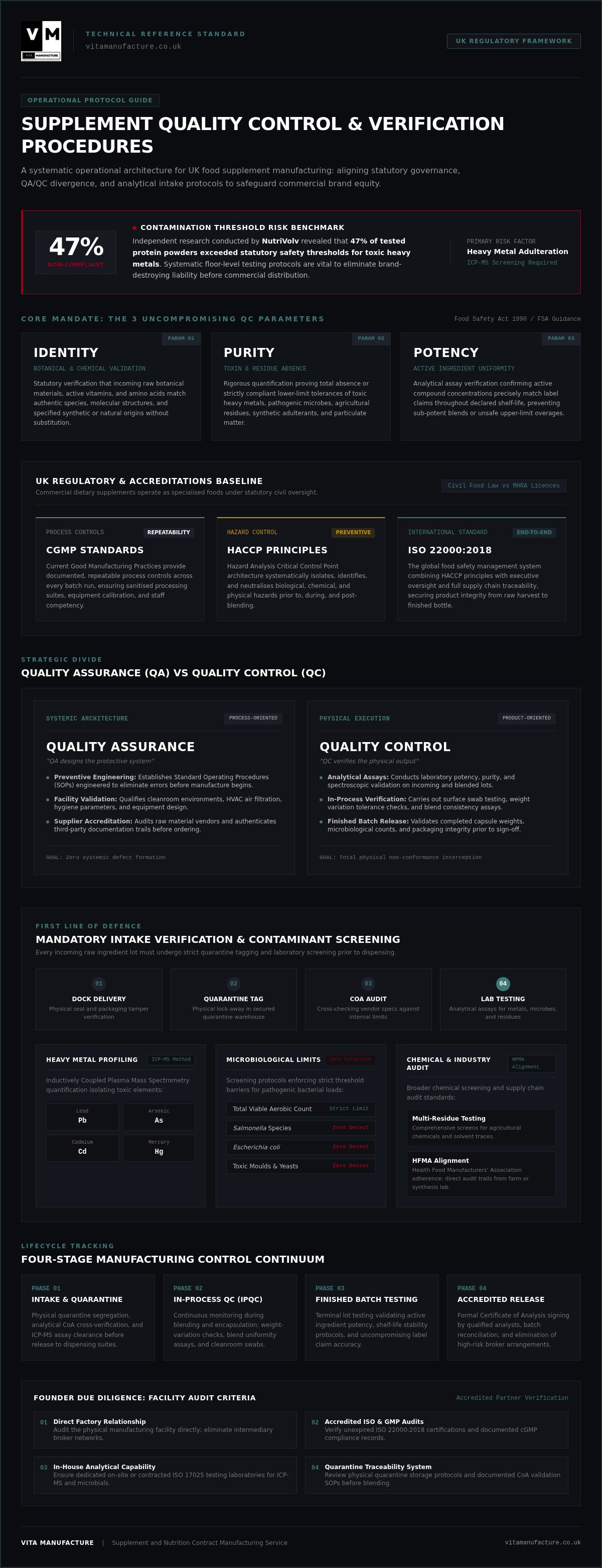
Operational excellence begins with a fundamental reframe. Quality control isn't a passive administrative hurdle; it represents the primary operational safeguard of your venture's commercial viability. In practice, robust supplement quality control procedures systematically verify three uncompromising parameters: identity, purity, and potency. Under UK law, food supplements fall under the Food Safety Act 1990 and Food Standards Agency oversight. Because supplements are legally governed as specialised foods rather than medicinal drugs, the statutory burden of ensuring consumer safety, batch uniformity, and compliant active ingredients rests squarely on your business.
Regulatory Baselines: ISO 22000, HACCP, and cGMP
Founders often confuse pharmaceutical manufacturing with food supplement compliance. While pharmaceutical production involves strict statutory licensing under the MHRA, commercial dietary supplements operate under rigorous food safety management legislation. Basic food hygiene simply won't protect complex active botanicals or concentrated micronutrients. High-performing facilities implement rigorous Hazard Analysis Critical Control Point (HACCP) systems to identify and neutralise biological, chemical, and physical risks before blending begins. Adhering to verified Good Manufacturing Practices (GMP) creates repeatable process controls across every production run. To establish truly bulletproof traceability, accredited facilities step beyond baseline guidelines by adopting ISO 22000:2018. This globally recognised food safety management system integrates HACCP principles with structured management oversight, locking down supply chain integrity from raw harvest to finished bottle.
Quality Assurance vs Quality Control: Strategic Differences
Do you know where Quality Assurance ends and Quality Control begins? QA represents the overarching, systemic design: the standard operating procedures, facility validations, and preventive protocols engineered to eliminate production errors before they happen. QC encompasses the physical, floor-level execution: analytical assays, swab testing, weight-variation checks, and finished batch validations.
QA designs the protective system; QC verifies the physical output. Blending proactive QA architectures with granular supplement quality control procedures ensures that sub-potent raw materials or particulate contaminants never slip into your commercial inventory. It's the ultimate operational shield protecting your brand from catastrophic product recalls and preserving valuation.
Raw Material Intake and Ingredient Verification Checklist
Your finished formula is only as dependable as the raw powders arriving at the warehouse dock. Raw ingredient verification forms your operational first line of defence against adulteration, mislabelling, and sub-potent batches. Establishing resilient supplement supply chain management UK practices ensures that every batch entering quarantine meets strict predetermined specifications before moving anywhere near the dispensing room.
Certificate of Analysis Verification and Supplier Auditing
Never accept a Certificate of Analysis (CoA) at face value. A paper trail confirms what the vendor claims, not what is physically inside the drum. Best-practice intake protocols mandate immediate physical quarantine tagging, keeping raw ingredients locked away while analytical chemists verify the CoA parameters against internal specifications. Credible suppliers operate in full alignment with the standards outlined by the Health Food Manufacturers' Association, demonstrating full documentation traceability from farm or synthesis lab directly to delivery.
Mandatory Contaminant Screening: Heavy Metals and Microbials
Toxins present an immediate risk to consumer health and your brand's future. Comprehensive intake testing requires an uncompromising screening battery for every single delivered lot:
Heavy metal profiling: Inductively Coupled Plasma Mass Spectrometry (ICP-MS) quantification for lead, arsenic, cadmium, and mercury.
Microbiological limits: Total viable aerobic counts alongside zero-tolerance screens for Salmonella, Escherichia coli, and toxic moulds.
Chemical residues: Extensive multi-residue pesticide screening and residual solvent validation on concentrated botanical extracts.
Identity and Botanical Authenticity Testing Protocols
Economically motivated adulteration remains a serious hazard in botanical sourcing. How do you prove that an incoming shipment of powdered extract contains genuine botanical material rather than an exhausted biomass spiked with synthetic adulterants? High-Performance Thin-Layer Chromatography (HPTLC) compares the botanical fingerprint against certified reference materials to confirm genus and species. Simultaneously, Fourier Transform Infrared (FTIR) spectroscopy matches molecular structures to establish true chemical identity.
Embedding these analytical checkpoints into your daily supplement quality control procedures eliminates manufacturing bottlenecks before production starts. If your current setup lacks full-spectrum testing capabilities, partnering with an established specialist like Vita Manufacture gives you direct access to accredited testing architectures and verified bulk sourcing.
In-Process Quality Control (IPQC) During Blending and Encapsulation
Formulation blueprints mean very little if mechanical processing fails on the factory floor. In-process quality control (IPQC) ensures that active ingredients disperse uniformly across every single unit, preventing hot spots or sub-potent doses. Even a minor mechanical oversight during production can alter dosing curves, potentially running afoul of official MHRA guidance on borderline products if active thresholds accidentally drift outside food supplement limits. Aligning your production schedule with professional supplement formulation services UK guarantees that physical variables like particle size and powder density are engineered for seamless high-speed runs.
Blend Uniformity and Homogeneity Verification Steps
Dry mixing demands scientific precision, not guesswork. Operators must validate blending duration and impeller speeds to prevent ingredient stratification, where dense compounds sink and lighter powders rise. Technicians pull multi-point samples from the top, middle, and bottom of the ribbon blender or V-mixer, validating coefficient of variation limits before releasing the mixture. In-process supplement quality control procedures also analyse bulk density, tapped density, and moisture content, ensuring the mass maintains consistent flowability without clumping inside mechanical hoppers.
Physical Parameter Monitoring for Capsules and Tablets
High-speed encapsulation equipment moves fast, which means mechanical deviations escalate rapidly without watchful monitoring. Line technicians conduct routine floor checks every 15 minutes, recording critical physical metrics on live batch production logs:
Capsule fill weight variation: Individual and gross weight measurements verify that active potencies remain identical across all blister strips or bottles.
Tablet hardness and friability: Mechanical pressure checks confirm tablets withstand downstream packaging vibrations without fracturing or shedding powder.
Disintegration testing: In-vitro water bath trials confirm finished delivery systems dissolve completely within statutory timeframes to support nutrient bioavailability.
Cleanroom Environmental and Cross-Contamination Controls
Floor hygiene requires constant environmental vigilance. High-grade processing suites operate under positive air pressure differentials paired with medical-grade HEPA filtration, ensuring airborne particulates flow outward rather than into open formulation tubs. Strict allergen segregation barriers prevent cross-contact during machine changeovers. Technicians maintain continuous digital logs of relative humidity and ambient temperature, shielding hygroscopic herbal extracts, vulnerable vitamins, and live probiotics from heat-induced degradation before primary packaging begins.
Finished Batch Testing, Stability Protocols, and Release Criteria
Every prior quality gate converges at final release. Finished product release acts as your definitive commercial barrier before inventory enters the market, ensuring that every container matches your exact label claims. Leading health supplement manufacturers in the UK never permit a batch to leave the loading bay without formal, documented sign-off from an independent Quality Unit. This final verification stage protects your customer base and prevents the devastating reputational damage caused by product discrepancies.
Release Testing: Potency, Purity, and Label Claims
Trust relies on hard chemistry. Finished batch testing requires High-Performance Liquid Chromatography (HPLC) or mass spectrometry to confirm that botanical bioactives, minerals, and vitamins meet declared values across every pack. Accurate analytical assays depend heavily on verified, high-purity testing media, with laboratories frequently sourcing critical chemical supplies from specialist manufacturers like RMR Reagents. Microbiological release testing reconfirms the absolute absence of pathogenic flora, while packaging engineers check that tamper-evident bands, induction seals, and automated batch code stampings are clean, secure, and fully legible.
How do you guarantee a formula remains potent 24 months after production? Stability testing provides the empirical data required to back up your expiry dates. A comprehensive stability protocol uses two distinct testing tracks:
Accelerated stability testing: Finished product samples are placed in controlled climatic chambers at elevated temperatures (typically 40°C) and 75% relative humidity for three to six months to model degradation kinetics and predict true shelf-life curves.
Real-time ambient testing: Parallel production samples are stored under normal warehouse conditions (25°C / 60% relative humidity) and pulled at designated intervals (6, 12, 18, and 24 months) to verify that real-world nutrient degradation matches initial projections.
Formulation overages: Chemical data dictates precise, compliant overages during blending so that volatile compounds like Vitamin C or live cultures remain at or above 100% of the declared label claim on day 730.
Batch Retention Sampling and Recall Preparedness Systems
Preparedness separates amateur brands from market leaders. Contract facilities must preserve duplicate finished batch samples in climate-controlled retention libraries for at least one year past their declared expiry date. Digital batch manufacturing records connect raw material lot numbers directly to customer distribution invoices. Annual mock recall exercises stress-test these links, proving that your supply network can trace every single finished unit back to its source ingredients within four hours.
Mastering these finished release standards ensures your products build unshakeable consumer trust from the very first order. To manufacture your formulations under an accredited, ISO 22000-certified quality system with complete batch traceability, partner with Vita Manufacture today.
Evaluating Your Contract Manufacturer: The Quality Audit Checklist
Outsourcing encapsulation doesn't outsource statutory liability. Under UK law, the business entity named on the container operates as the Food Business Operator (FBO), carrying ultimate legal and financial responsibility for product safety and label truthfulness. Vetting prospective facilities separates genuine contract partners from high-risk subcontracting brokers who compromise quality behind opaque supply chains. Before signing any commercial agreement, review our comprehensive framework for choosing a UK supplement manufacturer to ensure your venture partners with an accredited operator.
Critical Quality Documentation Every Founder Must Request
Paperwork reveals operational culture. Prior to scheduling an on-site visit or placing a purchase order, request these mandatory compliance files:
Accreditation certificates: Valid third-party audit certificates for ISO 22000:2018 food safety management systems or verified GMP compliance.
Master Manufacturing Records (MMRs): Detailed manufacturing blueprints demonstrating clear unit specifications, bill of materials, and critical control points.
Historical analytical logs: Redacted Certificates of Analysis from live production runs showing actual microbiological, heavy metal, and potency testing values rather than blanket "conforms" statements.
Facility and Traceability Red Flags During Audits
Walk the production floor with an investigative mindset. A transparent contract partner welcomes client oversight and readily agrees to a formal "Right to Audit" clause. Pay close attention to physical red flags: airborne dust escaping processing suites, erratic temperature logs in raw storage, or undocumented equipment sanitisation between batch changeovers.
Question their supply network directly. Does the facility execute blending and bottling in-house, or do they quietly broker jobs to unvetted third parties? Verify that digital batch management records tie raw ingredient lot numbers to finished cartons, backed by customer portals that let you monitor compliance documentation in real time.
Aligning Quality Protocols with Commercial Brand Scaling
Scalability requires consistency. As your product portfolio expands from initial pilot runs into high-volume commercial batches, your manufacturing protocols must maintain flawless precision. Working with an agile UK partner offering end-to-end oversight ensures formulation, pilot testing, encapsulation, and distribution remain fully synchronised. Embedding transparent supplement quality control procedures across every batch transforms regulatory compliance into your venture's greatest commercial differentiator.
Scale Your Brand on an Uncompromising Foundation of Quality
Elevating your wellness venture above market noise requires far more than compelling marketing; it demands verifiable product integrity. By embedding systematic supplement quality control procedures across raw material quarantine, cleanroom blending, and finished batch release testing, you eliminate recall vulnerabilities while turning rigorous compliance into your greatest commercial asset.
You don't have to navigate analytical testing panels and factory floor validations in isolation. Sustainable brand growth thrives on true operational transparency and disciplined scientific execution. Partner with an ISO 22000-certified UK supplement manufacturer today to access end-to-end contract manufacturing support spanning bespoke R&D formulation, encapsulation, and streamlined distribution. Backed by complete batch traceability and a dedicated digital client portal providing real-time production tracking, you gain the technical backing needed to lead your category with complete confidence.
Frequently Asked Questions
What is the difference between GMP and ISO 22000 in supplement manufacturing?
GMP focuses primarily on plant-level hygiene and manufacturing process execution, whereas ISO 22000:2018 is an internationally audited food safety management standard spanning complete supply chain traceability. While GMP provides foundational manufacturing controls, ISO 22000 layers HACCP principles into broader operational risk management. For UK brand founders, choosing an ISO 22000-certified contract manufacturer offers an internationally recognised framework of structural quality assurance that extends well beyond statutory baseline requirements.
How often should finished supplements undergo third-party laboratory testing?
Finished supplements should undergo independent third-party testing on every initial production batch and at periodic skip-lot intervals thereafter. Testing every batch during product launches verifies formulation integrity before retail distribution begins. As historical reliability builds, established brands typically test every third or fifth batch to audit their manufacturer's internal release data, verifying heavy metals, microbiological safety, and declared active vitamin or botanical potencies against statutory food guidelines.
What specific tests are legally required for dietary supplements sold in the UK?
UK food supplement law mandates safety compliance under general food safety legislation, requiring heavy metal screening and microbiological pathogen testing. Contaminant thresholds strictly regulate lead, cadmium, mercury, and arsenic, alongside zero-tolerance requirements for Salmonella and Escherichia coli. While third-party potency testing isn't explicitly codified in general food statute, you must legally substantiate declared nutritional values, making analytical assay verification vital for complying with Trading Standards and Food Standards Agency labelling rules.
How do contract manufacturers guarantee active ingredient consistency across batches?
Manufacturers guarantee consistency through validated blending times, multi-point powder sampling, and strict in-process supplement quality control procedures. Floor technicians run coefficient of variation analyses across high, middle, and low blender zones to verify powder homogeneity before encapsulation. Standardised fill-weight checks performed every 15 minutes ensure each capsule contains the exact active dose declared on your label, avoiding potency hot spots and preventing sub-potent variations across commercial production runs.
What documentation should I expect to receive with my finished supplement order?
Every completed supplement order must include a verified Certificate of Analysis (CoA) and a Certificate of Conformance (CoC). The CoA outlines physical parameters, microbiological culture screens, heavy metal assay data, and active potency quantification. The CoC, signed by the Quality Unit, confirms the entire batch was blended, encapsulated, and packaged in full accordance with the approved Master Manufacturing Record and governing UK food safety management protocols.
Can a supplement brand rely solely on a raw material supplier Certificate of Analysis?
No, relying entirely on a vendor's paperwork exposes your brand to severe commercial liability and regulatory risk. Paper documentation does not verify what sits inside the physical drum. Best-practice supplement quality control procedures require immediate quarantine upon intake, accompanied by independent identity testing via FTIR spectroscopy or HPTLC. Verifying raw materials through independent lab assays ensures adulterated, mislabelled, or sub-potent botanical powders never reach your active formulation hoppers.
What happens if a supplement batch fails quality control testing during production?
When a batch fails critical control specifications, the facility's Quality Unit places the entire lot on immediate physical and digital hold. Technicians initiate a formal Non-Conformance Report (NCR) and Root Cause Analysis (RCA) to investigate whether the failure stemmed from raw material degradation, human dispensing errors, or mechanical issues. The batch is quarantined, preventing cross-contamination, and safely rejected if it cannot be remediated under strict, documented re-processing protocols.