Private Label Supplements: A Beginner's Guide
A strong private label launch starts with a commercially focused brief, not a catalogue choice. If you’re wondering how to turn a supplement idea into a product you can take to market, the first steps can feel less straightforward than choosing a format or formula. A Beginner's Guide to Private Label Supplements explains what to decide before production begins.
You may know the audience you want to reach but still be weighing up what private label means in practice, which product concept is viable and how to plan for quality and compliance. These decisions are easier to manage when product development and manufacturing are considered together, rather than as separate stages.
This guide follows the journey from market idea to launch planning. You’ll learn how to shape a product brief, assess formulation and format options, consider regulatory requirements and plan for manufacturing and distribution. Vita Manufacture supports private label, white label and custom supplement development, connecting product development with manufacturing and operational support.
Table of Contents
What are private label supplements, and why do brands choose this route?
How does a private label supplement move from idea to production?
Which private label decisions shape product fit and commercial viability?
What should a beginner plan before committing to a supplement launch?
How can Vita Manufacture support your private label supplement journey?
What are private label supplements, and why do brands choose this route?
A private label supplement is produced by a manufacturer and sold by a business under its own brand. The brand owner shapes the customer proposition and route to market, while a manufacturing partner brings production expertise and may support product development and operations. For a foundational overview of the retail model, see What is a private label?
For a founder, the practical appeal is access to specialist production without having to establish and run a factory. That lets you focus on understanding customers, developing the brand and planning sales while working with a partner on the technical and operational work involved in bringing a product to market.
Private label describes a commercial arrangement, not a shortcut to market success. A manufacturer can help develop a considered concept, but cannot guarantee demand or make an unclear proposition compelling. Your brand still needs a defined audience, a credible reason for choosing the product and a realistic plan for reaching customers.
How private label fits a new supplement brand
Your role is to define who the product is for, the need it aims to address, how the brand should be positioned and where customers will encounter it. The manufacturer can contribute to formulation, production and related operational support. The level of tailoring depends on the project, so separate essential requirements from preferences early. For example, distinguish a required format or ingredient exclusion from a packaging preference that could change as the project develops.
This division of responsibilities clarifies the work: you bring the commercial direction, and the manufacturing relationship connects it with product and production decisions. The two should inform one another. The intended customer and brand positioning may shape the suitable format, while production considerations can affect what is practical to develop.
Private label is a broad starting point, not one fixed development pathway. Some projects begin with an existing product adapted for a brand; others involve more formulation input or wider product development. Choose the level of involvement according to what your brand needs to achieve and what the project is intended to deliver. For a deeper look at planning the commercial strategy, explore this private label supplements strategy guide.
Private label, white label and custom development at a glance
Private label generally refers to products made for sale under a retailer’s or brand’s own name. White label commonly describes a ready-made product that different brands can market under their own branding. Custom development involves creating or tailoring a product around a more specific brief. Manufacturers may use these terms differently, so treat them as descriptions of a project pathway, not universal technical definitions.
Set out in your project brief what is expected to be developed, adapted and produced. This helps prevent different assumptions about formulation, branding or scope from taking hold. For more detail on the white label route, read the white label supplements launch guide.
How does a private label supplement move from idea to production?
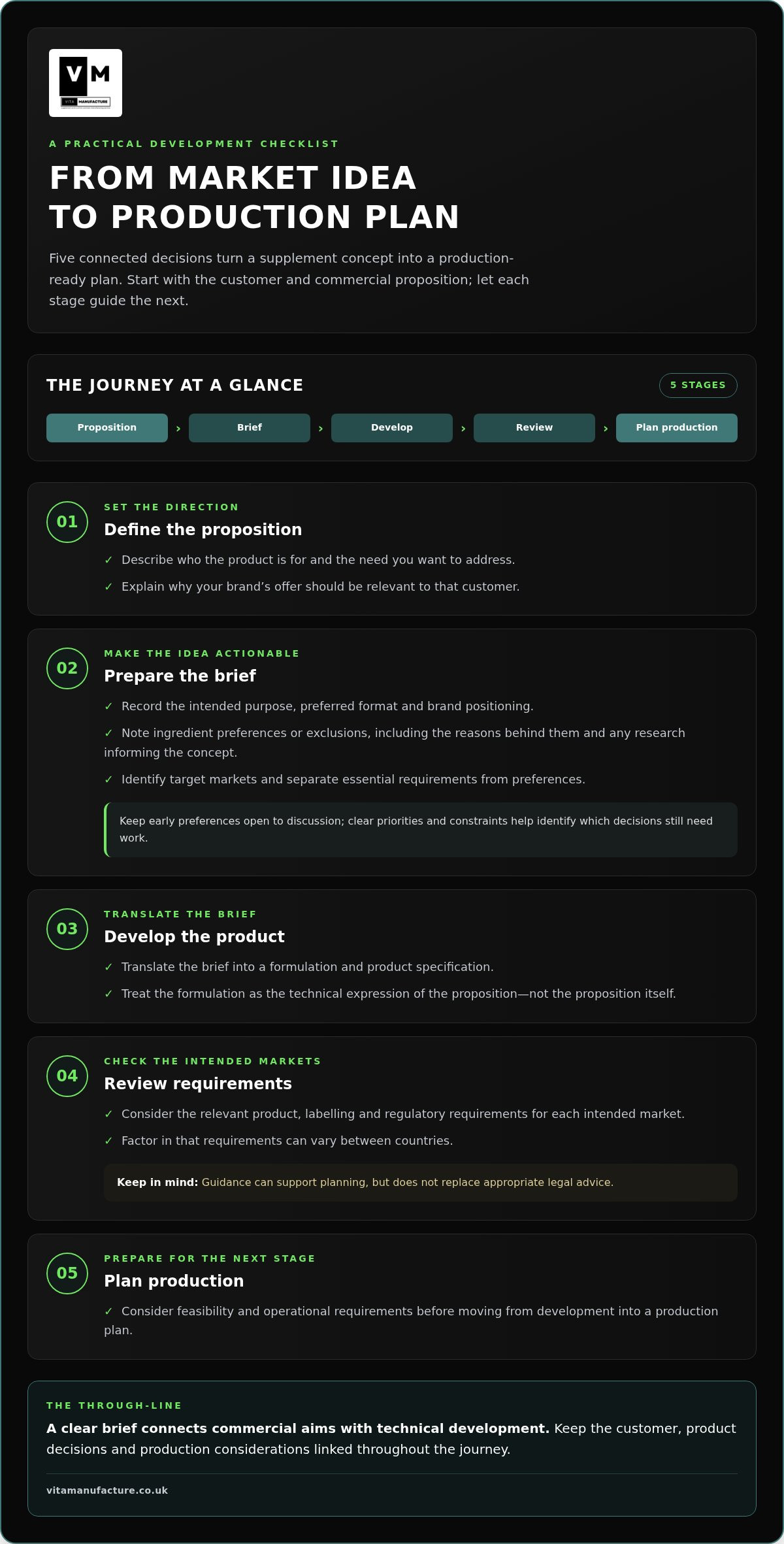
A product idea becomes production-ready through a series of connected decisions. Start with the customer and commercial proposition, translate them into a brief, develop and review the product, consider the requirements of its intended markets, then plan production. Each stage guides the next. A formula should not be chosen in isolation from the people it is meant to serve or the position the brand intends to occupy.
A clear brief aligns commercial aims with technical development. It gives the development team a reference point for turning a broad ambition into decisions that can be discussed and refined. The foundation of A Beginner's Guide to Private Label Supplements is to establish the rationale before moving towards manufacture.
Define the proposition. Describe the customer, the need you want to address and why your brand’s offer should be relevant to them.
Prepare the brief. Record the intended purpose, preferred format, positioning and ingredient preferences or exclusions.
Develop the product. Translate the brief into a formulation and product specification.
Review requirements. Identify intended markets early and consider the relevant product, labelling and regulatory requirements for each. Guidance supports planning but does not replace appropriate legal advice.
Plan production. Consider feasibility and operational requirements before moving from development into a production plan.
Build a brief that a development team can act on
Make the brief specific enough to guide decisions without treating early preferences as fixed specifications. Include the intended audience, product purpose, desired format and brand positioning. Record ingredient preferences and exclusions, with the reasons behind them and any research informing the concept. Identify target markets at this stage, since requirements can vary between countries. Clear priorities and constraints make it easier to assess possible directions and identify which decisions still need work.
Develop and review the product before scaling
Formulation work turns the brief into a product specification: the technical expression of the proposition, rather than the proposition itself. Review a prototype against the original brief to assess whether its format and characteristics suit your intended customer and positioning. If they do not, use the brief to refine the direction before advancing production planning. Explore this supplement formulation development guidance for more on how formulation decisions take shape.
Development and production are connected, but they are separate milestones. A promising concept still needs feasibility review and operational planning, including how the chosen product can move into manufacture and distribution. Treating these as deliberate stages can expose misalignment before the project progresses. A market idea is not automatically ready to produce.
Vita Manufacture’s development and manufacturing support connects formulation, regulatory guidance and manufacturing with production planning.
Which private label decisions shape product fit and commercial viability?
A product can be technically sound and still struggle to find a place in the market. Product fit depends on whether the offer makes sense for a specific audience. Commercial viability also depends on demand, competitive context and whether the concept can be produced and presented effectively. Consider these factors together rather than treating them as separate boxes to tick.
Match the product concept to a clearly defined audience
Describe the customer in practical terms: who are they, what need or preference is relevant to them, and what might make them choose your brand? A broad concept such as “a supplement for everyone” offers little direction. A focused proposition gives you a clearer basis for product decisions, messaging and market research before committing to a production plan.
Use research to test assumptions. Review how similar products are positioned, which formats they use and how their brands communicate. This will not prove that your concept will succeed, but it can reveal crowded positioning, customer preferences and practical questions worth exploring.
These are prompts, not a prescription. Choices affect one another: the desired experience may influence the format, while the format can shape packaging requirements and production feasibility. Market research and development planning help assess whether the full proposition holds together.
Choose format, packaging and claims with the brand in mind
Format should support usability as well as the intended brand experience. Packaging needs to present the product clearly, suit its practical requirements and reinforce the identity customers encounter across your other brand touchpoints. Consider the final concept alongside production and distribution needs, not on appearance alone.
Brand differentiation comes from the experience and positioning you create, not from making unauthorised product claims. Review proposed claims against current UK requirements and ensure they are appropriately supported. The US Federal Trade Commission’s FTC Guidelines for Health Product Claims offers a reference for understanding how health-related advertising claims are assessed in the United States; it is not a substitute for UK-specific review.
For A Beginner's Guide to Private Label Supplements, the practical takeaway is to assess audience fit, competitive context and operational feasibility as one joined-up decision. A more considered concept has a clear promise, a format suited to its customer and a realistic production plan. None of these removes the uncertainty around demand or profitability.
What should a beginner plan before committing to a supplement launch?
Before committing to production, make sure the commercial plan is as considered as the product idea. A readiness check can reveal gaps while there is still room to refine the project, rather than after stock and launch activity are underway.
Customer: Define who you intend to reach and what need or preference informs the product.
Product brief: Set out the product purpose, desired format, ingredient preferences and key exclusions.
Brand assets: Consider the name, visual identity, packaging direction and product information customers will need.
Target markets: Identify where you plan to sell, as relevant requirements can differ between countries.
Launch assumptions: Map out your route to market, stock plans, distribution and the resources needed to support launch.
Use the checklist to separate decisions already made from points that need investigation. A clear plan does not remove uncertainty, but it makes assumptions visible and easier to test.
Plan quantities, budget assumptions and route to market
Minimum order quantity is a project-specific planning factor, not a figure to assume before product and production requirements are understood. Consider how a proposed production quantity relates to expected demand, available working capital and inventory planning. Manufacturing is only one part of the budget: marketing, fulfilment and distribution also need to fit the plan.
Scenario planning can help you test assumptions. Consider how stock and cash-flow plans might change if sales are slower or faster than anticipated, without treating either outcome as a forecast. Your sales channel matters too. A website, retail or other route to market can affect packaging choices, fulfilment arrangements and the stock you need ready for launch.
Prepare for compliance and quality responsibilities
For UK-focused planning, the Food Standards Agency (FSA) is a useful reference point for food supplements, while the Advertising Standards Authority (ASA) provides advertising guidance. The CAP Code is relevant to non-broadcast advertising, including marketing communications. Requirements depend on the product, claims, audience and context, so use current UK guidance as your plans develop. Regulatory guidance supports decision-making but is not a substitute for legal advice where that is needed.
Quality planning belongs in the project conversation too. Consider how product decisions, specifications and production planning fit together, and what information needs review before manufacture proceeds. This helps ensure the launch plan accounts for the product as well as its promotion.
Timing depends on the product and project scope, so avoid building a launch plan around an assumed fixed schedule. Allow for development, reviews, production planning and distribution preparation. A Beginner's Guide to Private Label Supplements should leave you with a realistic next step: turn open questions into a prioritised project plan.
Vita Manufacture brings product development, regulatory guidance and manufacturing together to help align a supplement project with its launch assumptions. Plan your supplement project with Vita Manufacture.
How can Vita Manufacture support your private label supplement journey?
Once you have considered your audience, product direction and launch priorities, the next step is connecting those decisions with development and production. Vita Manufacture is a UK-based contract manufacturer supporting private label, white label and custom supplement development. Its services connect formulation, regulatory guidance, manufacturing, logistics and distribution across the project pathway.
This joined-up support helps founders and established brands keep commercial goals in view as technical and operational decisions take shape. Regulatory guidance can inform planning, while manufacturing and distribution considerations connect the product concept with what comes next. This support does not replace legal advice where that is needed.
From product brief to manufacturing partner
Your brief is the starting point for collaboration. Product development support connects its intended audience, purpose and positioning with formulation and production planning. Manufacturing and logistics can be considered alongside product decisions, rather than left until the concept is already set.
Transparency matters throughout the process. Vita Manufacture’s customer portal supports project transparency as the work develops. Vita Manufacture is ISO 22000:2018 certified, a relevant quality credential when considering a manufacturing partner. These features support a considered working relationship for brands at different stages, from an early concept to a more established product portfolio.
The value is not simply having several activities under one roof. It is the opportunity to align them around the needs of your project. A change in product direction, for example, can affect formulation and production planning. Considering those links early helps keep the development pathway coherent.
Plan a practical next step for your brand
You do not need every detail resolved before beginning a project discussion. Organise what you know: your intended customer, product concept, target markets, brand positioning and project priorities. Note open questions too. Separating firm requirements from areas where you are open to guidance gives the development conversation a useful starting point.
Development pathways can be tailored to the project, whether you are shaping a new concept or developing a product for an existing brand. The aim is to connect your commercial direction with the formulation, regulatory guidance and operational planning needed to move towards manufacturing and distribution.
A Beginner's Guide to Private Label Supplements can help you understand the decisions ahead. The next step is putting them into a project brief that reflects your brand’s goals. Explore private label supplement development with Vita Manufacture.
Turn your supplement concept into a clear next step
Your next move does not need to be a finished product plan. Write down what you want your brand to stand for, the customer you hope to serve and the questions that still need answering. This gives you a practical foundation for a focused project conversation.
A Beginner's Guide to Private Label Supplements is most useful when it helps you move from exploration to action. As you shape your plans, consider how formulation, regulatory guidance, manufacturing and logistics can work together. Vita Manufacture brings these areas into its development support, with an ISO 22000:2018-certified operation and a customer portal designed to support project transparency.
Your development pathway can be tailored to your project, whether you are refining an early concept or planning the next step for an established brand. A clear brief connects your ambition with a considered plan for development and production.
Ready to explore what your brand could become?Explore private label supplement development with Vita Manufacture.
Frequently Asked Questions
What is a private label supplement?
A private label supplement is made by a manufacturer for another business to sell under its own brand. The brand owner sets the commercial direction, while the manufacturing partner handles production and may contribute to development. For a clear project, document responsibility for decisions such as product specifications, artwork approval and market preparation. A Beginner's Guide to Private Label Supplements starts with understanding these roles and recording them in the project agreement.
Is private label the same as white label supplements?
Not always. White label often means an existing product is branded for different businesses, while private label may allow a more tailored arrangement. Manufacturers do not use these terms uniformly. Compare what is included in the project: formulation changes, packaging choices and development input are useful points to clarify in the agreed scope. This makes it easier to compare pathways and set expectations before product work begins.
How much does it cost to start a private label supplement brand?
There is no single reliable launch figure because investment depends on the project scope and route to market. Development, ingredients, production quantities, packaging, testing, regulatory work and logistics can all affect the budget. Include brand creation, fulfilment and working capital too. Build a project-specific budget with separate assumptions for manufacturing and reaching customers, then review it as decisions are made.
Can I own the formula for a private label supplement?
Formula ownership and usage rights depend on the development arrangement and written commercial terms. Selling a product under your brand does not automatically mean you own its formulation or have exclusive rights to use it. Clarify who owns newly developed intellectual property, what uses are permitted, and whether confidentiality or exclusivity applies. If these points matter to your strategy, record the agreed position in the project documentation before work progresses.
How long does it take to launch a private label supplement?
Launch timing varies according to the product, the amount of development involved and the decisions required along the way. Ingredient and packaging choices, product reviews, market considerations and production planning can all affect the sequence. Map the stages and their dependencies, including approvals needed before the next step. This creates a useful working plan without treating an indicative schedule as a promise.
Can I sell private label supplements outside the UK?
International sales can be part of your plan, but each intended market needs consideration. Product composition, labelling, permitted claims and import arrangements may differ by country, so identify target markets before finalising product and packaging decisions. Vita Manufacture serves clients worldwide and provides regulatory guidance to support planning. Use that guidance as one input, and check the current rules that apply in each market before placing a product there.
What should I prepare before approaching a supplement manufacturer?
Prepare a concise project outline, even if your idea is still developing. Include the customer you intend to reach, product concept, preferred format, brand positioning and target markets. Note ingredient preferences, exclusions and any research that supports the idea, then list open questions about quantities or packaging. You do not need a final formula; clear priorities help the development team understand your goals and which decisions remain open.