Medical Device Product Prototype: A Strategic Guide to Development
Why do so many breakthrough healthcare concepts stall before they ever reach a clinical trial? You've likely spent months refining your vision, yet the transition from a laboratory concept to a functional medical device product prototype often feels like a minefield of regulatory complexity and manufacturing risk. It's a high-stakes environment where a single design oversight can lead to thousands of pounds in wasted R&D spend. You aren't just building a model; you're building a business case.
We understand that the road to market is becoming more complex with the introduction of the Medical Devices (Amendment) Regulations 2026. This guide will show you how to navigate these UK-specific hurdles whilst transforming your idea into a commercially viable asset. You'll discover how to secure investor-ready documentation and create a testable model that meets stringent MHRA standards. We will explore the essential stages of strategic R&D, the nuances of the new annual registration fees, and how to build a roadmap that scales from your first unit to full-scale manufacturing. By the end, you'll have the clarity needed to move from a visionary concept to a market-ready reality.
Table of Contents
What is a Medical Device Product Prototype?
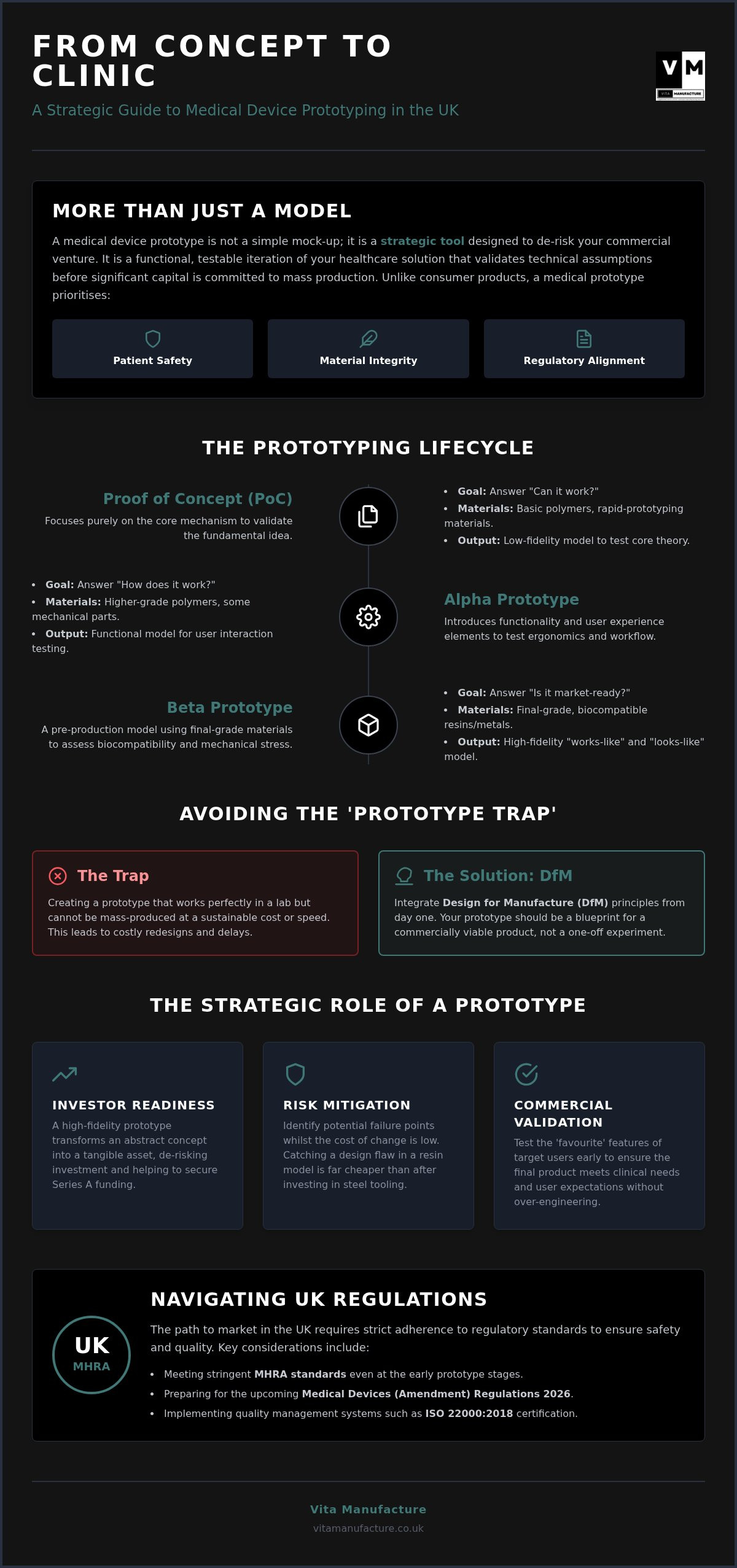
A medical device product prototype is far more than a simple physical model; it's a strategic tool designed to de-risk your commercial venture. It serves as a functional, testable iteration of your healthcare solution, allowing you to validate technical assumptions before significant capital is committed to mass production. Whilst a standard consumer prototype might focus on aesthetics, a medical iteration prioritises safety, material integrity, and regulatory alignment. Understanding what a medical device is in a clinical context is essential, as the MHRA requires specific documentation even at the early stages to ensure patient safety isn't compromised.
The development path typically moves through three distinct phases. A "Proof of Concept" (PoC) focuses purely on the core mechanism. Alpha prototypes then introduce functionality, whilst Beta models represent the pre-production stage, utilising final-grade materials. This tiered approach prevents the high cost of failed prototypes by identifying flaws when they're still inexpensive to fix.
The Evolution of a Medical Prototype
Low-fidelity models are your first step into the physical world. These often use rapid-prototyping materials like basic polymers to test ergonomic behaviour and user interaction. They answer vital questions: Does the device fit the hand? Is the interface intuitive for a clinician? These early versions don't need to be pretty; they just need to provide data.
As you progress, high-fidelity models incorporate final-grade materials to assess biocompatibility and mechanical stress. This is where the "Works-Like" versus "Looks-Like" distinction becomes critical. A "Works-Like" model proves the internal mechanics, whilst the "Looks-Like" version focuses on the outer shell and branding. Marrying these two into a single, functional unit is the ultimate goal of the R&D process.
Why "Design for Manufacture" (DfM) Starts at the Prototype Stage
Many founders fall into the "prototype trap." This occurs when a device works perfectly in a controlled laboratory setting but cannot be mass-produced at a sustainable cost or speed. Strategic prototyping avoids this by integrating "Design for Manufacture" (DfM) principles from day one.
You must identify raw material sourcing early to ensure supply chain stability. If a specific biocompatible resin is unavailable in the quantities you'll need for a UK launch, your medical device product prototype should reflect a viable alternative. At Vita Manufacture, our New Product Development (NPD) service bridges this gap. We integrate R&D with future production scalability, ensuring your prototype isn't just a one-off experiment, but a blueprint for a commercially viable product.
The Strategic Role of Prototyping in Healthcare Innovation
Innovation in healthcare often begins with a "what if," but it only becomes a viable business when you can say "here it is." A physical medical device product prototype validates the core thesis of your innovation by proving that your solution can function within the constraints of the physical world. This is especially true for hybrid products; consider vitamin-infused nasal sprays or medicated topical gels. In these cases, the delivery system is just as critical as the formula itself. How does the spray atomise? Does the gel pump clog? Prototyping answers these questions before they become expensive liabilities.
Investor Readiness and Commercial Validation
Securing Series A or angel investment for a health-tech start-up requires more than a sleek slide deck. Investors look for "Freedom to Operate" and evidence of intellectual property potential within your medical device product prototype. A high-fidelity "looks-like" prototype has a profound psychological impact during stakeholder presentations; it transforms an abstract concept into a tangible asset. It shows you've considered the human element of user-centric design, which is a major driver of modern medical device behaviour. The maturity of your prototype is directly proportional to the pre-money valuation of your venture.
Risk Mitigation in Regulated Markets
Iterative prototyping is your most effective tool for reducing long-term development costs. It allows you to identify potential failure points whilst the cost of change is still relatively low; catching a design flaw in a resin model is significantly cheaper than discovering it after investing in hardened steel tooling. Testing the "favourite" features of your target users early ensures these elements meet clinical needs without compromising safety. By following the Regulatory Compliance and Safety Testing for UK Prototypes guidelines during the R&D phase, you ensure your device meets the rigorous standards set by the MHRA. This proactive approach prevents the nightmare scenario of mass-production recalls. If you are ready to move from a laboratory concept to a market-ready solution, our team can help you conduct a pilot study to refine your device's performance.
The Prototyping Lifecycle: From CAD Design to Functional Model
Transforming a healthcare concept into a physical asset requires a disciplined, five-step lifecycle. It begins with conceptualisation and 3D CAD modelling, where digital blueprints are refined to ensure every component integrates seamlessly. This process isn't just about aesthetics; it's about defining the mechanical architecture that will eventually support mass production. Once the digital model is finalised, you must move to material selection and biocompatibility assessment. For a medical device product prototype, choosing materials that are safe for human contact is a critical regulatory hurdle that must be cleared before any clinical testing can begin.
The third phase involves rapid prototyping. Techniques such as Stereolithography (SLA) 3D printing or CNC machining allow you to hold a functional model in your hands within days. This speed is essential for functional testing and iterative refinement. You'll take these models to clinicians and end-users to gather feedback on ergonomic performance and ease of use. The final stage is finalising the "Master File". This comprehensive technical package contains every specification required to transition from a prototype to a full-scale contract manufacturing environment.
Scientific Formulation and R&D Depth
If your device is designed to deliver active ingredients, such as a vitamin spray or a medicated gel, chemical stability is paramount. The delivery mechanism must not interact with or degrade the formulation over time. At Vita Manufacture, our R&D team specialises in this intersection of hardware and chemistry. We organise rigorous pilot studies to ensure your formulation remains potent and stable within the device. Whilst international standards are helpful, we ensure every medical device product prototype meets specific UK standards for vitamin and supplement delivery, providing you with a robust foundation for market entry.
Material Selection and Fabrication
Choosing between medical-grade polymers and sustainable alternatives is a balance of performance and brand values. For those preparing for clinical trials, vacuum casting is an excellent method for producing high-quality, short-run units that mimic the properties of injection-moulded parts. The FDA's guidance on medical device prototypes emphasises the importance of preclinical research during this fabrication phase. To ensure a smooth path through local audits, we maintain all documentation in British English, adhering to the precise terminology required by UK regulatory bodies.
Regulatory Compliance and Safety Testing for UK Prototypes
Many founders assume that regulatory compliance is a bridge to be crossed only once a design is finalised. This is a dangerous misconception that often leads to expensive redesigns. In the post-Brexit landscape, the transition from CE marking to UKCA marking requires a proactive approach from the very first 3D print. Even at the alpha stage, your medical device product prototype must be accompanied by a nascent "Technical File." This document records your design choices, material safety data, and risk assessments, forming the backbone of your eventual MHRA submission. It's much easier to document your journey as you go than to reverse-engineer a paper trail months later.
ISO Standards and Quality Assurance
While ISO 13485 is the traditional medical standard, ISO 22000:2018 plays a vital role in the production of devices that deliver supplements or health-related formulations. It ensures that every component of your delivery system is manufactured under strict food-safety and quality-management protocols. Our facilities utilise cleanroom environments to prevent cross-contamination during the prototyping of clinical tools. This level of rigour isn't just about ticking boxes; it's about maintaining a transparent audit trail that you can present to investors and regulators alike through a centralised customer portal. Our commitment to these standards ensures that your prototype is built on a foundation of international reliability.
Patient Safety and Usability Testing
Technical performance is only half the battle. You must also conduct "Human Factors Engineering" (HFE) to observe how real people interact with your device. Is the dosage trigger easy to operate for an elderly patient with limited dexterity? Is the assembly intuitive for a busy clinician? Testing your medical device product prototype across diverse patient demographics identifies these friction points early. The MHRA mandates that safety testing for prototypes must demonstrate that the device does not compromise the clinical condition or safety of patients, or the safety and health of users, when used under the conditions and for the purposes intended. By integrating these tests into your R&D phase, you build a product that is safe by design, not just by chance.
If you're concerned about navigating these complexities, our team can help you organise a pilot study to validate your device's safety and efficacy before you commit to mass production.
Partnering with Vita Manufacture for Scalable Medical Prototypes
Launching a healthcare product shouldn't feel like a solo expedition through a regulatory wilderness. Vita Manufacture acts as your strategic ally, transforming abstract concepts into tangible, market-ready assets. We move beyond simple production to offer a comprehensive "New Product Development" (NPD) service. This service is the cornerstone of our support for your medical device product prototype, ensuring that every design choice is made with future scalability in mind. We don't just build models; we build the foundation of your business.
One of the most significant barriers for founders is the daunting leap from a single unit to a production run of thousands. We bridge this gap by offering low Minimum Order Quantities (MOQs) specifically for pilot market launches. This allows you to test your device's performance and gather real-world data without the financial burden of massive upfront inventory. You can track every milestone of this journey through our transparent customer portal, which provides real-time updates on your R&D progress and quality benchmarks.
End-to-End Support: From Littleport to the World
Our ISO 22000:2018-certified facility in Littleport, UK, serves as a global launchpad for healthcare innovation. We integrate logistics and distribution into your early product development plan, ensuring that the final "Master File" we discussed earlier is fully compatible with international shipping standards. Why juggle multiple vendors for bottling, ingredient sourcing, and assembly? By managing ingredients and bulk materials via a single partner, you eliminate supply chain friction and reduce the risk of contamination. This end-to-end approach ensures that your product is ready for a national audience or a global rollout from day one.
Your Vision, Our Expertise
We recognise that many founders face a sense of "imposter syndrome" when entering the highly regulated medical space. Our brand voice is one of entrepreneurial encouragement; we are here to provide the confidence you need to scale. We combine scientific rigour with a business-owner's intuition, prioritising your long-term commercial success over simple transactions. Our professional contract manufacturing fees are structured to help you build a sustainable venture, providing the clarity you need to manage your burn rate effectively. We are deeply invested in the quality and commercial outcomes of every project we handle.
Are you ready to take the next step in your development journey? Enquire about your medical device product prototype today and let's turn your healthcare vision into a commercial reality.
Future-Proofing Your Healthcare Innovation
Building a successful healthcare brand requires more than just a brilliant idea; it demands a rigorous, strategic approach to development. By treating your medical device product prototype as a commercial asset rather than a mere technical experiment, you secure the investor confidence and regulatory clarity needed to scale. We have explored how iterative design reduces long-term manufacturing risks and why the transition to UKCA marking must be integrated into your early R&D phases.
Are you ready to move from a laboratory concept to a shelf-ready solution? At Vita Manufacture, we provide the end-to-end support necessary to navigate this complex journey. As specialists in low MOQ supplement and device manufacturing, we offer comprehensive R&D and pilot study support within our ISO 22000:2018 certified facility. This ensures your innovation is built on a foundation of safety and international quality standards.
Start your product development journey with Vita Manufacture today. Your vision has the potential to transform patient care; let's ensure it has the strategic backing to reach the people who need it most.
Frequently Asked Questions
What is the typical cost of a medical device product prototype in the UK?
Costs depend on the device's classification and the complexity of the internal mechanics. Whilst early resin models are relatively affordable, high-fidelity prototypes requiring biocompatible materials and electronic integration command higher investment. You should account for R&D fees, material sourcing, and initial safety testing. Investing in a robust medical device product prototype early prevents the far greater expense of correcting design flaws during the mass-production phase.
How long does the medical device prototyping process usually take?
A standard timeline ranges from eight to sixteen weeks for a functional model. This duration covers the transition from initial 3D CAD design through to material assessment and rapid fabrication. Complex devices requiring custom electronic components or intricate fluid delivery systems may take longer. Efficiency is key; our methodical R&D process aims to move you through iterative refinements quickly whilst maintaining the scientific rigour required for eventual MHRA submission.
Do I need ISO 13485 certification for my early-stage prototype?
You don't necessarily need this certification as an individual founder, but your manufacturing partner must operate under strict quality management systems. Partnering with a facility that holds ISO 22000:2018 certification ensures that your device is produced within a controlled environment. This provides the transparent audit trail and safety documentation required for future regulatory hurdles. It's about building your project on a foundation of international reliability from the very first unit.
Can Vita Manufacture help with the regulatory documentation for my prototype?
We provide comprehensive support for the creation of your Technical File and supporting R&D documentation. Our New Product Development team helps you record design iterations, material safety data, and risk assessments. This proactive documentation is vital for demonstrating compliance to investors and regulatory bodies alike. By utilising our central customer portal, you can track this progress and maintain a secure repository for all your vital clinical and mechanical data.
What materials are best for medical-grade 3D printing?
The best materials depend on whether the device has short-term skin contact or interacts with chemical formulations. Biocompatible resins used in SLA printing are excellent for high-detail ergonomic models. For mechanical components, medical-grade PEEK or stainless steel offer the necessary durability and sterilisation potential. We help you select materials that balance functional performance with the biocompatibility requirements essential for a successful medical device product prototype in the UK market.
How do I protect my intellectual property during the prototyping phase?
Protection begins with a robust Non-Disclosure Agreement (NDA) before you share any CAD files or technical specifications. It's also wise to document your design history carefully, as this creates a clear paper trail of your innovation. Many founders choose to file a UK patent application before moving into the high-fidelity prototyping stage. This ensures your intellectual property is secure whilst you conduct pilot studies and present your vision to potential stakeholders.
What is the difference between a functional prototype and a clinical trial unit?
A functional prototype is a tool for internal design verification, whereas a clinical trial unit is a regulated product intended for human use. Functional models allow you to test ergonomics and mechanical triggers in a lab setting. Clinical trial units must be manufactured under more stringent quality controls, often within cleanroom environments, to ensure patient safety. Transitioning between these two stages requires a partner who understands the nuances of both R&D and compliant fabrication.
Can I scale from a low MOQ prototype to mass production with the same partner?
Scaling from a low MOQ prototype to mass production is a core part of our end-to-end service. We specialise in helping founders move seamlessly from a handful of testable units to full-scale commercial distribution. By using the same partner for both stages, you ensure that the "Design for Manufacture" insights gained during prototyping are perfectly preserved. This continuity reduces the risk of production errors and ensures your supply chain remains stable as you grow.