How to Protect Your Supplement Formula IP: A UK Brand Guide
A formula can be valuable before it reaches a production line. Sharing it without a plan can leave important questions unanswered. If you’re wondering how to protect your supplement formula IP, the answer isn’t simply to keep every detail under wraps or assume a contract will settle ownership. Confidentiality, development work and future use all deserve attention.
Protecting a formula means choosing suitable safeguards for each stage of development. This guide explains how patents, trade secrets, contracts and trade marks differ, and what to document before sharing formulation details with a supplier or manufacturing partner. You’ll also learn why clear agreements about ownership and improvements matter as your product evolves.
A layered plan can help you protect commercially sensitive information while keeping development practical. We’ll cover decisions to make before disclosure, records to maintain and when to seek qualified UK legal advice, so you can approach production with greater clarity.
Table of Contents
How to protect your supplement formula IP starts with identifying what needs protecting
How to protect your supplement formula IP with patents, trade secrets and brand rights
What to agree with a supplement development or manufacturing partner
A practical IP protection checklist for supplement formula development
Protecting formula IP through Vita Manufacture’s product development process
How to protect your supplement formula IP starts with identifying what needs protecting
Sharing a distinctive formula can feel like handing over the advantage you’ve worked hard to build. But a product concept isn’t automatically owned or protected just because you thought of it first. To plan how to protect your supplement formula IP, identify the specific information and assets that give your business value, then consider which legal rights may apply to each.
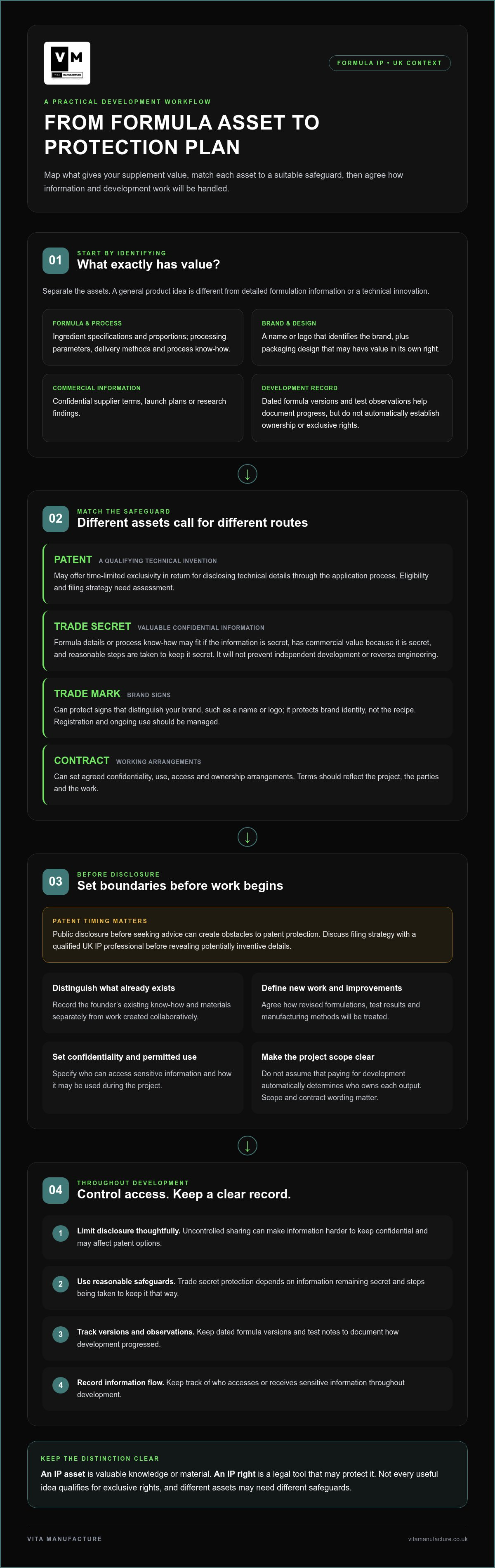
An IP asset is valuable knowledge or material; an IP right is a legal tool that may protect it. The distinction matters: not every useful idea qualifies for exclusive rights, and different assets may need different safeguards. The Intellectual Property Overview describes a broad range of rights, including patents, trade marks and trade secrets. The route that fits depends on your asset and circumstances.
Which parts of a supplement concept may have protectable value?
A general idea, such as a supplement aimed at supporting relaxation, differs from a detailed formula or technical innovation. Specific ingredient proportions, processing parameters, delivery methods and evidence of a technical effect may have commercial value. Whether a particular feature can receive legal protection depends on the evidence and applicable requirements, not simply on being distinctive to your brand.
Map the assets separately. The formula and ingredient specifications describe what goes into the product; process know-how covers how it is made. A name or logo identifies the brand, while packaging design may have value in its own right. Confidential commercial information can include supplier terms, launch plans or research findings. Dated formula versions and test observations help document how development progressed, but they don’t automatically establish ownership or grant exclusive rights.
What makes a formula vulnerable during development?
Uncontrolled sharing can make information harder to keep confidential. It may also affect patent options: public disclosure before seeking advice can create obstacles to obtaining patent protection. Discuss filing strategy with a qualified UK IP professional before revealing potentially inventive details. For trade secret protection, the UK framework focuses on whether information is secret, has commercial value because it is secret, and has been subject to reasonable steps to keep it secret.
Ownership can also depend on the project history and agreement. Know-how a founder brings to development may be distinct from work created collaboratively, such as a revised formulation, test results or a manufacturing method. Don’t assume that paying for development automatically determines who owns each output. The project scope and contract wording matter and should be reviewed for the specific project.
For example, imagine a founder shares a draft blend, preferred ingredient grades and early test notes with a development partner. During the project, the blend changes and new process guidance is recorded. The founder’s original information and the newly created materials may raise different ownership and confidentiality questions. This hypothetical example isn’t a legal outcome; it shows why clear records and agreed project boundaries matter before sensitive details are shared.
How to protect your supplement formula IP with patents, trade secrets and brand rights
There isn’t one protection route that suits every supplement business. A patent may be relevant to a technical invention, a trade secret strategy to confidential know-how, and a trade mark to your brand identity. Contracts can set expectations between collaborators. To decide how to protect your supplement formula IP, assess each asset and how you plan to develop, disclose and commercialise it.
When might a patent or trade secret be the better fit?
A patent can offer time-limited exclusivity for an invention that meets the relevant requirements, in return for disclosing technical details. Trade secrets may suit commercially valuable information that can realistically be kept confidential. Under the UK Trade Secrets (Enforcement, etc.) Regulations 2018, information must be secret, have commercial value because it is secret, and be subject to reasonable steps to keep it secret. A secret can potentially endure while those conditions continue, but it won’t stop independent development or reverse engineering.
Patentability depends on the full invention and applicable criteria, not simply on a novel-sounding blend or ingredient. The combination, technical effect, process or delivery approach may all form part of the assessment. Before public disclosure or deciding whether to file, seek advice from a qualified UK IP professional. A case-specific review can help weigh potential exclusivity against disclosure and confidentiality needs.
How do contracts and trade marks add another layer?
Written agreements can describe what information is confidential, how it may be used, who can access it and how project outputs are treated. They can distinguish your pre-existing materials from newly created work, such as revised formula versions or process records. The appropriate wording depends on the project and parties, so don’t assume a standard clause resolves every ownership question.
Keep brand protection separate from technical protection. Registering a name or logo as a UK trade mark may help distinguish your products, but it doesn’t give you rights in the formulation itself. Clear agreements and brand rights can complement a patent or trade secret approach, rather than replace it. For context on planning collaborative R&D, explore professional supplement formulation services. If you’re shaping a development brief, discuss your product development requirements as part of planning the project scope and information to share.
What to agree with a supplement development or manufacturing partner
Agree the project boundaries before sharing sensitive formulation details or starting development work. A clear written agreement gives both sides a shared reference point as the brief evolves. It can help prevent uncertainty about who may use information, what work is being created and how materials will be handled. It’s a practical foundation for collaboration, not an automatic guarantee of ownership or protection.
Separate background IP, which each party brings to the project, from project-created outputs. Your existing formula, ingredient specifications or process notes may differ from a partner’s pre-existing methods and know-how. New formula versions, test records, improvements and manufacturing instructions may raise separate questions. State how each category will be owned or licensed, and whether either party can use it beyond the project. Exclusivity and transfer terms are negotiable, project-specific provisions, not rights that arise automatically.
Which project terms should founders document?
Make the scope tangible. Name the materials and deliverables covered rather than relying on a broad phrase such as “product information”. For example, an agreement could identify formula versions, ingredient specifications, test records, samples, artwork or manufacturing instructions. It should also set out the permitted purpose for using confidential information and who may access it, including whether subcontractors can receive it and under what commitments.
Confidentiality and use: define the information covered, permitted activities and any limits on copying or onward disclosure.
Ownership and licences: distinguish supplied materials from new outputs, improvements and manufacturing know-how, and specify any agreed rights to use them.
Records and access: agree how project files, versions and access permissions will be maintained.
Changes and closure: address how scope changes are approved, what happens if the project ends, and whether confidential materials must be returned or securely disposed of.
These are planning points, not universal contract terms. Have a qualified UK solicitor review the wording and its application to your project, particularly where ownership, licensing or exclusivity could affect future production or scale-up.
How can you share information without oversharing?
Use staged disclosure. At an initial briefing, a partner may need the product objective, target format and broad ingredient direction, rather than exact proportions or the complete process. Share detailed specifications when they’re needed for an agreed development milestone and suitable confidentiality arrangements are in place. This keeps collaboration moving without circulating every sensitive detail at the outset.
Keep a simple disclosure log with the project records. Note what was shared, the date, recipient, version supplied and purpose or written permission for access. Restrict internal access to people who need the information, and record approved changes to recipients or use. These steps support confidentiality management, but don’t replace suitable agreements or legal review.
Taking these steps early makes how to protect your supplement formula IP part of project planning, rather than a question raised only after development is under way.
A practical IP protection checklist for supplement formula development
A useful IP plan should evolve alongside your product. Start before sharing details, then revisit your safeguards as the formula, process, suppliers or target markets change. This workflow turns how to protect your supplement formula IP into practical actions across development and scale-up.
Before sharing the formula
Map the assets. List the formula, ingredient specifications, process notes, brand materials and supporting records. Mark what is confidential, already public or supplied by another party, so you can handle each category appropriately.
Record the starting point. Keep dated copies of existing formula versions, development notes and relevant test materials. Note who contributed to each item and identify any third-party information or restrictions that may apply.
Agree the project boundaries. Set out the scope, confidentiality arrangements, permitted use and access expectations in writing. Clarify ownership questions for existing materials and work created during the project before disclosing sensitive details. Seek qualified UK legal advice on contract wording where appropriate.
During development and before scaling
Control versions and approvals. Maintain a clear record of formula changes, specifications, decisions, contributors and approvals. Distinguish the current approved version from earlier drafts, and record who has access to project files.
Reassess new developments. If development produces a potentially inventive technical feature, seek specialist UK patent advice before external disclosure. A change to the formula or process may alter the value of the information or the protection strategy; don’t assume an earlier decision still fits.
Review before operational changes. Before switching production arrangements, adding a supplier or expanding distribution, confirm in writing the relevant use rights, access arrangements and handover expectations. Check that records and agreed materials can support continuity without exposing information beyond the project’s needs.
Refresh the plan when circumstances change. A new target market, revised process or different supply chain may change which records need to be shared and with whom. Review confidentiality and ownership arrangements as part of the change, rather than treating IP planning as a one-off task.
“A clear record of who accessed or received information, and when, supports active confidentiality management.” Keep disclosure and access logs with version-controlled project records, including the purpose and any written permission. This makes it easier to understand how sensitive information has moved through development and production.
As your development plan takes shape, supplement formulation development can provide useful context for the technical stages, while UK supplement supply chain management can help frame operational considerations as production grows. For practical support moving from formulation planning towards manufacturing, explore Vita Manufacture’s product development support.
Protecting formula IP through Vita Manufacture’s product development process
IP planning can be part of product development from the first conversation, not a task to revisit only when manufacturing is about to begin. Vita Manufacture’s New Product Development service provides a practical setting to discuss your brief, project scope and development requirements alongside formulation, regulatory guidance and manufacturing support. A clear working plan connects technical decisions with your commercial objectives as the product progresses.
Build IP questions into the development brief
Before development starts, identify what you’re bringing into the project and what you want it to create. Your brief can distinguish confidential inputs, such as an existing formula or supplier specification, from information already in the public domain or materials provided by another party. Note any existing rights or commitments that could affect how those materials may be used.
Then describe the outputs you expect. These might include agreed formula versions, specifications, test records or process documentation. Recording the scope and decisions as they develop helps the parties maintain a shared understanding of the work and how it supports your product strategy. It also gives you a clearer basis for discussing changes to the brief or future production plans.
Keep the roles distinct. Formulation and manufacturing expertise can inform technical development and production planning; it doesn’t replace legal advice on ownership, confidentiality or licensing. Put project-specific arrangements in written agreements, reviewed with qualified UK legal advice where appropriate. Don’t assume that working with a development partner automatically transfers ownership of a formula or newly created materials.
Prepare for a scalable manufacturing relationship
As a product moves towards production, reliable records become valuable operational tools. Maintain the approved formula version, relevant specifications and agreed deliverables in an organised form, with a clear record of changes and approvals. That documentation can support continuity if production arrangements evolve, a supplier changes or the product is adapted for a new commercial requirement.
Vita Manufacture’s customer portal supports transparency during projects, helping keep project information accessible within the development relationship. It’s a collaboration feature, not a legal safeguard: ownership, permitted use and confidentiality still depend on the arrangements agreed for the specific project.
Vita Manufacture is ISO 22000:2018 certified. This is a food safety management system certification, not evidence of ownership over a client’s intellectual property or a guarantee of confidentiality. Keeping those points separate helps you assess quality systems and IP arrangements on their respective merits.
Thinking through how to protect your supplement formula IP early can make development discussions more focused and support a smoother path from formulation to manufacturing. If you’re ready to shape your brief and plan the next step, explore Vita Manufacture’s product development support.
Turn your IP plan into a confident next step
Your protection strategy should grow with your product. As development moves forward, treat each new decision as an opportunity to keep commercial goals, project records and agreed responsibilities aligned. That way, how to protect your supplement formula IP becomes part of building a product that can progress, rather than a separate concern to tackle later.
You don’t need every future decision settled before beginning. Start with a clear development brief, identify questions that need specialist legal advice and keep project discussions focused on the outcomes you want to achieve. A thoughtful first step can make collaboration more purposeful and support a stronger foundation for future growth.
Ready to shape your next stage of development? Explore Vita Manufacture’s product development support and consider how your brief can move towards a practical plan. Your formula’s future starts with deliberate decisions. Take the next step by discussing your product development requirements with Vita Manufacture.
Frequently Asked Questions
Can I share my supplement formula with a manufacturer before filing a patent?
Possibly, but consider whether patent protection may be relevant before disclosing technical details. Describing a product’s intended benefit without sharing exact ratios may reveal less than a complete technical dossier, yet even partial disclosure can matter depending on what it allows others to understand. If you’re considering a filing, seek UK patent advice before sharing. Don’t assume an NDA alone preserves every option, and keep a dated note of what you disclosed.
Does copyright protect a supplement formula?
Copyright may protect qualifying expression, but it doesn’t automatically give you control over the underlying recipe or concept. For example, the wording, layout or original illustrations in a formulation document may raise different questions from the ingredient combination it describes. Keep dated source files and identify who created each document, but don’t treat those records as proof of exclusive rights in the recipe. A UK solicitor can advise how copyright, contracts and confidentiality measures apply to your specific materials.
Can individual supplement ingredients be patented?
An ingredient’s presence in nature doesn’t, by itself, determine whether a particular invention involving it could qualify for a patent. The assessment may concern a specific technical use, formulation or process, considered against relevant requirements and existing disclosures. Simply combining familiar ingredients may not be enough to establish a patentable invention. Before revealing a proposed innovation, ask a qualified patent professional to assess the technical contribution and relevant prior art.
What counts as public disclosure of a supplement formula?
It depends on what information became accessible, who received it, when it happened and the circumstances of the disclosure. A presentation open to a broad audience, a public web page or a document circulated without confidentiality terms could raise different concerns from a restricted project discussion. If detailed formulation information has already been released, record the date, audience and material shared, preserve copies and seek specialist advice promptly about possible options in relevant jurisdictions.
Can I protect my supplement formula in more than one country?
Yes, but intellectual property rights are territorial, so protection in the UK doesn’t automatically provide the same rights elsewhere. Available filing routes and timing can depend on earlier applications and disclosures. A brand planning sales or production in multiple markets should identify those countries early, rather than assume one UK filing covers them all. A qualified IP professional can help plan an approach across priority markets and explain the relevant options.
Does a trademark protect the ingredients or recipe in my supplement?
No, a trade mark’s central purpose is to distinguish the commercial source of goods or services, not to give you ownership of a recipe. A qualifying brand name or logo may help customers recognise your product, while ingredient proportions and process details raise different protection questions. Keep brand records and technical formulation records distinct. If you’re deciding which rights to pursue, get advice on the particular assets and commercial uses you want to protect.
What should I do if a former partner still has my formula documents?
Preserve relevant agreements, messages, access logs and document versions first, and avoid deleting or changing potential evidence. Then review the written terms covering confidentiality, permitted use and what should happen to materials after the project ends. You can document what is still held and when access was last granted. Seek qualified UK legal advice before taking action, as possession alone doesn’t establish ownership or prove misuse, and the appropriate response depends on the circumstances.