FSA Novel Food Application for Supplements: 2026 Guide
What if a key regulatory decision needs to shape your supplement before formulation is complete? If you’re unsure whether an ingredient or combination is novel, understanding the FSA novel food application process for supplements early can help you avoid building a product plan around assumptions.
That uncertainty is understandable. Application evidence can be extensive, and it isn’t always obvious how to turn scientific information into a clear dossier. In Great Britain, foods without a significant history of consumption before 15 May 1997 may require authorisation before they can be placed on the market. Regulatory planning is therefore part of product development, not a final administrative step.
This guide explains the main application stages, the roles of the Food Standards Agency, Food Standards Scotland and ministers, and the evidence a supplement dossier may need. It also covers how to organise information on ingredients, manufacturing, composition, safety and history of use, and how to use those requirements to guide development decisions. Considering formulation expertise and regulatory guidance from the outset can help you make informed choices as your product moves towards assessment and manufacturing.
Table of Contents
What is a novel food, and when does a supplement need FSA authorisation?
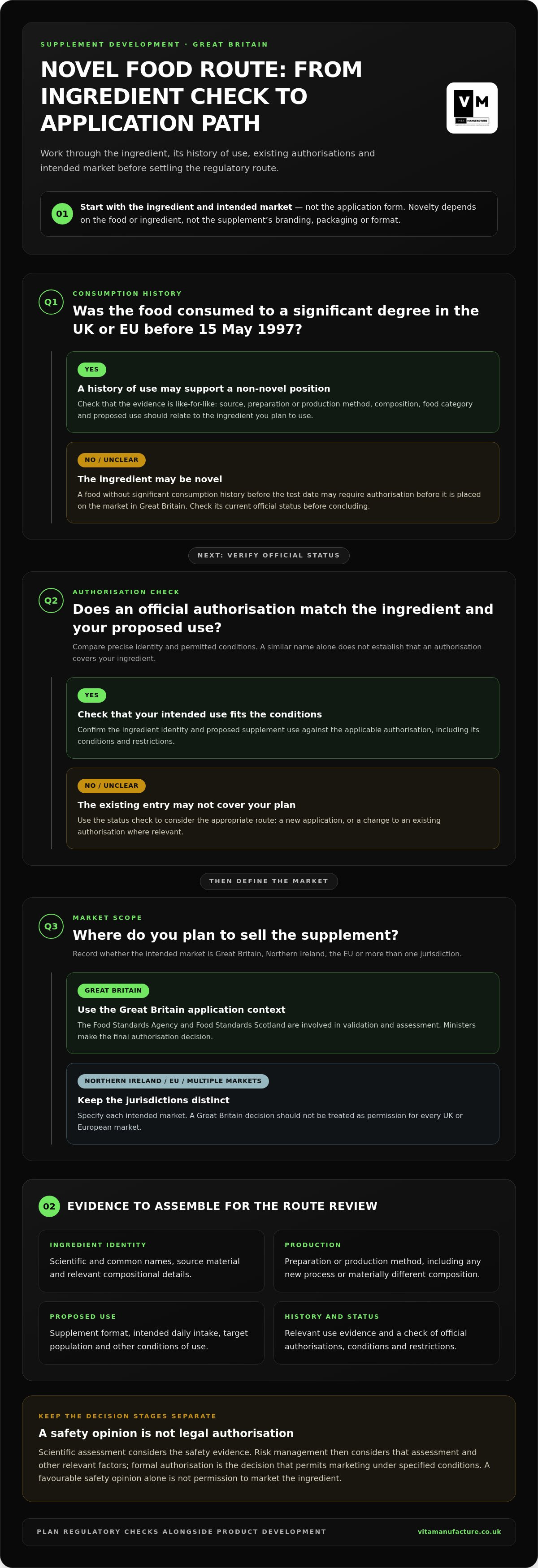
A supplement can contain a novel food even if the product concept itself isn’t new. Novelty is assessed at the level of the food or ingredient, not its branding, packaging or place in a product range. Under the assimilated Regulation (EU) 2015/2283, the relevant test in Great Britain is whether the food was consumed to a significant degree in the UK or EU before 15 May 1997. If it wasn’t, it may be novel and require authorisation before it can be placed on the market.
A new-to-market marketing idea doesn’t automatically make a familiar ingredient novel. Equally, presenting an ingredient as a capsule, powder or drink doesn’t resolve a novelty question. The supplement format alone doesn’t determine the ingredient’s regulatory status. For a general introduction to the concept and its development, see What is a Novel Food?. For a commercial decision, the applicable UK framework and current official status matter.
Which supplement ingredients may need a novelty assessment?
Consider novelty if an ingredient comes from a new source, is made using a new production process, or has a materially different composition from foods with an established history of use. The question is not simply whether something with a similar name has been eaten before. Evidence needs to relate to the ingredient’s identity and proposed conditions of use, including how it will be consumed. Check current official status before drawing conclusions about a particular ingredient.
Prior-use evidence is most useful when it allows a like-for-like comparison. Record the ingredient’s source, preparation or production method, composition, intended food category and proposed use. A history relating to a different extract, manufacturing process or level of consumption may not establish a history for the ingredient you plan to use. This early fact-finding can inform ingredient selection and formulation before development decisions become difficult to change.
Does an FSA safety opinion mean a supplement is authorised?
No. A scientific safety assessment and legal authorisation are separate steps. The assessment considers evidence about safety; risk management then considers that assessment and other relevant factors. In Great Britain, the FSA and Food Standards Scotland are involved in validation and assessment, while ministers make the final authorisation decision. A favourable safety opinion alone shouldn’t be treated as permission to market the ingredient.
A safety assessment evaluates the evidence; authorisation is the formal decision that permits a novel food to be marketed under specified conditions. Those conditions can shape permitted uses, so a brand must establish that its ingredient and intended supplement use fit the applicable authorisation. This distinction is central to the FSA novel food application process for supplements: assessment informs the decision but does not replace it.
Novel food status is only one part of compliance. Health claims raise a separate regulatory question, as do general food requirements. A novel food authorisation doesn’t, by itself, establish that every claim, label or other aspect of the finished supplement complies. Treat the ingredient assessment as one workstream in a broader development plan, bringing formulation and regulatory considerations together early.
How to establish the correct UK novel food application route
Start with the ingredient and intended market, not the application form. A short route-selection exercise can show whether you’re checking an existing authorisation, considering a change to one, or preparing a new application. It also helps prevent a Great Britain decision from being treated as permission for every UK or European market.
Identify the ingredient. Record its precise identity, source, composition and production process.
Check its status. Search official records for relevant authorisations, conditions and restrictions.
Define the proposed use. Set out the supplement format, intended daily intake, target population and other conditions of use.
Establish the market. Specify whether you plan to sell in Great Britain, Northern Ireland, the EU or more than one jurisdiction.
This sequence gives your regulatory review a clear starting point. The FSA’s FSA Novel Food Application Process guidance provides the current Great Britain application context. For wider product planning, the UK supplement regulations guide can help you consider the novelty question alongside other regulatory requirements.
Check ingredient identity, history and existing authorisations
Searches are only as reliable as the ingredient description behind them. Assemble the scientific and common names, source material, relevant compositional details and a concise account of how the ingredient is produced. Then compare those details with the identity and permitted conditions in any relevant authorisation entry. A similar name doesn’t prove that two ingredients are equivalent or that an authorisation covers your proposed use.
If an authorisation appears relevant, check its scope before deciding what happens next. A product that matches the authorised identity and conditions may follow a different path from one that changes the ingredient, proposed use or another authorised parameter. If the change falls outside the existing authorisation, investigate the applicable modification route rather than assuming the original permission extends to it.
Define the market and proposed supplement use
Write down who the supplement is for, how it will be taken, its intended daily intake and any other use conditions. These details help you compare the proposed product with an authorisation’s scope and identify where a variation in use may matter. Record the intended market alongside them, rather than leaving it until labelling decisions are made.
Great Britain uses the Regulated Products Application Service for novel food applications. Northern Ireland and the EU have distinct regulatory contexts, so don’t assume a Great Britain authorisation or route automatically settles market access elsewhere. Record each jurisdiction-specific conclusion and review it against current official guidance, particularly if you’re planning a multi-market launch. The FSA novel food application process for supplements should be mapped to both the ingredient and the destination market.
As formulation takes shape, aligning ingredient specifications and intended use with regulatory considerations can support better-informed development decisions. Vita Manufacture’s supplement development and manufacturing support brings formulation expertise and regulatory guidance into product planning. The applicant remains responsible for its regulatory obligations.
What evidence belongs in an FSA novel food dossier?
A dossier should tell one coherent story about the ingredient, how it is made and how people are expected to consume it. Evidence categories are a planning framework, not a guarantee that an application will be accepted or that every ingredient requires the same studies. The appropriate evidence package depends on the food’s characteristics and proposed use.
Evidence must describe the exact ingredient being assessed and its intended conditions of use, not just a related material or product category. This connects the technical evidence to the supplement you plan to develop. In the FSA novel food application process for supplements, gaps between the ingredient described in research, the manufactured material and the proposed use can make the safety case harder to interpret.
Ingredient identity, manufacture and specifications
Build a traceable description of the ingredient from source to finished raw material. Set out the source materials, production steps and any processing that could affect its identity or composition. Then organise the compositional data and specifications that define the ingredient, including the analytical methods used to measure key characteristics.
Make sure these records support one another. The manufacturing description should explain how the material covered by the specification is produced, while analytical results should show whether batches align with that description. Batch data can help clarify what the proposed food is and whether the evidence represents the ingredient intended for use. Keep formulation and manufacturing records aligned with the dossier description, and record changes so the documents remain consistent.
Identity and source: Capture precise naming, source materials and relevant composition details.
Manufacture: Describe the production process and steps that could influence the final material.
Specifications and analysis: Define critical quality characteristics and explain how they are measured.
Consistency: Organise batch data to show how the supplied ingredient relates to the stated specifications.
Safety, exposure and proposed conditions of use
Safety evidence may include toxicological information, nutritional information, allergenicity considerations and other data relevant to the ingredient. The dossier should also explain the proposed conditions of use, including the supplement format, anticipated daily intake and target population. Together, these details help assessors consider exposure in the context of the food and its intended consumers.
There isn’t a universal study checklist for every novel food. Organise the available evidence around the ingredient and its use, identify limitations clearly, and consider whether further evidence is needed to address the safety questions in the specific case. Include the history of use where relevant, making sure it relates to the ingredient and proposed conditions.
Keep safety evidence distinct from substantiation for nutrition or health claims. A safety dossier addresses whether the novel food can be used safely under specified conditions; it doesn’t, by itself, establish that a marketing claim is authorised or supported. Bringing formulation, manufacturing and regulatory considerations together during development can help keep the evidence aligned as the product evolves.
What happens after submission: FSA checks, assessment and authorisation
Submission starts a review process, not an automatic route to market. In Great Britain, a novel food application goes through administrative checks before scientific assessment. The FSA and Food Standards Scotland handle validation and assessment, with relevant expert committee input where applicable. The review considers the evidence and whether the proposed food can be used safely under the conditions set out in the application.
Timing can vary considerably, so avoid building a launch plan around a guaranteed decision date. The FSA’s published figures indicate that validation takes an average of 10 months, while scientific evaluation can range from six months to four and a half years. These are not deadlines for an individual application. Check the FSA’s novel food application guidance for process updates and current instructions.
Assessment, questions and public consultation
Scientific assessors may identify gaps or request clarification and additional evidence. Treat these requests as part of active dossier management: assign responsibility for each response, trace answers back to source records and keep submitted evidence consistent with the product being developed. Coordinating a complete response takes time, so allow for it in project planning.
Consultation may also form part of risk management, but it shouldn’t be assumed to follow the same pattern in every case. The route and circumstances matter. Scientific review produces advice about the evidence and safety; risk management considers that advice alongside other relevant factors. These are distinct stages, not interchangeable descriptions of one decision.
Decision, authorisation conditions and market readiness
A scientific assessment conclusion is not, by itself, permission to place a novel food on the market. In Great Britain, ministers make the final authorisation decision. Since 1 April 2025, authorisations take effect following a ministerial decision and are published in the register, rather than being made by statutory instrument. Once a decision is made, read the register entry and final authorisation carefully. Conditions may specify permitted food uses or other limits, and your product must fit within them.
Keep market preparation moving, but make it responsive to the outcome. Review the final conditions against your ingredient, formulation and proposed use before treating the product as ready for launch. Novel food authorisation is only one workstream: labelling, nutrition and health claims, and general food-law duties require separate consideration.
The FSA novel food application process for supplements calls for a plan that can adapt as assessment progresses. Vita Manufacture’s product development and manufacturing support can help align formulation and production planning with regulatory considerations. See Vita Manufacture’s supplement development and manufacturing support for information about the service.
Prepare your supplement development plan around novel food requirements
Make regulatory readiness part of the development plan from the start. Before finalising a formula or committing to launch assumptions, establish what the ingredient is, what evidence supports it, who controls that evidence and which markets the product is intended for. This won’t guarantee authorisation, but it can help you identify information gaps before they drive costly changes to the product plan.
Use this checklist to organise the first decisions:
Ingredient: Record its identity, source, composition, production process and current authorisation status.
Evidence ownership: Identify who holds the scientific, manufacturing and analytical records, and how your team can access them for regulatory work.
Intended use: Define the supplement format, proposed intake, target population and relevant use conditions.
Market scope: Specify whether the plan covers Great Britain, Northern Ireland, the EU or multiple markets, and track jurisdiction-specific requirements.
Development status: Note which decisions remain open and what evidence or regulatory advice is needed before they are fixed.
Build a regulatory workstream into product development
Set decision gates before approving the final formulation, packaging or launch plan. For example, review ingredient status and evidence readiness before fixing a dose or making packaging claims that depend on the intended use. As the project develops, keep supplier information, ingredient specifications, manufacturing details and formulation records aligned. If one changes, assess whether supporting documents and regulatory assumptions also need updating.
This is practical project control, not simply paperwork. Early regulatory review can inform ingredient selection and formulation choices while there is still room to adapt them. For more on how development work connects with formulation decisions, read Vita Manufacture’s supplement formulation and R&D services.
How Vita Manufacture supports supplement development
Vita Manufacture supports supplement new product development through formulation expertise, regulatory guidance and manufacturing. This can help teams organise product specifications and development records so the intended ingredient and finished product are described consistently. Its new product development work includes formulation expertise and regulatory compliance checks, while manufacturing knowledge can inform practical decisions about ingredient specifications and production.
Keep responsibilities clear. A manufacturer can contribute product development and manufacturing information, but it doesn’t replace the applicant’s legal or regulatory responsibilities. A safety opinion or manufacturing review doesn’t guarantee authorisation either. The applicant remains responsible for the application and for ensuring that the product placed on the market complies with applicable requirements.
If you’re shaping a supplement concept around a novel ingredient, plan formulation, regulatory considerations and manufacturing together from the outset.
Turn regulatory planning into your next development decision
Treat regulatory readiness as an active part of your product plan. Decide what needs resolving before formulation is fixed, who will coordinate the supporting evidence and how regulatory advice will inform commercial choices. This gives your team a clearer basis for moving forward without assuming that an assessment guarantees authorisation.
The FSA novel food application process for supplements can influence ingredient selection, specifications and development priorities. Vita Manufacture’s new product development support brings formulation expertise and regulatory compliance checks into the planning process, alongside ISO 22000:2018-certified manufacturing operations. The applicant retains responsibility for its regulatory obligations, while a development partner can help connect product decisions with manufacturing requirements.
Ready to plan your next steps? Discuss your supplement development plans with Vita Manufacture and build a product plan with regulatory considerations in view.
Frequently Asked Questions
Does every new supplement ingredient need an FSA novel food application?
Not necessarily. A new ingredient name or newly launched blend doesn’t, by itself, mean you need a new application. For the FSA novel food application process for supplements, check current official records against your specific raw material and intended use. Keep the supplier specification and source documents that support your classification decision together, so your team can revisit the rationale if the ingredient or formulation changes. Seek specialist regulatory advice if the evidence leaves its status uncertain.
Can a supplement brand use an ingredient that is already authorised as a novel food?
Potentially, provided the ingredient and proposed use fall within the authorisation’s scope and conditions. Compare the official entry with the supplier’s precise ingredient identity, specification, permitted food category, intake limits and restrictions. For example, a change in source or composition may affect whether the material matches the authorised food. Keep a copy of the record you relied on and note the date of your review, then verify the applicable position for each intended UK market.
Can I sell a supplement while its novel food application is being assessed?
Don’t assume that a pending application permits sale. Market access depends on the ingredient’s legal status, the relevant jurisdiction and any applicable transitional or enforcement arrangements. Before setting a launch date or accepting orders, check current official guidance for the specific ingredient and market, and obtain regulatory advice if the position is unclear. Keep promotional plans provisional too: an assessment timetable is not a reliable substitute for a decision on whether the product can be marketed.
Are novel food authorisation rules the same in Great Britain and Northern Ireland?
No. Don’t treat a Great Britain assessment as automatic permission to sell in Northern Ireland or the EU. First map the territories where the product will be supplied, then record which regulatory framework applies in each. Before approving labels, distribution plans or sales materials, review current official guidance for those markets. This market-by-market check is particularly useful if a launch plan changes, such as adding Northern Ireland after scoping a Great Britain launch.
Does a novel food authorisation allow a brand to make health claims?
No. Novel food authorisation and permission to use a nutrition or health claim are separate matters. A product may have an authorised novel food ingredient and still need an independent review of its claims across labels, websites and advertising. Before publishing promotional copy, create a claims list and assess each statement against the relevant rules. Don’t assume that wording describing the ingredient’s assessed properties is automatically an authorised claim for your finished supplement.
Can Vita Manufacture help develop a supplement containing a novel food ingredient?
Yes. Vita Manufacture supports supplement product development, formulation, regulatory guidance and manufacturing. This can help your team connect a product concept with practical formulation and manufacturing considerations while organising relevant development information. The applicant remains responsible for its regulatory obligations, and Vita Manufacture doesn’t replace the FSA or determine an application’s outcome. Bring a clear outline of the ingredient, intended product and target markets to a development discussion so the project can be planned around those decisions.