Benefits of ISO 22000 Certified Supplement Manufacturing: A 2026 Guide
What if an ISO 22000 certificate looks reassuring on paper but tells you little about the controls behind your supplement? The benefits of ISO 22000 certified supplement manufacturing depend on how a manufacturer’s food safety management system works in practice and whether the certified scope covers the work you need.
When choosing a manufacturing partner, it’s reasonable to look for evidence of safety controls, consistent production and traceability. Certification is not a guarantee of every product’s quality or a substitute for detailed questions. Check what the certificate covers and ask what evidence supports the manufacturer’s approach to supplier oversight and risk management.
This 2026 guide explains ISO 22000’s role in a manufacturer’s food safety system and how its risk-based, HACCP-informed framework can support structured oversight. You’ll learn what to request during supplier due diligence, which questions can help distinguish documented controls from marketing language, and how to assess whether a partner’s systems and services suit your product plans and future growth.
Table of Contents
What does ISO 22000 certification mean for supplement manufacturing?
How ISO 22000 controls can strengthen supplement manufacturing
ISO 22000 vs GMP and other assurances: what should you compare?
How to assess an ISO 22000 certified supplement manufacturer
Choosing an ISO 22000 certified partner for your supplement brand
What does ISO 22000 certification mean for supplement manufacturing?
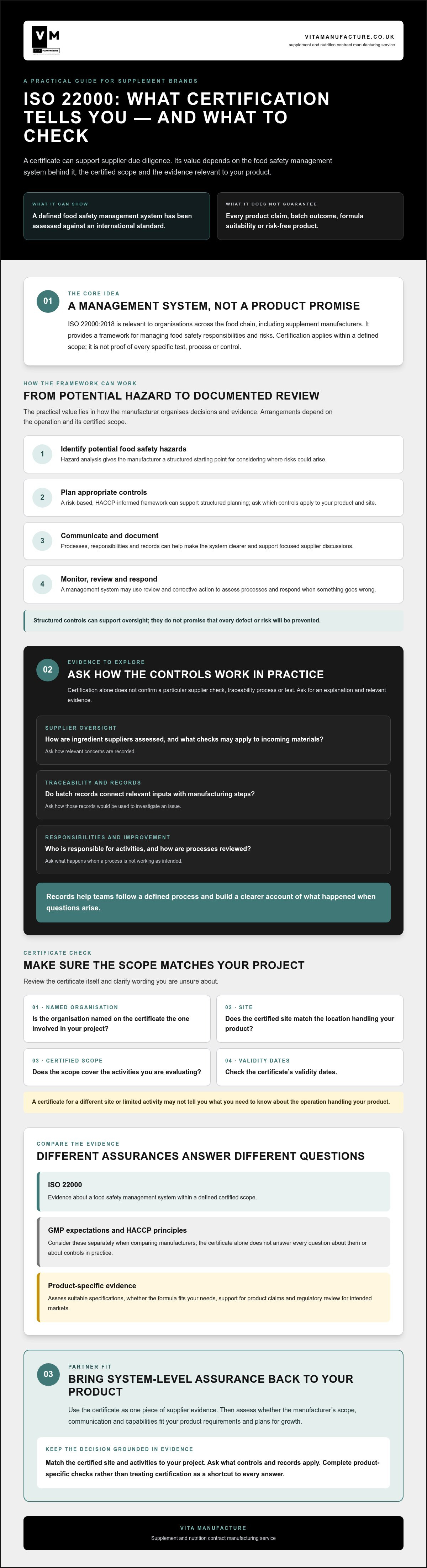
ISO 22000 certification is independent evidence that a defined food safety management system has been assessed against an international standard. The current edition, ISO 22000:2018, is relevant to organisations across the food chain, including supplement manufacturers. It sets a framework for managing food safety responsibilities and risks. It does not certify every product claim or promise a risk-free product. For an overview of the standard’s background and principles, see ISO 22000.
For a supplement brand, the practical value is a clearer basis for supplier discussions. A well-defined system can set out processes, responsibilities and records. This can help you ask focused questions about how the manufacturer identifies hazards, communicates relevant information and documents controls, rather than relying on broad quality claims. These are potential benefits of ISO 22000 certified supplement manufacturing, but the certificate is useful to your assessment only if its scope matches the work being considered.
What does the standard cover in a manufacturing context?
ISO 22000 takes a management-system approach. In accessible terms, it expects an organisation to consider where food safety hazards could arise, plan appropriate controls, communicate relevant information and keep its system under review. Arrangements vary according to the organisation and its activities. Certification should not be taken as proof of any particular test, process or control unless the manufacturer provides that evidence.
Check the certificate’s scope and named site. Does it cover the organisation and site involved in your project? Does its wording fit the manufacturing activities you’re evaluating? A certificate for a different site or a limited activity may not tell you what you need to know about the operation handling your product. Ask the manufacturer to clarify any terms you’re unsure about.
What certification does, and doesn’t, tell a brand
Certification provides evidence about a management system within a defined scope. It can support a more structured supplier conversation, but it does not establish that every formula is suitable, every batch will meet your requirements or every product claim is substantiated. Nor does it replace product-specific checks, suitable specifications or regulatory review for your intended markets.
As you develop a brand, treat the certificate as one piece of supplier evidence. Then assess whether the manufacturer’s scope, communication and capabilities fit your product and business needs. A useful discussion connects system-level assurance with the details of your project, rather than treating certification as a shortcut to every answer.
How ISO 22000 controls can strengthen supplement manufacturing
The practical value of a food safety management system lies in how it organises decisions and evidence, not in the certificate alone. ISO describes ISO 22000 as a food safety management system standard for organisations across the food chain. In supplement manufacturing, its framework can support risk-based planning, clear responsibilities and review. Controls depend on the operation and its certified scope, so ask the manufacturer what applies to your product and the site involved.
Risk management, supplier oversight and traceability
Hazard analysis gives a manufacturer a structured way to identify potential food safety risks and decide how to manage them. For a brand, it’s a useful starting point for supplier discussions. Ask how the manufacturer assesses ingredient suppliers, what checks may apply to incoming materials, and how relevant concerns are recorded. These are practical questions, not controls to assume from certification alone.
Records can help establish a product’s history. Ask whether batch documentation connects relevant inputs with manufacturing steps, and how the manufacturer would use those records to investigate an issue. Traceability depends on the records and processes in place, so request an explanation of the system rather than relying on a general assurance.
Records help teams follow a defined process and build a clearer account of what happened when questions arise.
Consistency, accountability and continual improvement
Documented procedures can clarify who is responsible for activities and how work should be carried out. A management system may also use monitoring, review and corrective action to assess whether processes are working as intended and respond when something goes wrong. This does not promise that every defect or risk will be prevented. It supports a structured response, learning from findings and consideration of whether processes need to change.
For your brand, this can make supplier conversations more specific. Instead of asking only whether a manufacturer is certified, explore how its documented responsibilities and review processes relate to your product, materials and production requirements. Confirm that the answers align with the certificate’s scope and the site involved.
Potential benefits of ISO 22000 certified supplement manufacturing include a more organised basis for oversight, clearer records and informed discussions with a manufacturing partner. Vita Manufacture states that it is ISO 22000:2018 certified and offers contract manufacturing. You can explore Vita Manufacture’s contract manufacturing and ask for current certificate details and information about the scope relevant to your project.
ISO 22000 vs GMP and other assurances: what should you compare?
These terms can all appear in a manufacturer’s quality information, but they describe different things. Compare what each assurance covers, the evidence behind it and how it relates to your product. The benefits of ISO 22000 certified supplement manufacturing are easier to assess when you distinguish system-level certification from operational practices and product-specific checks.
How ISO 22000 differs from GMP and HACCP
ISO 22000 sets out a management-system framework. HACCP is a hazard-analysis approach that can form part of food safety controls, while GMP refers more broadly to practices for managing manufacturing operations. They are related, but not interchangeable labels. Do not assume one automatically replaces another or covers every obligation relevant to your brand. Check current UK guidance for your product and business role before drawing conclusions about specific requirements.
What certification cannot replace
A manufacturer’s certificate does not, by itself, tell you whether an ingredient meets your specification, whether finished-product testing is appropriate or whether your label and claims have been reviewed for your intended markets. Ask for relevant product evidence and clarify who is responsible for each part of the project. Your responsibilities depend on your role and market, so treat supplier assurance as one part of due diligence.
Verify the certificate directly. Check the named organisation, site, certified scope, issuing body and validity dates, and ask about the audit arrangements. For broader context on evaluating a partner, read this UK supplement regulations guide.
How to assess an ISO 22000 certified supplement manufacturer
A certificate is a starting point, not the whole assessment. Use a clear sequence: confirm it is current, check that its scope covers the relevant site and activities, explore how the manufacturer manages processes connected to your product, then assess whether the partnership fits your commercial plans.
Questions to ask before appointing a manufacturer
Request a copy of the current certificate and verify the named organisation, site, certified scope and validity dates. If it isn’t clear whether the activities you need are included, ask the manufacturer to explain. Then check that its answers relate to your project rather than relying on a broad certification claim.
Use questions such as these to guide the discussion:
Which site and activities are covered by the current certification?
How are ingredient suppliers assessed, and what incoming-material checks may apply to the ingredients in our formula?
What production records are available to support traceability or an investigation, and how are issues and corrective actions handled?
How are changes to a formulation, packaging or product specification reviewed and communicated?
How are audit arrangements managed, and can you explain how they relate to the certificate and scope?
The answers should help you understand what evidence is available and how responsibilities are discussed. Don’t assume a particular testing, record-keeping or change-control system exists. Ask for details relevant to the work and agree what information you’ll need during the project.
Match certification evidence to your product and growth plans
Certification is only one part of manufacturing fit. Discuss your dosage form, ingredients, packaging requirements and target markets, then consider whether the manufacturer’s capabilities and communication suit your launch plans and potential future needs. Clarify what development support and regulatory guidance are available, and who will review product information as the project progresses.
Pay particular attention to the formulation handover. Ask how the manufacturer will receive and review your formula, specifications and any agreed changes. This is also a useful point to explore professional supplement formulation services and clarify how development information connects with manufacturing requirements.
The benefits of ISO 22000 certified supplement manufacturing matter most when the certificate’s scope, the manufacturer’s communication and your product requirements align. Use the checklist to identify unanswered questions before appointing a partner. You can review Vita Manufacture’s supplement manufacturing services as part of that assessment.
Choosing an ISO 22000 certified partner for your supplement brand
Certification can provide useful system-level assurance, but it can’t determine whether a manufacturer is right for your product or business. That judgement depends on the certificate’s current scope, the activities and site it covers, and whether the partner’s services match what you need. The benefits of ISO 22000 certified supplement manufacturing are most relevant when that evidence sits alongside a practical fit for your plans.
Vita Manufacture states that it is certified to ISO 22000:2018. Treat this as one part of your due diligence, not a guarantee of product safety, efficacy or a particular result. Request the current certificate and confirm its issuing body, validity dates, named organisation, site and certified scope directly.
When an end-to-end manufacturing partner may suit your plans
A coordinated service model may help simplify handovers between product development, manufacturing, regulatory guidance and logistics. This can be useful if you’re developing a product from an early brief and want to understand how development information will carry through to production. But not every brand needs every service, and a broader offer isn’t automatically the best fit.
Consider what stage you’re at. Do you need support developing a new formula, or are you considering a white label option? Will you need logistics support as well as manufacturing? Clarify what the manufacturer can provide, what sits outside its role and who will communicate with you at each stage. For downstream considerations, see this supplement supply chain management guide.
Turn certification into an informed next step
Make your initial discussion more productive by sharing the details that shape manufacturing fit. You might outline:
your product format and key ingredient requirements;
your target markets and current development stage;
the packaging and logistics support you may need; and
your anticipated plans for future product development or growth.
Then ask how the manufacturer’s certified scope relates to your project and what relevant processes or supporting information it can explain. Clear answers help you assess both certification evidence and service fit, without treating either as a promise of outcomes.
If you’re weighing up a new formulation, white label supplements or contract manufacturing, an initial discussion can help clarify which route may suit your brief. Learn about Vita Manufacture’s support for supplement projects and request the relevant certification details for your assessment.
Benefits of ISO 22000 certified supplement manufacturing in practice
The benefits of ISO 22000 certified supplement manufacturing start with a structured food safety management system, but the certificate is only one part of choosing a partner. Check its current scope, site and validity, then assess whether the manufacturer’s processes, communication and services fit your product and plans. Certification does not guarantee product outcomes, so include product-specific evidence and regulatory review in your due diligence.
Vita Manufacture states that it is certified to ISO 22000:2018. Confirm the current certificate details directly. Its stated support spans product development, manufacturing, regulatory guidance and logistics, with a transparent customer portal. Consider whether this coordinated approach suits your stage of development and the support you need.
Have a product brief in progress, or are you still shaping the idea? Discuss your supplement project with Vita Manufacture and request the relevant certification details for your assessment.
Frequently Asked Questions
What are the main benefits of ISO 22000 certified supplement manufacturing?
The main benefits are a structured approach to food safety management, clearer responsibilities and documented processes within the manufacturer’s certified scope. This can give your brand a stronger basis for supplier discussions about hazards, controls and records. The benefits of ISO 22000 certified supplement manufacturing depend on how relevant the system is to your product and site. Check the certificate and ask what evidence is available rather than relying on the certification label alone.
Does ISO 22000 certification guarantee that supplements are safe?
No. ISO 22000 certification assesses a food safety management system against a standard within a defined scope. It does not guarantee that every product is risk-free or that every batch will meet your requirements. Ask how the system applies to the site and activities involved, and request product-specific evidence relevant to your needs. Your assessment should also consider the formula, ingredient specifications and intended market, rather than treating certification as a substitute for due diligence.
Is ISO 22000 the same as GMP for supplement manufacturing?
No. ISO 22000 is a food safety management system standard, whereas GMP refers to good manufacturing practices and related operational expectations. HACCP principles focus on identifying and managing hazards and may inform food safety controls, but they are not another name for ISO certification. These concepts are related, not interchangeable. Ask which GMP framework or expectations a manufacturer means, what evidence supports its claims, and how each assurance applies to your product and target market.
What should I check on an ISO 22000 certificate?
Check the certificate’s named organisation, site, certified activities or scope, issuing certification body and validity dates. Make sure the scope appears relevant to the manufacturing work you’re considering, rather than assuming a certificate covers every service or location. If the wording is unclear, ask the manufacturer to explain it and provide supporting details. You can also contact the issuing certification body to confirm the certificate’s status and particulars.
Can a small supplement brand benefit from an ISO 22000 certified manufacturer?
Yes. A smaller brand can use certification as one useful part of supplier evaluation, regardless of its size. A documented management system may make discussions about food safety responsibilities and relevant records more structured. Establish whether the certified scope covers the site and work your product needs, then assess service fit, communication and product-specific evidence. Ask practical questions and choose support that matches your current stage and plans.
Does ISO 22000 certification cover supplement labelling and regulatory compliance?
Not by itself. ISO 22000 concerns a food safety management system, and certification should not be treated as approval of a supplement’s label, claims or compliance in every market. Ask separately who will review your product information and what regulatory guidance is included in the proposed arrangement. Your checks should reflect the product and countries where you plan to sell. Confirm responsibilities with the manufacturer and seek appropriate specialist advice where needed.
How can I verify that a supplement manufacturer’s ISO 22000 certification is current?
Request a copy of the current certificate, then check its validity dates, issuing body, named organisation, site and scope. Confirm that the scope relates to the activities required for your product. If you need assurance beyond the document, ask the manufacturer how to verify its status with the issuing certification body and contact that body directly where possible. Recheck the details during supplier due diligence, particularly if the site or project scope changes.