Avoiding Hidden Costs in Supplement Production: The Complete 2026 Buyer's Guide
The cheapest per-unit manufacturing quote invariably hides the highest downstream expenses. If you have ever wondered why an initial estimate differs so dramatically from your final invoice, you aren't alone. For ambitious wellness brands, mastering the discipline of avoiding hidden costs in supplement production isn't merely an administrative exercise; it is the foundational requirement for long-term commercial survival.
You already know how devastating it feels when unanticipated post-production charges, sudden analytical re-testing fees, and unbudgeted tooling modifications erode your carefully calculated margins. You deserve absolute financial predictability before allocating precious capital to inventory. In this guide, you will discover how to identify, audit, and eliminate unexpected manufacturing fees to protect your brand's profit margins from day one. We break down every variable component influencing your true landed unit costs, deliver an airtight contract due diligence framework, and demonstrate how aligning with a transparent UK contract manufacturer secures your strategic growth.
Table of Contents
The True Cost of Supplement Production: Beyond the Initial Quote
Headline unit pricing creates an alluring illusion of profitability. When evaluating manufacturing proposals, founders often mistake an ex-works or factory gate estimate for their actual cost of goods sold. True commercial viability requires looking far beyond the nominal per-capsule figure. Without a rigorous approach to avoiding hidden costs in supplement production, unforeseen post-production line items will quickly dismantle your financial forecasts.
Deconstructing Nominal Unit Pricing versus Landed Cost
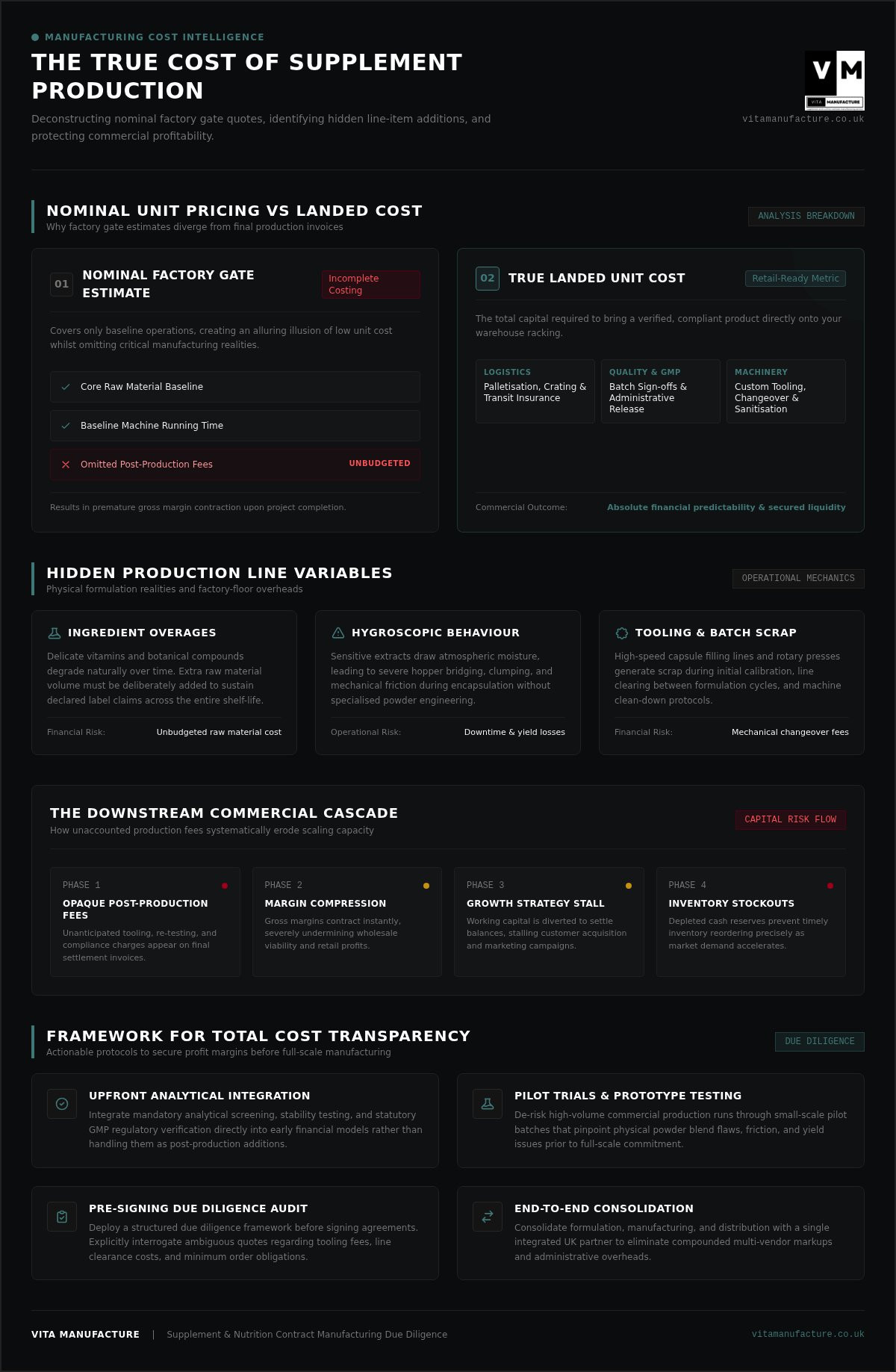
A nominal quote covers little more than baseline machinery operation and core raw materials. Landed unit cost, by contrast, represents the total capital invested to bring a retail-ready product directly onto your warehouse racking. Factory gate estimates regularly exclude vital operational line items, leaving brands vulnerable to unexpected settlement figures upon project completion.
These omitted expenses typically accumulate across several operational areas:
Ancillary logistics: Palletisation fees, specialised crating, transport surcharges, and transit insurance.
Quality documentation: Batch record sign-offs, administrative release charges, and audit compliance aligned with statutory Good Manufacturing Practices (GMP) standards.
Machinery preparation: Custom tooling adjustments, capsule changeover calibration, and equipment sanitisation between formulation cycles.
Artificially high minimum order quantities (MOQs) compound these issues. While volume commitments suppress headline unit rates on paper, they force excessive capital commitment into stagnant inventory and inflate physical storage overheads.
The Downstream Commercial Impact of Underbudgeting
What happens when these unaccounted fees finally surface? They extract capital directly from your bottom line. An unexpected post-production charge immediately narrows both wholesale margins and retail profitability. If your gross margin contracts prematurely, your customer acquisition strategy suffers an immediate blow.
Brand scaling demands disciplined, sustained investment. When working capital gets diverted to settle opaque manufacturing balances, customer acquisition budgets dry up and promotional campaigns stall. Depleted cash reserves prevent timely reordering, triggering catastrophic stockouts precisely as market momentum accelerates. Avoiding hidden costs in supplement production isn't just about managing supplier invoices; it's about safeguarding the operational liquidity required to scale your enterprise.
Hidden Production Line Expenses: Formulation, Ingredients, and Wastage
Factory floors present harsh commercial realities that clean spreadsheets fail to capture. Even after agreeing on a nominal unit price, production physics introduce variable expenses that frequently catch growing brands off guard. Truly avoiding hidden costs in supplement production requires a granular understanding of how botanical extracts behave, how machines operate, and how bulk procurement rules dictate your real manufacturing invoice.
Active Ingredient Overages and Formulation Complexities
Nutritional degradation happens naturally over time. To ensure that delicate vitamins and sensitive botanical compounds meet declared label claims through the entire stated shelf-life, formulations must incorporate deliberate ingredient overages. That extra raw material volume comes straight out of your margin if it wasn't factored into the initial quote. Hygroscopic extracts pose another physical challenge, drawing moisture from the atmosphere to cause clumping, hopper bridging, and severe line friction during encapsulation. Collaborating with expert supplement formulation services UK helps engineer stable powder blends that prevent compounding downtime and costly yield losses.
Machinery Tooling, Changeovers, and Batch Wastage
Every mechanical transition carries a measurable price tag. Preparing rotary tablet presses or high-speed capsule filling lines isn't an instantaneous task. Production runs routinely generate predictable scrap during initial calibration, line clearing, and final clean-down phases.
Keep these operational expenses on your balance sheet radar:
Line clearance protocols: Rigorous deep-cleaning and validation cycles mandated when transitioning between potent allergens or distinct natural flavour systems.
Custom tooling charges: Capital expenditure for proprietary tablet dies, bespoke punches, or debossing tools required for distinctive branding shapes.
Compounding yield loss: Scrap margins that accumulate across powder transfer systems, hopper residue, and capsule weight-sorting rejections.
Raw Material Sourcing Premiums and Minimum Buys
Branded, clinically validated actives command premium performance, but they also bring rigid minimum order quantities from ingredient suppliers. When your contract manufacturer purchases specialized actives, you may be compelled to pay for an entire raw material pack size, even if your specific batch run requires only a fraction of it. That surplus raw material often sits in holding, tying up working capital and nearing expiry dates before you ever schedule a second production cycle.
Sourcing ingredients through fragmented, multi-vendor broker channels inflates administrative handling fees and import duties. Partnering directly with an established provider offering consolidated contract manufacturing and bulk sourcing networks ensures transparent material allocations, helping your business secure sustainable wholesale economics without unexpected raw material balance liabilities.
Regulatory, Analytical, and Quality Assurance Blind Spots
Quality compliance is non-negotiable, yet it represents one of the largest financial blind spots in contract manufacturing. Many founders discover too late that standard production estimates rarely account for mandatory laboratory clearance protocols, batch release paperwork, and complex regulatory sign-offs. Successfully avoiding hidden costs in supplement production means treating analytical testing not as an optional afterthought, but as an essential line item built into your initial launch expenditure.
Mandatory Analytical Assays and Batch Release Testing
A Certificate of Analysis isn't merely an administrative formality; it is legal proof of safety and potency. Before any finished batch enters commerce, comprehensive analytical screening must verify active ingredient concentrations while screening for microbiological contamination, pesticide residues, and heavy metals such as lead, arsenic, cadmium, and mercury.
Who covers these laboratory fees? Opaque contracts leave brands liable for per-sample assay charges, re-testing protocols if initial homogenisation yields ambiguous reads, and independent laboratory audit fees. Partnering with certified health supplement manufacturers UK operating under ISO 22000:2018 standards ensures that strict quality checkpoints and batch documentation protocols are integrated seamlessly into production schedules, preventing ruinous commercial recalls before product leaves the facility.
Stability Studies and Shelf-Life Verification
Retail buyers and regulatory authorities demand empirical proof of product longevity. Simply assigning a two-year expiry date to your label without supporting data creates immediate legal vulnerability. Proving commercial stability requires two distinct testing frameworks:
Accelerated stability testing: Subjecting samples to elevated temperature and humidity chambers over three to six months to predict molecular breakdown.
Real-time ambient trials: Storing retain samples under standard commercial warehouse conditions, with mandatory testing intervals at scheduled yearly milestones.
These studies incur ongoing costs for environmental chamber storage, periodic laboratory testing, and sample retention governance that can quickly unbalance cash flow if left unbudgeted.
Packaging Governance, Labelling Reviews, and Legal Compliance
Packaging errors produce catastrophic balance sheet damage. The regulatory framework governing nutritional wording, allergen disclosures, and permitted health claims is fiercely enforced. If an unvetted formulation claim violates statutory labelling guidelines, your entire inventory run faces immediate quarantine.
Scrapping tens of thousands of pre-printed cartons, tamper-evident labels, and printed foils devours working capital. Resolving these discrepancies through emergency relabelling adds substantial manual handling surcharges and creates severe shipping delays. True mastery in avoiding hidden costs in supplement production requires in-house regulatory and graphic design review before initial proofs reach the printing press.
Evaluating Contract Manufacturer Quotes: A Due Diligence Checklist
Receiving multiple manufacturing proposals often feels like comparing completely different operational models. One facility presents an all-inclusive rate, whilst another unbundles every mechanical step to advertise an artificially deflated headline price. Developing a structured audit protocol is central to avoiding hidden costs in supplement production before contractual commitments bind your business.
Critical Line-Item Audit: Uncovering Buried Contract Fees
Scrutinise the line-item granularity of every prospective agreement. Transparent manufacturing quotations clearly distinguish which processes are covered within your per-unit pricing and which trigger separate invoicing. When reviewing proposals, audit these operational divisions carefully:
Conversion and finishing processes: Confirm whether raw powder blending, encapsulation or tableting, bottle filling, induction sealing, and automated labelling are bundled or billed as isolated workstation setups.
Quality and release governance: Verify whether batch record sign-offs, Certificate of Analysis documentation, and retain sample management incur secondary administrative fees.
Post-production storage thresholds: Clarify whether finished goods attract immediate pallet storage fees if distribution channels experience retail delivery delays.
Mastering these contractual distinctions represents a crucial phase in choosing a UK supplement manufacturer capable of supporting your scaling goals with genuine operational transparency.
Essential Questions to Ask Before Signing a Manufacturing Agreement
Never sign an ambiguous contract. Put prospective production partners to the test by demanding direct answers to these commercial questions before committing capital:
Who owns the intellectual property and master manufacturing records? Ensure you retain absolute ownership of custom formulas and technical compounding instructions should you ever decide to scale across facilities.
What exact yield variance is contractually guaranteed? Establish clear accountability thresholds defining who absorbs ingredient replenishment costs when finished yields drop below agreed production targets.
What protections exist if production delivery milestones are missed? Shield your retail relationships against unexpected factory delays that trigger out-of-stock retail penalties and lost revenue.
A rigorous due diligence process transforms quote appraisal from guesswork into an exact science. In the high-stakes wellness industry, avoiding hidden costs in supplement production protects your cash flow and builds enterprise value. To safeguard your next batch run with total line-item transparency, partner with Vita Manufacture for your contract manufacturing and secure predictable, scalable commercial production from day one.
Protecting Your Margins: The Value of End-to-End Partnership
Fragmented supply chains quietly drain capital. When you juggle separate formulation chemists, raw material brokers, encapsulation plants, testing labs, and distribution depots, every handoff introduces an additional contractor markup and potential point of failure. The most reliable shield against these compounding expenses is consolidating your operations under a single, integrated partner. Truly avoiding hidden costs in supplement production requires an operational infrastructure built on complete structural visibility.
Eliminating Supply Chain Fragmentation with Unified Production
Coordinating disconnected suppliers wastes both financial capital and leadership bandwidth. Every time materials transfer between unlinked vendors, you absorb intermediate freight bills, double-handling fees, and administrative friction. Streamlining your operations through consolidated supplement supply chain management UK removes third-party markups whilst unifying accountability under one roof. When a single entity manages your formulation, production run, and final dispatch, operational miscommunications vanish and unit costs stabilise.
De-Risking Commercial Scale Through Structured Pilot Studies
Committing capital to an unproven commercial batch invites substantial financial risk. Pilot studies and small-scale prototype runs provide an empirical safety net, allowing technical teams to test powder compaction, disintegration rates, and machine flowability on specialised machinery before full manufacturing begins. These trials verify essential physical characteristics:
Active ingredient cohesion: How potent botanical compounds interact with chosen excipients under real compression forces.
Packaging compatibility: Container seal integrity and hygroscopic powder behaviour over trial storage periods.
Mechanical throughput: Tablet hardness, friability, and capsule fill weight consistency prior to high-speed automation.
Identifying formula adjustments during pilot trials prevents disastrous factory re-runs and massive raw material scrap, making structured prototyping indispensable for avoiding hidden costs in supplement production.
The Vita Manufacture Advantage: Total Cost Transparency
Scaling an ambitious wellness brand requires a manufacturing ally that thinks like a business owner, not a transactional vendor. Operating within advanced facilities certified to ISO 22000:2018 standards, Vita Manufacture provides complete end-to-end capabilities spanning initial concept development through to warehousing and national distribution.
Clients gain full operational clarity through our dedicated customer portal, delivering real-time production tracking and line-item visibility across every phase. With in-house regulatory advisors and design specialists safeguarding packaging compliance, you eliminate the threat of unexpected billing adjustments. To scale your brand with complete financial predictability, Partner with Vita Manufacture to secure transparent supplement manufacturing and protect your hard-won margins.
Take Control of Your Supplement Manufacturing Economics
Sustainable commercial success doesn't happen by accident. It requires looking past flattering factory gate estimates to interrogate every variable line item, from stability testing protocols and custom tooling to scrap allowances. Master the discipline of avoiding hidden costs in supplement production, and you safeguard the liquidity required to invest aggressively in brand marketing and retail expansion.
You don't have to navigate fragmented supplier networks alone. Vita Manufacture delivers comprehensive end-to-end solutions spanning bespoke formulation, pilot trials, packaging, and national logistics under strict ISO 22000:2018 certified quality standards. Through our transparent digital client portal, you gain complete line-item clarity alongside real-time production tracking across every manufacturing milestone.
Protect your hard-earned profit margins from day one. Scale your supplement brand with transparent contract manufacturing at Vita Manufacture and turn supply chain certainty into your strongest commercial asset.
Frequently Asked Questions
What are the most common hidden costs in supplement manufacturing?
The most common hidden costs include third-party analytical assay fees, custom machinery tooling, stability storage, and packaging scrap. Facilities often exclude mandatory raw material overages, batch record release charges, and pallet transport from baseline quotations. When these operational charges emerge on your final settlement invoice, they erode planned commercial margins. Identifying these unbundled line items early is the cornerstone of avoiding hidden costs in supplement production.
Why do initial per-bottle supplement quotes often increase before final delivery?
Initial per-bottle quotes increase because factory gate estimates rarely incorporate the full spectrum of finishing, compliance, and distribution expenses. Base quotes frequently omit allergen line clearance, label application setup, secondary laboratory verification, and storage tariffs. If formulation adjustments or raw material price fluctuations occur during production, manufacturers pass those compounding losses directly to the brand. Working with an integrated partner offering all-inclusive pricing prevents these unpleasant budget variances.
How do ingredient overages affect total supplement production costs?
Ingredient overages directly increase raw material expenditure because manufacturers must add extra active compounds to satisfy label claims until product expiry. Sensitive vitamins and botanicals naturally degrade under ambient storage conditions. To compensate for this anticipated loss, technical formulators blend surplus active ingredients into each batch. If your contract manufacturer omits this surplus volume from the initial quote, your final ingredient invoice will reflect substantial, unbudgeted material charges.
Who is legally responsible for supplement testing and quality assurance fees?
Brand owners bear ultimate legal responsibility for regulatory compliance, product safety, and finished batch analytical validation. While contract facilities manage mechanical compounding, regulatory authorities hold the brand accountable for verifying microbiological purity, heavy metal limits, and declared potencies. Contract manufacturers routinely pass third-party laboratory assay fees and Certificate of Analysis generation costs directly to the brand owner. Always confirm whether routine batch release testing is bundled into your manufacturing rate.
Can pilot studies actually save my supplement brand money in the long run?
Yes, pilot studies save substantial capital by exposing physical formulation flaws before you commit to large-scale commercial production runs. Small-scale trials identify mechanical powder flow restrictions, tablet friability issues, and packaging seal failures on commercial machinery. Correcting these compounding challenges on pilot batches prevents catastrophic machine blockages, ruined bulk raw materials, and emergency product re-runs. Investing in structured prototype testing de-risks your balance sheet and ensures smooth full-scale manufacturing.
What should be included in a transparent contract manufacturing quotation?
A transparent quotation must detail every operational stage, from raw material procurement and active ingredient overages to testing and finished packaging. Look for comprehensive proposals that clearly itemise blending, encapsulation, bottling, induction sealing, and laboratory batch release documentation. Crucially, transparent agreements explicitly define yield scrap thresholds and transit palletisation fees. Ensuring every production variable is documented upfront is vital for avoiding hidden costs in supplement production and protecting net profitability.
How do minimum order quantities impact initial working capital requirements?
High minimum order quantities inflate working capital requirements by forcing brands to purchase excess inventory, packaging runs, and ingredient surplus. While high MOQs offer lower nominal unit costs, they lock substantial capital into physical stock that risks expiration before sale. They also trigger ongoing pallet warehousing charges. Aligning with an agile production partner that supports sensible initial batch sizes allows emerging wellness brands to preserve cash flow for active customer acquisition.