Ultra-Processed Foods: What Nutrition Brands Must Know
Is processing itself the problem, or has the debate turned a useful tool into a verdict on product quality? That’s the question behind “Ultra-Processed Foods: Is Processing Really the Problem? What Nutrition Brands Need to Know”. If conflicting headlines have left you unsure what the evidence shows, you’re not alone. Nutrition brands need to respond to consumer interest without reducing a complex scientific discussion to a simple “good” or “bad” label.
The NOVA classification can describe how foods are made, but it isn’t a definitive measure of nutritional quality. Research has found associations between higher consumption of ultra-processed foods and poorer health outcomes, while researchers continue to investigate the reasons behind those associations. Processing alone doesn’t tell the whole story.
This article explains what ultra-processing means, what the classification can and can’t tell you, and how to interpret the evidence carefully. It also offers a practical framework for considering product purpose, composition, usability and consumer expectations during development, so your decisions can be grounded in evidence and aligned with your brand’s goals.
Table of Contents
What are ultra-processed foods, and what does the label actually mean?
How processing changes a food: function, formulation and context
Is processing really the problem? How to read the evidence carefully
A practical framework for nutrition brands assessing product design
Turn the ultra-processed foods debate into a responsible brand strategy
What are ultra-processed foods, and what does the label actually mean?
Headlines often frame processing as a simple healthy-or-unhealthy divide. That makes for a clear soundbite, but it obscures the range of methods the term covers. Food processing includes cooking and freezing, as well as methods used to preserve ingredients, create a particular texture or make a product convenient to prepare. The method alone doesn’t tell you the nutritional value of the finished food.
The Ultra-processed food overview describes the term and the NOVA system, a framework that groups foods according to the nature and purpose of their processing. NOVA is useful for discussion and research, but it isn’t a nutrition score or a definitive measure of product quality.
How does the NOVA classification describe ultra-processed foods?
NOVA divides foods into four broad groups: unprocessed or minimally processed foods; processed culinary ingredients; processed foods; and ultra-processed foods. The first group includes foods such as fresh or frozen produce, while the second covers ingredients used in cooking, such as oils. Processed foods may combine foods and ingredients through methods such as baking or preserving. Group 4 generally refers to industrial formulations made with ingredients or additives less commonly used in home cooking.
These categories describe processing and formulation, not a uniform set of ingredients or nutritional characteristics. Two products in the same group can differ in composition, purpose and how they fit into someone’s diet. Treat the category as a starting point for better questions, not a complete product assessment.
Does processing automatically make a food unhealthy?
No. Processing can serve practical functions, including preservation, safety, consistency and convenience. Freezing vegetables, pasteurising milk and baking bread all involve processing, but the methods and finished products differ substantially. The relevant questions are what the process does and what the final product contains.
For nutrition brands, this distinction matters. A formulation choice may help deliver a particular product format or improve usability, but its purpose doesn’t establish the product’s nutritional profile. A product’s classification also can’t tell consumers, by itself, whether it meets their needs. Consider the ingredients, composition, intended use and role of the product together.
That’s the practical answer to Ultra-Processed Foods: Is Processing Really the Problem? What Nutrition Brands Need to Know: processing is one factor to examine, not a standalone verdict. Use NOVA to prompt closer analysis, then assess the finished product on its own merits.
How processing changes a food: function, formulation and context
A processing method has a job. It may help prepare an ingredient, create a consistent texture, support preservation or make a product easier to use. Knowing the method doesn’t tell you whether the finished product has a particular nutritional profile. That depends on the ingredients, their proportions and how the product is intended to be used.
A processing step explains what a product is designed to do; its nutritional profile describes what it contains. Keeping these questions separate helps brands assess product design without treating one method or classification as a complete judgement.
What roles can processing play in food production?
Methods such as heating, drying, mixing and fermentation serve different functions. Heating can cook ingredients or contribute to safety when the process is appropriately designed. Drying removes moisture and can help preserve some foods. Mixing distributes ingredients and supports a consistent result, while fermentation can develop characteristic flavours and textures.
No method is automatically beneficial or harmful in every context. Its effects depend on the material being processed, the conditions used and the product’s purpose. Teams should identify the intended function of each step, then consider whether the finished product meets its quality and usability goals.
Why do ingredients and formulation matter alongside processing?
Products can share a broad processing category yet differ in ingredients, proportions, texture and intended use. A category can’t replace a review of the full formulation. Consider the overall composition and how each choice contributes to the product, rather than drawing conclusions from a single ingredient or processing step.
For product teams, this means starting with a clear use case. Is the format designed to be easy to prepare, consistent from serving to serving or practical to store? Give each formulation decision a defined purpose, then assess the final product as a whole. Processing can affect food characteristics, so both the method and the finished composition deserve attention.
Consumer expectations are another part of the context. Harvard Health Publishing offers consumer-facing guidance on ways to reduce ultra-processed foods, illustrating why people may have questions about ingredients and processing. For nutrition brands, that interest is a reason to communicate precisely, not to make broad claims that a processing label alone can support.
This is the practical lens behind Ultra-Processed Foods: Is Processing Really the Problem? What Nutrition Brands Need to Know: understand what each method is for, examine the formulation and judge the finished product in context.
Is processing really the problem? How to read the evidence carefully
A link between higher ultra-processed food consumption and a health outcome doesn’t, by itself, prove that processing caused it. Processing may be one part of a wider picture involving dietary patterns, product composition, portion sizes and behaviours that can be difficult to separate in research.
For nutrition brands, the right response is neither to dismiss the findings nor to make processing the sole explanation. Ask what kind of study produced a result, what it measured and which other factors it could account for. That distinction is central to Ultra-Processed Foods: Is Processing Really the Problem? What Nutrition Brands Need to Know.
What can observational research show, and what can it not prove?
Observational studies can identify associations across populations and reveal patterns worth investigating. But people’s diets and circumstances vary. Factors such as overall dietary choices or other behaviours may influence both the foods people eat and the health outcomes measured. Researchers can adjust for known factors, but this doesn’t always isolate the independent effect of processing.
Controlled research can test specific changes under defined conditions, offering stronger evidence about whether an intervention affects measured outcomes. Its findings still depend on what was tested, for how long and which outcomes were assessed. No single study design answers every question. Before repeating a finding, check the original study’s scope and conclusions rather than relying on a headline or broad summary.
How can brands discuss uncertainty without dismissing the evidence?
Be precise about what is known, what is plausible and what remains unresolved. Acknowledge reported associations where the evidence supports them, but don’t present an association as proof of a single cause. Equally, uncertainty about mechanisms isn’t evidence that all processing is harmless.
For product teams, review the evidence relevant to the specific claim under consideration and make its limits clear in communications. Responsible language builds credibility: describe findings in proportion to their strength, distinguish evidence from interpretation and avoid turning a broad classification into a claim about an individual product.
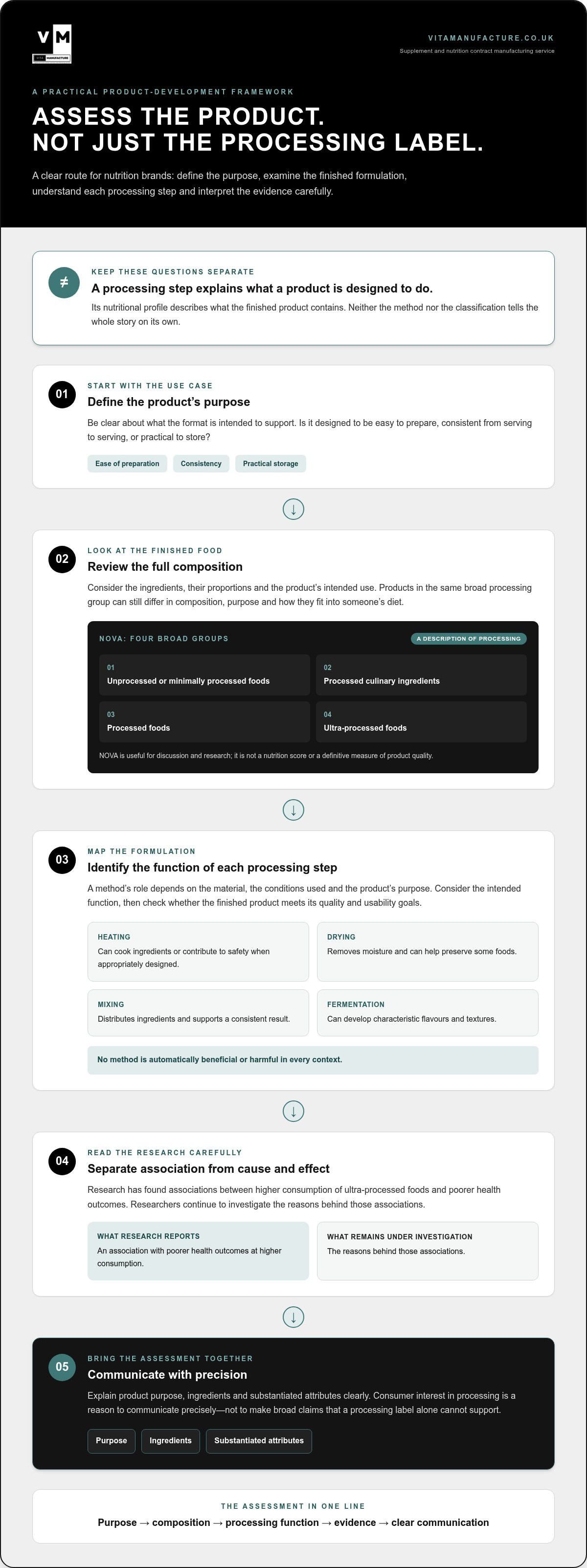
A practical framework for nutrition brands assessing product design
Turn the debate into a disciplined product review. Rather than beginning with a processing label or a demand for a shorter ingredient list, work through the product’s purpose, composition, processing functions and supporting evidence. This sequence helps your team distinguish a meaningful design decision from a response driven mainly by headlines or assumptions.
Which questions should a brand team ask during product review?
Start by defining who the product is for, what role it is intended to play and which practical characteristics it needs to deliver. For a supplement, those considerations might include format, ease of use and consistency. Then review the ingredients, overall composition and rationale for each manufacturing step together. Each formulation decision should have a clear purpose, such as supporting the product’s intended use, quality or usability.
Purpose: Who is the intended consumer, and what need is the product designed to address?
Composition: What does the full formulation contain, and how do its components contribute to the product?
Function: What role does each processing or manufacturing choice serve?
Evidence: What supports the team’s conclusions, and what remains uncertain?
Record evidence gaps as part of the review. If the team assumes an ingredient or process improves a product, distinguish that assumption from what can be substantiated. This makes product decisions and consumer communications more robust.
How can brands balance product function with consumer expectations?
Consumer interest in simpler formulations can be a useful prompt to review a product, but a short ingredient list isn’t proof of nutritional superiority. Nor does changing or removing an ingredient automatically preserve the product’s intended use or quality. Evaluate a proposed change against the product’s purpose, then consider its effects on composition, usability and consistency.
Distinguish a substantive formulation improvement from a surface-level signal. Decisions should be grounded in what the product needs to do, not simply how an ingredient list may look at first glance. For supplement projects, expert custom supplement formulation development can help teams consider intended use, formulation choices and consumer expectations as connected parts of product planning.
This measured approach is central to Ultra-Processed Foods: Is Processing Really the Problem? What Nutrition Brands Need to Know. Use it to guide decisions, document the rationale and ensure consumer-facing statements are accurate and supported. Vita Manufacture provides supplement development support spanning formulation and product development.
Turn the ultra-processed foods debate into a responsible brand strategy
Processing is one design consideration, not a standalone measure of product quality. For nutrition brands, a responsible strategy starts with the product’s purpose and composition, then considers how it is made and what the evidence supports. This gives teams a clearer basis for development decisions and more credible communication with consumers.
How should nutrition brands communicate about processing?
Be specific. Describe what a product is designed to do, identify its ingredients clearly and explain relevant manufacturing attributes accurately. Avoid broad statements such as “unprocessed means healthy” unless the wording is supported by appropriate evidence. A processing category alone cannot substantiate a claim about a product’s nutritional value or effects.
It’s also important to distinguish food-classification debates from the assessment of supplements. NOVA is a framework for classifying foods by processing, not a substitute for evaluating a supplement’s formulation, intended use or applicable requirements. Before making nutrition or health claims in the UK, verify that the proposed wording and evidence meet current requirements. Precision supports consumer understanding and helps brands avoid claims that go beyond what their product can support.
Where can structured supplement development support help?
For supplement brands, formulation, regulatory guidance and manufacturing planning need to work towards the same product objectives. A structured process can help teams consider the intended consumer, product format, ingredient choices and production requirements together. If you’re choosing a UK supplement manufacturer, consider how development decisions carry through from formulation to manufacturing planning.
Vita Manufacture is a UK-based contract manufacturer specialising in vitamins, minerals and dietary supplements, with support across new product development, formulation, regulatory guidance, manufacturing and logistics. The company is ISO 22000:2018-certified. This is a food safety management certification, not a guarantee of a supplement’s nutritional quality or health effects.
The central takeaway from Ultra-Processed Foods: Is Processing Really the Problem? What Nutrition Brands Need to Know is practical: assess the finished product in context, communicate only what you can substantiate and make design decisions that serve a clear purpose.
Make your next product decision with confidence
Processing isn’t a verdict on quality. The NOVA classification can describe how foods are processed, but it can’t replace a full assessment of composition, purpose and context. Research can identify associations, but brands should communicate findings in proportion to the evidence rather than present processing alone as a proven cause.
For supplement teams, the practical next step is to define what the product needs to do, review its formulation and manufacturing rationale, and ensure consumer-facing claims are accurate and supported. That measured approach is at the heart of Ultra-Processed Foods: Is Processing Really the Problem? What Nutrition Brands Need to Know.
Vita Manufacture supports supplement development from formulation and regulatory guidance through manufacturing and logistics. Its manufacturing is ISO 22000:2018-certified, providing a structured foundation for development, not a guarantee of a product’s health effects.
Ready to turn your product objectives into a development plan?Discuss your supplement product development goals with Vita Manufacture.
Frequently Asked Questions
Is all processed food ultra-processed?
No. Processing includes a wide range of methods, from cooking and freezing to industrial formulation. The NOVA classification groups foods according to the nature and purpose of processing, and only some processed foods fall into its ultra-processed category. The terms “processed” and “ultra-processed” aren’t interchangeable. For brands, NOVA can help describe a food, but it doesn’t provide a complete assessment of its ingredients or nutritional quality.
Does processing itself make food unhealthy?
No. Processing alone can’t establish a food’s nutritional quality or health effects. The method, ingredients, overall composition and intended use all matter. Research may find associations between dietary patterns and health outcomes, but an association doesn’t prove processing caused an outcome. That’s the central question in Ultra-Processed Foods: Is Processing Really the Problem? What Nutrition Brands Need to Know. Brands should assess evidence for each product and avoid sweeping claims.
Can food processing improve safety or shelf life?
Some processing methods can support safety, preservation, consistency or convenient preparation, depending on the method and product. Heating, for example, may be used in processes designed to address safety, while drying can help preserve certain foods. These effects aren’t universal. When describing a specific product, explain the process accurately and use relevant technical or scientific information to support claims about safety, quality or shelf life.
How are ultra-processed foods classified?
NOVA is a framework that groups foods according to the extent and purpose of processing. Its four groups range from unprocessed or minimally processed foods to ultra-processed formulations. Researchers and readers can use it to describe foods and dietary patterns, but it isn’t a nutrient score or a complete evaluation of an individual product. State which framework a source uses, and don’t treat a category as proof of a specific health effect.
What should nutrition brands consider when developing a product?
Start with the product’s intended purpose and audience, then review its ingredients, overall composition and the function of each processing choice. Consider how usability, quality and consumer expectations fit together. Don’t rely on one label or trend to make the decision. For supplements, assess the product category, formulation and relevant requirements in their own context rather than automatically applying food-classification frameworks as measures of supplement quality.
Can a brand call its product clean label or minimally processed?
Potentially, but the wording needs a clear meaning and evidence appropriate to the product and market. Consumers may interpret terms such as “clean label” differently, and broad language shouldn’t imply an unsupported health benefit. Define precisely what the claim means, review the product and its evidence, and verify current UK requirements before making nutrition or health claims in marketing. Clear, substantiated descriptions help consumers understand what the product offers.