How to create a unique supplement formula with suitable ingredients and doses
Creating a unique supplement formula means selecting ingredients, doses and a format that suit the product’s purpose and intended customers. Dose choices depend on the ingredient and relevant evidence, as well as factors such as age, sex and health status. A formula needs more than a popular blend: each ingredient and amount should have a clear rationale.
A distinctive concept also has to work in practice. This guide explains how to assess ingredients and doses, compare custom development with private- and white-label options, and consider taste, stability, UK labelling requirements and testing. The aim is to shape a formula that is appealing to customers and viable to develop and manufacture.
Table of Contents
Ingredient stability, dosage and taste constraints
Start with the product’s intended use, then assess whether its ingredients, doses and format work together. A structured development process can turn your brand vision into a practical product for consumers.
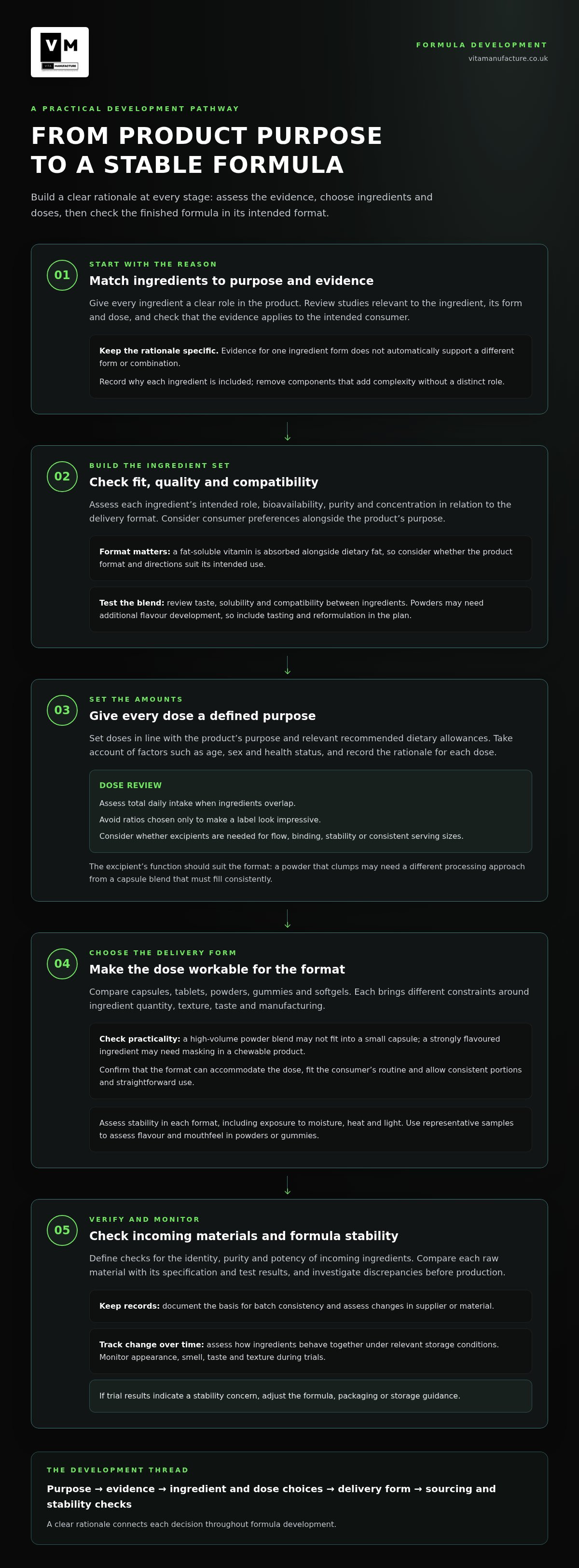
Review ingredient benefits and supporting studiesMatch each ingredient to a clear product purpose, then review studies relevant to that ingredient, form and dose. Check whether the evidence applies to your intended consumer instead of assuming findings for one group apply to everyone. For example, research on one ingredient form does not automatically support claims about a different form or combination.Record the evidence and rationale for including each ingredient. Remove components that add complexity without a distinct role: a crowded formula can make its intended purpose harder to explain.
Select ingredients for the formulaAssess each ingredient’s intended role, bioavailability, purity and concentration in relation to the delivery format. For instance, a fat-soluble vitamin is absorbed alongside dietary fat, so consider whether the product format and directions suit its intended use. Select ingredient forms that fit both the product’s purpose and consumer preferences.Review each ingredient’s taste, solubility and compatibility with the rest of the formula. Powders may need additional flavour development, so build tasting and reformulation into the development plan rather than leaving flavour until packaging.
Set ingredient ratios and dosageSet doses in line with the product’s purpose and relevant recommended dietary allowances, taking into account factors such as age, sex and health status. Record the rationale for each dose and assess total daily intake when ingredients overlap. Avoid choosing ratios just to make a label look impressive: every amount should serve a defined purpose.Determine whether excipients are needed to support flow, binding, stability or consistent serving sizes. Their function should suit the format. For example, a powder that clumps may need a different processing approach from a capsule blend that must fill consistently.
Choose suitable dosage formsChoose a format that can accommodate the dose and fit the consumer’s routine. Capsules, tablets, powders, gummies and softgels each bring different constraints around ingredient quantity, texture, taste and manufacturing. A high-volume powder blend may not fit into a small capsule, while a strongly flavoured ingredient may need masking in a chewable product.Compare how stable the formula is in each format, including its exposure to moisture, heat and light. Confirm the format allows consistent portions and straightforward use. Assess the flavour and mouthfeel of powders or gummies using representative samples.
Check ingredient sourcing and stabilityBefore formulation trials, define checks for the identity, purity and potency of incoming ingredients. Compare each raw material with its specification and test results, investigating discrepancies before production. Keep records so there is a documented basis for batch consistency and changes in supplier or material can be assessed.Assess how the chosen ingredients behave together over time and under relevant storage conditions. Track changes in appearance, smell, taste and texture during trials, then adjust the formula, packaging or storage guidance if the results indicate a stability concern.
Custom formulation versus private-label and white-label supplements
Choose a development route by weighing how closely the formula needs to match your target customer against launch speed and differentiation. Assess ingredient interactions using relevant evidence and consider intended users’ medicines, allergies and health status. When selecting a UK contract manufacturer, evaluate relevant production capabilities, testing, material controls, capacity and the support offered across development and supply.
Define the target customer and product positionDescribe your target customer, their nutritional priorities and the role the product should fill. A product for people seeking a simple daily routine, for example, needs a different position from a specialist blend with several ingredients. Define the intended purpose, preferred format and price positioning for your business planning, then use these criteria to guide formulation decisions.Check how the product’s purpose differs from existing items in your range. A clear position helps you decide whether a custom supplement adds meaningful value or a ready-made formula meets the same need.
Compare custom and ready-made optionsChoose custom formulation when you want a product developed around your brand goals, ingredient choices or a specific combination. Private label generally involves selling a ready-made formula under your branding, while white label typically refers to a ready-to-sell product that multiple brands can use. The terms can overlap, so compare the actual formula and level of customisation offered.Private- and white-label routes may support a quicker market entry and require less upfront development than a custom project. Custom development calls for more initial work but can offer greater differentiation. Before deciding, compare how much can be changed, including ingredients, doses and format.
Check ingredient safety and interactionsReview each ingredient’s identity, form and intended dose, then assess available safety information for interactions and contraindications. Consider the intended consumer’s medicines, allergies, age and health status, as these can affect suitability. Assess combinations as well as individual ingredients: components with separate evidence still need careful review when used together.Document why each ingredient is included and note relevant cautions. Don’t rely solely on a supplier’s description: compare specifications with supporting evidence and remove components whose risks or interactions conflict with the product’s intended use.
Create compatible custom blendsBuild the blend around ingredients with complementary roles, compatible forms and workable serving sizes. Combining ingredients with related purposes may create a clearer product proposition than adding components just to lengthen the list. Assess taste, solubility and stability together, since one ingredient can affect the finished blend’s flavour or texture.Record the purpose of each component and test the proposed blend as a whole. Look for duplicated ingredients, conflicting directions and practical manufacturing constraints. This review helps keep the nutritional rationale coherent while supporting consistent production and a credible brand position.
Once you’ve defined the formula brief, compare UK manufacturing capabilities against its ingredients, format and testing needs. Custom supplement development can help translate a product concept into a workable formulation.
Supplement label claims and regulatory requirements
Plan the label and packaging alongside the formula, rather than waiting until production is under way. Reviewing ingredients, claims and intended use early helps prepare your supplement brand for launch.
Set out the information consumers need. Draft the ingredient list, nutritional information, directions and relevant warnings, then check every detail against the finished formula. If the serving size changes, for example, update it everywhere it appears on the label. Keep the wording clear and consistent across the pack.
Review every proposed claim against the evidence and the product’s intended purpose. Distinguish factual descriptions, such as naming an ingredient, from statements that suggest a health benefit. Do not imply that an ingredient or supplement can diagnose, treat, cure or prevent disease. Claims should be accurate, supportable and consistent across packaging and other product communications.
Assess the requirements for the specific product and sales market before approving artwork. Ingredient type, product category, intended use and claims can affect which rules apply. For a UK launch, identify the applicable requirements and document how the formula, label and presentation meet them. Review any notification or registration requirements separately; not every supplement follows the same route.
Check ingredient disclosures and serving information against the formula specification. Confirm that ingredient names are recognisable, amounts match the stated serving and directions are consistent. Include warnings where the ingredients or intended use make them necessary. Before approval, compare the artwork with the formula to ensure edits to one document have not left another out of date.
Choose packaging that helps protect the contents from contamination, moisture and light. Match the pack to the product’s format and storage needs, and make sure the label remains readable on the container. A compact bottle, for example, may have limited label space, so prioritise legible ingredient and dosage information rather than shrinking the text excessively. Review the complete pack before approving production.
Keep a controlled record of the label review. Store approved artwork with the formula version, ingredient details, claim evidence and relevant regulatory decisions. If an ingredient, dose or claim changes, repeat the relevant checks before updating the packaging. A traceable record helps maintain consistency between the product made and the product described to consumers.
Stability, purity and efficacy testing
Key risks include incorrect ingredient identity or potency, contamination, instability and issues that emerge during scale-up. Common mistakes include skipping pilot work, relying only on raw-material checks and treating positive customer feedback as proof of a health benefit.
Check incoming ingredients before blending. Verify each material’s identity, purity and potency against its specification, and retain the results with its batch record. An identity check, for example, can distinguish the specified botanical from a visually similar ingredient. Investigate discrepancies before production instead of allowing uncertain materials into the formula.
Assess the finished product as well as its ingredients. Test whether potency matches the label claim, and assess impurities, microbial limits and heavy metals. Where appropriate, use a qualified independent laboratory for third-party testing and link its reports to the relevant product batch. These checks can reveal issues that ingredient certificates alone may not show.
Run a pilot batch before planning full-scale production. Use it to assess blending, filling and packaging, then monitor the batch during production. For capsules, check whether the blend fills consistently and the finished units remain intact. Record deviations and corrective actions so future runs can draw on specific findings rather than assumptions.
Assess stability over time and under relevant storage conditions. Use pilot samples to see how heat, humidity and time affect appearance, texture, smell and potency. A powder that clumps or a capsule that changes appearance can signal a practical issue even before testing detects a change in potency. Use the findings to refine the formula, packaging or storage instructions.
Keep evidence of a health benefit separate from product quality testing. Finished-product tests can verify potency and screen for contaminants, but they do not by themselves demonstrate a health benefit. Review studies relevant to the ingredients, forms and doses, and ensure the formula reflects the evidence. Keep claims within what that evidence supports.
Test the market before committing to extensive custom packaging or a large promotional campaign. Use simple packaging to gather structured feedback on taste, format, directions and consumer preferences. Set aside marketing budget for defined activities, such as sample feedback and concept testing, then use the findings to refine the launch plan. Customer interest can inform commercial decisions, but it does not replace safety, stability or evidence assessment.
Formula development and dosage selection
Creating a unique supplement formula starts with a clear purpose, evidence-based ingredient choices and suitable doses, followed by refinement and testing. Initial formula development is estimated to take about 4 weeks; the wider timeline depends on formulation decisions and later production stages.
Write a focused product brief before discussing ingredients with a manufacturer. Specify the intended consumer, product purpose, preferred format and key point of difference. A daily powder for a defined nutrition goal, for example, needs a different brief from a capsule designed for convenience. A focused brief keeps ingredient choices connected to consumer needs and commercial priorities.
Turn the product purpose into specific formulation objectives. List the intended benefits, essential ingredients, format constraints and sensory requirements, such as a neutral-tasting powder. Separate essential features from preferences. This makes trade-offs visible early, particularly when an ingredient’s serving size affects the amount of powder or number of capsules needed.
Assess potential ingredients against the evidence, form, purity, concentration and bioavailability. Compare each form with those used in relevant studies, then record why it belongs in the formula. An ingredient name alone is not enough: its form, dose and intended consumer all affect whether research supports your formulation choice.
Set draft doses in line with the product’s purpose and relevant recommended dietary allowances, considering the intended consumer’s age, sex and health status. Review combined daily intake when ingredients overlap across servings or products. Document each proposed amount and its rationale to create a traceable basis for reviewing formulation decisions and label information.
Check that the ingredients suit the intended format. A powder needs to mix and taste acceptable, while a capsule has physical limits on how much blend it can hold. Use excipients only for a clear function, such as supporting flow or binding. Adjust the serving size or format if the draft formula is impractical to use.
When creating a unique supplement formula, ask the manufacturer to review the draft for compatibility and production feasibility. Discuss material specifications, blend uniformity, processing needs and ingredient behaviour. A formula that looks sound on paper may need adjustments for taste, texture or manufacturability. Record each proposed change, its rationale and its effect on the product brief.
Move from the draft to a prototype, then refine it using documented feedback and testing. Compare the sample with the original objectives, including intended dose, format, taste and practical use. Allow for reformulation if a sample misses a key requirement. Finalise the specification when the formula and product brief align, creating a clear basis for the next development stage.
Develop your supplement formula through a structured product development process.
Vita Manufacture: New Product Development
Vita Manufacture’s New Product Development helps turn a defined supplement concept into a product brief and formulation aligned with your brand goals. It’s a natural next step if you’ve identified your target customer, ingredient direction and preferred format but need support moving towards production. Discuss formulation alongside launch considerations such as regulatory guidance and manufacturing. If you want an existing formula under your branding, Private Label Supplements may be a better fit; Contract Manufacturing supports production of a developed product. The right route depends on how much of the formula you want to customise and where you are in development.
To discuss your supplement concept, contact Vita Manufacture.
Turn your concept into a confident next step
Turn your ambition into a decision-ready brief. Define what the product should mean to your brand, what you want customers to experience and which trade-offs you are prepared to make. This gives development discussions a clear starting point and helps align commercial decisions with your vision.
Creating a unique supplement formula is a strategic decision about the product your business wants to bring to market. Vita Manufacture offers New Product Development for brands shaping a concept, Contract Manufacturing for production and Private Label Supplements when a ready-made route better suits the plan. Consider which pathway fits your goals and how much ownership you want over the formula.
Before taking the next step, bring together your product brief, intended market, preferred format and key questions. A focused conversation can then centre on the decisions that matter to your project. Contact Vita Manufacture to discuss your supplement plans and move your idea forward with purpose.
Frequently Asked Questions
Which active ingredients and evidence-based dosages should a supplement formula include?
Choose ingredients and doses that fit the product’s purpose, intended consumer and supporting evidence: there is no single formula for every audience. Compare studies with the ingredient form and dose you’re considering, noting the population studied and outcome measured. Evidence for one extract, for example, should not automatically justify a different extract. Document why each active ingredient belongs in your formula.
What UK regulations apply to supplement ingredients, labels and health claims?
UK supplements must meet applicable food-safety, ingredient, labelling and nutrition-and-health-claims requirements. Review the product as a whole: its ingredients, serving directions, warnings, presentation and promotional wording all shape how consumers understand it. Never describe a supplement as treating, preventing or curing disease. Keep the rationale and evidence for each claim with the label version it supports, so product information and marketing stay aligned.
When does a supplement formula need to be registered or notified in the UK?
There is no single notification route for every supplement formula. Requirements depend on factors such as product category, ingredients and intended market, so establish the applicable steps before launch. Create a product file covering the formulation, ingredient specifications, label and responsible business, and record relevant notification or registration steps. Reassess the route if you change an ingredient or reposition the product.
How can I protect a supplement formula and check ingredient or product claims?
Set out ownership and permitted use of the formula in written agreements with development and manufacturing partners, and control access to detailed specifications. Consider a confidentiality agreement before sharing the full formulation. For claims, retain evidence matched to the exact ingredient form, dose and intended product, then compare proposed wording with applicable UK requirements. Keep dated versions of the formula, supporting records and approved marketing so changes can be traced.