How allergen-free supplement manufacturing controls excipients
An allergen-free formula is only as dependable as its excipients and production controls. Allergen-free supplement manufacturing means assessing every ingredient, including fillers and binders, as well as supplier risks, shared equipment, cleaning and labelling. For UK food manufacturers, the Food Standards Agency identifies 14 allergens that must be managed.
When developing an excipient-free supplement, it’s understandable to focus first on the active ingredients. But less visible parts of the formula and potential cross-contact during production matter too. Any label claim must reflect the complete formulation and manufacturing process, not just the ingredient list.
This article explains how excipients can introduce allergen risks, how supplier and production controls can help manage them, and how cleaning validation and suitable testing support allergen claims. It also distinguishes an excipient-free formulation from a product designed to avoid a specific allergen, and outlines the UK labelling considerations that inform the decision.
Table of Contents
ATP testing and allergen swabs to validate cleaning
Cleaning evidence helps show whether a production process is controlled, rather than relying on equipment that simply looks clean. ATP testing and allergen-specific swabs answer different questions, so interpret results alongside the cleaning procedure and the next product’s allergen profile.
Cleaning validation methods
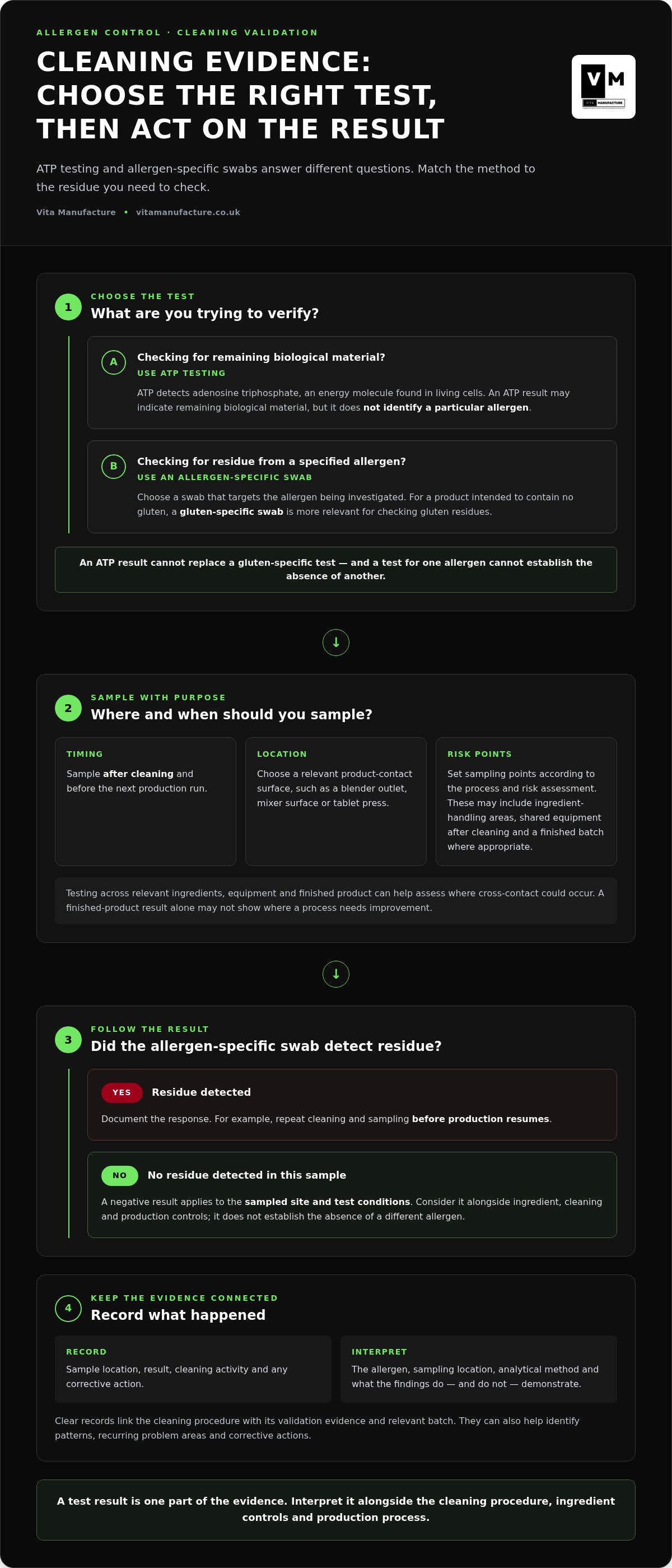
ATP testing detects adenosine triphosphate, an energy molecule found in living cells. Allergen swabs, by contrast, target residues from a specified allergen. ATP results may indicate remaining biological material, but they don’t identify a particular allergen. For a product intended to contain no gluten, for example, a gluten-specific swab is more relevant for checking gluten residues.
A useful validation process links the cleaning method to a sampling point. After cleaning, a trained operator can swab a product-contact surface, such as a blender outlet or tablet press, before the next production run. Record the location, result, cleaning activity and any corrective action. Validated cleaning protocols and allergen swab testing between production runs help assess whether residues remain.
Testing across manufacturing stages
Testing across manufacturing stages means assessing relevant ingredients, equipment and finished product at points where cross-contact could occur. A clean result from the finished product alone may not show where a process needs improvement. For example, testing a swab from a mixer surface after cleaning can help assess the equipment before a new batch enters production.
Set sampling points according to the process and risk assessment. These may include incoming ingredient-handling areas, shared equipment after cleaning and a finished batch where testing is appropriate. Match each test to the allergen being investigated. An ATP result cannot replace a gluten-specific test, and a test for one allergen cannot establish the absence of another.
Interpret results in light of the test method’s purpose and limits. A positive allergen swab calls for a documented response, such as repeating cleaning and sampling before production resumes. A negative result applies to the sampled site and test conditions, so consider it alongside ingredient, cleaning and production controls. Record results to help identify patterns, recurring problem areas and corrective actions.
For UK food businesses, testing records support a transparent account of how cleaning controls work. EU Regulation (EC) No 178/2002 sets out general food law requirements, including food safety requirements, according to the European Union. The regulation’s identifier is 178/2002. Clear records can connect a cleaning procedure with its validation evidence and the relevant batch.
Supplement testing and verification should be proportionate to the claim and process risk. A manufacturer can record the allergen, sample location, analytical method and result, then explain what the findings do and do not demonstrate. This gives product teams a sound basis for reviewing a proposed claim instead of relying on a general statement that the production area is clean.
Ingredient sourcing and manufacturing quality controls
Allergen control starts with ingredient identity and continues through handling, production and record-keeping. A documented process connects food-safety decisions to each supplement batch.
Ingredient sourcing and manufacturer choice
Ingredient sourcing and manufacturer selection require assessing allergen risks from raw materials through to finished-product handling. An excipient or supplier process can introduce food allergens beyond those present in the active ingredients.
Review ingredient specifications, allergen declarations and supplier change controls for every component, including coatings, flavours, capsules and processing aids. A formula may avoid a particular allergen in its active ingredients but still encounter it in a shared ingredient-handling area. Your contract manufacturer should explain how its allergen assessment informs sourcing, storage and production decisions.
Allergen-free, gluten-free, vegan and organic are not interchangeable claims: each describes a different product attribute or production requirement. A gluten-free claim has a defined UK and EU threshold, while allergen-free claims require rigorous assessment of ingredients, processes and the production environment.
Preventive controls and HACCP
Preventive controls and HACCP allergen hazard controls identify where food allergens could enter a product and how the risks are managed. Prevention relies on defined responsibilities and documented checks, not just a test of the finished product.
A HACCP plan should identify allergen hazards that require avoidance, removal or mitigation. Assign responsibility for updating records, schedule regular checks at critical control points and retain the results. For example, a change in ingredient supplier should prompt a review of the hazard assessment and relevant handling controls.
The US Food Safety Modernization Act was signed into law on January 4, 2011, and aims to shift food safety from responding to contamination towards preventing it. It is a US law, not a substitute for UK food-safety controls; its preventive approach illustrates why documented risk management matters.
Food allergen control programmes
A food allergen control programme brings ingredient, storage, personnel and production controls together. It matters because risks can arise at several points, such as when powders are received, weighed or moved between production areas.
Useful programme elements include clear ingredient identification, controlled storage, handling procedures and defined staff responsibilities. A supplier substitution, for example, should trigger a review of the replacement ingredient’s allergen profile before it enters the established process. This keeps purchasing and manufacturing decisions aligned.
Compare a manufacturer’s controls with the exact claim you intend to make. “Vegan” does not mean free from food allergens, and avoiding gluten alone does not establish that other allergens are absent. Each claim needs evidence that matches its scope and wording.
Documentation and audit records
Documentation and audit records provide traceable evidence of how allergen hazards are assessed and controlled. They help connect a product’s ingredient profile with the procedures used to manufacture it.
Relevant records include current ingredient specifications and allergen declarations, supplier assessments, HACCP hazard controls, staff responsibilities, critical-control-point checks and corrective actions. UK food safety inspectors may ask manufacturers for HACCP records. Batch-linked records help show which ingredients and procedures applied to a production run.
Audit records should show who completed each check, what it covered, the result and any action taken. This makes changes easier to review, including a revised supplier specification or an altered production sequence. For a project requiring outsourced production, contract supplement manufacturing can form part of a wider development plan built around defined product requirements.
Free-from and precautionary allergen labelling
In UK supplement manufacturing, “allergen-free” needs to match the product’s ingredients, process and production environment. It is not a universal claim with one threshold for every allergen; gluten has a defined limit.
Dietary supplement allergen labelling
Dietary supplement allergen labelling communicates relevant ingredients and allergen risks to consumers. The Food Standards Agency states that UK food manufacturers are responsible for identifying and managing 14 known allergens.
Read the full ingredient list, not just the product name or front-of-pack wording. Check compound ingredients, flavourings, capsule materials and excipients for potential sources such as milk, soy or nuts. Allergen sources may be named differently from familiar everyday terms, so review each ingredient carefully.
Under EU Regulation (EU) No 828/2014, food sold to the final consumer may be labelled “gluten-free” only when it contains no more than 20 mg/kg of gluten, according to the European Union. Commission Implementing Regulation (EU) No 828/2014 applies from 20 July 2016, according to the European Union. These gluten rules do not create a general threshold for other allergen-free claims.
Defending allergen-free claims
To support an allergen-free claim, keep evidence that matches the exact wording on the label. An absolute claim can mislead consumers if ingredients and cross-contact risks have not been assessed.
Build the evidence around ingredient specifications, supplier information, production controls and suitable testing. Where testing supports a claim, use a validated analytical method appropriate to the specified allergen. For gluten-free claims, the stated limit is 20 mg/kg; a result below that limit supports the gluten threshold, not a broader claim covering other allergens.
Precautionary allergen statements warn that a product may contain an allergen. Consider the actual risk from shared equipment or production lines instead of using a warning as a substitute for allergen control. A precautionary statement should communicate a credible residual risk to consumers.
Meaning of allergen-free in the UK
In the UK, an allergen-free claim requires rigorous assessment of ingredients, processes and the production environment. Apart from gluten claims, no specific legislation covers allergen “free-from” claims; general food law and food information rules apply.
For example, a supplement formulated without milk still needs an assessment of ingredient handling and manufacturing cross-contact. A “free-from” claim is treated as absolute unless a regulatory threshold has been set. Keep the label wording aligned with the evidence, and don’t imply that “vegan”, “organic” or “gluten-free” means free from every allergen.
Before approving a label, compare it with the finished formula, supplier declarations and relevant production controls. Check that any precautionary statement reflects an identified risk and that the ingredient list clearly communicates allergen sources. This connects dietary supplement product information with manufacturing practice.
Supplier and supply-chain cross-contact risks
Allergen cross-contact can happen before ingredients reach the production line. A supplement’s risk profile therefore includes supplier handling, transport, storage and the manufacturing facility. For example, a powder could be packed on shared equipment and then handled beside another ingredient during warehouse picking. Tracing these stages helps identify where contamination could enter the product.
Assess every ingredient, including excipients, capsules, flavours and processing aids. Compare supplier specifications and allergen declarations with the product formula, then record the relevant allergen profile. A change in supplier, ingredient specification or processing site can alter the risks. Review the change before the material enters production instead of relying on an earlier assessment.
Transport and receiving create additional control points. A sealed container can still arrive with damaged packaging or unclear identification. At goods-in, match the delivery paperwork to the ingredient label and purchase specification. Keep materials identified and segregated according to their allergen profile so, for example, a milk-derived ingredient isn’t mistaken for a different powder.
Cross-contact risks also depend on how a facility stores and moves materials. Shared scoops, open containers, spillages and staff moving between handling areas can transfer residues. Practical protocols can define closed-container handling, dedicated or clearly identified utensils, spill response and movement between areas. Controls need to suit the actual layout and work sequence, not just appear in a general policy.
Supplier assessments should go beyond a simple “allergen-free” declaration. Consider what the supplier makes or handles, how it identifies materials, and how it manages changes and shared equipment. Link the assessment and supporting ingredient documents to the relevant material. If an ingredient changes, review the formula and process risk before approving the replacement.
Testing can support an investigation when a particular cross-contact route is suspected. ELISA allergen tests can detect allergens at levels often measured in parts per million, supporting cleaning validation and cross-contact prevention. The appropriate test depends on the allergen and sample, such as powder or a surface swab. A result applies to that sample and method, so testing complements rather than replaces supply-chain controls.
Strong protocols connect purchasing, goods-in, storage and production. Trace an ingredient from supplier paperwork to its storage location and point of use. Check whether its identity remains clear at each handover and whether a supplier or process change triggers reassessment. This gives product teams a clearer basis for managing cross-contact risks across the supply chain.
Dedicated allergen-free equipment and production areas
Dedicated equipment and production areas can reduce opportunities for allergen cross-contact. Decide whether separation suits the product risks, production layout and controls, rather than relying on a label alone.
A manufacturer may use one production line for products described as “100% allergen free”. Dedicated equipment can reduce contamination risk from human error, such as using a shared scoop after handling an allergen-containing powder. For supplement production, consider contact points including weighing tools, mixers, transfer containers and filling equipment.
Dedicated equipment means more than reserving a large machine. Smaller items, such as scoops, hoses and removable mixer parts, also need clear identification and controlled storage. For example, colour-coded utensils can help operators distinguish equipment assigned to a specific production area. The system only works when staff understand the markings and return each item to its designated storage place.
A separate production area provides physical separation, but workflow still matters. Map how ingredients move from receipt to weighing, mixing and packing. Check whether staff, mobile bins or packaging materials pass between areas. For instance, a shellfish-derived ingredient handled elsewhere in the facility should not share an uncontrolled route with materials for a product intended to avoid shellfish.
Dedicated areas also need defined entry and handling protocols. Specify where materials are stored, which equipment may enter, and how staff manage clothing or tools between zones. These details help limit accidental transfer during busy production periods. Documented responsibilities make controls easier to apply consistently across shifts and batches.
Not every product or facility needs a fully separate line. A risk assessment can weigh the allergen profile, equipment design, production sequence and effectiveness of cleaning controls. A dedicated utensil set may address one contact point, while a shared line may require a more extensive control strategy. Base the decision on the actual process, not assumptions drawn from the product name.
Effective separation requires practical expertise as well as physical boundaries. Review the area layout, ingredient routes, equipment identification and staff procedures together. Then assess whether the controls address foreseeable cross-contact points, including storage and packing. This joined-up approach helps product teams set realistic manufacturing requirements before a formula moves into production.
If you’re developing a supplement that needs dedicated equipment or production-area planning, plan your supplement development around its allergen-control requirements from the outset.
Vita Manufacture: New Product Development
Vita Manufacture’s New Product Development can help turn your supplement concept and allergen requirements into a defined product brief. It’s a useful next step when assessing excipients, intended label claims and production controls before settling on a formula.
Discuss how the ingredient profile, manufacturing approach and product format fit your commercial objectives. Vita Manufacture also offers Contract Manufacturing and Private Label Supplements, supporting different routes from development to production. Clear requirements from the outset help connect formulation decisions to the product you plan to bring to market.
To explore your supplement project, visit Vita Manufacture online.
Build allergen requirements into your next product brief
Make allergen control a design decision, not a late-stage label adjustment. As you move from concept towards launch, define the intended consumer, ingredient exclusions and evidence needed to support your product claims. This gives formulation and production decisions a shared direction while connecting commercial goals with the product’s practical requirements.
For allergen-free supplement manufacturing, the next step is to turn your priorities into a workable development plan. Vita Manufacture offers New Product Development, Contract Manufacturing and Private Label Supplements, providing routes to shape and produce a supplement that fits your business model. The right starting point depends on whether you’re creating a new formula, arranging production for an established product or developing a private-label range.
Bring your product concept and allergen priorities into the conversation early. A clear brief helps focus decisions on formulation, manufacturing and how the finished product will be presented to consumers.
Contact Vita Manufacture to discuss your supplement project and take the next step with confidence.
Frequently Asked Questions
How can I ensure my supplements are excipient-free?
Specify that the formula should contain no excipients, then review the complete formulation, not just its active ingredients. Ask for every component to be identified, including capsule shells, coatings, flow agents and processing aids. Compare the formula with the draft ingredient declaration before approving production. If a manufacturing process requires a processing aid, assess whether it fits your definition of excipient-free and how the finished product information should describe it.
What is cross-contact?
Cross-contact is the unintentional transfer of an allergen from one ingredient, surface or product to another. It can happen without the allergen being deliberately added. For example, residue on a shared transfer container could reach a later batch, even if that batch’s formula excludes the allergen. Mapping ingredient movement and equipment use helps identify where transfer could happen and which controls are needed.
Which food allergens must UK supplement manufacturers declare on labels?
UK food manufacturers are responsible for identifying and managing 14 known allergens, according to the Food Standards Agency. The label review should identify allergens present in the product, including those entering through compound ingredients or excipients. Examples of potential sources include milk, gluten, soy, nuts and shellfish. Check each ingredient’s composition, rather than relying on a supplier’s product name or the supplement’s front-of-pack description.
Are there UK rules or certification standards for allergen-free supplements?
UK “free-from” claims are subject to general food law and food information rules; specific legislation covers gluten claims. Under EU Regulation (EU) No 828/2014, food sold to the final consumer may be labelled “gluten-free” only when it contains no more than 20 mg/kg of gluten, according to the European Union. A certification or quality scheme should not be treated as a substitute for evidence supporting the exact claim on your label.
How do supplement manufacturers prevent allergen cross-contamination?
Manufacturers prevent cross-contamination by controlling how ingredients, people and equipment move through production. For example, a facility can plan the production sequence, restrict movement between handling areas, and set procedures for closing and storing opened materials. Procedures should also explain what to do after a spill or ingredient mix-up. These controls work best when they match the actual layout and are recorded for the relevant production batch.
What testing methods and detection limits verify allergen-free supplements?
Allergen-specific swabs can test surfaces, while ELISA methods can detect specified allergens in samples, often at levels measured in parts per million. ATP testing checks for biological material but does not identify a particular allergen. There is no single detection limit for every allergen and sample; results depend on the validated method. For gluten, the stated “gluten-free” limit is 20 mg/kg, not a universal threshold for other allergens.
How do I choose a UK contract manufacturer for allergen-free supplements?
Choose a manufacturer whose formulation and production controls fit your product’s specific allergen exclusions and label claims. For allergen-free supplement manufacturing, prepare a brief that identifies the intended formula, excipients, target market and required claim wording. Then assess how those requirements connect to supplier information, production arrangements, testing and batch records. A clear brief helps align technical decisions with the product you plan to launch.
What are the risks of allergen-free claims and undeclared allergen contamination?
An unsupported allergen-free claim can mislead consumers about a product’s ingredients or manufacturing risks. Undeclared allergen presence can create a serious safety concern for people avoiding that allergen, while inaccurate labelling can undermine confidence in the brand. Keep claim wording tied to the product evidence, and review it whenever the formula, supplier or production process changes. Precautionary statements should reflect an identified residual risk.