UK Supplement Market Trends 2026: Guide for Brands
Did you know the UK nutritional supplements market is projected to reach a valuation of up to $19.5 billion by 2026? This growth isn't coming from generic multivitamins; it's driven by a radical shift towards functional precision and metabolic health. You probably feel the pressure to innovate whilst worrying that your next formula might be obsolete before it even hits the shelves. It's a common concern for founders who want to lead rather than follow.
In this guide, you'll discover the high-growth categories and regulatory shifts defining the UK supplement market trends 2026. We'll help you identify winning niches like GLP-1 companion supplements and longevity science, ensuring your brand stays ahead of shifting consumer behaviours. We will also break down the technical requirements for next-gen products and the latest FSA updates on ingredients like magnesium L-threonate. By the end, you'll have a clear roadmap to navigate the complexities of UK-based manufacturing and secure your place in a competitive sector.
Table of Contents
The UK Supplement Market in 2026: An Overview of Growth
The UK wellness sector has transitioned from a niche interest into a primary economic driver. By 2026, the market is no longer defined by simple vitamin deficiencies. It is a sophisticated landscape where consumers demand measurable results and total transparency. Understanding the UK supplement market trends 2026 is essential for any brand looking to scale whilst maintaining a competitive edge in a crowded field.
Market Size and Economic Trajectory
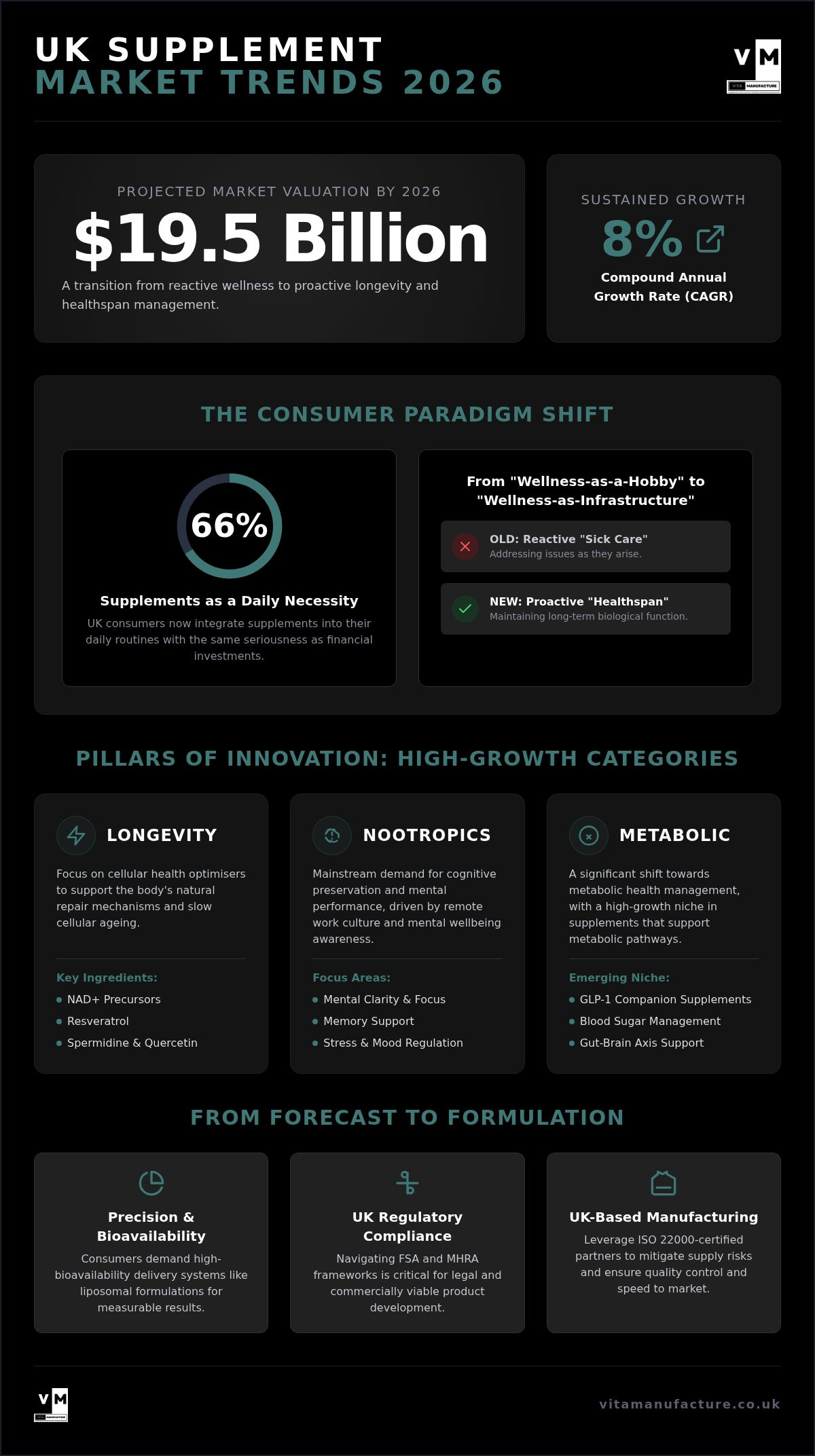
Recent data indicates the UK nutritional supplements market is projected to reach between $18.7 and $19.5 billion in 2026. This represents a robust Compound Annual Growth Rate (CAGR) of approximately 8%. This isn't just a temporary spike; it's a sustained trajectory fuelled by inflation-resistant wellness spending. Digital-first brands are capturing this growth by moving closer to their consumer base and prioritising agility in their supply chains.
Why does UK-based manufacturing matter so much in this climate? Brands are increasingly moving production to British soil to mitigate global supply risks and reduce "food miles". Working with an ISO 22000-certified partner ensures that your scaling efforts aren't hampered by logistics delays or inconsistent quality. It allows for tighter control over the R&D process, ensuring that new product development remains aligned with rapid market shifts.
The Preventative Healthcare Paradigm Shift
We've witnessed a definitive move from reactive "sick care" to proactive "healthspan" management. British consumers are no longer just looking to live longer; they want to live better for longer. Industry reports suggest that 66% of UK consumers now view supplements as a daily necessity. This shift is particularly visible amongst the ageing population, where preventative nutrition is used to maintain cognitive function, bone density, and metabolic health.
This maturation of the market means "wellness-as-a-hobby" has evolved into "wellness-as-infrastructure". Consumers treat their supplement regimes with the same seriousness as their financial investments. Whilst the Dietary Supplement Health and Education Act provides a historical framework for how the industry defined these products globally, the 2026 UK consumer expects even higher standards of proof and efficacy than previous generations. They're looking for functional health solutions that integrate seamlessly into their lives.
Trust is now built through the "Clean Label" imperative. In 2026, a clean label isn't just about removing artificial colours or preservatives. It's about full traceability, from bulk sourcing to the final delivery system. Success in this environment requires a strategic ally who understands that bioavailability and regulatory compliance are the two non-negotiable pillars of commercial viability. Founders who prioritise these elements will find themselves well-positioned to lead the next wave of industry growth.
Pillars of Innovation: Longevity, Nootropics, and the Gut-Brain Axis
Innovation in 2026 has moved beyond simple nutrient replacement. The modern consumer is scientifically literate and seeks products that offer systemic optimisations. Identifying the most profitable UK supplement market trends 2026 requires a focus on three core pillars: longevity, cognitive performance, and the intricate link between the gut and the mind. Success in these categories depends on your ability to translate complex biochemistry into accessible, high-performance retail products.
The Longevity Revolution
The conversation has shifted from "lifespan" to "healthspan". Consumers are no longer interested in just living longer; they want to remain biologically young and active well into their later decades. This has led to an explosion in demand for cellular health optimisers. Longevity supplements are engineered to support the body's natural repair mechanisms at a mitochondrial level, effectively slowing cellular senescence and oxidative stress.
Key ingredients like NAD+ precursors, Resveratrol, and Spermidine are leading this charge. Quercetin is also gaining significant traction for its senolytic properties. For brand founders, the challenge lies in navigating the regulatory landscape whilst communicating these high-level benefits. Refining these complex formulas requires deep technical expertise, making new product development a critical first step for brands entering the longevity space.
Nootropics and Mental Wellbeing
Cognitive preservation is no longer the sole domain of biohackers. Nootropics have entered the mainstream, driven by a remote-work culture that demands sustained focus and professional professionals looking for stress-support solutions. With a projected CAGR of over 13% in UK brain health supplement trends, the opportunity for specialised cognitive blends is immense. Consumers are moving away from caffeine-heavy stimulants in favour of "clean energy" and "flow state" products.
Adaptogenic Blends: Combining Ashwagandha or Rhodiola with traditional B-vitamins to manage cortisol levels.
Focus Formulas: Utilising L-theanine and Lion's Mane mushroom to enhance clarity without the jitters.
Sleep Hygiene: Products that facilitate deep recovery, acknowledging that mental performance starts with rest.
The innovation extends to the gut-brain axis. We are seeing a move beyond basic probiotics towards "psychobiotics" — specific bacterial strains designed to influence mood and neurotransmitter production. Alongside this, female-specific health is expanding rapidly. Products addressing menopause and hormonal balance are high-growth niches, as women seek targeted support for cognitive fog and metabolic shifts. Brands that can combine these functional benefits with superior bioavailability will lead the market in 2026.
The Metabolic Shift: GLP-1 Companion Supplements
The rise of GLP-1 receptor agonists has fundamentally altered the weight-loss sector. This isn't just a pharmaceutical trend; it's a catalyst for a new category of "companion supplements" designed to address the physiological changes induced by these medications. As we analyse UK supplement market trends 2026, the ability to support the metabolic health of millions of users represents one of the most significant commercial opportunities of the decade. Success in this niche requires a move away from generic diet pills towards sophisticated, functional support systems.
Supporting the GLP-1 User
Rapid weight loss often comes with a hidden cost: the loss of lean muscle mass. Brands that focus on high-quality protein powders, BCAAs, and essential amino acids are positioning themselves as essential partners for the GLP-1 patient. It's about protecting the "metabolic engine" whilst the medication manages appetite suppression. Without targeted amino acid support, users risk sarcopenia, which can lead to a rebound in weight once the medication is ceased.
Digestive health is another critical area of concern. Because these medications slow gastric emptying, users often experience significant discomfort. Formulating with soluble fibres like psyllium husk or glucomannan, alongside specific digestive enzymes, can provide the relief consumers are searching for. Additionally, the extreme calorie restriction associated with these treatments creates significant nutrient gaps. A targeted multivitamin that prioritises B-vitamins, iron, and electrolytes is no longer optional; it's a necessity for maintaining energy levels and long-term vitality.
Natural Metabolic Alternatives
Whilst many consumers are embracing pharmaceuticals, a significant segment remains wary of prescription drugs. This has fuelled the rise of "natural GLP-1 alternatives" like Berberine, which has seen a surge in interest for its role in glucose management and insulin sensitivity. Consumers are actively looking for blood sugar stabilisation through plant-based interventions that don't require a medical prescription. This "Berberine-boost" trend is maturing into a broader interest in metabolic flexibility.
Strategic positioning in this space requires a balance of scientific rigour and market-savvy intuition. Are you ready to capture this metabolic shift? Success depends on finding a manufacturing partner capable of executing complex, multi-ingredient formulas that meet both consumer expectations and UK regulatory standards. By leveraging pilot studies and market research, brands can test these metabolic concepts before committing to mass production. This proactive approach ensures your brand remains a leader in the functional precision era, offering the reliability and sophistication that the 2026 consumer demands.
Consumer Expectations: Bioavailability and Precision Nutrition
In 2026, the sophistication of the British consumer has reached a tipping point. They no longer ask what is in your supplement; they ask how much of it actually reaches their cells. This shift from simple ingestion to proven absorption is one of the most defining UK supplement market trends 2026. Brands that rely on legacy formulations with poor uptake are finding themselves displaced by "precision nutrition" competitors who prioritise cellular delivery over raw ingredient weight.
Advanced Delivery Systems
The rise of liposomal encapsulation has revolutionised the delivery of notoriously difficult-to-absorb nutrients like Vitamin C and Glutathione. By wrapping active ingredients in a phospholipid bilayer, brands can bypass the harsh environment of the digestive tract, ensuring significantly higher plasma concentrations. This isn't just a technical upgrade; it's a commercial necessity for premium positioning. Bioavailability is the key differentiator in 2026 because consumers now recognise that unabsorbed nutrients represent a failure of both science and value.
Timed-release technology is also seeing renewed interest, particularly for nootropics and sustained-energy products. Instead of a single "spike" and subsequent crash, these advanced capsules provide a metered release of ingredients like caffeine or L-theanine. This ensures a steady "flow state" that aligns with the professional demands of the modern remote-work era. Achieving this level of precision requires a manufacturing partner with the technical infrastructure to handle complex, multi-stage encapsulation processes.
The Personalisation Frontier
The "one-size-fits-all" multivitamin is in terminal decline. We are seeing a massive shift towards bespoke nutrition, where supplement regimes are dictated by DNA testing, blood markers, and real-time data from wearable technology. Consumers expect their health products to be as unique as their biological profile. This move towards cohort-specific formulation allows brands to target high-value niches, such as postpartum recovery or executive stress management, with surgical precision.
How does a brand stay defensible in such a rapidly evolving space? It starts with unique, scientifically backed formulas that competitors cannot easily replicate. By leveraging specialised contract manufacturing and in-house R&D, you can develop proprietary delivery systems that secure your market share. Success in 2026 isn't about being the biggest; it's about being the most precise. If you are ready to move beyond generic white-label products and build a brand based on functional excellence, it's time to partner with a strategic ally who understands the high stakes of innovation.
From Forecast to Formulation: Executing Your 2026 Strategy
Strategy is nothing without execution. Whilst identifying the UK supplement market trends 2026 is the first step, the true challenge lies in bringing a compliant, high-quality product to the British shelf. The 2026 landscape demands more than just a good idea; it requires a robust supply chain and a manufacturing partner who understands that regulatory precision is just as important as the formula itself. You need more than a supplier; you need a strategic ally who can navigate the high stakes of a rapidly evolving sector.
Why is UK-based production becoming the gold standard for growth-oriented brands? It's about more than just reducing lead times. It's about supply chain reliability and the peace of mind that comes from oversight in an ISO 22000-certified facility. For founders, the fear of launching "yesterday's news" is real. This is where pilot studies and market research become invaluable. They allow you to test next-gen metabolic or longevity formulas with low MOQs, gathering real-world data before committing to a mass-market launch.
Navigating UK Regulations
The regulatory environment in England and Wales is increasingly rigorous. Between the Food Standards Agency (FSA) oversight and the evolving list of authorised Novel Foods, the technical requirements for 2026 products are steep. Are your current formulas ready for the latest standards? A professional manufacturer doesn't just mix ingredients; they handle the complex regulatory paperwork and ensure every claim is substantiated. This built-in compliance protects your brand from the risk of MHRA intervention and builds the long-term trust that modern consumers demand.
Partnering with Vita Manufacture
We position ourselves as your visionary growth partner, not just a service provider. By leveraging our end-to-end R&D, ingredients and bulk sourcing, and in-house logistics, you gain a seamless path from concept to distribution. Our transparent customer portal provides real-time visibility into your supply chain, ensuring you're never in the dark about production status or quality assurance. We think like business owners, prioritising your commercial outcomes and long-term scalability.
Success in 2026 requires a partner who combines scientific rigour with market-savvy intuition. Whether you're scaling a medical device prototype or launching a private label range, we provide the infrastructure needed to win. Ready to turn these UK supplement market trends 2026 into a commercial reality? Enquire about our contract manufacturing services today and let's build the future of British wellness together.
Leading the Future of British Wellness
The shift towards functional precision is no longer a distant forecast; it's the current reality for brands aiming to thrive. We've explored how metabolic support, longevity science, and advanced delivery systems are redefining consumer expectations. These UK supplement market trends 2026 represent a significant commercial opportunity for founders who prioritise scientific rigour over generic formulations. Success in this landscape requires a move away from "yesterday's news" towards products that offer measurable cellular benefits and total transparency.
Executing this vision requires a manufacturing partner that functions as a strategic ally rather than a mere service provider. At Vita Manufacture, we offer an ISO 22000:2018 Certified Facility and expert R&D for custom formulations, ensuring your brand stays compliant whilst pushing the boundaries of innovation. Combined with our comprehensive UK-based logistics, you can scale from pilot studies to mass distribution with total confidence in your supply chain reliability.
Partner with Vita Manufacture to launch your 2026 product range and secure your place at the forefront of the health and wellness sector. The market is ready for your next breakthrough, and we're ready to help you build it.
Frequently Asked Questions
What are the top-selling supplement categories in the UK for 2026?
Longevity and cognitive health are the dominant sectors this year. Consumers are prioritising "healthspan" over simple lifespan, driving demand for NAD+ precursors and advanced nootropic blends. The broader UK supplement market trends 2026 indicate a shift towards functional precision, with gut-brain axis products and metabolic support also seeing significant growth. Vitamins and minerals remain the largest volume segment, but high-margin innovation is concentrated in targeted, science-backed formulas.
How is the GLP-1 weight loss trend affecting the UK supplement market?
The widespread adoption of GLP-1 medications has birthed a massive "companion supplement" sector. These products address specific side effects like muscle mass loss and nutrient deficiencies caused by rapid weight loss. Brands are successfully launching high-quality protein powders, essential amino acids, and digestive enzymes to support patients on these treatments. This metabolic shift represents a unique opportunity to provide functional nutrition that complements pharmaceutical interventions whilst protecting long-term metabolic health.
What are the latest MHRA regulations for UK supplement manufacturers?
The primary regulation remains the distinction between food supplements and medicines. The Food Standards Agency (FSA) oversees supplements, whilst the MHRA regulates products making medicinal claims. In 2026, the Nutrition Regulations amendment permitted magnesium L-threonate monohydrate for use in food supplements in England. Manufacturers must ensure all health claims comply with retained EU regulations to avoid classification as an unauthorised medicine, which falls under strict MHRA enforcement.
Is it better to use a UK-based supplement manufacturer or source from abroad?
UK-based manufacturing offers superior supply chain reliability and regulatory peace of mind. Partnering with a domestic facility reduces "food miles" and eliminates the complexities of international customs and import duties. It also allows for tighter quality control and faster iteration during the R&D process. For brands targeting the British market, local production ensures that your logistics and distribution are seamless, whilst maintaining the high standards expected by sophisticated UK consumers.
What is the role of bioavailability in modern supplement formulation?
Bioavailability is the single most important factor in modern formulation because it determines how much of a nutrient actually reaches the cells. In 2026, consumers are moving away from generic tablets in favour of liposomal delivery systems and timed-release capsules. These advanced delivery methods bypass digestive degradation, offering superior absorption rates. Brands that prioritise bioavailability can justify premium price points by proving their products deliver functional results rather than just expensive waste.
How can new brands test 2026 trends with low MOQs?
New brands can mitigate risk by utilising pilot studies and market research. These services allow for the production of small-batch prototypes to test consumer demand before committing to mass-market volumes. By choosing a partner that offers low MOQ options for market testing, you can iterate on your formulas based on real-world feedback. This lean approach to UK supplement market trends 2026 ensures you don't over-invest in products that don't resonate with your audience.
What ingredients are considered "longevity supplements" in 2026?
Longevity supplements focus on cellular repair and mitochondrial function to extend "healthspan". Key ingredients in 2026 include NAD+ precursors, Resveratrol, Spermidine, and Quercetin. These compounds are often combined into complex blends designed to slow cellular senescence and manage oxidative stress. As the ageing British population seeks proactive wellness solutions, these ingredients have moved from niche biohacking circles into mainstream, high-performance retail products that support long-term vitality.
Why is ISO 22000 certification important for my supplement brand?
ISO 22000:2018 is an international standard that defines the requirements for a food safety management system. For your brand, this certification is a powerful proof point of quality and safety that builds immediate consumer trust. It ensures that every stage of the manufacturing process, from raw material sourcing to final packaging, meets rigorous global standards. Working with an ISO 22000-certified partner protects your reputation and ensures your products are fit for national distribution.