UK Food Supplement Regulations: 2026 Strategic Guide
Updated: Sep 28
A single non-compliant label can dismantle years of brand building in a matter of days. In an industry where the line between a wellness breakthrough and a medicinal violation is razor thin, your regulatory strategy is either your greatest asset or your biggest liability. You're likely feeling the pressure of navigating UK food supplement regulations whilst trying to scale, perhaps fearing the "Novel Foods" trap or the sudden enforcement of new purity criteria. It's a common anxiety for ambitious founders who want to innovate without risking a costly product recall or an MHRA investigation.
This strategic guide is designed to help you master these complexities, ensuring your brand remains compliant, credible, and ready for commercial scale throughout 2026. We'll provide a clear roadmap for UK compliance, from understanding the August 2026 authorisations for magnesium L-threonate monohydrate to the latest 10mg daily limit for CBD products. You'll learn which health claims are permitted on the Great Britain register and how to find a manufacturing partner that simplifies your operational burden. By the end, you'll have the clarity needed to transform regulatory hurdles into a foundation for long-term growth and consumer trust.
Table of Contents
Understanding the UK Food Supplement Regulatory Landscape in 2026
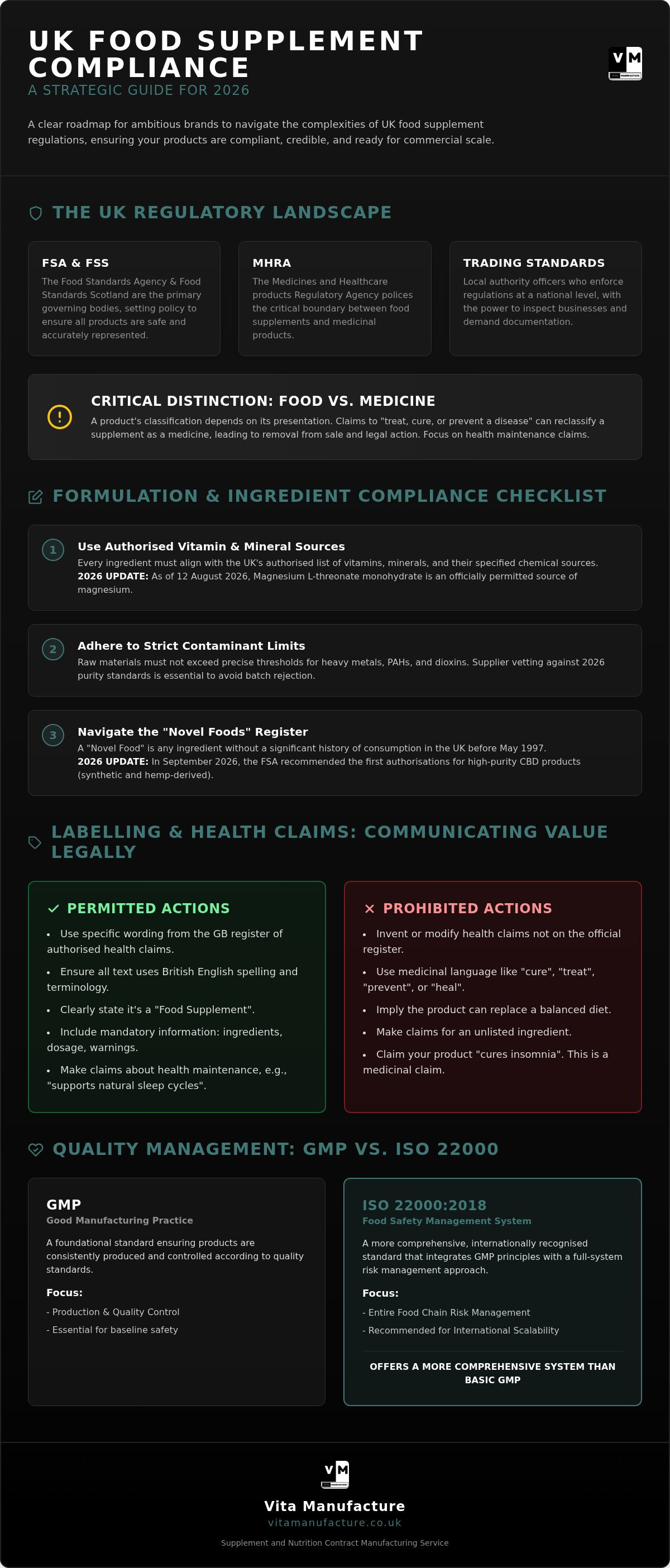
Success in the British wellness market begins with a precise understanding of the legal framework. Under UK law, food supplements are defined as concentrated sources of nutrients or other substances with a nutritional or physiological effect, specifically intended to supplement the normal diet. These products must be delivered in dose form, such as capsules, tablets, or liquid ampoules. The Food Standards Agency (FSA) and Food Standards Scotland (FSS) are the primary governing bodies responsible for policy, ensuring that every product on the shelf is safe for consumption and accurately represented to the public.
Since the transition from EU retained law to a dedicated UK-centric framework, the responsibility for compliance rests squarely on the shoulders of the brand owner. Navigating UK food supplement regulations involves understanding that while the UK has historically aligned with Dietary Supplement Regulations from the EU, it now operates its own independent registers for ingredients and health claims. This shift requires a more hands-on approach to regulatory monitoring to ensure your brand doesn't fall behind as domestic standards evolve independently from Brussels.
The Legal Boundary: Food vs Medicine
Is your product a supplement or a medicine? The Medicines and Healthcare products Regulatory Agency (MHRA) is tasked with protecting this boundary. They monitor for products that are "medicinal by presentation," meaning any branding or marketing that suggests a product can treat, cure, or prevent a disease. This is a common pitfall for new founders. If you claim a botanical extract "cures insomnia" rather than "supporting natural sleep cycles," you risk your product being reclassified as a Traditional Herbal Medicine (THR). This leads to immediate removal from sale and potential legal action. Strategic positioning focuses on health maintenance, keeping your brand safely within the food category.
The Role of Local Authorities and Trading Standards
Whilst the FSA sets the rules, Trading Standards officers enforce them at a national level. They have the authority to inspect your business and request detailed documentation regarding your formulations and marketing. For brands looking to scale, the Primary Authority scheme is an invaluable tool. By forming a legal partnership with a specific local authority, you receive assured advice that provides a layer of protection against inconsistent enforcement across different regions. Preparing for inspections means having your technical files, certificates of analysis, and label proofs organised and ready for review at a moment's notice.
Formulation Compliance: Permitted Ingredients and Novel Foods
Building a successful supplement formula is a high-stakes exercise in balancing innovation with strict compliance. You must ensure every component aligns with the UK’s authorised list of vitamins and minerals. These regulations don't just dictate which nutrients you can use; they specify the exact chemical sources permitted. For example, as of 12 August 2026, magnesium L-threonate monohydrate was officially added as a permitted source of magnesium in England. Success requires more than a passing glance at the official UK food supplement guidance; it demands a deep technical understanding of purity criteria.
Contaminant limits are a critical part of the equation. Regulators set precise thresholds for heavy metals, polycyclic aromatic hydrocarbons (PAHs), and dioxins. If your raw materials exceed these limits, your entire batch is a commercial liability. Navigating UK food supplement regulations means vetting every supplier against these 2026 purity standards. We help our partners by managing ingredients and bulk sourcing through a verified supply chain, ensuring that your formulation is market-ready from the moment it leaves the production line.
Navigating the Novel Foods Register in 2026
What defines a "Novel Food"? In the UK, this covers any ingredient with no significant history of consumption before May 1997. The register is dynamic. In September 2026, the FSA recommended the first authorisations for high-purity CBD products, including synthetic CBD and hemp-derived isolates. As consumer interest remains high, European specialists such as FastCBD demonstrate how established retailers curate diverse CBD formulations while navigating strict product standards. Whilst trending ingredients like NMN offer significant market appeal, they remain under intense scrutiny. The authorisation process is a multi-year commitment involving safety dossiers and toxicological data. You must factor these timelines into your product development cycle to avoid launching a product that the FSA could later remove from the market.
Maximum Permitted Levels (MPLs) and Safety Limits
Safety limits are the non-negotiable ceiling of your product's potency. UK experts establish "upper safe levels" to protect consumers from over-supplementation. Your dosages must be effective enough to justify your health claims, yet low enough to remain legally compliant. For instance, the current proposed maximum intake for CBD is set at 10mg per day for adults. Our scientific formulation team uses pilot studies and market research to ensure your product hits this "sweet spot" of efficacy and safety, protecting your brand from the reputational damage of an adverse event report.
Labelling and Health Claims: Communicating Value Legally
Your label is the most visible point of regulatory scrutiny. Whilst it serves as your primary marketing tool, it is first and foremost a legal document. In 2026, the Great Britain Nutrition and Health Claims Register (NHCR) remains the final authority on what you can and cannot say. Navigating UK food supplement regulations requires a disciplined approach to every word printed on your packaging. Mandatory elements are non-negotiable: the product name must include the phrase "food supplement," followed by a complete nutrient list, the recommended daily dose, and specific warning statements for vulnerable groups.
Precision in terminology is equally vital. You must use metric units and British English spelling throughout. Using "color" instead of "colour" or failing to use metric measurements can lead to your stock being rejected by major UK retailers. Unauthorised claims are the fastest way to receive a cease-and-desist letter from Trading Standards. If a claim isn't on the NHCR, don't use it. It's better to have a conservative, compliant label than a bold one that triggers a total product recall.
Authorised vs Unauthorised Health Claims
Understanding the hierarchy of claims is essential for commercial safety. A "Nutrition Claim" describes what is in the product, such as "High in Vitamin C." In contrast, a "Health Claim" describes a physiological benefit, like "Vitamin C contributes to the normal function of the immune system." Understanding food supplements is critical here; you cannot imply that your product treats or prevents disease. Unless specifically authorised for an ingredient, "reduction of disease risk" claims are strictly prohibited and will trigger immediate enforcement action.
Visual Compliance: Layout and Font Size
Legality extends to aesthetics. The law mandates a minimum font size for mandatory information, typically an x-height of 1.2mm, to ensure legibility for all consumers. Organising your "Nutrition Table" requires adherence to specific UK standards, listing nutrients per daily portion rather than just per 100g. If you are planning global distribution from a UK base, multi-language labels must be carefully designed to ensure the English text remains prominent and compliant without cluttering the visual hierarchy. Strategic design ensures your brand looks premium whilst meeting every technical requirement.
Quality Management Standards: ISO 22000 vs GMP
Quality management is the silent engine of a commercially viable supplement brand. Whilst formulation and labelling attract the most attention, your manufacturing certifications are what ultimately protect your equity from a catastrophic safety failure. Navigating UK food supplement regulations effectively requires a partner who treats quality as a strategic asset rather than a box-ticking exercise. In the 2024/2025 period alone, the MHRA completed 353 GMP inspections, highlighting the active enforcement of production standards in the British market. Good Manufacturing Practice (GMP) remains the essential foundation for ensuring batch-to-batch consistency and preventing cross-contamination.
However, for brands with global ambitions, GMP is often only the beginning. ISO 22000:2018 represents a more comprehensive Food Safety Management System (FSMS) that integrates scientific rigor with operational excellence. Whilst the UK market is highly regulated, navigating UK food supplement regulations becomes a streamlined process when your production is backed by ISO 22000 standards. By choosing an ISO-certified environment, you ensure that every process, from raw material intake to final dispatch, is governed by a system designed to exceed basic food safety requirements.
The Advantage of ISO 22000:2018 Certification
ISO 22000:2018 is a sophisticated framework that merges Hazard Analysis and Critical Control Point (HACCP) principles with high-level business management. This integration is vital for brands looking to export, as ISO standards carry significant weight amongst international distributors and retailers. Vita Manufacture chose to achieve ISO 22000:2018 certification because it provides a higher level of assurance than standard food safety protocols. It demonstrates a proactive commitment to risk management that inspires trust in potential partners and investors alike.
Traceability and Documentation from Factory to Shelf
Transparency is the hallmark of a secure supply chain. You must maintain a "one step back, one step forward" traceability system that allows you to identify the origin of every ingredient and the destination of every finished bottle. This isn't just about compliance; it's about speed. If a quality issue arises, you need the technical systems in place to execute a targeted product recall within hours, not days. Our transparent customer portal provides real-time access to batch records and certificates of analysis, giving you total visibility over your production history. This level of documentation ensures you are always prepared for an audit or a Trading Standards inquiry.
To secure your supply chain with a certified partner, explore our contract manufacturing services.
Strategic Partnership: Ensuring Compliance at Scale
Your choice of contract manufacturer is the single most consequential regulatory decision you'll make. It's the difference between a brand that scales and one that stalls due to compliance failures. Navigating UK food supplement regulations requires more than just a production line; it demands a partner with the scientific depth to anticipate changes before they become obstacles. From initial concept to logistics and distribution, an end-to-end partner ensures that every link in your supply chain is fortified against legal risk. This strategic alignment allows you to focus on growth whilst we handle the technicalities of production.
Leveraging Professional R&D for Compliance
Stability is the foundation of a credible brand. Using pilot study and market research allows you to test formulation integrity and legal compliance before committing to mass production. This proactive approach is essential when dealing with ingredients on the Novel Foods register or newly authorised substances. If standards shift, scientific expertise allows for rapid reformulation, ensuring your product remains market-ready without compromising on its physiological effect. Consistent quality is further secured through strategic ingredients and bulk sourcing, which guarantees that every batch meets the strict UK purity criteria required in 2026.
Final Steps: Launching Your Compliant Brand
Before your first production run, you need a final compliance checklist. Have you verified your health claims against the latest NHCR? Is your label font size compliant for the UK market? Managing these moving parts is significantly easier with a centralised system. The Vita Manufacture portal serves as your regulatory hub, allowing you to track batch records, certificates of analysis, and technical files in real-time. This level of transparency doesn't just simplify audits; it builds the high-level confidence needed to attract premium retailers and international distributors. It's about having total visibility over your supply chain from factory to shelf.
Looking ahead, the UK regulatory landscape will likely continue its trend towards dynamic alignment with global safety standards. Staying competitive means staying informed and agile. By treating your manufacturer as a visionary growth partner rather than a mere service provider, you position your brand to lead the market rather than react to it. It's time to stop viewing compliance as a hurdle and start seeing it as your most powerful commercial advantage. Ready to take the next step?
Future-Proofing Your Supplement Brand for 2026
Scaling a supplement venture in today's market requires more than just a visionary formula; it demands a rigorous commitment to legal precision. You've seen how the boundary between food and medicine is monitored and why technical accuracy in labelling is the bedrock of consumer trust. Navigating UK food supplement regulations doesn't have to be a barrier to your growth. When you treat compliance as a strategic asset, you build a brand that is not only legally secure but also commercially formidable.
Are you ready to transition from a successful prototype to a market-leading product? As an ISO 22000:2018 Certified Facility, we provide the expert regulatory guidance essential for new product development. Our transparent customer portal ensures full batch traceability, giving you the high-level confidence to lead in a competitive landscape. Let's transform these regulatory complexities into your brand's greatest competitive advantage. We're here to ensure your vision meets the highest international standards.
Partner with Vita Manufacture for compliant, high-quality supplement production and secure your place at the forefront of the UK wellness industry.
Frequently Asked Questions
Do I need a licence to sell food supplements in the UK?
You don't need a specific licence to sell food supplements in the UK, as there is no general requirement to register individual products with the government before market entry. However, you must ensure every product complies with all relevant food safety and labelling laws. It's your responsibility to register your business as a food operator with your local authority. This shift in accountability makes navigating UK food supplement regulations a continuous process of due diligence.
What is the difference between a food supplement and a medicine in the UK?
The primary difference lies in the intended purpose and the claims made. Food supplements are concentrated sources of nutrients meant to supplement a normal diet, whilst medicines are substances used to treat, cure, or prevent disease. The MHRA strictly monitors supplements for "medicinal by presentation" claims. If your branding suggests your product can heal an illness, it'll be reclassified as a medicine. This classification triggers a far more demanding and expensive regulatory pathway.
Are US-compliant supplement labels legal in the UK?
No, US-compliant labels aren't legal for sale in the UK without significant modifications. UK regulations require metric measurements, specific warning statements, and the mandatory inclusion of the term "food supplement" on the packaging. Additionally, health claims must align with the Great Britain Nutrition and Health Claims Register rather than US FDA standards. Using US labels often leads to immediate rejection by UK retailers and potential enforcement action by Trading Standards officers.
What are the current UK regulations for CBD and Novel Foods in 2026?
As of September 2026, the FSA has recommended the first authorisations for high-purity CBD isolates and hemp-derived products as novel foods. A critical regulation is the proposed maximum daily intake of 10mg for adults. Labels must now include this limit alongside warnings for those under 18 and other vulnerable groups. Any ingredient without a significant history of consumption before May 1997 must undergo this rigorous novel food safety assessment before being sold.
Can I make health claims on my supplement packaging?
You can only make health claims that are officially listed on the Great Britain Nutrition and Health Claims Register. These claims must be used exactly as authorised, describing a physiological benefit rather than a medical cure. For example, you can state that Vitamin D contributes to the maintenance of normal bones. Navigating UK food supplement regulations successfully means avoiding any "unauthorised" claims, as these are the fastest way to trigger a cease-and-desist letter from local authorities.
What happens if my supplement is found to be non-compliant?
Non-compliance can lead to severe commercial consequences, including immediate product recalls and the destruction of existing stock. Trading Standards or the MHRA can issue cease-and-desist letters or pursue legal action, which may result in significant fines and reputational damage. In many cases, retailers will delist your entire brand if a single product is found to be unsafe or misleading. Maintaining rigorous quality systems is the only way to protect your business from these outcomes.
Is GMP certification mandatory for UK supplement manufacturers?
Whilst not a "licence" in the traditional sense, following Good Manufacturing Practice (GMP) is a regulatory requirement for ensuring the safety and quality of food supplements. The MHRA actively conducts GMP inspections to verify that facilities maintain batch-to-batch consistency and prevent contamination. For brand owners, partnering with a GMP-compliant manufacturer is essential. It provides the technical documentation and quality assurance needed to prove your products are manufactured to a safe and consistent standard.
How does ISO 22000:2018 differ from standard food safety rules?
ISO 22000:2018 is a comprehensive Food Safety Management System (FSMS) that goes significantly beyond basic hygiene rules. It integrates Hazard Analysis and Critical Control Point (HACCP) principles with high-level business management processes. This standard offers a proactive approach to risk management, ensuring safety is embedded in every operational layer. For ambitious brands, ISO 22000 provides a globally recognised seal of quality that simplifies market entry and builds trust with international distributors.