The Ultimate Supplement Manufacturing Agreement Checklist for Brand Owners
What if the most vulnerable part of your business isn't your marketing strategy or your product efficacy, but the legal document sitting on your desk? For many brand owners, the transition from a brilliant concept to a physical product is fraught with anxiety over intellectual property theft and the risk of regulatory non-compliance. You've worked hard to build your reputation; you're right to worry about how a manufacturing partner handles your proprietary secrets and quality standards.
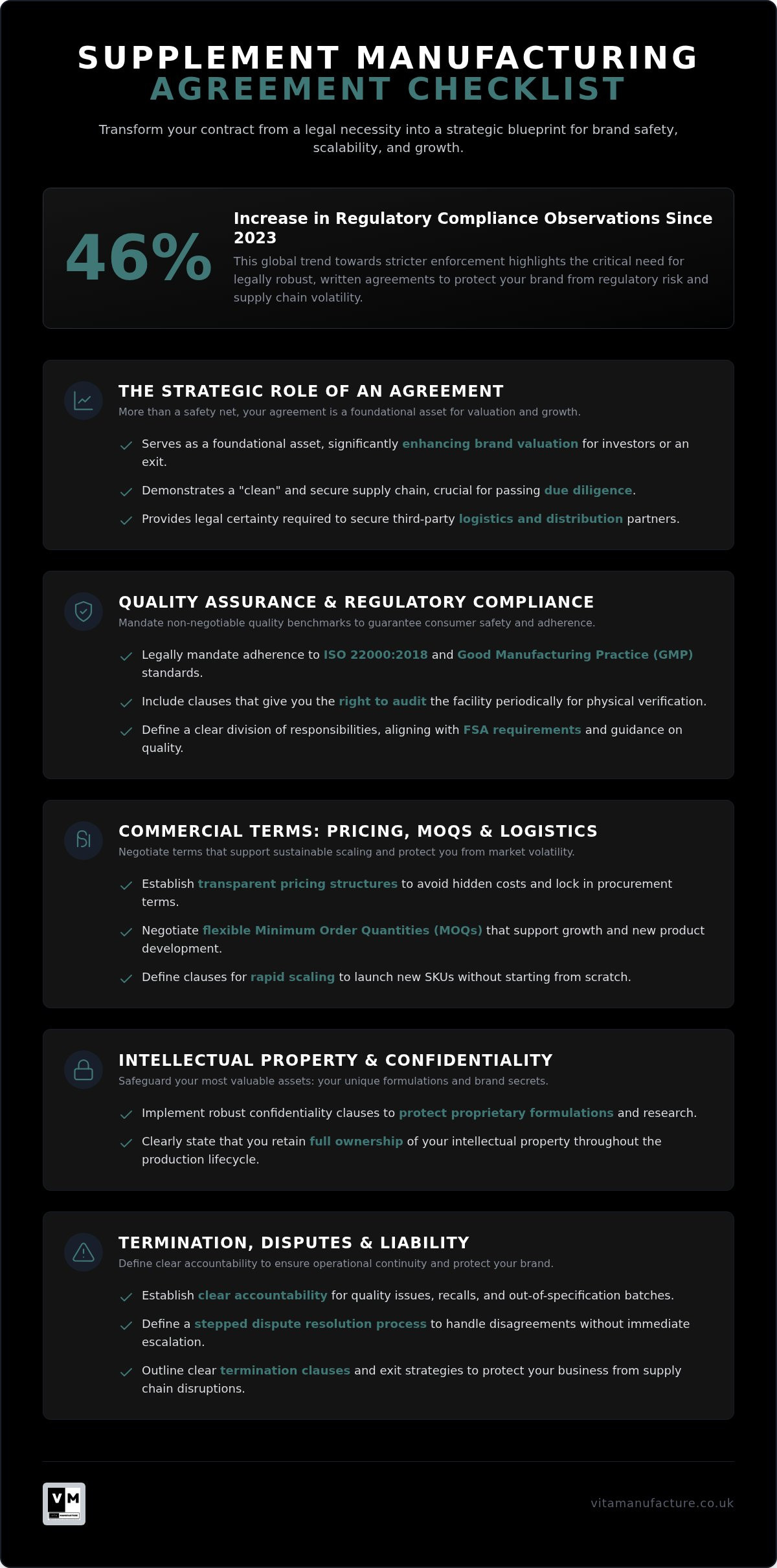
This comprehensive 2026 guide provides the supplement manufacturing agreement checklist you need to transform a standard contract into a strategic blueprint for growth. With regulatory scrutiny increasing, evidenced by a 46% rise in compliance observations since 2023, you cannot afford to leave your brand's safety to chance. We'll show you how to lock in transparent pricing, define clear accountability for quality issues, and establish a framework that protects your equity whilst allowing your business to scale effortlessly. From navigating FSA requirements to avoiding the trap of inflexible MOQs, this checklist ensures your partnership is built on a foundation of reliability and shared ambition.
Table of Contents
The Strategic Role of a Supplement Manufacturing Agreement
Your manufacturing agreement isn't just a safety net; it's the architectural blueprint for your brand's future. In a market where consumer trust is the ultimate currency, this document establishes the baseline for quality and commercial integrity. It moves the relationship beyond a simple transaction and into a partnership of shared ambition. Think of it as the foundational asset that defines how your brand interacts with the physical world.
Are you planning to seek investment or eventually exit? Savvy investors look for "clean" supply chains that can withstand rigorous due diligence. A robust contract with a contract manufacturer demonstrates that you own your intellectual property and have secured your production capacity. This clarity significantly boosts your brand valuation by removing the risks that plague less professionalised ventures. It proves you aren't just selling a product, but a scalable, protected business model.
Why a Handshake is Not Enough in 2026
The era of the "gentleman's agreement" in the supplement industry has ended. Today, the UK regulatory landscape is increasingly complex, requiring precise documentation to satisfy UK consumer protection laws and safety standards. With the FDA reporting a 46% increase in compliance observations since 2023, the global trend towards stricter enforcement is undeniable. Relying on a handshake leaves you vulnerable to more than just bad batches. It leaves you exposed to raw material price volatility and supply chain disruptions that can sink a growing brand overnight.
A written agreement mitigates these risks by locking in procurement terms and defining exactly how your partner should behave when the market shifts. It also provides the legal certainty needed to secure third-party logistics and distribution partners. These entities often require proof of a stable, legally binding supply chain before they'll commit to moving your stock. Without a contract, you're not just risking your production; you're risking your entire path to market.
Aligning Business Goals with Contractual Clauses
Does your current contract allow you to pivot when a new trend hits the market? Your supplement manufacturing agreement checklist should prioritise clauses that support rapid scaling and new product development. A strategic ally doesn't just fill bottles; they provide the operational depth to help you launch new SKUs without starting from scratch. They understand that your success is their success, and the contract should reflect this shared vision.
By embedding transparency into the contract, such as access to real-time tracking through a customer portal, you build long-term brand equity. This level of detail ensures that both parties are aligned on growth targets and quality benchmarks. It transforms a simple vendor relationship into a visionary partnership. When your agreement is aligned with your business goals, it becomes a tool for innovation rather than a list of restrictions, ensuring you stay ahead of the competition whilst maintaining complete operational excellence.
Quality Assurance and Regulatory Compliance Checklist
Quality is the bedrock of your brand's longevity. Without it, you're one bad batch away from a PR disaster or a regulatory shutdown. Your supplement manufacturing agreement checklist must prioritise these non-negotiable quality benchmarks to ensure every bottle leaving the facility meets the highest international standards. It's not enough to assume compliance; you must mandate it through specific, enforceable clauses that leave no room for ambiguity.
Start by requiring absolute adherence to ISO 22000:2018 and Good Manufacturing Practice (GMP) standards. These aren't just acronyms; they are rigorous frameworks that govern everything from personnel training to equipment maintenance. Whilst some manufacturers might claim to follow these rules, a legally robust contract gives you the right to audit their facility periodically. This physical verification ensures that what happens on the factory floor matches the promises made in the boardroom. Aligning your contract with established FDA guidance on quality agreements provides a clear division of responsibilities, ensuring no detail falls through the cracks.
Certifications and Standards to Demand
Why settle for basic food standards when your customers expect clinical-grade reliability? ISO 22000:2018 is critical because it integrates HACCP principles with a food safety management system, making it essential for international distribution. Your agreement should specify requirements for cleanroom environments and strict protocols for cross-contamination prevention. This is particularly vital if your products are vegan or allergen-free, where even trace amounts of prohibited ingredients can trigger a costly recall.
Batch Retention and Testing Protocols
How do you handle a quality dispute six months after production? Your contract must define batch retention periods, specifying how long samples must be stored by the manufacturer. Per 21 CFR 111.605, records should be kept for at least one year past the shelf-life date. Establish clear "Pass/Fail" criteria for finished product release and specify which third-party labs are acceptable for independent verification. This level of detail ensures that Certificates of Analysis (COAs) and stability studies are not just paperwork, but meaningful guarantees of efficacy.
Ensuring your supply chain is secure starts with choosing a partner who values transparency as much as you do. You can learn more about UK-based production standards and how they protect your brand's integrity through every stage of development.
Commercial Terms: Pricing, MOQs, and Logistics
Whilst your quality standards protect your reputation, your commercial terms protect your bank balance. A robust supplement manufacturing agreement checklist must move beyond generalities to define the precise financial mechanics of your partnership. In a market where raw materials can account for 30-50% of your total production costs, price transparency isn't just a preference; it's a requirement for survival. Your contract should serve as a financial roadmap that accounts for every penny from initial R&D to final delivery.
By adhering to best practices during the negotiation phase, you ensure that your manufacturer remains a strategic ally rather than a source of financial friction. This means establishing clear Minimum Order Quantities (MOQs) that align with your growth trajectory. Does your partner allow for tiered pricing as you scale? Can you increase a 5,000-unit run to 25,000 units with a predictable reduction in per-unit costs? These details must be codified to ensure your margins remain healthy as your brand gains momentum.
Navigating Pricing and Hidden Costs
Hidden fees are the silent killers of supplement startups. Your agreement should clearly distinguish between "all-in" manufacturing costs and separate charges for bottling, labelling, and secondary packaging. Don't let your margins be eroded by unexpected tooling fees or stability testing costs that weren't disclosed upfront. It's also vital to include clauses for raw material price adjustments. In a volatile global market, having a pre-agreed mechanism for price shifts prevents sudden supply halts and allows you to manage your retail pricing with confidence.
Lead Times and Supply Chain Resilience
Timing is everything in the retail world. Your contract must establish firm lead times and define specific penalties for delivery delays that impact your ability to fulfil orders. A visionary partner understands that a missed deadline for you is a lost customer for them. This section should also define "Force Majeure" narrowly, ensuring that global ingredient shortages don't become a blanket excuse for poor performance.
To mitigate these risks, Vita Manufacture provides a transparent customer portal for real-time tracking. This tool provides visibility into every production milestone, from bulk ingredient sourcing to final logistics and distribution. By embedding this level of transparency into your agreement, you gain a "single source of truth" that keeps both parties accountable. This proactive approach to communication ensures you're never left guessing about the status of your inventory, allowing you to focus on scaling your brand whilst we handle the operational complexities.
Intellectual Property and Confidentiality Safeguards
Your brand's competitive advantage isn't just the physical product; it's the intellectual property that defines your market position. Without ironclad legal protections, your unique formulations and market research are vulnerable to exploitation. A critical part of any supplement manufacturing agreement checklist is ensuring that every piece of proprietary data, from ingredient ratios to pilot study findings, remains firmly under your control. It's about securing the "secret sauce" that makes your brand investable and distinct.
Protecting your brand trademarks and label designs from unauthorised use is equally vital. Your manufacturer should be a guardian of your brand equity, not a risk to it. This means the agreement must explicitly prohibit the use of your designs or names for any purpose other than fulfilling your specific orders. By codifying these safeguards, you ensure that your manufacturer acts as a strategic ally in your growth, rather than a potential competitor.
Formula Ownership: Who Owns the Recipe?
One of the most common pitfalls for founders is failing to distinguish between white label and private label ownership. In a white label arrangement, the manufacturer typically retains the rights to the formula. However, for those engaging in custom New Product Development, your contract must state that you own the R&D results and final formulations. This clarity is essential for long-term scalability. Including these IP protections in your supplement manufacturing agreement checklist prevents future legal headaches and ensures your brand remains a valuable, standalone asset. Ensure your agreement includes language for the seamless transfer of IP once the R&D phase is complete, protecting trade secrets involved in blending and encapsulation processes.
Confidentiality in the Supply Chain
Confidentiality must extend beyond the four walls of the production facility. Your Non-Disclosure Agreements (NDAs) should encompass third-party ingredient suppliers and logistics partners who handle your proprietary materials. This prevents "backdoor" competition where a manufacturer might use your data to launch a rival product. Data security is another pillar of trust; ensure your partner uses secure digital tools. At Vita Manufacture, our transparent customer portal is designed with high-level security to protect your sensitive order data whilst providing real-time visibility.
Securing your brand's future starts with a partner who respects your creative and scientific assets. To build a production strategy that puts your IP first, contact Vita Manufacture today to discuss your project requirements.
Termination, Disputes, and Liability Management
A visionary partnership is built on trust, but it's sustained by clear boundaries. Every professional supplement manufacturing agreement checklist must include a detailed roadmap for when things go wrong or when it's simply time to move on. Planning for a potential exit isn't a sign of doubt; it's a mark of sophisticated business management. It ensures that your brand equity remains protected regardless of the relationship's status.
Clear grounds for termination are essential. These typically include repeated quality failures, significant delivery delays, or a breach of regulatory compliance. However, you shouldn't jump straight to litigation. A stepped dispute resolution process, beginning with senior management meetings and moving to formal mediation, often preserves the relationship whilst saving thousands in legal fees. If a resolution isn't possible, the contract must specify the orderly transfer of your assets. This includes tooling, dies, and any remaining raw materials you've paid for, ensuring your production doesn't grind to a halt.
Designing a Professional Exit Strategy
How do you transition to a new partner without losing your market position? Your agreement should define notice periods that provide enough time to secure a new manufacturer whilst protecting the current partner's production schedule. Crucially, include provisions for "run-off" production. This allows for a final batch to be completed during the notice period, preventing disastrous stockouts during the handover. Finally, mandate the immediate return of all proprietary data, branding materials, and formulation secrets to ensure your intellectual property remains exclusive.
Liability and Indemnification
Product recalls are a significant concern for any supplement brand owner. Who pays for the logistics, the destroyed stock, and the brand damage? Your contract must define clear liability caps and indemnification clauses. Whilst you are responsible for your marketing claims, the manufacturer should be liable for defects arising from the production process. Insist on contractual requirements for Product Liability Insurance from both parties. This protects your brand's financial exposure and ensures that a single manufacturing error doesn't become a terminal event for your company. Using a supplement manufacturing agreement checklist to verify these insurance requirements is a non-negotiable step for any serious founder.
Securing Your Brand's Production Legacy
Securing a manufacturing partner who aligns with your long-term vision is the most critical step in scaling your business. By utilising this supplement manufacturing agreement checklist, you've moved beyond simple production and into the territory of strategic brand building. You now understand that a robust contract protects your intellectual property whilst ensuring your products meet the highest ISO 22000:2018 standards. It's the difference between a vulnerable startup and a commercially viable venture ready for global expansion.
Ready to turn these insights into a reality? Partner with a transparent, ISO-certified UK manufacturer; Contact Vita Manufacture today to benefit from our comprehensive UK-based R&D and production. Our transparent customer portal provides real-time tracking, giving you total visibility over your supply chain from start to finish. We're here to help you navigate the complexities of the industry with confidence and scientific rigour. Your brand's success is our shared ambition, and we are ready to support your next phase of growth.
Frequently Asked Questions
What is the most important clause in a supplement manufacturing agreement?
The intellectual property ownership clause is arguably the most critical element of your agreement. It ensures that you retain the rights to your unique formulations and brand assets, preventing the manufacturer from using your research for other clients. Equally vital is the Quality Agreement, which defines who is responsible for meeting specific regulatory standards. Without these clearly defined, your brand's commercial valuation and legal safety are significantly compromised.
Does a contract manufacturer own my supplement formula by default?
Not necessarily, but it depends entirely on the service model you choose. For white label supplements, the manufacturer typically retains ownership of the pre-existing recipe. However, if you engage in custom New Product Development, your contract should explicitly state that the formula belongs to you. Always verify this within your supplement manufacturing agreement checklist to avoid disputes that could hinder your brand's future exit or investment opportunities.
How do I include ISO 22000 standards in my manufacturing contract?
You should mandate ISO 22000:2018 certification as a non-negotiable requirement within the Quality Assurance section of your contract. This ensures the manufacturer operates a rigorous food safety management system that integrates HACCP principles. Specify that the partner must maintain this certification throughout the agreement's term. At Vita Manufacture, we are ISO 22000:2018 certified, providing the international safety benchmarks required for global distribution and consumer trust.
What happens if my manufacturer fails to meet the agreed lead times?
Your agreement should outline specific penalties or liquidated damages for significant delivery delays that aren't caused by force majeure. These clauses protect your revenue and retail relationships. It's also essential to establish a formal communication protocol for production milestones. Using a transparent customer portal allows you to track progress in real-time, helping you identify potential delays early and adjust your marketing or distribution strategies accordingly.
Can I audit my supplement manufacturer under a standard agreement?
Yes, you should always include a Right to Audit clause in your manufacturing agreement. This allows you or a third-party representative to inspect the facility and review production records to ensure compliance with GMP and ISO standards. Regular audits are a fundamental part of a robust supplement manufacturing agreement checklist. They provide physical verification that the manufacturer's operational behaviour aligns with the high-level promises made in your contract.
What are the typical MOQs for private label supplements in the UK?
Minimum Order Quantities (MOQs) for capsules in the UK generally start between 1,500 and 5,000 units, though these vary based on the complexity of the formulation. Larger runs often unlock significant per-unit cost savings; for example, increasing an order from 5,000 to 10,000 units can lead to a 15-30% decrease in per-unit price. Your agreement should clearly define these tiers to support your brand's commercial viability as you scale.
How does a customer portal improve contract transparency?
A customer portal transforms the contract from a static document into a dynamic tool for accountability. It provides real-time tracking of raw material sourcing, production stages, and logistics. This visibility ensures that the manufacturer is adhering to the agreed timelines and quality protocols. By centralising data, it reduces the risk of hidden delays and provides a single source of truth that keeps both parties aligned on project goals.
What should I do if my manufacturer increases prices mid-contract?
Your contract should include a price adjustment clause that defines how and when costs can change. In a volatile market, raw materials can account for 30-50% of production costs, making some shifts inevitable. You should require a specific notice period and evidence of the price increase from the manufacturer's suppliers. If the increase exceeds a pre-agreed threshold, the contract shouldn't prevent you from renegotiating or terminating the agreement.