The Ultimate Guide to Contract Manufacturing for Supplement Brands in 2026
Why would you gamble your brand's future on a manufacturing partner that treats your vision as just another SKU? In 2026, the UK supplement market is projected to reach nearly £20 billion, yet many founders are still held back by the staggering capital costs of in-house machinery and the complexity of shifting food safety regulations. You likely already know that inconsistent product quality or a single batch of contaminated raw ingredients can ruin your reputation overnight. Relying on a basic contract manufacturing service is no longer a viable strategy for those who intend to dominate the market.
You deserve a strategic ally that functions as a seamless extension of your own team. This guide reveals how to select and manage a contract manufacturing partnership that secures your margins, ensures total regulatory compliance, and allows your brand to scale without friction. We'll explore the necessity of ISO 22000 standards, the value of specialist R&D expertise, and how transparent lead times can transform your commercial viability. From initial pilot studies to global distribution, it's time to build a supply chain that's as ambitious as your growth targets.
Table of Contents
What is Contract Manufacturing in the Supplement Industry?
At its core, contract manufacturing is the outsourcing of the formulation, production, and packaging of dietary supplements to a specialist third party. Rather than investing millions in high-spec machinery and cleanroom facilities, brands partner with a Contract Manufacturer to leverage their existing infrastructure and expertise. This model has evolved significantly. It's no longer just a transactional exchange where you send a recipe and receive a box of bottles. In 2026, the relationship has shifted toward a strategic partnership where the manufacturer acts as a technical and regulatory guardian for your brand.
Why are UK founders moving away from in-house production? The answer lies in the increasing complexity of the health and wellness sector. Professional facilities offer core components that are difficult to replicate at scale without massive overheads. These include:
Raw Material Sourcing: Access to high-quality, ethically sourced ingredients through established global networks.
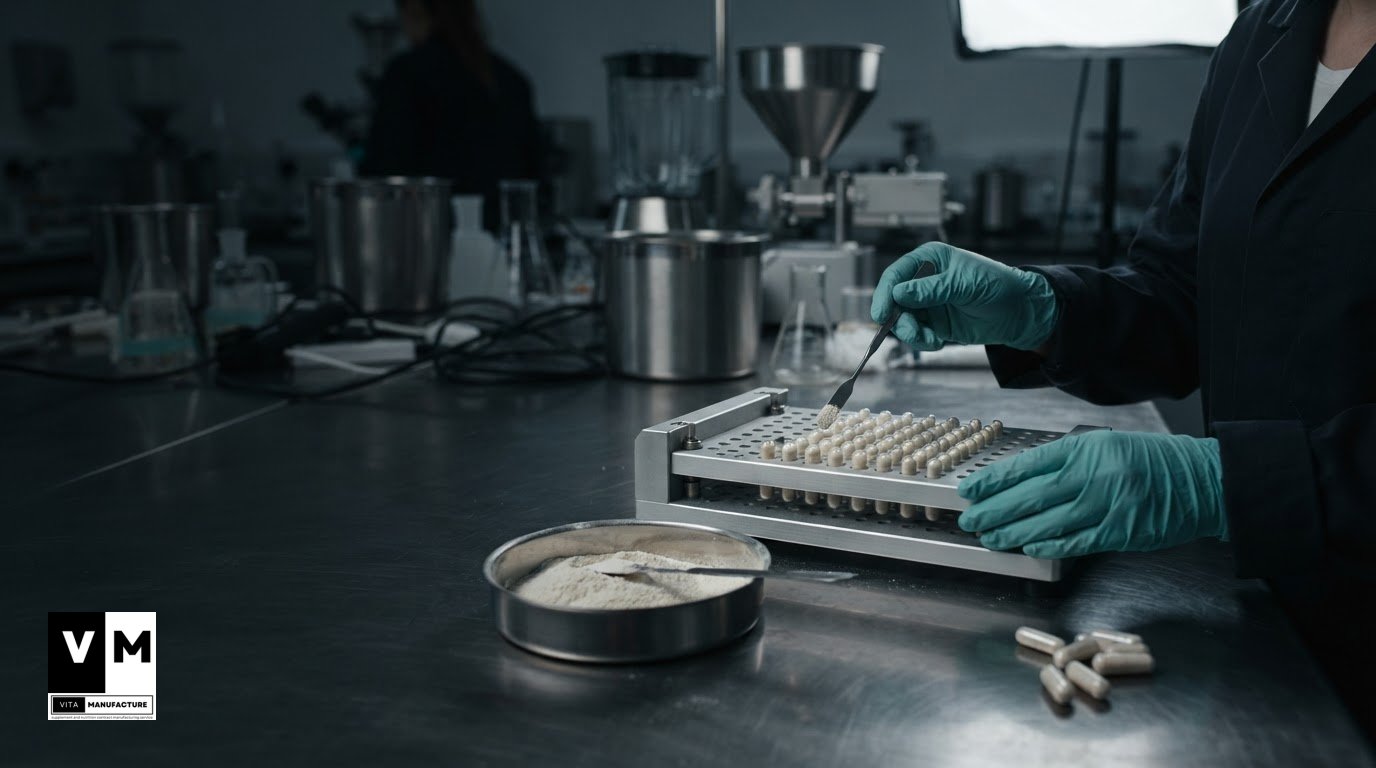
Technical Encapsulation: Precision engineering for powders, liquids, and bespoke capsule formats.
Compliance Testing: Rigorous laboratory analysis to ensure every batch meets UK food safety standards.
The Difference Between Private Label and Custom Contract Manufacturing
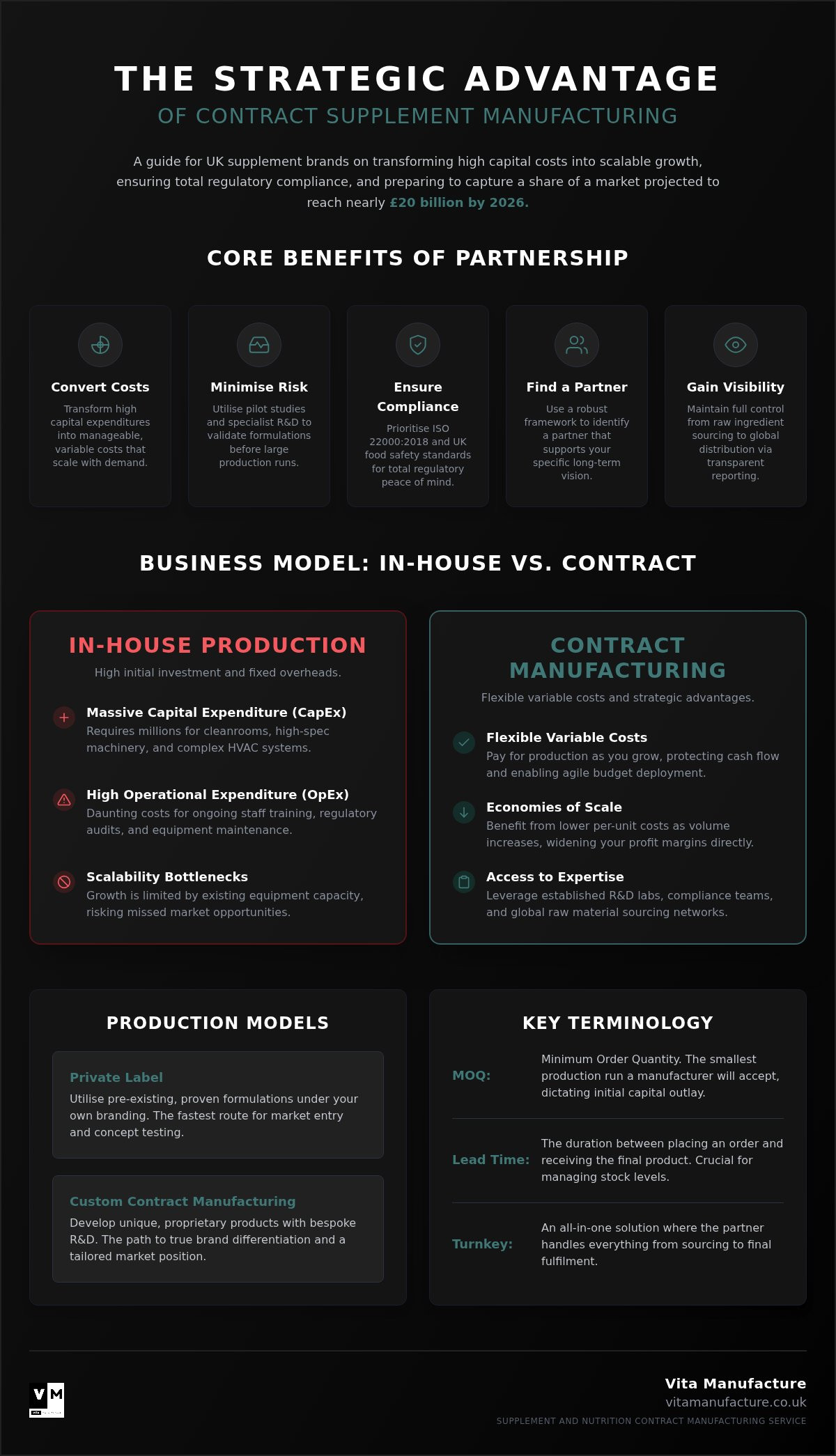
Choosing the right production model depends on your commercial objectives. White label supplements are the most basic off-the-shelf option for new founders looking to test a concept with minimal friction. If you require rapid market entry, private label supplements allow you to use pre-existing, proven formulations under your own branding. However, for those seeking true brand differentiation, custom contract manufacturing offers bespoke R&D. This path allows you to create unique, proprietary products that are scientifically tailored to your target audience's specific needs.
Key Terminology for Supplement Founders
Understanding the industry's vocabulary is essential for managing your cash flow and expectations. The Minimum Order Quantity (MOQ) is perhaps the most critical metric, as it dictates your initial capital strategy and stock levels. Lead times are equally vital; you must balance production schedules with market demand to avoid stockouts. Many brands now opt for turnkey solutions. This is where your partner handles everything from ingredient sourcing to final fulfilment, allowing you to focus entirely on marketing and business development.
Evaluating the Business Model: Costs, Margins, and Scalability
Success in the supplement market depends on how effectively you deploy your capital. By choosing contract manufacturing, you convert heavy fixed costs into flexible variable costs. This allows you to protect your cash flow whilst scaling your brand. Why sink millions into stainless steel machinery when you can pay for production as you grow? You avoid the massive burden of maintaining specialised staff and quality control labs. A production partner lets you jump from 1,000 units to 100,000 without a single change to your own office setup.
The impact of economies of scale is most visible in your cost per capsule. As your volumes increase, your manufacturer can negotiate better rates for raw materials and run high-speed machinery more efficiently. These savings are passed directly to you, widening your profit margins. This scalability is the engine of brand growth, providing the agility to respond to viral trends or sudden retail opportunities without the risk of equipment bottlenecks.
Cost Comparison: In-House vs. Contract Manufacturing
Building an in-house facility requires massive Capital Expenditure (CapEx). You'd need pharmaceutical-grade cleanrooms, complex HVAC systems, and high-speed encapsulation machines. Operational Expenditure (OpEx) is just as daunting. You must fund ongoing staff training, regulatory audits, and equipment maintenance. To ensure your operations meet global Risk Management and Quality Assurance Standards, the investment is substantial. The break-even point for moving production in-house only occurs when your annual volume is high enough to absorb these fixed overheads at a lower rate than a third-party fee.
Protecting Your Margins Through Strategic Sourcing
Strategic sourcing is your best defence against supply chain volatility. Manufacturers have established global networks to secure bulk ingredients at prices an individual brand cannot match. This directly reduces your unit costs and protects you from sudden market spikes. For new ventures, 'Low MOQ' manufacturing is a vital tool for testing commercial viability without overextending your budget. If you are ready to explore optimising your production strategy, look for a partner that offers transparency in their procurement process. This ensures you aren't just buying a product, but a secure, cost-effective supply chain.
Bulk Sourcing: Leveraging a partner's buying power to reduce raw material costs.
Variable Costs: Paying only for what you produce, keeping your balance sheet lean.
Infrastructure: Accessing world-class facilities without the debt of ownership.
The End-to-End Production Journey: From Formulation to Fulfilment
How does a conceptual health goal transform into a market-ready product? The journey from a visionary formula to a shelf-stable supplement is a sophisticated sequence of scientific and operational milestones. In contract manufacturing, your brand's success depends on the precision of this journey. It's a multi-phase process that requires absolute synchronicity between laboratory research and high-speed production lines.
Phase 1 begins with R&D and Formulation. At this stage, specialists work to ensure your supplement is effective, stable, and compliant with UK regulations. This leads directly into Phase 2: The Pilot Study. This stage acts as a crucial safety net, allowing you to validate the formula before you commit significant capital to a large-scale production run. Once validated, Phase 3 focuses on the rigorous sourcing and blending of raw ingredients, where the precision of ratios determines the final purity. Phase 4 involves encapsulation and bottling within controlled environments to prevent contamination. Finally, Phase 5 manages the complexities of logistics and distribution, ensuring your inventory navigates global shipping and customs protocols without friction.
The Critical Role of Pilot Studies and Market Research
Why are prototypes so essential? For brands launching a medical device product prototype or a complex new nootropic, a pilot study provides the empirical data needed to verify shelf-life and bioavailability. You don't want to guess how your active ingredients interact over twelve months. By testing stability during the R&D phase, you can use hard data to refine your marketing claims and packaging. This methodical approach transforms a high-risk launch into a calculated commercial venture, ensuring your product performs exactly as promised when it reaches the consumer.
Supply Chain Transparency and Customer Portals
A primary concern for many founders is the perceived loss of control once production begins. Real-time tracking for your production batches is the solution to this anxiety. High-level transparency reduces communication friction and builds the trust required for a long-term strategic partnership. When you have instant access to status updates, you can coordinate your marketing and stock replenishment with total accuracy. You can learn more about Vita Manufacture’s transparent customer portal to see how digital reporting keeps you in the loop at every stage, from the initial blending to the final dispatch of your goods.
Precision Blending: Ensuring every capsule contains the exact ratio of active ingredients.
Stability Testing: Verifying that your product remains potent throughout its entire shelf-life.
Global Fulfilment: Navigating the logistical hurdles of international distribution.
Risk Management and Quality Assurance Standards in the UK
Risk is the invisible line between a thriving brand and a legal catastrophe. Whilst some critics claim that outsourcing leads to a loss of control, the opposite is true when you partner with a high-calibre facility. A professional contract manufacturing partner provides a level of oversight that is nearly impossible to replicate in-house without millions in overhead. They act as your regulatory shield, ensuring that every batch meets the stringent expectations of the Food Standards Agency (FSA) and broader UK law.
The gold standard for this level of protection is ISO 22000:2018. This certification isn't just a badge on a website; it's a comprehensive food safety management system that standardises every movement within the factory. It ensures total traceability, allowing you to track every single ingredient back to its specific origin batch. If a supplier provides a compromised raw material, a robust system identifies every affected unit within minutes, protecting your customers and your reputation from widespread damage. Rigorous third-party audits further mitigate any perceived risk, transforming the manufacturer into a transparent extension of your own quality department.
Navigating Labelling and Compliance for 2026
By 2026, the regulatory environment for supplements has become significantly more complex. New Extended Producer Responsibility (EPR) rules mean you are now responsible for the full lifecycle of your packaging, and the 9 p.m. TV watershed for "less-healthy" products has tightened the window for advertising. Your manufacturer must assist with precise regulatory guidance to ensure your health claims are legally permissible. Accuracy in allergen declarations and nutritional information is non-negotiable; a single labelling error can lead to a total product recall. You must secure your regulatory compliance by working with experts who understand how these shifts impact your specific product range.
Quality Control vs. Quality Assurance
It's vital to understand the distinction between these two pillars of safety. Quality Control (QC) is the final gatekeeper, involving the physical testing of the finished product to verify its purity and potency before it leaves the warehouse. In contrast, Quality Assurance (QA) refers to the systemic processes and documentation that prevent errors from occurring in the first place. Hazard Analysis and Critical Control Point (HACCP) is a mandatory systematic approach to food safety that identifies and manages biological, chemical, and physical hazards within the manufacturing process. By integrating both QC and QA, contract manufacturing facilities ensure that your brand remains synonymous with reliability and scientific integrity.
FSA Compliance: Adhering to the latest UK food safety and labelling regulations.
ISO 22000:2018: Implementing the highest international standards for food safety management.
Batch Traceability: Maintaining a digital paper trail for every ingredient sourced and used.
Selecting Your Manufacturing Partner: A Strategic Framework
Choosing a contract manufacturing partner is the single most consequential decision you'll make for your brand's longevity. It's easy to be swayed by a low quote, but you must look deeper into their operational DNA. Does the facility align with your specific product format, whether that's precision-filled capsules or complex liquid suspensions? Beyond physical capacity, you need to verify their regulatory alignment. Confirming they hold ISO 22000 and GMP certifications is the baseline for ensuring your products aren't just produced, but protected. Does your manufacturer think like a vendor or a visionary?
Financial health is often overlooked. A partner who struggles with their own cash flow is a systemic risk to your supply chain. You need a manufacturer with the stability to be there for your tenth production run and beyond. Evaluation should focus on their communication style as much as their machinery. A strategic growth partner proactively suggests ways to optimise your formula or reduce lead times, whilst a mere vendor simply waits for your next purchase order. Transparency is the currency of trust in this industry.
The 'Founder-First' Checklist for Choosing a Manufacturer
You need a partner who understands the nuances of your niche. If you are launching a complex nootropic or a high-potency Vitamin D supplement, does their R&D team have the scientific credentials to ensure ingredient synergy? Use this framework to vet potential partners:
Niche Experience: Verify their track record with your specific product category and ingredient complexity.
R&D Lab Capabilities: Assess their in-house laboratory facilities and the credentials of their scientific staff.
Logistics Network: Confirm they offer global distribution and can manage the complexities of international shipping.
Why Vita Manufacture is the Strategic Choice for UK Brands
Vita Manufacture bridges the gap between scientific rigour and entrepreneurial ambition. We don't just provide a service; we act as a strategic ally for brands at every stage of their lifecycle. Whether you are a startup requiring a pilot study to test market viability or an established brand scaling to high-volume production, our facility is built to support your trajectory. Our commitment to UK manufacturing standards ensures that your products meet global excellence whilst maintaining the agility required in a fast-moving market. We combine technical expertise with a business-owner mindset to ensure your commercial success is as prioritised as your product's purity. You can start your production journey with a Vita Manufacture consultation to align your brand with a partner that values your vision.
Securing Your Brand's Future in the 2026 Wellness Market
Navigating the complexities of the supplement industry requires more than just a production line; it demands a partner that prioritises your commercial viability alongside scientific integrity. By leveraging contract manufacturing, you transform heavy fixed overheads into scalable assets and ensure every batch adheres to the highest safety standards. This strategic shift allows you to focus on market expansion whilst your partner manages the technical intricacies of production and compliance.
Success in this evolving landscape is built upon a foundation of ISO 22000:2018 certification and the scientific depth of a specialist UK R&D facility. When you secure end-to-end supply chain management, from initial formulation to global distribution, you remove the friction that stalls most growing brands. You don't want to leave your brand's growth to chance when the stakes are this high. You can scale your brand with Vita Manufacture's expert production services and gain the operational confidence needed to dominate your niche. The journey to building a global supplement brand is rigorous, but with the right strategic ally, your growth potential is limitless.
Frequently Asked Questions
What is the typical lead time for supplement contract manufacturing?
Lead times typically range from 8 to 12 weeks for custom formulations, though this varies based on ingredient availability and production complexity. Private label options often feature shorter timelines as the R&D phase is already complete. It's vital to account for raw material sourcing and stability testing within your launch schedule. A transparent partner provides real-time updates via a customer portal to ensure your marketing campaigns align perfectly with inventory arrival.
How do I ensure my custom supplement formula remains my intellectual property?
Your custom supplement formula remains your property through robust legal agreements and Non-Disclosure Agreements signed before R&D begins. It's essential to verify that your agreement explicitly grants you ownership of the proprietary ratios and ingredient combinations. This protection prevents the manufacturer from selling your unique formulation to competitors. Maintaining clear documentation throughout the New Product Development phase ensures your brand's unique scientific edge is legally secure.
What are the minimum order quantities (MOQs) for new supplement brands?
Minimum order quantities generally range from 2,000 to 5,000 units for standard capsules and powders, though some facilities offer lower entry points for pilot studies. High-volume runs naturally reduce the unit cost, but low MOQ manufacturing is a strategic tool for testing market viability without excessive capital risk. You should evaluate MOQs alongside your storage capacity and projected sales velocity to ensure a healthy cash flow whilst scaling your brand.
Does a contract manufacturer handle the product labelling and design?
Whilst a manufacturer provides essential regulatory guidance on labelling laws and nutritional accuracy, they typically don't offer in-house graphic design services. You remain responsible for the creative branding and visual identity of your labels. However, your production partner will review your designs to ensure they meet UK food safety standards and that all health claims are legally permissible before the final print run commences to avoid costly recalls.
Is ISO 22000 certification mandatory for UK supplement manufacturers?
ISO 22000:2018 is not a legal requirement for UK manufacturers, but it's widely regarded as the gold standard for food safety management. Adopting this standard demonstrates a commitment to international quality levels that exceed basic regulatory compliance. Choosing a partner with this certification ensures every batch is produced under a rigorous framework of hazard analysis and traceability. This provides the level of transparency required to build long-term consumer trust in your brand.
Can a contract manufacturer help with global distribution and shipping?
Many end-to-end partners provide comprehensive logistics and distribution services to simplify your supply chain. This includes managing international shipping protocols, customs documentation, and inventory storage. By integrating production with fulfilment, you reduce the risk of damaged goods and shipping delays. This holistic approach allows you to focus on global brand expansion whilst your manufacturer handles the operational complexities of moving products across borders efficiently and securely.
How do I calculate the total cost of contract manufacturing vs in-house?
Calculating the total cost requires comparing the manufacturer's unit price against the combined Capital Expenditure of machinery and the Operational Expenditure of staff and cleanroom maintenance. You must also factor in the "hidden" costs of regulatory audits and laboratory testing. Choosing contract manufacturing often proves more cost-effective for brands because it transforms these massive fixed overheads into variable costs. This shift allows you to scale production in direct response to market demand.
What is the difference between a co-packer and a contract manufacturer?
A co-packer focuses primarily on the final packaging of pre-made goods, whereas a contract manufacturing partner handles the entire production journey from R&D to fulfilment. The latter acts as a strategic ally, providing scientific expertise in formulation and raw ingredient sourcing. Whilst a co-packer is suitable for simple assembly tasks, a manufacturer is essential for brands that require custom formulations, rigorous quality assurance, and a scalable supply chain built on technical innovation.