The Definitive Guide to Supplement Supply Chain Management in the UK
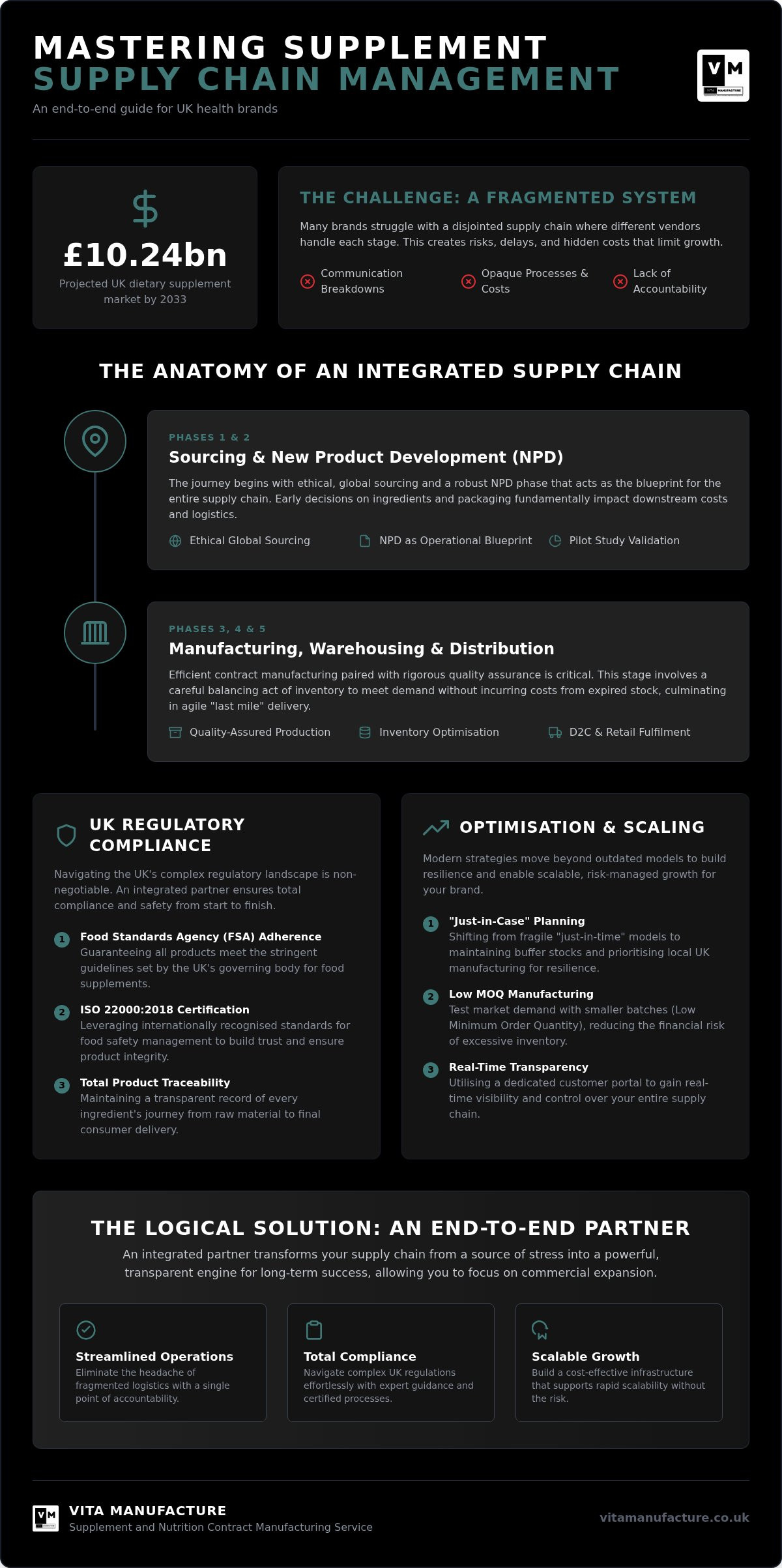
Could a single delayed shipment of raw magnesium be the invisible ceiling on your brand's growth? You've likely felt the frustration of unreliable lead times or the headache of navigating the Food Standards Agency's latest guidelines. Scaling a health brand is difficult enough without the constant worry of fragmented logistics or opaque manufacturing processes. We understand that your priority is commercial expansion, not getting bogged down in the minutiae of food safety paperwork. This guide empowers you to master supplement supply chain management UK from the ground up, moving seamlessly from raw ingredient sourcing to final customer delivery. With the UK dietary supplements market projected to reach USD 10.24 billion by 2033, the stakes for your operational efficiency have never been higher. You'll learn how to ensure total regulatory compliance whilst building a streamlined, cost-effective infrastructure that supports rapid scalability. We'll examine how total product traceability and integrated R&D can transform your operations from a source of daily stress into a powerful, transparent engine for long-term success.
Table of Contents
What is Supplement Supply Chain Management in the UK?
Effective supplement supply chain management UK is far more than just moving boxes from a warehouse to a customer's doorstep. It's a comprehensive, end-to-end lifecycle that begins the moment a raw ingredient is sourced and only concludes when the final, compliant product reaches the consumer. In the UK, this process is governed by a unique set of regulatory hurdles and logistical nuances that demand absolute precision. Are you viewing your supply chain as a cost centre or a strategic asset?
The chain involves a delicate dance between three primary groups: suppliers providing high-purity raw materials, manufacturers transforming those materials into finished dosages, and distributors ensuring the product reaches the market safely. Many brands struggle with a fragmented model where each stage is handled by a different vendor. This often leads to communication breakdowns, hidden costs, and a lack of accountability. An integrated approach provides a seamless flow of data, ensuring that every stakeholder is aligned with your commercial growth.
The Complexity of the Modern Nutraceutical Journey
Sourcing raw materials is a global endeavour. You might find your botanical extracts in India and your vitamins in Europe, but bringing them together requires meticulous coordination. Finite shelf lives mean that speed is a non-negotiable requirement. A delay of just a few weeks can significantly impact your product's commercial viability. Additionally, many vitamins and probiotics require temperature-controlled environments to maintain their potency. This adds another layer of logistical complexity that requires specialist expertise to manage effectively.
Why UK Brands Must Prioritise Supply Chain Resilience
Recent global disruptions have exposed the fragility of the "just-in-time" delivery model. For UK brands, relying on distant suppliers for every component is a risk that can lead to empty shelves and lost revenue. We're seeing a strategic shift towards "just-in-case" planning. This involves businesses maintaining buffer stocks and prioritising local UK-based manufacturing to mitigate risk. Moving production closer to home doesn't just reduce lead times. It offers greater oversight and ensures your brand can weather unforeseen market shifts without compromising on quality or availability.
The Anatomy of an Integrated Supplement Supply Chain
Think of your supply chain as a single, living organism rather than a collection of disconnected departments. When you treat manufacturing and logistics as separate silos, you invite inefficiency and risk. In a truly integrated model, every decision made during the formulation stage ripples through to the final delivery. Successful supplement supply chain management UK relies on this holistic view, where the scientific development of your product serves as the operational blueprint for everything that follows.
Phase 1 & 2: Sourcing and Product Development
Your journey begins with sourcing, which in 2026 is as much about ethics as it is about purity. Consumers now demand transparency regarding where their botanical extracts or marine oils originate. Beyond ethics, your New Product Development (NPD) phase dictates your future shipping costs. A formulation that requires heavy glass packaging or specific temperature controls will fundamentally alter your distribution budget. This is why we advocate for conducting a Pilot Study and Market Research before committing to mass production. It allows you to validate your supply chain assumptions in a controlled environment, ensuring your product is commercially viable before you scale.
Phase 3, 4 & 5: Production, Warehousing, and Distribution
Once the blueprint is set, the focus shifts to Contract Manufacturing. Here, efficiency is the primary driver of downstream success. High-quality production must be paired with rigorous quality assurance checks to meet UK food supplement regulations. At this stage, inventory management becomes a balancing act. You must maintain enough stock to prevent frustrating stockouts whilst avoiding the high costs of expired goods.
The "last mile" is particularly critical in the UK market. Whether you are fulfilling Direct-to-Consumer (D2C) orders or supplying major retail chains, your distribution strategy must be agile. An integrated partner provides a transparent customer portal, giving you real-time data on stock levels and shipment status. This visibility eliminates the guesswork and allows you to pivot quickly if market demand shifts. By aligning your production cycles with your distribution needs, you create a resilient system that supports long-term brand equity and customer trust.
Navigating UK Regulatory Compliance and Quality Standards
Compliance isn't a hurdle to be cleared; it's the bedrock of your brand's reputation. In the British market, the Food Standards Agency (FSA) acts as the primary guardian of consumer safety. Mastering supplement supply chain management UK requires more than just logistical talent; it demands a deep commitment to regulatory rigour. Whilst the FSA doesn't require pre-market authorisation for most products, every business must be registered as a Food Business Operator (FBO). This puts the onus of safety and compliance directly on you. Are you prepared for the scrutiny of post-market checks?
Adopting high standards aligns with broader supply chain best practices that protect both the business and the end consumer. From precise labelling of active ingredients to ensuring your health claims don't cross into medicinal territory, every detail matters. Failure to comply doesn't just lead to fines. It can result in total product recalls that devastate your commercial viability overnight.
ISO 22000 vs. GMP: Understanding the Difference
Many founders confuse Good Manufacturing Practice (GMP) with more comprehensive certifications. GMP is a vital baseline that ensures products are consistently produced according to quality standards. However, ISO 22000:2018 is the true gold standard for those seeking a visionary growth partner. It's a complete food safety management system that looks at the entire supply chain, identifying potential hazards before they manifest. Choosing a partner with this certification builds immediate trust with retailers and sophisticated consumers who recognise the scientific rigour behind your production.
Traceability: The Backbone of Consumer Safety
Traceability is your safety net. We operate on the "one step forward, one step back" principle, ensuring we can pinpoint the exact journey of every ingredient. If a specific batch of raw magnesium is flagged, our digital systems allow us to identify every unit affected within minutes. This level of transparency is only possible when your manufacturing and distribution data are integrated into a single source of truth. Batch records serve as the ultimate, immutable proof of your brand's compliance and operational integrity. By maintaining these meticulous records, you don't just follow the law; you prove that your brand is built on a foundation of reliability and shared ambition.
Strategies for Optimising and Scaling Your Supply Chain
Scaling a health brand in the UK requires a fundamental shift from reactive problem-solving to proactive strategic planning. How do you grow your volume without losing your grip on quality or cash flow? The answer lies in agile supplement supply chain management UK. By utilising low MOQ manufacturing, you can test new formulations in the market without committing to massive capital expenditure. This "test and learn" approach ensures that you only invest heavily in products with proven commercial viability, protecting your margins during the critical early stages of growth.
Efficiency doesn't mean cutting corners; it means eliminating waste. By integrating R&D, manufacturing, and distribution under one roof, you remove the "middleman" markups and communication delays associated with multiple vendors. This streamlined infrastructure doesn't just save money. It protects your timeline. In a market where consumer trends shift rapidly, the ability to move from a pilot study to full-scale distribution in record time is your greatest competitive advantage.
Leveraging Technology for Real-Time Visibility
Transparency is the antidote to supply chain anxiety. Traditional manufacturing often leaves brands in the dark until the final shipment arrives. We solve this through a dedicated customer portal that provides real-time tracking of production and stock levels. Cloud-based inventory management eliminates the risks associated with manual spreadsheets, ensuring that your data is accurate and accessible. When you can see exactly where your raw materials are or how many units are currently in distribution, you can identify and eliminate bottlenecks before they impact your bottom line.
Scaling from Start-up to National Brand
Transitioning from small-batch production to national distribution is a high-stakes evolution. As your volume increases, so does the complexity of managing multi-channel distribution across web platforms, Amazon, and physical retail. Fragmented logistics become a liability at this stage. Consolidating your operations with an all-in-one partner reduces operational friction and ensures that your brand message remains consistent across all touchpoints. This unified approach allows you to focus on marketing and brand development whilst your partner handles the intricacies of Logistics and Distribution.
Managing the transition to large-scale production requires a partner who thinks like a business owner. You need more than a service provider; you need a strategic ally who understands the nuances of bulk sourcing and international standards. A consolidated supply chain ensures that as you scale, your quality remains unshakeable and your delivery remains punctual. This reliability is what transforms a promising start-up into a household name.
Why an End-to-End Partner is the Logical Solution
Managing a fragmented supply chain is a recipe for operational friction. When your R&D team, manufacturer, and logistics provider operate as separate entities, miscommunication is inevitable. Every handoff between vendors represents a potential point of failure, leading to delayed launches and inconsistent product quality. Who takes responsibility when a shipment of raw materials fails a purity test or a distribution deadline is missed? Mastering supplement supply chain management UK requires a single point of accountability. An end-to-end partner doesn't just provide services; they act as a strategic ally who understands the high stakes of your commercial growth.
By consolidating your operations, you eliminate the "middleman" markups and the logistical headaches of coordinating multiple vendors. This all-in-one model provides the stability needed to scale a health brand with confidence. Are you ready to stop troubleshooting vendor disputes and start focusing on your long-term vision?
The Vita Manufacture Approach to Supply Chain Excellence
Our methodology is built on the principle of total integration. By housing New Product Development, Contract Manufacturing, and Logistics under one roof, we provide a streamlined approach to supplement supply chain management UK. This centralised facility ensures that the scientific integrity of your formulation is preserved from the lab to the warehouse. Every phase of production is governed by ISO 22000:2018 standards, providing the scientific rigour necessary to counter any concerns regarding quality control or food safety compliance.
Transparency is the foundation of our partnership. Our dedicated customer portal serves as a key differentiator, offering real-time visibility into your production cycles and stock levels. You no longer have to wait for weekly reports to understand your inventory status. This immediate access to data allows you to make informed commercial decisions, ensuring your brand remains agile in a competitive market.
Securing Your Brand's Future in the UK Market
Reliability is the most valuable asset in the nutraceutical sector. A robust supply chain allows for faster market entry, giving you the ability to capitalise on emerging health trends before your competitors. When your operational infrastructure is secure, you can dedicate your energy to brand development and strategic marketing whilst we handle the heavy lifting of distribution and bulk sourcing. This partnership model is designed for founders who prioritise scalability and commercial viability above all else. If you're looking to streamline your operations and guarantee total product traceability, now is the time to consult with experts who can design a tailored strategy for your brand's unique needs. Learn more about how we can support your growth at vitamanufacture.co.uk.
Securing Your Competitive Advantage in the Nutraceutical Market
Mastering your supplement supply chain management UK is the defining difference between a brand that merely survives and one that dominates the market. You've seen how integrating R&D with manufacturing and distribution eliminates the friction of fragmented logistics. By prioritising an ISO 22000:2018 Certified Facility, you ensure your products meet the highest safety standards whilst building unshakeable consumer trust. Real-time visibility through a Real-time Customer Portal isn't just a luxury; it's a commercial necessity for scaling with precision. Your brand's growth shouldn't be limited by operational bottlenecks or opaque processes. By consolidating your efforts with a partner that offers End-to-End R&D, Manufacturing, and Logistics, you reclaim the time needed to focus on your strategic expansion. Streamline your supplement supply chain with Vita Manufacture's end-to-end solutions. Your vision deserves a partner that matches your entrepreneurial ambition. Let's build a resilient, transparent, and highly profitable future for your health brand together.
Frequently Asked Questions
What are the main challenges of supplement supply chain management in the UK?
The primary challenges in supplement supply chain management UK include navigating complex Food Standards Agency regulations and managing unreliable lead times for raw materials. Fragmented logistics often lead to communication breakdowns and hidden costs when multiple vendors are involved. Maintaining total product traceability whilst scaling volume is a significant operational hurdle for growing brands. Integrated solutions mitigate these risks by providing a single point of accountability from sourcing to distribution.
How does ISO 22000 certification affect my supplement brand?
ISO 22000:2018 certification serves as a comprehensive food safety management system that covers the entire supply chain. Unlike basic GMP, this standard identifies and controls safety hazards before they manifest in the final product. For your brand, this builds immediate credibility with retailers and consumers who prioritise scientific rigour. It ensures that every stage of production meets rigorous international standards, protecting your brand's reputation and commercial viability.
Can I manage my own logistics as a small supplement start-up?
Whilst you can manage your own logistics, the complexity of UK food safety regulations and the high costs of fragmented shipping often make it commercially unviable. Small start-ups frequently struggle with storage requirements and real-time tracking. Partnering with a specialist for logistics and distribution allows you to focus on marketing and brand growth. This transition ensures your products are stored and delivered under compliant, professional conditions without the overhead of internal warehousing.
What is the difference between private label and custom contract manufacturing in terms of logistics?
Private label supplements typically involve pre-formulated products, which simplifies the initial sourcing phase and speeds up the distribution cycle. Custom contract manufacturing requires a more complex supply chain, including unique raw ingredient sourcing and bespoke R&D phases. From a logistics perspective, custom orders often demand more precise inventory forecasting and longer lead times. Both models benefit from an integrated approach that manages everything from the factory floor to the final destination.
How long does the typical supplement manufacturing and distribution cycle take in the UK?
The duration of a manufacturing and distribution cycle varies significantly based on product complexity and raw material availability. A standard production run might take several weeks, but custom formulations requiring extensive R&D or pilot studies will extend this timeline. Integrated supplement supply chain management UK reduces delays by eliminating vendor handoffs. Utilising a transparent customer portal allows you to track real-time progress, helping you plan your market entry with greater accuracy.
What are the labelling requirements for supplements sold on the UK market?
UK supplement labels must comply with strict Food Standards Agency guidelines, including the clear declaration of active ingredients and allergens. You must specify the recommended daily dose and ensure that any health claims are legally permitted and not medicinal in nature. Precise labelling is a critical component of regulatory compliance. Working with a partner that understands these nuances prevents costly recalls and ensures your brand remains compliant with current British legislation.
How do I ensure raw ingredient traceability for my vitamin brand?
Ensuring traceability requires a rigorous "one step forward, one step back" digital tracking system for every raw material. You must maintain detailed batch records that identify the origin of every botanical extract or mineral used in your formulation. This transparency is essential for managing potential recalls and maintaining quality assurance. Digital customer portals provide real-time access to this data, allowing you to prove your product's integrity to retailers and regulatory bodies.
Why is low MOQ manufacturing important for supply chain testing?
Low Minimum Order Quantities (MOQs) are vital for testing new formulations without committing to excessive capital expenditure. This approach allows you to conduct pilot studies and market research to validate consumer demand before scaling up production. It reduces the risk of holding expired inventory and allows for more agile inventory management. Scaling from small batches to national distribution becomes a logical, data-driven process rather than a financial gamble.