Supplement Stability Testing Guide for UK Brands
A shelf-life date shouldn’t be a best guess. The supplement stability testing process builds product-specific evidence about how potency, appearance and quality may change over time, helping you make a more confident decision about how long your product can remain on sale.
If you’re unsure whether to use real-time, accelerated or stress testing, the first step is to define the decision you need the data to support. The right approach depends on the formulation, packaging and intended storage conditions. A generic protocol may miss the issues that matter most to your product, while focused testing can highlight problems early enough to inform development choices.
This guide explains the key stages of a stability study, what each testing approach can tell you and how to interpret results against defined acceptance criteria. You’ll learn how to plan a proportionate, product-specific strategy and connect the evidence with formulation, packaging and launch decisions. Considering stability alongside product development and manufacturing gives you a clearer basis for a shelf-life decision.
Table of Contents
What is the supplement stability testing process, and why does it matter?
How the supplement stability testing process moves from protocol to results
Real-time, accelerated and stress testing: which stability approach answers your question?
How to plan supplement stability testing around formulation, packaging and UK requirements
How to interpret stability results and turn them into product-development decisions
What is the supplement stability testing process, and why does it matter?
The supplement stability testing process tracks selected attributes of a finished supplement over time under planned storage conditions. It builds evidence to assess product quality and support a reasoned shelf-life decision. The aim is to understand whether the product is likely to remain within its defined specification for the period you intend to state on the label.
That evidence supports commercial decisions as well as quality planning. A suitable shelf life can inform labelling, stock management and launch timelines. Findings can also flag a need to review a formulation or pack before production scales. Stability testing does not promise that every batch or storage situation will behave identically. Its conclusions apply to the product and conditions actually studied.
The scientific principles involve observing how environmental factors can affect a product over time. This Stability testing process overview provides useful background, although its pharmaceutical context should not be treated as a supplement-specific protocol or regulatory requirement.
What does stability mean for a finished supplement?
Stability can involve physical, chemical and microbiological attributes. Depending on the product, monitoring may include active ingredient potency, colour, odour, moisture, tablet integrity or relevant microbiological measures. A change in one attribute might affect product quality, usability or whether the supplement still meets its specification.
There’s no universal list of tests. A tablet, powder, liquid or capsule can have different stability risks. The ingredients and product specification help determine which attributes matter. Focus the study on meaningful measures for the specific product rather than applying a generic checklist without considering its formulation.
Why is shelf-life evidence product-specific?
Small differences can matter. Ingredient combinations, ingredient characteristics and the manufacturing process may influence how a supplement changes over time. Packaging is part of the picture too: the pack and closure affect the environment around the product, so evidence from one pack format may not directly support a different one.
Results from a similar product can provide context, but they can’t automatically validate another formulation. A sound shelf-life decision links documented study data to the defined product specification, including the formulation, packaging and storage conditions represented in the study. If any of these change, reassess whether the evidence remains relevant.
Think of stability planning as part of product development, not a final box to tick. Coordinating formulation, packaging and manufacturing decisions early gives you a clearer basis for deciding what to monitor and how results can inform a commercially sound shelf life.
How the supplement stability testing process moves from protocol to results
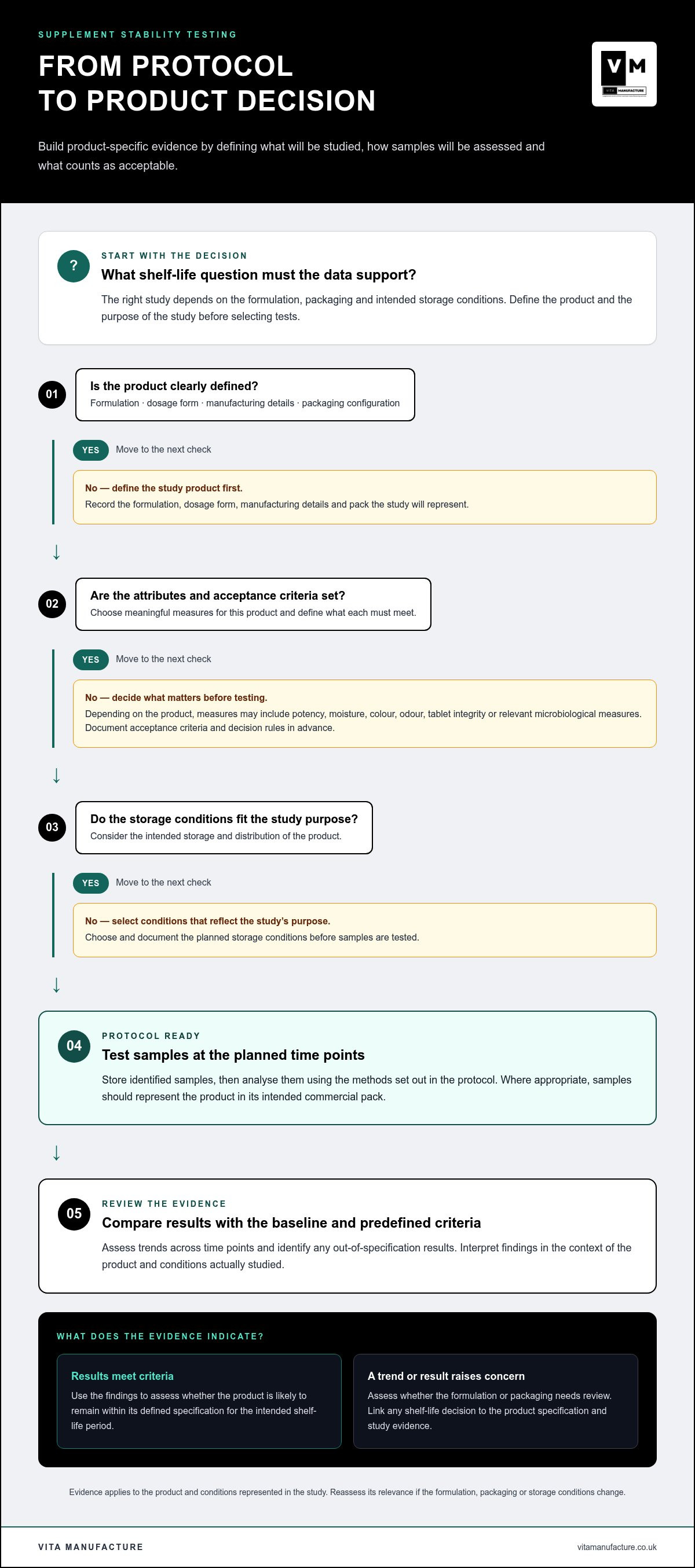
A useful stability study is planned before samples are tested. The protocol connects the product you’re making with the evidence you need, so results can inform decisions rather than simply generate data. Define the product, study question and intended use of the findings before selecting tests.
Define the product. Record the formulation, dosage form, manufacturing details and packaging configuration the study will represent.
Set criteria. Identify the product attributes to monitor and the specification or acceptance criteria each must meet.
Select conditions. Choose storage conditions that reflect the study’s purpose and the product’s intended storage and distribution.
Test samples. Store identified samples, then analyse them at the time points set out in the protocol.
Review results. Compare findings with the starting measurements and predefined criteria, then assess any trends or out-of-specification results.
In short: the protocol defines what will be studied, how and when samples will be assessed, and what counts as acceptable. Interpretation then uses the resulting data to evaluate product stability and guide decisions.
How are stability protocols and acceptance criteria set?
Start with the product specification, ingredient risks, dosage form and packaging configuration. These inform which attributes are meaningful to measure, such as potency, moisture or physical integrity, and which analytical methods are suitable. Before the study begins, the protocol should identify the samples, storage conditions, sampling time points and test methods.
Document acceptance criteria and decision rules in advance. This gives results a clear point of comparison and helps prevent criteria being adjusted simply to fit an unexpected finding. The ICH Q1 stability testing guidelines provide technical background on stability study design; consider their applicability in the context of the supplement and its requirements.
What happens during sampling and laboratory analysis?
Samples should represent the product and, where appropriate, be stored in the intended commercial pack. At scheduled time points, analyse samples and compare the results with the starting measurements and the specification. The protocol should also state how samples are identified and handled, so findings can be interpreted in context. Consistent sample handling and clear records make it easier to investigate an unexpected result.
There isn’t one universal laboratory panel. Methods depend on the attribute being assessed and the product: a potency test, for example, answers a different question from a check of tablet integrity. Align stability considerations with formulation, packaging and manufacturing choices. Vita Manufacture supports founders through supplement product development as they progress towards manufacture.
Real-time, accelerated and stress testing: which stability approach answers your question?
Each approach answers a different question. Real-time studies show how a product changes under defined storage conditions over time. Accelerated studies examine change under more demanding conditions, whilst stress testing explores possible degradation pathways. In the supplement stability testing process, choose an approach according to the decision you need the evidence to support.
When is real-time stability testing most useful?
Real-time testing is most relevant when you need to understand product behaviour under the storage conditions your study is designed to represent. Measurements at planned intervals build a record that can be reviewed against the product specification as data accumulates. Set the study duration and sampling points for the product and purpose; there’s no single timeline or guaranteed outcome that suits every supplement.
What can accelerated or stress testing tell a brand?
These approaches can help identify potential weaknesses during development. For example, accelerated results may prompt a closer look at a sensitive ingredient or packaging choice, whilst stress testing may help investigate how a product degrades under challenging exposure. Use them to answer focused questions, not as shortcuts that turn limited results into proof of a particular shelf life.
Interpret findings alongside formulation knowledge, packaging details and available real-time evidence. An accelerated condition may produce a different change mechanism from the one seen during ordinary storage, so its results shouldn’t be treated as a direct substitute for real-time data.
Pharmaceutical ICH stability protocols can offer scientific context, but they aren’t automatically a universal requirement for food supplements. Design the study in proportion to the product, its intended storage conditions and the decision being made. Coordinating the plan with formulation and packaging development keeps testing relevant to the product without overstating what any one approach can establish.
How to plan supplement stability testing around formulation, packaging and UK requirements
A useful stability plan starts with the product you intend to manufacture and sell, not a standard test panel. Formulation, dosage form, pack and expected storage conditions all shape what should be assessed. Bring these decisions together early so the study reflects the commercial product and can inform development choices.
Which product and packaging factors shape the study?
Use this checklist to frame the study rationale:
Dosage form: Tablets, capsules, powders and liquids can have different physical and stability considerations.
Formula: Consider whether moisture, oxygen, light, heat or interactions between ingredients could affect the attributes you plan to monitor.
Packaging: Record the pack material and closure. A change to either may alter the product’s exposure to its environment and warrant a review of existing evidence.
Storage and distribution: Define the conditions the study is intended to represent, taking account of how the product is expected to be stored and distributed.
The point isn’t to assume that every product faces every risk. Use the formula and pack details to select relevant attributes and conditions, then document why they fit. Laboratory testing generates analytical results against an agreed protocol; coordinated development planning connects those results with formulation, packaging and manufacturing decisions. The two are complementary: testing generates evidence, while development planning helps apply it to the product.
How should UK compliance fit into stability planning?
Shelf-life evidence is one part of product quality planning. It doesn’t replace broader responsibilities for food-supplement safety, specifications, labelling or permitted claims. The Food Standards Agency’s guidance is a useful starting point for understanding consumer-facing supplement information. Check current requirements for the specific product and its intended UK market before finalising labels or claims.
Stability decisions should sit alongside those checks, rather than being treated as proof of overall regulatory compliance. Vita Manufacture’s UK supplement regulations guide can help place development and manufacturing considerations in context.
Pharmaceutical ICH stability guidance can provide scientific background, but it isn’t automatically a universal requirement for food supplements. Build the study around the supplement’s specification and intended use, and ensure the selected methods and conditions fit the product and study protocol. For founders bringing a concept towards manufacture, plan your supplement product development with formulation, packaging and stability considerations aligned from the outset.
How to interpret stability results and turn them into product-development decisions
Stability data is most useful when it leads to a clear, documented decision. In the supplement stability testing process, don’t judge shelf life from one result in isolation. Review the pattern across time points and compare it with the study protocol, product specification and conditions represented by the data.
What should a brand look for in a stability report?
First, check that the report relates to the product and pack you intend to sell. Review sample identification, test methods, scheduled time points and recorded storage conditions. Then compare each result with the predefined specification. A result within limits may still deserve attention if it forms part of a consistent change over time.
Use the pattern to guide the next step:
Results remain within specification with no concerning trend: retain the specification and assess whether the full body of relevant data supports the proposed shelf life.
Variation appears between time points: document an investigation into the result, method, sample or study conditions rather than assuming it is harmless.
A result falls outside specification or a trend raises concern: assess the potential impact and consider whether the formulation, packaging or shelf-life decision needs review.
Any shelf-life decision should have a documented rationale that connects the relevant data to the specification and study conditions. A single passing result, or a result from a different formulation or pack, doesn’t establish the full product’s shelf life.
How can stability findings inform the next development stage?
Findings can shape practical development choices. If an attribute changes over time, investigate whether the formulation, ingredient interactions, pack material or closure may be contributing. Assess a proposed change for its effect on the product and on the relevance of existing study evidence. Manufacturing scale-up decisions should also reflect the product and process represented by the data.
Stability review can continue after launch as part of ongoing quality oversight. Documenting trends and decisions creates a clearer record for future product reviews, especially if the formulation, packaging or manufacturing process changes. Stability evidence informs these decisions, but doesn’t guarantee identical behaviour across every batch or storage situation.
For formulation-led development, Vita Manufacture supports coordinated product development, including formulation, regulatory guidance and production planning. To progress from concept towards manufacture, explore Vita Manufacture’s product development support.
Build shelf-life confidence into your next product decision
A credible shelf-life decision rests on evidence for the specific formulation, packaging and study conditions, not a generic protocol. The supplement stability testing process can also reveal when a trend needs investigation or when development choices merit review. Real-time, accelerated and stress studies each answer different questions, so choose an approach that fits the decision you need to make.
Bring stability planning into product development early, alongside formulation, packaging, regulatory guidance and production planning. Vita Manufacture is ISO 22000:2018-certified, a food-safety management credential rather than stability-testing accreditation. Its support also includes a transparent customer portal and end-to-end manufacturing and logistics, helping founders progress from concept towards production with coordinated decisions.
Explore Vita Manufacture’s product development support and take the next step towards building a product with a well-planned route to market.
Frequently Asked Questions
What is the supplement stability testing process?
The supplement stability testing process assesses how selected product attributes change over time under planned storage conditions. A protocol defines the product and packaging being studied, the conditions, sampling time points, suitable analytical methods and acceptance criteria. Results are compared with the starting measurements and product specification to assess whether quality is maintained and inform a shelf-life decision. The evidence applies to the product and conditions represented in the study, not every possible batch or storage situation.
How long does supplement stability testing take?
There’s no fixed duration for every study. Real-time testing follows the planned storage conditions over the period relevant to the shelf-life decision, with samples analysed at protocol-defined intervals. Accelerated or stress testing may provide earlier information about potential vulnerabilities, but doesn’t automatically replace real-time evidence. The study duration and sampling schedule depend on the product, its specification, the attributes being monitored and the question the study is intended to answer.
What is the difference between real-time and accelerated stability testing?
Real-time testing monitors a supplement under defined storage conditions over time, providing direct evidence about its behaviour in those conditions. Accelerated testing assesses change under more demanding conditions, which can help identify potential vulnerabilities sooner. The approaches answer different questions: accelerated findings can inform development, but may not mirror every change mechanism seen during real-time storage. A product-specific study may use both, with results interpreted in context.
Can accelerated stability testing determine a supplement’s shelf life?
Accelerated testing alone shouldn’t be treated as definitive proof of a supplement’s shelf life. It can help assess potential changes under more demanding conditions and support an early development decision, but those results may not predict every real-time change. A defensible shelf-life decision should consider relevant study data, the product specification, formulation, packaging and intended storage conditions. Interpret accelerated results alongside available real-time evidence and document the reasoning behind the decision.
Which tests are included in supplement stability testing?
There isn’t one universal test panel. The selected tests depend on the ingredients, dosage form, specification and likely stability risks. For example, a protocol might monitor active ingredient potency, moisture, colour, odour or tablet integrity; microbiological attributes may also be relevant to the product. Each method should suit the attribute being assessed, and the protocol should state acceptance criteria before results are reviewed.
Do UK supplement brands have to follow ICH stability guidelines?
ICH pharmaceutical stability guidelines aren’t automatically a universal requirement for food supplements. They can provide useful scientific context, but a supplement study should be designed for the product, its specification and the decision it needs to support. UK food-supplement responsibilities are broader than shelf-life evidence, so brands should verify current requirements using authoritative guidance, including relevant Food Standards Agency information, and consider product-specific regulatory guidance.
Does changing supplement packaging mean stability testing must be repeated?
Not necessarily, but a packaging change should prompt a review of whether existing stability evidence still applies. A different material or closure could change exposure to moisture, oxygen or light, depending on the product and pack. Compare the proposed packaging with the configuration represented in the study, then document whether further testing or other evidence is appropriate. The decision depends on the nature of the change and its relevance to product quality.