Supplement Formulation Development: A Strategic Guide
What if the ingredient that makes your supplement concept exciting is also the one that makes it difficult to produce consistently? A strong idea needs more than a compelling ingredient list. Successful supplement formulation development brings scientific rationale, serving size, product format and manufacturing feasibility into the same conversation from the start.
If you’re turning a broad idea into a clear brief, you may have questions. Which ingredients fit your product’s purpose? Will the intended serving work in a capsule, powder or another format? What quality and regulatory considerations should you raise before moving towards production? These choices shape not only the formula, but also its place in your brand and market.
This guide gives you a practical framework for assessing a formulation concept, weighing ingredient and format decisions, and preparing for discussions with development and manufacturing experts. You’ll see how a product brief can progress through prototype development and feasibility planning towards production readiness, with key considerations to keep in view. The goal is a product concept that is evidence-informed, commercially considered and designed with manufacture in mind.
Table of Contents
What does supplement formulation development involve?
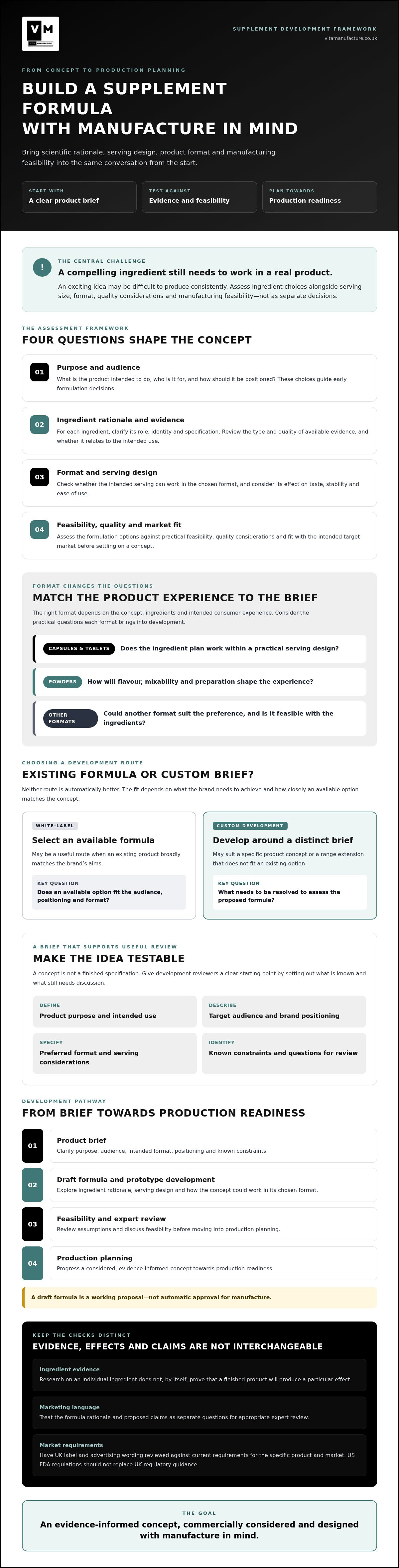
Supplement formulation development turns a product brief into a considered, testable formula, with ingredients, serving design and format assessed before production decisions are made. It connects the idea behind a product with the practical questions needed to judge whether it can be developed for a particular audience and market.
This differs from choosing a finished, off-the-shelf product. With a white-label option, a brand selects from formulas already available. Custom development starts with a distinct brief and explores how a formula could meet it. Neither route is automatically better. The right choice depends on what your brand needs to achieve and how closely an existing option fits the concept.
A supplement’s intended purpose, target consumer and market positioning shape early decisions. A product for people who prefer a convenient daily routine may call for different format considerations from one positioned around a particular flavour experience. For foundational context on supplement types and ingredients, see this overview of the Dietary supplement.
What is the difference between a concept and a formula?
A concept describes the product you want to create and who it is for. It might outline the intended use, audience, brand positioning and preferred format, but it isn’t a finished specification. In the direct-to-consumer space, services such as Zenutri Personalised Vitamins illustrate how concepts can be shaped around individual wellness needs and daily routines. Turning an idea like this into a draft formula raises questions for development: which ingredients have a clear rationale, how could they work in the chosen format, and what serving design needs review?
A draft formula is a working proposal, not automatic approval for manufacture. A suitably experienced development and manufacturing partner can review its assumptions and discuss feasibility before production planning moves forward.
Who needs custom supplement formulation development?
Custom development may suit founders with a specific product brief, as well as established brands looking to expand their range with a concept that doesn’t fit an existing option. If you’re still shaping your idea, the custom supplement formulation checklist can help you organise the questions to resolve.
A white-label product may be a useful route when an existing formula broadly matches your aims. Decide whether your priorities are best served by selecting an available option or developing a formula around a more distinct brief. Either way, make the intended audience, positioning and format clear early. This gives expert reviewers a stronger starting point for assessing the concept.
How evidence, ingredients and format shape a supplement formula
A sound formula starts with a clear reason for every ingredient. The intended use and target audience help shape that rationale, whilst evidence quality, ingredient specifications and product positioning help determine whether each choice belongs in the brief. A popular ingredient isn’t automatically the right one. It needs to make sense for the concept and the product the brand intends to bring to market.
Ingredient selection needs to fit both the product brief and the intended format. Otherwise, a promising concept may be impractical to deliver as designed.
How should brands assess an ingredient rationale?
Ask what role each ingredient serves and why it’s relevant to the intended audience. Review the type and quality of available evidence, the ingredient’s identity and specification, and whether the evidence relates to the intended use. Research on an individual ingredient doesn’t, by itself, prove that a finished product will produce a particular effect. Treat the formula rationale and any proposed marketing language as separate questions for appropriate expert review.
Scientific plausibility and permitted marketing claims aren’t interchangeable. Before making claims on a UK product label or in advertising, have the proposed wording reviewed against current UK requirements for the specific product and market. The FDA’s regulations for dietary supplements are relevant to US-market planning, but shouldn’t be treated as a substitute for UK regulatory guidance.
How does product format change formulation decisions?
Format affects both the consumer experience and the development brief. Capsules and tablets need to work within a practical serving design. Powders raise questions about flavour, mixability and preparation. Other formats may suit different preferences, but feasibility depends on the ingredients, manufacturing process and a partner’s capabilities. No format is automatically right for every concept.
Consider the trade-offs early:
Palatability: Could the ingredients create a taste or texture that affects regular use, particularly in a powder?
Serving practicality: Does the proposed format allow for a serving the target consumer can use comfortably?
Compatibility and stability: Do the ingredients and chosen format need specific review or protective packaging?
Manufacturing feasibility: Can the proposed combination be made consistently using the available process and capabilities?
These are development questions to review, not assumptions to settle in isolation. In supplement formulation development, collaborative review can connect ingredient rationale with practical design and production planning. If you’re exploring that route, consider discussing your brief with a partner offering new product development and contract manufacturing.
How to compare formulation options for commercial viability
A formula can look compelling on paper and still raise unanswered questions about sourcing, production or customer appeal. Compare options against the same criteria, then record what’s established and what needs further investigation. This gives you a more useful basis for discussion than choosing a concept simply because it contains more ingredients or sounds more distinctive.
Which formulation criteria should a brand compare?
Use a simple comparison table to assess each option against your customer brief, intended format and product positioning. A narrower formula, for example, might be easier to explain. A multi-ingredient concept may offer a different point of distinction, but need closer review. Treat the table as a decision aid, not proof that a formula is ready to manufacture.
Use the table to capture open questions for formulation, quality or regulatory input. Confirm ingredient availability and process compatibility with relevant experts rather than assuming either from a draft specification. For additional criteria to consider when assessing a manufacturing partner, see the UK supplement manufacturer selection guide.
How can a brand balance differentiation and feasibility?
More ingredients can increase a product’s complexity, but complexity alone doesn’t make a formula more valuable. Ask what each proposed ingredient contributes to the brief, whether the intended customer will understand the product’s purpose, and what further questions it raises about format, sourcing, quality or production. If its contribution is unclear, consider whether it belongs in the concept.
A simpler option may be easier to communicate, whilst a more complex one might better reflect a specific product strategy. Neither is automatically the stronger choice. In supplement formulation development, a concept becomes a more credible commercial proposition only after its market appeal, technical feasibility and costs have been validated. Use the comparison to identify what can be decided now, what needs evidence, and what to discuss with a development and manufacturing partner before proceeding.
What should a supplement formulation development brief include?
A useful brief doesn’t need to be a finished technical specification. It should give a development partner a clear view of the product you’re aiming to create, its audience and the decisions that still need expert input. Separate confirmed requirements from ideas and unanswered questions so assumptions don’t become hidden constraints.
What information should founders prepare first?
Start in plain language. Describe the intended customer, the product concept and how you want it positioned. Then use this sequence to organise your draft brief:
Define the audience: Who is the product intended for, and what needs or preferences should shape its design?
Describe the concept: What is the product’s purpose, and how should it fit your brand and range?
State the target market: Identify where you plan to sell the product, as requirements and review needs can vary by market.
Record format preferences: Note whether you’re considering capsules, tablets, powders or another format, and why.
List ingredient ideas: Include initial preferences and the rationale, if known. Treat these as ideas for review, not confirmed formula requirements.
Note practical constraints: Record known sourcing, packaging or other project considerations that could influence development.
Separate open questions: Flag claims, regulatory matters, ingredient suitability and technical details that need qualified review.
Prepare for discussion: Share the brief with relevant development, quality, regulatory and commercial stakeholders, then agree what needs to be resolved next.
How should teams review a draft formulation?
Check that the proposed ingredients and format still serve the original audience, product purpose and positioning. Invite input from scientific, quality, regulatory and commercial stakeholders. Each may identify different questions, from ingredient specifications to customer fit. Mark decisions as confirmed only when they’ve been properly reviewed, and keep unresolved points visible for the next project discussion.
For more prompts to help shape your preparation, use the custom formulation development checklist. A clear brief makes supplement formulation development a more focused, collaborative conversation, even if some technical details remain undecided. To discuss how your concept could progress towards development and production planning, contact Vita Manufacture about your product brief.
From formulation development to production readiness with a partner
A reviewed formula concept is a starting point, not yet a production-ready product. The next stage is to resolve technical and operational questions, then plan the appropriate steps towards a prototype and production. Keeping development and manufacturing considerations connected can help surface feasibility questions early, before decisions become difficult to change.
What questions should brands resolve before production?
Review the formula, format and proposed packaging with the relevant specialists. Confirm that ingredient specifications are understood and identify what needs checking before a prototype or production plan can be agreed. Testing, documentation and regulatory review depend on the product and its intended market, so a generic checklist is not a substitute for product-specific advice.
Clarify responsibilities and decision points with your development partner. Who will review the formula, confirm specifications and advise on the information needed for the next stage? Agree how decisions and project updates will be shared. These conversations help make remaining assumptions visible before they carry into production planning.
How can an end-to-end partner support the next stage?
Vita Manufacture supports supplement brands with formulation, regulatory guidance, manufacturing and logistics. This joined-up support gives brands a partner to discuss the route from product concept towards production planning, while recognising that the work required depends on the individual brief and target market.
The company’s customer portal supports project transparency. Confirm which features are relevant to your project before relying on it for specific information-sharing needs. Vita Manufacture is ISO 22000:2018-certified.
Before moving forward, use the partner discussion to confirm the current brief, unresolved technical and regulatory questions, and what information each party needs to progress. Strong supplement formulation development depends on clear decisions as well as a sound concept. If you’re ready to discuss the next steps for your idea, discuss a supplement concept with Vita Manufacture.
Move your supplement concept towards its next stage
A strong product idea needs a clear brief, a reasoned ingredient rationale and a format that works for both the intended customer and the manufacturing process. Comparing options against evidence, quality, feasibility and market fit helps show which decisions are ready to make and which need expert review.
That’s the value of a considered approach to supplement formulation development: it brings product ambition and practical questions together early, then creates a clearer route from concept towards prototype and production planning. Testing, specifications and regulatory review should be considered in relation to the product and the markets you intend to serve.
Vita Manufacture offers support across development and manufacturing, alongside regulatory guidance and logistics. The company is ISO 22000:2018-certified, and its customer portal supports project transparency.
Your concept doesn’t need to be fully resolved before the conversation begins. With clear questions and the right expertise around the table, you can take the next step. Discuss your supplement development brief with Vita Manufacture.
Frequently Asked Questions
What is supplement formulation development?
Supplement formulation development turns a product brief into a considered formula for expert review and potential manufacture. It brings together the product’s purpose, target audience, ingredient rationale, serving design and intended format. The process differs from selecting a finished product because development decisions are shaped by your specific concept. A draft formula still needs appropriate scientific, quality, regulatory and manufacturing review before production planning.
How long does it take to develop a supplement formula?
There isn’t one reliable timeframe for every project. The development pathway can depend on how defined the brief is, the ingredients and format being considered, and the reviews or prototype work the product requires. Questions about sourcing, specifications, testing and target markets may also affect planning. Ask a development partner to clarify the project stages, dependencies and decisions that could influence timing before agreeing a schedule.
What information should I provide for a supplement formulation brief?
Provide a plain-language description of your target customer, product purpose, positioning and intended market. Include your preferred format, any ingredient ideas and known sourcing or packaging considerations. Separate confirmed requirements from assumptions, and list open questions about claims, specifications or regulatory review. You don’t need a finished technical formula to begin, but a clear brief helps a development partner identify what needs discussion and assessment.
Can a supplement manufacturer help with ingredient selection?
A manufacturer that offers formulation support may help assess ingredient ideas against the product brief, intended format and manufacturing considerations. Vita Manufacture offers new product development, formulation, and ingredients and bulk sourcing. Discuss the rationale, specifications and intended use for each proposed ingredient, and ask what further review is appropriate. Ingredient selection should be informed by relevant expertise. Evidence about an ingredient alone doesn’t prove the effects of a finished product.
How do brands know whether a supplement formula is suitable for manufacturing?
A formula’s suitability needs to be assessed with the manufacturer and relevant specialists, not assumed from a draft ingredient list. Review whether the ingredients, specifications, serving design, format and packaging requirements can be supported by the proposed process and manufacturing capabilities. Identify any compatibility, quality, sourcing or testing questions that remain open. Production planning should follow appropriate technical and product-specific review, rather than an assumption that the concept is ready.
Does supplement formulation development include regulatory guidance?
It can, depending on the development partner and the project’s agreed scope. Vita Manufacture offers regulatory guidance alongside formulation and manufacturing support. The reviews needed depend on the specific product and the markets where it is intended to be sold. Discuss proposed ingredients, claims, labelling and documentation with qualified specialists, and confirm who is responsible for each review. Don’t treat general guidance as confirmation that every product-specific requirement has been met.
What is the difference between custom formulation and white label supplements?
Custom formulation begins with a brand’s specific brief and develops a formula for review against its product aims. White-label supplements are existing options a brand can select, rather than formulas created from a bespoke concept. The best route depends on how closely an available option matches your audience, positioning and format preferences. Compare the fit and remaining development questions before deciding which approach suits your plans.