Supplement Factory Lead Times: The Complete 2026 Production Planning Guide
What if the production delay frustrating your commercial growth is actually protecting your brand? When you watch retail stock run dangerously low, understanding true supplement factory lead times ceases to be an academic exercise; it becomes a matter of commercial survival. You've likely experienced the sting of unexpected stockouts, dark retail channels, and the opaque silence surrounding raw ingredient quarantine windows. It's deeply frustrating when an initial bespoke run stretches across months whilst customer demand peaks, leaving you to explain costly inventory gaps to key retail partners.
The reality is that production timelines reflect supply chain rigour, not arbitrary operational drag. This 2026 production planning guide will help you master supplement manufacturing timelines to eliminate supply chain bottlenecks and forecast inventory with absolute precision. We'll examine every operational stage that governs the manufacturing critical path, unveiling actionable strategies to accurately forecast re-order points and compress production turnaround with your supply partners.
Table of Contents
Decoding Supplement Factory Lead Times: Industry Benchmarks and Realities
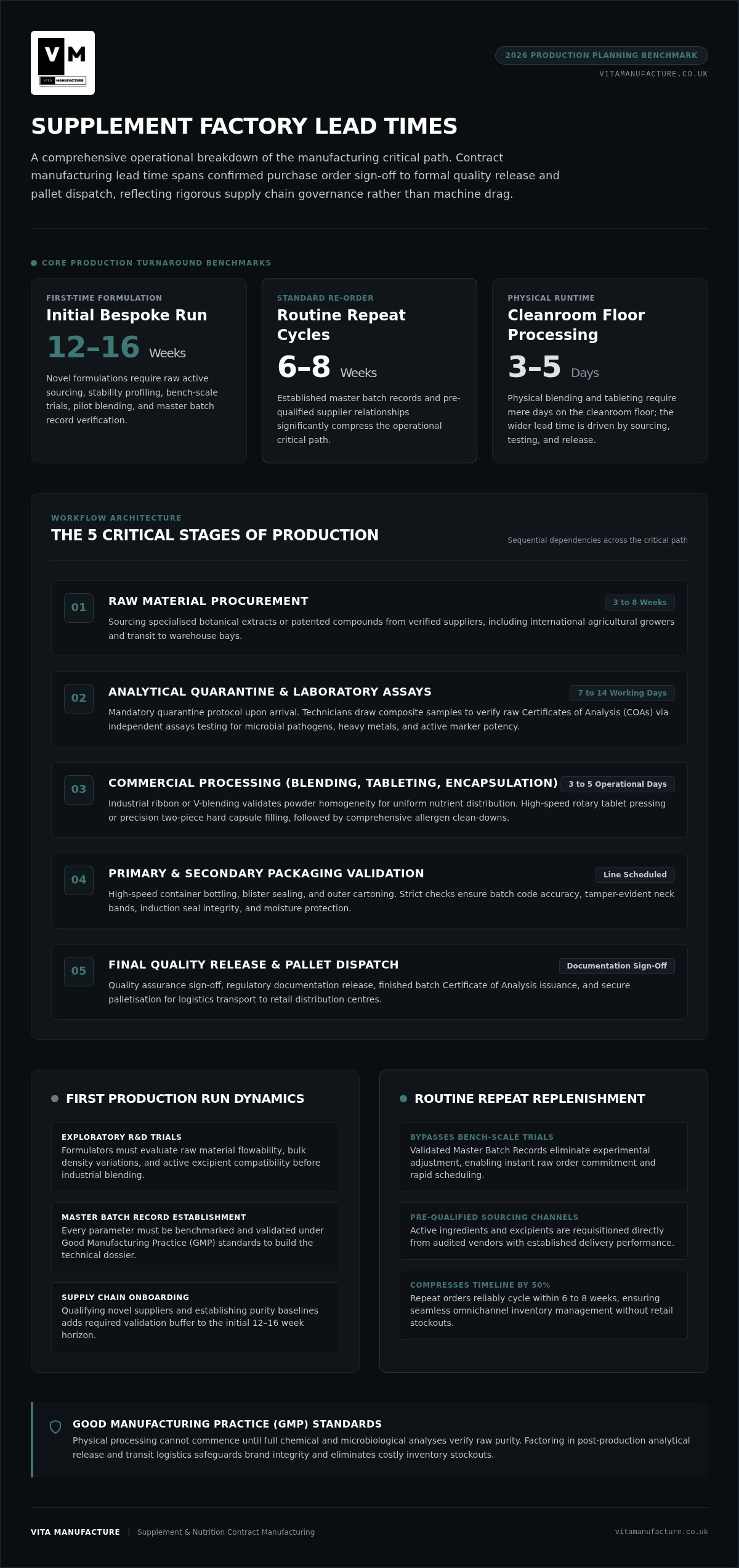
Contract manufacturing lead time is the complete duration spanning confirmed purchase order sign-off to formal quality release and pallet dispatch. Many brand founders mistakenly measure this duration purely by scheduled machine runtime. Blending powders or pressing tablets might only require three to five operational days on the cleanroom floor. However, realistic supplement factory lead times encompass raw material procurement, international shipping, quarantine hold periods, analytical laboratory assays, packaging validation, and regulatory documentation release.
Within the UK market, concrete benchmarks dictate production planning:
Initial bespoke formulations: 12 to 16 weeks. Novel formulations require active ingredient sourcing, stability profiling, pilot blending, and regulatory verification.
Routine repeat production cycles: 6 to 8 weeks. Established master batch records and pre-qualified supplier relationships significantly compress the operational critical path.
The Anatomy of a Manufacturing Critical Path
Factory scheduling slots must be secured weeks before raw materials ever arrive at the warehouse loading bay. If blending suites, encapsulation machines, and bottling lines aren't booked in advance, arriving raw ingredients sit in costly holding bays. Modern facilities adhere strictly to Good Manufacturing Practice (GMP) standards, which dictate that physical processing cannot commence until full chemical and microbiological analyses verify raw purity. Factoring in post-production analytical release and transit logistics protects your business from stockouts far more effectively than wishful thinking.
First Production Runs vs Routine Repeat Orders
Why do initial bespoke runs demand nearly double the turnaround of re-orders? Brand launches require extensive exploratory research and development. Formulators must evaluate raw material flowability, bulk density variations, active excipient compatibility, and organoleptic qualities before committing tonnes of raw materials to industrial blenders. Engaging proven supplement formulation services UK ensures these R&D trials establish a validated master batch record. Once that foundational baseline exists, repeat orders bypass bench-scale trials, accelerating raw procurement and locking in reliable 6-to-8-week replenishment cycles.
The 5 Critical Stages Driving Dietary Supplement Production Timelines
Supplement factory lead times aren't arbitrary waiting periods. They represent five strict, interdependent operational phases: raw ingredient procurement, analytical quarantine testing, commercial processing, primary and secondary packaging, and final quality release. If a single stage slips, the entire critical path shifts backwards. As highlighted in recent reporting on Dietary Supplement Manufacturing Trends, supply chain variability and active ingredient availability remain major drivers of production friction across the sector.
Stage 1 & 2: Material Procurement and Analytical Quarantine
Sourcing specialised botanical extracts or patented compounds can take anywhere from three to eight weeks, particularly when materials originate from international growers. Once raw goods arrive at the factory, they don't move straight to the production floor; they enter mandatory analytical quarantine. Quality technicians draw composite samples to verify raw Certificates of Analysis (COAs) against independent laboratory assays. Mandatory testing for microbial pathogens, heavy metals, and active marker potency typically requires 7 to 14 working days. These testing protocols prevent batch contamination and ensure finished supplements meet strict food safety standards before a single kilogram enters production.
Stage 3: Physical Blending, Tableting, and Encapsulation
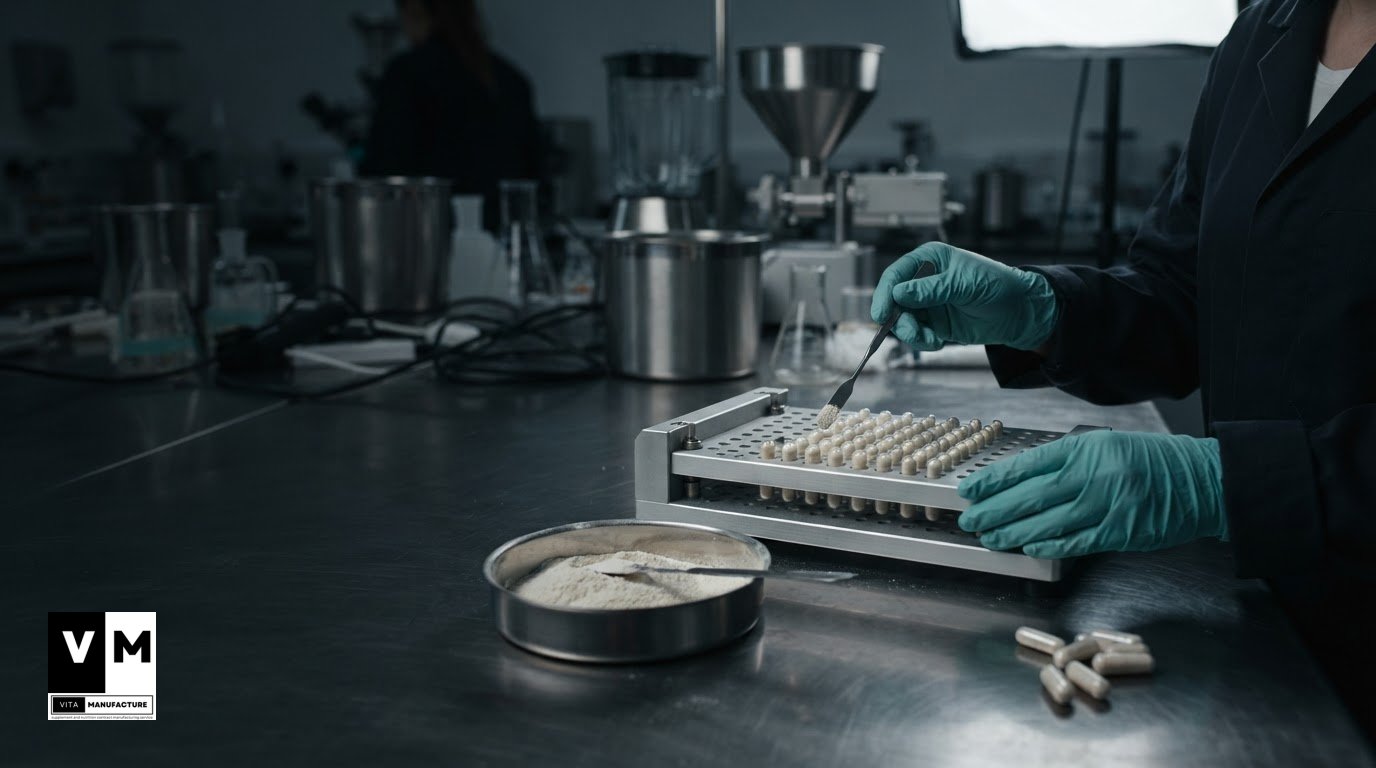
Active processing begins with industrial ribbon or V-blending, where technicians validate powder homogeneity to ensure uniform nutrient distribution across every dose. From there, machine availability and product format dictate throughput speed. High-speed rotary tablet presses can punch out tens of thousands of units per hour, whereas precision two-piece hard capsule filling requires tighter mechanical calibration. Comprehensive clean-down and line changeover protocols between allergen and non-allergen production runs also add necessary turnaround days to factory scheduling.
Stage 4 & 5: Primary Packaging and Final Batch Release
Packaging involves far more than dropping capsules into tubs. Automated packaging lines manage container feeding, desiccant insertion, induction heat sealing, and tamper-evident capping to protect shelf stability. Technicians then oversee meticulous label reconciliation and laser batch coding before finished units are packed into transit cartons. Under ISO 22000 management systems, quality release requires an exhaustive review of all environmental logs and finished-product laboratory assays before pallets leave the loading bay. Collaborating with a reliable partner like Vita Manufacture ensures these complex phases remain transparent, turning potential operational blind spots into predictable milestones.
Bespoke Formulations vs White Label: Lead Time Comparison
Choosing between a completely custom recipe and an established white-label base dictates your entire inventory schedule. Bespoke formulations grant commercial exclusivity and targeted ingredient dosing, yet they demand patience during development. White label supplements, conversely, provide tested recipes that allow rapid market capture. Understanding how these pathways diverge gives you complete control over your commercial launch calendar.
The Custom Formulation Timeline: R&D to Mass Fill
Novel products require rigorous lab-scale validation. Chemists must assess active compound synergy, identify proper excipients, and execute pilot runs to evaluate particle flowability through mechanical hoppers. Furthermore, novel recipes require organoleptic fine-tuning and accelerated stability testing under controlled temperature chambers to confirm active shelf-life claims. Choosing an experienced supplement manufacturer UK partner ensures these developmental trials proceed methodically without unnecessary delays.
White Label and Private Label Speed Advantages
White label manufacturing sidesteps the R&D maze entirely. Because the bulk base formula has already passed stability trials, microbial testing, and industrial blend validations, raw ingredients are frequently kept in stock or sourced swiftly. The remaining operational window focuses strictly on primary container fill, branded label application, and secondary boxing. When market velocity matters more than unique dosing profiles, private label bridges the gap seamlessly.
Delivery Format Sensitivities: Powders, Liquids, and Capsules
Format selection directly influences supplement factory lead times. Standard two-piece hard capsules and loose powder blends clear manufacturing lines swiftly. Conversely, hygroscopic active powders require dehumidified cleanrooms and slower machine speeds to prevent moisture caking during encapsulation. Custom gummies represent the longest turnaround across all formats, requiring hot-pour starch moulding, multi-day temperature curing, and intensive de-moulding wash cycles before primary bottling can even begin.
How Brand Owners Can Actively Compress Manufacturing Lead Times
Production agility isn't down to luck; it's engineered through disciplined operational alignment. While production schedules rely on physical processing limits, forward-thinking brand owners consistently compress their supplement factory lead times by eliminating commercial inertia. You don't have to wait passively for finished goods to land at your warehouse. By taking proactive ownership of your supply critical path, you can shave weeks off production turnarounds.
Proactive Forecasting and Rolling Production Schedules
Securing factory capacity requires transparency. Brand owners who share a rolling 12-month production forecast with a committed 90-day demand window allow facilities to reserve machine slots well before purchase orders arrive. Utilising blanket purchase orders with scheduled call-offs guarantees bulk material volume pricing while locking in scheduled cleanroom hours. For an actionable operational roadmap, review our guide to supplement supply chain management UK frameworks.
Eliminating Packaging and Regulatory Bottlenecks
Delayed artwork approvals cause more factory line downtime than raw material shortages. Blending can finish within days, but if printed labels or induction-seal lids haven't arrived, unbottled capsules sit vulnerable in bulk drums. Avoid this costly stall by taking decisive steps:
Pre-clearing label claims: Validate Great Britain nutrition and health claims regulations during initial formulation to prevent eleventh-hour redesigns.
Parallel packaging procurement: Print carton sleeves, foil pouches, and labels simultaneously whilst active raw compounds undergo quarantine testing.
Pre-defining ingredient alternatives: Document secondary certified suppliers for commodity excipients so single-source material shortages never pause mixing.
Strategic Component Pre-Allocation and Buffer Stocks
Holding inventory carries carrying costs, yet stockouts on major retail channels destroy commercial momentum. Forward-thinking brands maintain strategic buffer stock for proprietary packaging shapes, branded lids, and long-lead active botanical extracts. Storing high-turnover components directly with your manufacturing partner removes weeks from repeat runs, turning what would be a lengthy procurement cycle into immediate production scheduling. If you're ready to secure dependable production schedules and streamline your pipeline, partner with Vita Manufacture today.
Partnering for Predictability: Transparent Production with Vita Manufacture
Production uncertainty erodes retail trust and caps business growth. For too long, the nutraceutical contract manufacturing sector has treated production schedules like an opaque black box, leaving brand founders guessing when pallets will clear warehouse bays. Vita Manufacture removes that friction by transforming production planning into a transparent, data-driven partnership. When operations run with complete clarity, managing supplement factory lead times shifts from damage control to a strategic commercial advantage.
Complete Milestone Visibility via the Client Portal
Guesswork shouldn't dictate your omnichannel marketing launch. Through our dedicated real-time client portal, you track every operational checkpoint as it happens. From raw botanical arrivals and quarantine assay submissions to blender loading, primary bottling, and final batch sign-off, live visibility puts you in command. Proactive communication protocols notify your team immediately of upstream supply changes, allowing you to co-ordinate distribution and marketing campaigns with total confidence.
Rigorous Quality Standards That Eliminate Rework
Nothing inflates production turnaround faster than quality deviations and laboratory re-testing. Vita Manufacture operates under stringent ISO 22000:2018 food safety management system certifications, embedding strict compliance checks into every physical step. Comprehensive pilot studies de-risk bespoke recipes before industrial blending begins, validating powder compressibility and active potency early. Meticulous batch manufacturing records ensure finished goods meet every analytical specification immediately, preventing the compliance delays that often stall secondary releases.
Accelerating Your Brand Growth from Formulation to Fulfilment
Fragmenting your supply chain across different formulation labs, contract packers, and distribution centres creates compounding logistical delays. Consolidating your operations under an integrated manufacturing partner preserves momentum across every growth stage. Our end-to-end framework unites:
New product development: Precision R&D and pilot validation.
Bulk sourcing: Pre-qualified active ingredients and reliable primary packaging.
Contract manufacturing: High-efficiency tableting, encapsulation, and liquid blending.
Logistics and distribution: Seamless transport management from factory floor to retail fulfilment centres.
Dedicated project managers champion your vision, ensuring your brand scales sustainably without operational bottlenecks. Partner with Vita Manufacture to secure reliable production schedules today.
Turn Manufacturing Lead Times into Your Strategic Advantage
Mastering your supply chain is the single most effective way to protect commercial momentum and scale your brand. Realistic supplement factory lead times reflect rigorous quality testing, precise blending, and uncompromised regulatory standards rather than arbitrary operational drag. By aligning rolling 12-month demand forecasts with pre-cleared packaging artwork, you turn potential retail stockouts into clockwork replenishment.
True supply resilience comes from having the right partner in your corner. Vita Manufacture eliminates uncertainty through ISO 22000:2018 certified manufacturing processes, complete turnkey execution spanning bespoke R&D to distribution, and a transparent customer portal delivering live milestone tracking from order placement to pallet dispatch. You don't have to navigate production blind spots or risk dark retail shelves. Take command of your inventory critical path and discuss your production timeline with Vita Manufacture today.
Frequently Asked Questions
What is the average supplement factory lead time for a new custom product in the UK?
The average supplement factory lead time for a novel bespoke product runs between 12 and 16 weeks. This timeline accounts for bespoke active ingredient procurement, pilot blending trials, analytical quarantine testing, and primary packaging. If your formula uses rare overseas botanicals or complex delivery formats like pectin gummies, the initial development window can occasionally extend up to 18 weeks before full commercial dispatch.
Why do initial supplement production runs take substantially longer than re-orders?
Initial runs require extensive R&D validation before high-speed machinery can run safely. Chemists must test raw powder bulk density, evaluate ingredient flowability, and conduct pilot batches to ensure active nutrients blend homogeneously. Repeat production cycles compress down to 6 to 8 weeks because the master batch record, validated supplier network, and machine calibration parameters are already established and documented.
Can brand owners fast-track or expedite supplement contract manufacturing schedules?
You cannot bypass physical blending limits or mandatory analytical testing, but you can compress lead times operationally. Finalising compliant packaging artwork early, sharing a rolling 90-day production forecast, and pre-approving alternative ingredient suppliers prevents avoidable line stoppages. Reserving production suite capacity in advance also ensures your batch moves immediately onto the cleanroom schedule once raw materials clear quarantine.
How do raw material shortages and testing protocols impact factory lead times?
Raw material verification represents a non-negotiable critical path step. Arriving ingredients undergo mandatory analytical quarantine for 7 to 14 working days to verify identity, purity, heavy metals, and microbiological safety. If an active compound fails assay specifications or an international harvest suffers logistical delays, production cannot proceed under ISO 22000:2018 food safety standards until compliant replacement stock arrives.
What is the standard turnaround time for white label or private label vitamins?
White label and private label supplements typically deliver within 2 to 8 weeks. Because the bulk formulation is pre-tested and the raw nutritional bases are held in factory inventory, brands bypass initial R&D and stability trials entirely. The remaining production window centres primarily on printing branded labels, automated primary container filling, tamper-evident induction sealing, and secondary transit boxing.
What steps can brands take to avoid running out of stock during production cycles?
Brands avoid costly retail stockouts by maintaining strategic buffer inventory and implementing rolling 12-month re-order models. Calculate your inventory re-order points using conservative supplement factory lead times rather than best-case scenarios. Placing blanket purchase orders with scheduled call-offs secures factory machine slots months ahead, ensuring finished stock replenishes your distribution warehouse before retail shelves ever run bare.