Start a Supplement Company in 2026: Complete Guide
A compelling supplement idea isn’t yet a viable business. How to Start a Supplement Company in 2026 begins with proving that customers want the product, then building a practical route from concept to compliant launch.
If you’re weighing up product ideas, concerned about UK labelling and marketing rules, or unsure whether to choose white label, private label or custom development, you’re asking the right questions. Early decisions can shape your costs, differentiation and ability to scale. Supplements are regulated as food in the UK, and rules differ between Great Britain and Northern Ireland, so compliance needs to inform your plans from the outset.
This guide sets out a prioritised roadmap: research your audience and validate demand, choose a product and development model, understand key business and food-safety responsibilities, then prepare for manufacturing, packaging and distribution. It also explains where specialist support can connect formulation, regulatory guidance and production. Start with a clear business case so you can make informed decisions and build a brand designed to grow with demand.
Table of Contents
How to start a supplement company: validate the opportunity before the product
Turn your supplement idea into a UK-ready product and compliance plan
Choose a supplement business and manufacturing model that can scale
Prepare your supplement brand, sales channels and launch operations
Launch with a development partner and build a route to sustainable growth
How to start a supplement company: validate the opportunity before the product
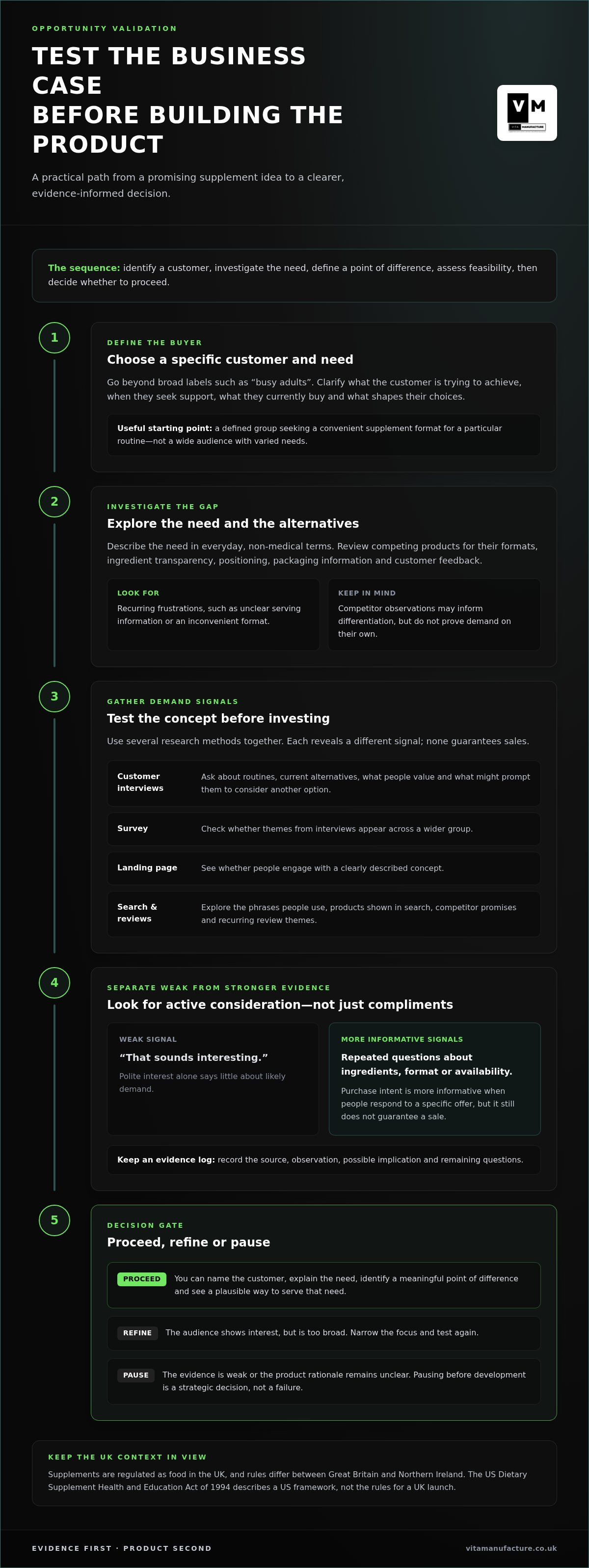
A promising supplement idea is only a starting point. Before investing in formulation, packaging or production, define the customer, find evidence of a real need and establish why your offer could earn a place in the market. That’s the first discipline in How to Start a Supplement Company in 2026: test the business case before building the product.
Use a simple sequence: identify a customer, investigate the need, define what could make your offer distinct, assess feasibility, then decide whether to proceed. Customer interviews, competitor reviews and search or marketplace research reveal different signals. Used together, they help distinguish an opportunity with a clear buyer from an idea that sounds attractive but has little evidence behind it.
Choose a specific customer and unmet need
Move beyond broad labels such as “busy adults” or “fitness enthusiasts”. Consider what a potential customer is trying to achieve, when they look for support, what they currently buy and what influences their choices. A useful starting point might be people seeking a convenient supplement format for a particular routine, rather than an entire age group with varied needs.
Describe the need in everyday, non-medical terms. Avoid framing a supplement as treating, curing or preventing disease. Then review competing products. Compare formats, ingredient transparency, positioning, packaging information and customer feedback. Look for recurring frustrations, such as unclear serving information or a format customers find inconvenient. These observations may inform differentiation, but they don’t prove demand on their own.
Test demand before investing in a product
Speak with potential customers about their routines and current alternatives. Ask what they have tried, what they value and what might prompt them to consider another option. A survey can help test whether interview themes appear across a wider group, whilst a simple landing page can show whether people engage with a clearly described concept. Treat each result as a signal, not proof of guaranteed sales.
Separate polite interest from stronger evidence. “That sounds interesting” is a weak signal. Repeated questions about ingredients, format or when the product might be available suggest more active consideration. Purchase intent is more informative when people respond to a specific offer, although it still doesn’t guarantee they will buy.
Search and marketplace research adds another perspective. Check the phrases people use, the products that appear for those searches and the themes in customer reviews. Record what competitors promise, how they explain ingredients and where feedback points to unmet expectations. Keep a short evidence log with the source, observation, possible implication and remaining questions. If you’re also choosing a UK supplement manufacturer, take this evidence into discussions about the product brief rather than presenting an untested concept.
Keep regulatory context in view, but don’t mistake overseas guidance for UK requirements. The Dietary Supplement Health and Education Act of 1994 (DSHEA) describes a US framework, not the rules for a UK launch.
Set a decision gate. Proceed when you can name the customer, explain the need, identify a meaningful point of difference and see a plausible way to serve that need. If the audience is interested but too broad, refine it and test again. If the evidence is weak or the product rationale remains unclear, pause before committing to development. That is a strategic decision, not a failure.
Turn your supplement idea into a UK-ready product and compliance plan
A validated opportunity now needs to become a product that can be formulated, labelled and marketed responsibly. For How to Start a Supplement Company in 2026, that means turning the concept into a practical brief and addressing regulatory questions early, before they lead to avoidable changes to the product or packaging.
Set out the intended customer, purpose, format, proposed ingredients and the rationale for each ingredient. Be precise about what the product is intended to do, but avoid language suggesting that it treats, cures or prevents disease. The brief should also identify what needs to be established about ingredient suitability, dose rationale, safety evidence, stability and product quality. A formulation partner can help assess how these elements fit together. Vita Manufacture’s product development support connects formulation planning with regulatory guidance and manufacturing considerations.
Set a product brief that can be assessed
A useful brief gives your development team decisions to evaluate, not just a list of preferred ingredients. Record the intended format, serving approach, customer context and desired positioning. Note constraints such as ingredient exclusions or packaging preferences, and identify the evidence needed to support ingredient safety and proposed use. Include the work required to assess stability and quality. This creates a clearer basis for custom supplement formulation development and helps surface feasibility questions before the formula is finalised.
Check UK classification, labels and claims
Food supplements are regulated as food, but a product’s ingredients, presentation and claims can affect its classification. A product presented with medicinal claims, such as claims to treat or prevent a condition, may fall within medicines regulation. If classification is borderline, seek specialist regulatory review rather than relying on marketing wording alone. The Food Standards Agency (FSA) and Food Standards Scotland (FSS) are key food-safety reference points in their respective jurisdictions. The Medicines and Healthcare products Regulatory Agency (MHRA) provides guidance on medicines and borderline products.
Before drafting packaging or website copy, check the current rules for the market where you intend to sell. For Great Britain, consult the current Nutrition and Health Claims Register and relevant official guidance on food supplements and labelling. Confirm that each proposed claim is permitted and that the product meets the conditions for using it. An ingredient’s presence does not, by itself, make a health claim acceptable.
Build label review into development rather than leaving it until the final artwork check. Confirm the applicable requirements for product description, ingredients, allergen presentation, recommended use and warnings against current official guidance. Ingredient suitability also needs attention: some ingredients may raise novel food questions, so verify their status and any relevant authorisation requirements before committing to a formula. Rules can change, and Northern Ireland may differ from Great Britain. Check current official UK guidance for the specific market before launch, particularly if you plan to sell across both.
Use this compliance review as a development gate. Move to final formulation and artwork only when the product brief, ingredient rationale, classification, evidence needs and proposed claims have been reviewed. Coordinating these decisions early gives your manufacturing plan a more dependable foundation.
Choose a supplement business and manufacturing model that can scale
Your manufacturing route shapes more than your first product. It affects how much you can differentiate, how much development input is needed and which decisions you’ll control as the business grows. In How to Start a Supplement Company in 2026, the right choice is the one that fits your evidence and capabilities now whilst leaving room to respond to customer feedback.
Start by matching the route to your product brief. A white-label option generally uses an existing product concept, with your brand’s presentation distinguishing it in the market. Private label and custom development can allow different levels of input into the specification or formulation, depending on the project. More development input may create greater scope for differentiation, but it also brings more decisions around ingredients, evidence, testing and production readiness. Vita Manufacture supports white-label and private-label routes alongside new product development, helping founders align their approach with their product ambitions.
Compare routes by control and differentiation
Decide what needs to be distinctive. If the opportunity depends on a well-defined product concept and a branded customer experience, an existing formula may be a practical starting point. If a particular specification or ingredient profile is central to your proposition, a more tailored route may suit better. Compare options by formulation input, brand presentation and the decisions you’ll need to make. Don’t assume one model is always faster or more scalable. Let your evidence and launch objectives guide the choice.
Build quality and scale into the manufacturing plan
Manufacturing readiness depends on clear specifications and reliable controls. Review how quality systems, ingredient and batch traceability, documentation and change control are managed. Certification can provide useful context, but its relevance depends on its scope and current validity. As your project moves towards production, samples, pilot work where appropriate and documented specification approval can help identify avoidable uncertainty before a larger run.
Consider these connected operating decisions as you plan:
Batch planning: Base initial production planning on realistic demand assumptions and the product’s development requirements. Avoid adding multiple products before you have evidence to support them.
Formulation and testing: Product complexity can affect the checks, documentation and coordination needed to deliver a consistent product. Build those requirements into the plan rather than treating testing as a last step.
Packaging and fulfilment: Choose packaging with the product, storage conditions, label information and intended sales channels in mind. Its dimensions and protection needs can also affect storage and distribution.
Keep decisions evidence-led. Start with a focused product range, define what a successful customer response would look like, then use sales and feedback to inform future variants or volume changes. A transparent view of project milestones can help you coordinate development and production. Vita Manufacture’s customer portal supports project visibility across the process. For a connected route from product development through manufacturing and logistics, explore Vita Manufacture’s development and manufacturing support.
Prepare your supplement brand, sales channels and launch operations
A product is not launch-ready just because it has been manufactured. Your brand, packaging, sales route and fulfilment process need to work together, with customer-facing information reviewed before you accept orders. In How to Start a Supplement Company in 2026, launch planning means preparing the whole buying experience, not simply publishing a product page.
Build a clear, credible brand and compliant packaging
Make the brand promise specific to the audience you’ve validated and the product’s evidence-supported role. A clear identity helps customers understand what the product is and who it is intended for, without implying medical effects. Check the proposed business and brand names, domain and visual assets for potential conflicts before investing in packaging or promotion. For current UK business-name guidance, use Companies House. Consult the Intellectual Property Office for relevant trade mark information, and recheck official guidance as requirements can change.
Packaging must be legible and consistent with the product information customers see online. Before approving artwork, review the label content, presentation and every claim against current requirements for your intended UK market. Keep a controlled final version of approved artwork and product information so updates to a formula, label or product page can be reviewed and recorded before use.
Select sales channels and plan fulfilment
Choose channels based on the customer experience you want to create and the operating workload you can support. A direct-to-consumer online shop offers more control over presentation and customer interactions, but you’ll need to manage the website, enquiries and order journey. Marketplaces can help customers discover products, whilst their platform rules and selling environment shape how you present the brand and access customer information. Retail can put products in front of shoppers in a different setting, but requires planning for buyer relationships, stock and fulfilment. Compare these routes without assuming one suits every business.
Whichever channel you choose, map the order from product page to delivery. Make sure product information is accurate, customer enquiries have an owner, and storage, stock records, packing and delivery responsibilities are clear. Set out how you’ll handle complaints, returns and product-related questions before orders begin.
Use a practical launch-readiness check before opening sales:
Brand and product: Names and visual assets reviewed; product information and claims checked; final artwork approved.
Stock and fulfilment: Initial stock plan recorded; storage, order handling and delivery responsibilities assigned.
Customer experience: Product pages checked; enquiry, complaint and returns processes ready.
Measurement: A simple way to monitor qualified traffic, conversion, repeat interest and customer feedback established.
These early indicators help you see where customers respond and where the experience needs work, without treating one sales measure as the whole story. For coordinated support with packaging and your online presence, work with Vita Manufacture on label and website design as part of preparing your brand for launch.
Launch with a development partner and build a route to sustainable growth
A strong launch comes from connected decisions, not a single production milestone. Before committing to launch, check that you have evidence of a customer need, a defined product brief, a completed compliance review, a workable production plan and sales operations ready to serve customers. This final gate brings the work behind How to Start a Supplement Company in 2026 into one practical decision: are the product and business ready to move forward together?
Validated need: The audience and its reason to consider the product are clearly defined.
Product brief: Intended use, format, formulation direction and positioning are recorded.
Compliance review: Classification, ingredients, label information and claims have been reviewed for the intended UK market.
Production plan: Manufacturing requirements, quality documentation and packaging decisions are coordinated.
Sales readiness: Product information, stock planning, fulfilment and customer support are prepared.
If a key item is unresolved, address it before opening sales. A deliberate pause can protect customer confidence and prevent avoidable changes after production or launch.
Coordinate product development from brief to production
A clear brief gives formulation and development work a commercial direction by connecting the customer need to product decisions. Vita Manufacture supports founders through product development, formulation and regulatory guidance, then manufacturing and packaging coordination. Aligning these hand-offs helps keep the product’s intended role, approved information and production requirements connected as the project advances. Its customer portal provides project visibility, helping founders follow progress.
Vita Manufacture’s operation is ISO 22000:2018-certified, a relevant quality-system proof point. Consider the certification alongside its applicable scope and the processes relevant to your project when reviewing manufacturing documentation. Connected logistics and distribution support can also help founders plan beyond production and towards getting finished products into their intended sales channels.
Use early market feedback to guide the next stage
Launch is the start of a learning cycle. Review customer questions, product feedback, sales indicators and operational issues together. If customers understand the offer but repeatedly ask for clearer serving or ingredient information, improve how the product is explained. If interest is present but conversion is weak, examine the product page and buying journey before assuming the formulation needs to change.
Use this evidence to refine positioning, product specifications or channel priorities, while keeping proposed changes within the appropriate compliance and quality review. Expansion should follow demonstrated demand and the business’s ability to maintain consistent production, fulfilment and customer support. A measured next step might be improving the current offer before adding another product, rather than increasing complexity without clear evidence.
Vita Manufacture brings development, regulatory guidance, manufacturing, logistics and distribution together to support founders moving from brief to launch and beyond. To shape your next step, discuss your product-development brief with Vita Manufacture.
Turn your supplement concept into a confident next step
The next move isn’t to solve every future challenge at once. Turn your strongest opportunity into a focused development brief, with the customer, commercial purpose and key decisions clearly set out. That gives you a practical starting point for conversations about formulation and production, while keeping the business case at the centre.
How to Start a Supplement Company in 2026 is ultimately about building with intent: learn from the market, make considered product decisions and grow in step with the evidence. You don’t need every long-term detail mapped before beginning, but you do need a clear first milestone and the right expertise to move towards it.
Vita Manufacture works with supplement founders on product development, manufacturing and logistics, bringing connected support to the journey from concept towards launch. If you’re ready to explore how your idea could take shape, discuss your supplement product idea with Vita Manufacture.
A considered first step can create momentum. With a sound brief and a growth-minded approach, you can build towards a brand that earns customer confidence and develops with demand.
Frequently Asked Questions
How long does it take to start a supplement company?
There’s no fixed timeline. It depends on the product route, formulation work, compliance review, production planning and launch preparation. A white-label project using an existing product concept may involve different development steps from a bespoke formulation. Build a schedule around decisions and approvals, not an assumed launch date. For How to Start a Supplement Company in 2026, allow time to resolve ingredient, label and claims questions before confirming production and sales plans.
Do I need to register a limited company to sell supplements in the UK?
No. You can operate as a sole trader or form a limited company, but each structure has different responsibilities for finances, records and tax. Choose based on your business plans and circumstances, and seek suitable accounting or legal advice if you’re unsure. Separately, food businesses generally need to register with their local council at least 28 days before trading. Company formation and food business registration are distinct steps, so one doesn’t replace the other.
Can I sell supplements internationally from a UK company?
Yes, a UK company can explore international sales, but permission to sell at home doesn’t automatically mean a product meets another market’s rules. Before taking orders, check the destination country’s ingredient restrictions, product classification, permitted claims, labelling and import requirements. Also map who will handle fulfilment and customer enquiries in that market. If you plan to sell in Northern Ireland as well as Great Britain, account for applicable regulatory differences when preparing product information.
Is product liability insurance required for a supplement company?
Product liability insurance isn’t a universal legal requirement for every UK supplement business, but it can be important protection against claims linked to products you sell. Retailers, distributors or other commercial partners may also set insurance conditions in their contracts. Consider your role in the supply chain, the markets you serve and the risks associated with your product, then speak with a qualified insurance adviser about appropriate cover and policy terms.
Can I launch a supplement brand with just one product?
Yes. A single product can give you a focused way to test your positioning, customer experience and sales approach without managing a broad range from day one. Make sure it addresses a clearly defined need and that you can support it with credible product information and a workable fulfilment plan. Use customer questions, feedback and sales patterns to decide whether to refine the offer or develop another product, rather than expanding simply to fill a catalogue.
How do I protect the name of my supplement brand?
Start by searching Companies House records, relevant trade mark databases and domain names for existing uses that could conflict with your proposed brand. Company-name registration alone doesn’t necessarily give you trade mark protection. The UK Intellectual Property Office explains how to search and apply for trade marks; protection depends on the mark and goods or services covered. Consider professional intellectual property advice before investing heavily in packaging, marketing or other assets built around the name.
Can I make and sell supplements from home in the UK?
Potentially, but working from home doesn’t remove food-safety or business obligations. Food businesses generally need to register with their local council at least 28 days before trading, and the premises and activities must meet applicable food hygiene requirements. Whether a home setup is suitable depends on what you’ll make, how you’ll handle ingredients and products, and the premises themselves. Check current official guidance and discuss the proposed activity with your local council before investing in equipment or stock.