
Sourcing High-Quality Supplement Ingredients: 2026 Guide
What if an ingredient with an impressive certificate still isn’t right for your product? Sourcing high-quality supplement ingredients takes more than comparing supplier claims. You need evidence that confirms identity and quality, complete documentation, and confidence that the ingredient will work in your intended formulation. When specifications or test records are incomplete, it’s difficult to compare suppliers or judge whether an option can support consistent production.
Looking beyond price and marketing language is a sensible first step. Ingredient choice can affect product quality, formulation performance, availability and your ability to scale, so ask focused questions before committing to a sourcing route. This guide explains how to assess supplier evidence, review specifications and testing records, and check ingredient suitability against your product format and development plans. It also shows how sourcing connects to formulation, regulatory considerations and manufacturing requirements, helping you make a more informed decision about product development.
Sourcing High-Quality Supplement Ingredients: Table of Contents
What Does High-Quality Supplement Ingredient Sourcing Actually Mean?
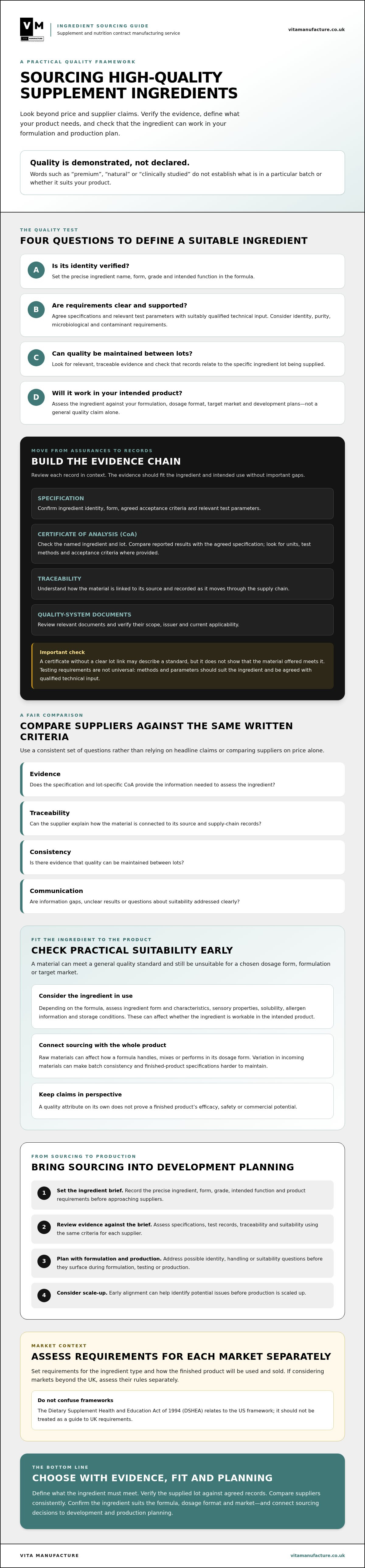
Quality is demonstrated, not declared. An ingredient is suitable for your product when its identity is verified, its agreed specifications are supported by evidence, its quality can be maintained between lots, and it performs as intended in the formula. A supplier’s use of words such as “premium”, “natural” or “clinically studied” may describe an ingredient’s positioning, but those phrases don’t establish what is in a particular batch or whether it suits your product.
High-quality supplement ingredient sourcing means selecting materials against defined requirements and confirming those requirements with relevant, traceable evidence for the ingredient supplied. A material can meet a general quality standard yet still be unsuitable for your chosen dosage form, formulation or target market. Set requirements according to the ingredient type and how you plan to use and sell the finished product.
If you’re considering markets beyond the UK, assess their rules separately. For example, the Dietary Supplement Health and Education Act of 1994 (DSHEA) relates to the US framework. It should not be treated as a guide to UK requirements.
Which quality attributes should buyers define first?
Start with a clear ingredient brief. Identify the precise ingredient name, form, grade and intended function in the formula. Then work with suitably qualified technical input to set relevant identity, purity, microbiological and contaminant parameters. Avoid applying generic limits without considering the material and its intended use.
Consider practical fit as well. Depending on the formula, sensory characteristics, solubility, allergen information and storage conditions may affect whether an ingredient is workable. Record these expectations before approaching suppliers so you can review their proposals against the same criteria.
Why does sourcing quality matter beyond the ingredient itself?
Raw materials don’t operate in isolation. Differences in ingredient form or characteristics can affect how a formula handles, mixes or performs in its dosage form. If incoming materials vary, maintaining batch consistency and meeting finished-product specifications may become harder. A quality attribute on its own, however, doesn’t prove a product’s efficacy, safety or commercial potential.
Clear requirements also support efficient development. If the ingredient brief is incomplete, questions about identity, handling or suitability may surface during formulation, testing or production, creating avoidable review and rework. Agreeing criteria early connects sourcing decisions to the product specification and manufacturing plan, rather than treating procurement as a separate step.
How to Verify Supplement Ingredient Quality and Supplier Evidence
Move from supplier assurances to records you can assess. Start with the specification, then check the certificate of analysis (CoA), traceability information and relevant quality-system documents. Each should relate to the ingredient and its intended use, and the evidence should fit together without leaving important gaps.
Specification: Confirm the ingredient’s identity, form and agreed acceptance criteria, including relevant test parameters.
Certificate of analysis: Compare the reported results with the specification and check that the CoA identifies the specific lot being considered.
Traceability: Ask how the supplier links the material to its source and records its movement through the supply chain.
Quality-system documents: Review relevant documents and verify their scope, issuer and current applicability.
A certificate without a clear lot link may describe a standard, but it doesn’t show that the material offered to you meets it. Lot-specific documentation connects the evidence to the batch under review. Testing requirements aren’t universal, so the methods and parameters should suit the ingredient and be agreed with qualified technical input.
What should a certificate of analysis tell you?
Check that the CoA names the ingredient and lot, reports relevant test results with units, and identifies methods and acceptance criteria where provided. Compare each result with the agreed specification rather than relying on a “pass” statement alone. If a result is missing, unclear or appears unsuitable for your requirements, ask a qualified technical reviewer to assess it before proceeding.
Which supplier documents and questions support due diligence?
Request the current specification, traceability details and relevant quality-system documentation. Ask how the supplier manages changes to the material or process, non-conformances, complaints and retained records. A supplier-level certificate may provide evidence about a defined system or site, but it doesn’t establish that a particular ingredient lot meets your specification. Check the document’s scope and applicability rather than treating any certificate as blanket assurance.
Third-party verification can add another evidence point, but check exactly what it covers. For example, the USP Verified Mark relates to a verification programme for dietary supplements. It shouldn’t be assumed to certify every raw material or replace review of lot-specific records. For wider context on supply-chain traceability, see this supplement supply chain management guide.
If sourcing is part of a wider product-development plan, you can review ingredient and bulk sourcing alongside formulation and manufacturing requirements.
How to Compare Supplement Ingredient Suppliers Beyond the Headline Claim
A fair comparison starts with one shared brief. If suppliers quote different ingredient forms, grades or specifications, their proposals aren’t directly comparable, even if they use similar marketing language. Set your requirements in writing first, then assess each option against the same criteria. This makes trade-offs visible and stops a persuasive headline claim from outweighing practical evidence.
How should buyers compare ingredient options fairly?
Use a comparison matrix to record what each supplier has documented, what remains unclear and how they respond to follow-up questions. Include formulation and production colleagues where the requirements could affect blending, dosage form or processing. A material that looks suitable on paper still needs to work in the intended product and production plan.
Compare like with like before weighing proposals. For example, two materials with the same general ingredient name may differ in form or grade, which can affect formulation fit. Record strengths alongside evidence gaps. A clear response to a reasonable technical question is useful information, but it doesn’t replace supporting documentation.
What are the warning signs in a sourcing conversation?
Some answers should prompt further questions, not an immediate verdict. A vague specification, an unsupported quality claim, unclear lot traceability, inconsistent documents or reluctance to explain test methods can make an offer difficult to assess. Ask for clarification and give the supplier an opportunity to provide relevant records. Don’t label a supplier non-compliant without first verifying the applicable requirements and reviewing the evidence.
Look beyond the quoted purchase price. Commercial suitability also depends on production practicality, documented consistency and how the supplier manages changes to materials or processes. Ask how they communicate supply changes and what continuity planning they can describe. No supplier can be assumed to guarantee uninterrupted availability, so consider what a disruption or specification change could mean for development and production.
This broader view makes sourcing high-quality supplement ingredients a product decision as well as a purchasing one. A structured comparison helps you identify a credible fit for formulation and production, while keeping unresolved questions visible before you commit.
Matching Ingredient Quality to UK Market Requirements
A well-documented ingredient still needs to suit both the formula and the market. Ingredient form and specification can affect how a material behaves in a capsule, tablet, powder or other dosage format. Quality assessment should therefore include practical performance, not just paperwork.
What makes an ingredient suitable for a specific formulation?
Assess compatibility with other ingredients, stability under relevant conditions, sensory properties and processing needs with formulation specialists. The form proposed by a supplier must match the product brief. A material that meets its specification may still be difficult to blend, handle or incorporate into the intended dosage format.
Documents can help establish material characteristics, but they may not show how the ingredient will perform in your specific formula. Where suitability is uncertain, plan a technical evaluation or trial before finalising the sourcing decision. This can surface formulation or production questions earlier. For deeper development context, read this professional supplement formulation guide.
Which UK checks should brands confirm before sourcing?
Requirements depend on the ingredient, product category, intended use and where the finished product will be placed on the market. Great Britain and Northern Ireland operate under different food-supplement frameworks, so don’t assume a decision for one market automatically applies to the other. Confirm current guidance with a qualified regulatory specialist before committing to an ingredient or formula.
As part of that review, assess whether the ingredient’s status and proposed use are appropriate for the target market, and identify any relevant product documentation. If an ingredient may be classed as a novel food, establish its status for the market concerned before proceeding. Keep the review current, as requirements and guidance can change.
Raw material evidence is only one part of readiness. It doesn’t, by itself, establish that finished-product labelling or marketing claims are suitable. In Great Britain, nutrition and health claims must be authorised and listed on the GB nutrition and health claims register, so product claims need a separate check. A supplier’s or manufacturer’s quality-system certification can support confidence in its processes, but it doesn’t replace assessment of the specific product and its presentation.
Sourcing high-quality supplement ingredients works best when the ingredient brief, formulation and regulatory review develop together. If you’re assessing ingredient suitability alongside product format and production needs, explore sourcing and product development with Vita Manufacture.
How to Build a Reliable Sourcing Plan with a Development Partner
A reliable sourcing plan connects the product idea to the material, formula and production requirements. Rather than selecting an ingredient in isolation, work through a sequence: define the product brief, agree ingredient requirements, review evidence, assess formulation fit, then plan how sourcing aligns with production. This makes decisions and outstanding questions easier to track before you commit to a route.
What information should you prepare before approaching a partner?
You don’t need every technical detail resolved before starting a discussion. A concise brief gives a development partner a useful starting point and clarifies where expert input is needed. Include:
Product concept: target customer, intended markets and proposed dosage format.
Ingredient requirements: known preferences, required specifications and the evidence you expect suppliers to provide.
Open questions: uncertainties around ingredient form, formulation, documentation or market suitability.
Development stage: what has already been decided, what needs validation and your ambitions for future production.
Be clear about what’s still provisional. For example, if the dosage form is undecided, say so. That context can help specialists assess ingredient options without treating an early preference as a fixed requirement.
How can sourcing support product development and scale-up?
Bring formulation and manufacturing considerations into sourcing discussions early. Ingredient specifications may need to align with how the material will be incorporated into the formula and the requirements of the planned production process. A development partner can help assess those connections, identify questions for technical or regulatory review, and coordinate the handover from ingredient selection to production planning.
Agree how documents will be reviewed, who confirms approval and how changes to an ingredient or specification will be assessed. These steps give your team a clearer basis for responding if a supplier proposes a change later. They also keep sourcing decisions connected to the product brief as development progresses.
Vita Manufacture offers ingredients and bulk sourcing alongside New Product Development, formulation, regulatory guidance, manufacturing and logistics support. This integrated perspective may be useful if you want sourcing considered as part of a wider product-development plan. For broader considerations when choosing a production partner, see the UK supplement manufacturer selection guide.
With a clear brief and unresolved questions in hand, you can discuss your supplement project with Vita Manufacture and explore how sourcing could fit alongside your formulation and manufacturing requirements.
Make your next sourcing decision with confidence
Strong sourcing decisions start with clear requirements and verifiable evidence. Check that ingredient documentation relates to the specific lot, compare suppliers against the same criteria, and assess whether the material fits your formulation, production needs and intended UK market.
Sourcing high-quality supplement ingredients is not simply a purchasing task. It’s part of building a product that can move from development towards production, with formulation and regulatory questions considered early rather than left until later. A development partner may help bring those decisions together. Vita Manufacture offers ingredient and bulk sourcing alongside formulation and manufacturing support.
Have a product brief or sourcing question to explore? Discuss your supplement ingredient sourcing requirements with Vita Manufacture and take a considered next step towards developing your product.
Frequently Asked Questions
How can you tell if a supplement ingredient is high quality?
Look for evidence that the ingredient matches a clear specification and is suitable for its intended use. Check its identity, relevant quality parameters and consistency information, then confirm that documents relate to the specific lot under consideration. Consider how its form and characteristics fit your dosage format and target market. Terms such as “premium” or “natural” aren’t proof of identity, purity or formulation suitability.
What documents should a supplement ingredient supplier provide?
Ask for a current ingredient specification, a lot-specific certificate of analysis and traceability information. Depending on the ingredient and your requirements, relevant quality-system documents and details of test methods may also help your review. Check that the records are current, internally consistent and applicable to the material offered. Ask how the supplier manages specification changes, non-conformances and complaints, and raise gaps with a qualified technical reviewer.
Is a certificate of analysis enough to verify ingredient quality?
No. A certificate of analysis (CoA) is useful evidence, but it should be checked against the agreed specification and identify the lot being supplied. Review the reported tests, units, methods and acceptance criteria where available. A CoA doesn’t establish every aspect of supplier quality, traceability or suitability for your formula. Testing needs depend on the ingredient, so have a qualified technical reviewer assess any missing or unclear results.
How do I compare supplement ingredient suppliers?
Give each supplier the same written requirements, then compare equivalent ingredient forms and grades. Record specification fit, available evidence, traceability, information about consistency and change control, and the clarity of supplier communication. Note unanswered questions alongside documented strengths, and follow up before deciding. Consider production practicality as well as purchase price. An option must work for the intended formulation and production plan, not just look attractive in a quotation.
Can ingredient quality affect the final supplement formulation?
Yes. Ingredient form and characteristics can affect compatibility with other materials, sensory qualities, stability, blending and processing. A material can meet its own specification yet still prove difficult to use in a particular dosage format. Discuss uncertain performance with formulation and production specialists, and consider technical evaluation or trials where documents alone can’t confirm fit. Ingredient quality supports product consistency, but it doesn’t by itself prove efficacy or commercial success.
What should UK supplement brands check before sourcing an ingredient?
Confirm the ingredient’s status and proposed use for each intended market, alongside the product category, dosage format and relevant documentation. Great Britain and Northern Ireland have different food-supplement frameworks, so check requirements for where the product will be sold. Review finished-product labelling and claims separately from raw material evidence, using current official guidance and qualified regulatory input. Don’t assume a supplier’s certificate confirms product-level compliance.
When should a supplement brand involve a contract manufacturer in ingredient sourcing?
Involve a contract manufacturer while the product brief and ingredient requirements are being developed, especially if the dosage format or production approach could affect ingredient suitability. Early discussion can help align specifications with formulation and manufacturing needs, identify evidence gaps and clarify how changes will be reviewed. Vita Manufacture offers ingredients and bulk sourcing alongside formulation and manufacturing support, connecting sourcing discussions to wider product development.