Rising Under-50s Cancer Rates: UK Health Trends
In England, bowel cancer incidence among under-50s more than doubled between 2001 and 2023, rising from 3.9 to 8.4 cases per 100,000 people. That is a striking trend, but it does not explain why it is happening or predict an individual’s risk. The question behind why bowel, prostate and breast cancer rates are rising among under-50s needs a closer look at what the figures actually measure.
If headlines about rising diagnoses have left you unsure whether cancer is genuinely becoming more common in younger adults, that uncertainty is understandable. Case numbers and incidence rates are not interchangeable, and findings for one cancer type cannot automatically be applied to another.
This article examines the UK evidence for bowel, prostate and breast cancer, including what the figures can and cannot tell us about possible causes. It also gives practical context on symptoms and screening guidance, which varies across the UK. For health brands, the trend calls for careful, evidence-led communication, not claims that supplements prevent or treat cancer. The aim is to separate established findings from hypotheses so you can respond with clarity rather than alarm.
Key Takeaways
The cancer-rates-rise-under-50s-bowel-prostate-breast evidence needs cancer-specific interpretation: trends differ and don’t establish a shared cause.
Check each study’s age band, time period, geography and data source before comparing reported rates.
Researchers are investigating several possible explanations, but associations don’t prove cause.
Know when persistent symptoms merit clinical advice, and use current screening guidance for your UK nation and personal circumstances.
For health brands, treat a trend as a prompt to assess evidence, not as proof of a product benefit or medical claim.
Table of Contents
Are cancer rates rising among under-50s? Start with what the figures measure
Bowel, breast and prostate cancer: what the under-50 evidence says
Why might early-onset cancer rates change? Separate evidence from hypotheses
What should under-50s do about symptoms, screening and personal risk?
What rising cancer rates mean for health brands and responsible communication
Are cancer rates rising among under-50s? Start with what the figures measure
Evidence points to rising rates for some cancers in younger age groups, but the pattern isn’t universal and its causes aren’t settled. “Early-onset cancer” usually means a diagnosis before age 50. Studies don’t always use identical age bands: a World Cancer Research Fund (WCRF) analysis of NHS data examined people aged 25 to 49, whilst cancer-specific analyses may group everyone under 50 together or use narrower ranges. Check the age band before comparing findings.
The distinction between totals and rates matters. Case counts show how many diagnoses occurred; they can rise as the population grows or its age profile changes. An incidence rate relates new diagnoses to the population at risk, making comparisons more meaningful across different population sizes. Some rates are also age-standardised: statisticians adjust for differences in age structure so populations can be compared more consistently. Not every published rate is age-standardised, so check how the source describes its measure.
An incidence rate measures new diagnoses in a defined population over a stated period, usually relative to population size, so it’s more informative than a raw case total when comparing populations or years. It describes diagnosed new cases, not a person’s chance of developing cancer and not the number of people currently living with it. For an overview of how incidence, age and sex are considered in cancer trends, see Epidemiology of cancer.
Rates also depend on the cancer type, dataset, geography and years being compared. A result for England isn’t automatically a UK-wide result, and a finding for one age band shouldn’t be presented as applying to every person under 50.
What does a rise in cancer rates actually mean?
It means that, within the population and period studied, more new diagnoses were recorded relative to the population size than before. For example, WCRF’s analysis of NHS data reported a 24% increase in overall cancer incidence among UK adults aged 25 to 49 between the early 1990s and 2019; the analysis was published in October 2026. That figure applies to the specified age band, period and data, not to every cancer individually.
When reading a headline, look for the source, publication date, geography, age range, cancer type and whether the rate is age-standardised. These details show what the figure supports and where comparisons may mislead.
Why headlines about younger adults need context
A long-term trend across multiple years is different from a short-term fluctuation. Changes in reporting, awareness or diagnostic practice may also affect recorded diagnoses. One year’s movement alone doesn’t establish a lasting shift or explain its cause.
Population-level rates describe patterns across groups, not an individual reader’s diagnosis or personal risk. Nor do all cancers follow the same trend. The phrase “cancer-rates-rise-under-50s-bowel-prostate-breast” brings three distinct topics together, but each needs its own evidence and context before conclusions can be drawn.
Bowel, breast and prostate cancer: what the under-50 evidence says
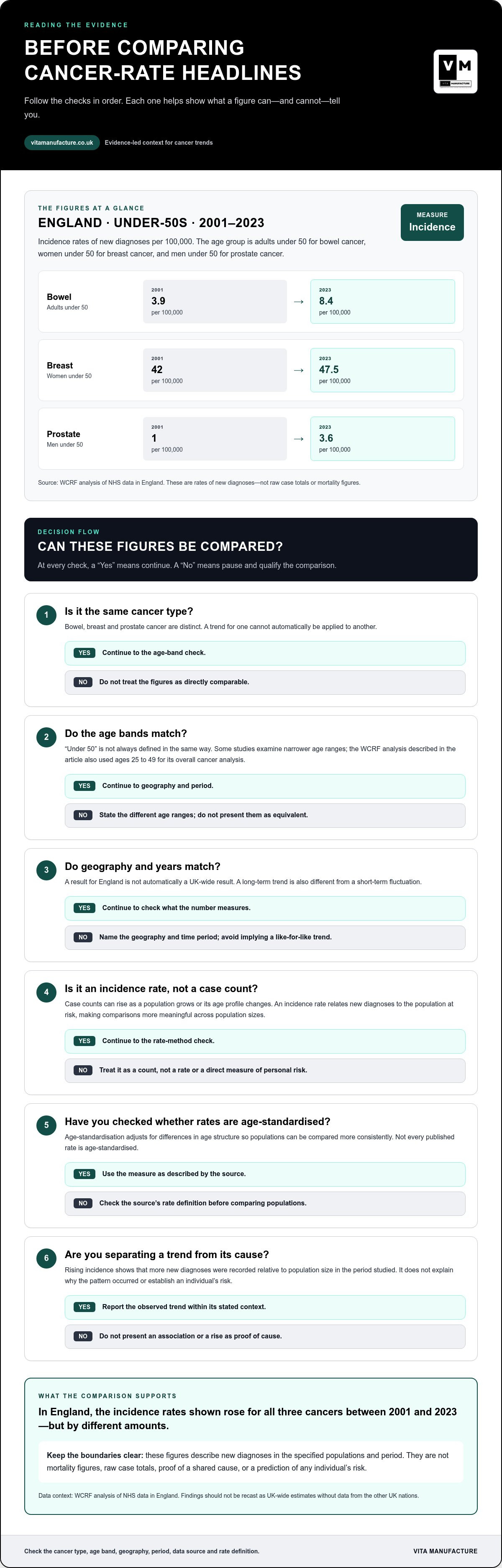
The figures point in the same broad direction, but the scale differs substantially by cancer type. The comparison below uses incidence rates for people under 50 in England from 2001 to 2023. The rates share a geography, age threshold and period, making them more comparable than figures drawn from different studies. They still describe three distinct cancers and populations.
In England, between 2001 and 2023, incidence rates among under-50s rose for bowel cancer in adults, breast cancer in women and prostate cancer in men, though by different amounts. These figures are rates of new diagnoses per 100,000, not mortality figures or raw case totals. The source is an analysis of NHS data; the findings shouldn’t be recast as UK-wide estimates without data from the other nations.
Bowel cancer in younger adults
Bowel cancer’s rate increased from 3.9 to 8.4 per 100,000 adults under 50 in England over the period shown. That is more than double the earlier rate, but the statistic covers a broad under-50 age group. It doesn’t mean that every age within the group experienced an identical change. Nor does a rise in diagnoses explain why the pattern occurred. The data show an incidence trend, not a proven cause.
Breast and prostate cancer before age 50
Breast cancer showed a more modest rate increase, from 42 to 47.5 per 100,000 women under 50. Prostate cancer rose from 1 to 3.6 per 100,000 men under 50. Both are upward trends in these data, but their starting rates and scale differ. Describing them simply as the same kind of “surge” can obscure that distinction.
Interpretation also depends on who is counted and how diagnoses are made. The breast and prostate figures apply to different sex-specific populations, whilst the bowel figure covers adults. Screening and other routes to detection can influence recorded diagnoses, so comparisons between cancers need care. These population statistics can’t tell you whether you personally will be diagnosed.
For health brands, the comparison is a reason to examine evidence carefully, not to infer a product benefit. If research is informing a new supplement concept, evidence-led product development and regulatory guidance can support responsible decisions without turning a cancer trend into a prevention or treatment claim.
Why might early-onset cancer rates change? Separate evidence from hypotheses
Researchers haven’t established one cause for rising early-onset cancer rates. The pattern may reflect several influences acting together, and the balance could differ between cancer types. Observational studies can identify associations, but an association alone doesn’t show that a factor caused cancer. Stronger explanations need evidence from different methods, including research into biological mechanisms and changes over time.
That distinction matters for the phrase “cancer-rates-rise-under-50s-bowel-prostate-breast”. It links three trends, not one explanation. A factor associated with bowel cancer can’t automatically explain breast or prostate cancer, and findings in one population may not apply equally to another.
What researchers are investigating
Several lines of enquiry are active. They should be treated as hypotheses or research questions, not settled conclusions:
Behaviour and diet: Obesity, dietary patterns, physical activity and alcohol consumption are among the factors experts are investigating. Observational evidence can reveal associations, but may not separate one influence from others that occur together.
Biological changes: Researchers are exploring whether factors such as inherited susceptibility or changes in the gut microbiome could help explain patterns, particularly for bowel cancer. These are developing areas of research, not established explanations for population-level increases.
Environmental exposures: Possible effects of pollutants and chemicals are also being studied. Investigation alone doesn’t demonstrate that a particular exposure causes early-onset cancer.
Ageing processes: A headline about faster biological ageing may point to a research question, but it isn’t proof that accelerated ageing explains rising diagnoses. The headline alone doesn’t provide the methods or results needed to establish causation.
The WCRF analysis of NHS data in England, published in October 2026, identified increases in early-onset incidence across seven cancer types. That breadth makes it valuable to investigate shared and cancer-specific explanations, but it doesn’t identify a single driver. The Prospect-UK trial is recruiting 250,000 people to investigate diet and lifestyle factors in bowel cancer among younger adults. Its focus shows that these questions are still being tested, rather than already answered.
Detection, data and changing diagnosis patterns
Recorded rates can also be influenced by how cancer is recognised and diagnosed. Greater symptom awareness may prompt people to seek advice sooner; changes in diagnostic techniques or data recording may affect which cases are identified and counted. These possibilities can contribute to changes in recorded diagnoses without explaining every increase or proving that the underlying biology has changed.
Detection is part of the picture, not a complete explanation. Awareness and improved diagnosis may contribute, but aren’t thought to account fully for the observed rise. That leaves room for biological, behavioural and environmental research, whilst requiring care about what each study can establish.
No single explanation for rising early-onset cancer rates should be treated as settled; the evidence points to active investigation, with possible factors interacting differently across cancers and populations. For health brands, the practical standard is clear: assess the quality and limits of evidence before shaping product decisions or communications. A trend may justify further research, but it can’t substantiate a cancer prevention or treatment claim for a supplement.
What should under-50s do about symptoms, screening and personal risk?
Rising rates in some younger age groups are a reason to be informed, not to assume you need a scan or screening test. Pay attention to changes that persist, seek clinical advice if something concerns you, and use the screening guidance for the UK nation where you live. This is general information, not a diagnosis or a substitute for advice from a qualified clinician.
When should someone seek medical advice?
A new or persistent change is worth discussing with a GP, particularly if it’s unusual for you, getting worse or affecting daily life. Examples can include an unexplained lump, unusual bleeding, ongoing bowel changes or unexplained weight loss. These symptoms can have many causes and don’t, on their own, mean someone has cancer. This isn’t a complete symptom checklist; a clinician can assess your circumstances and advise on next steps.
For general guidance, see the NHS cancer symptoms page and Cancer Research UK’s cancer symptoms guidance. Page content and review dates can change, so check the date shown on each source when you read it. Don’t wait for a screening invitation if you have a symptom that needs medical attention.
What under-50s should know about screening
Screening is offered to people without symptoms who meet a programme’s eligibility criteria. It’s different from diagnostic tests arranged because someone has symptoms, or from an assessment prompted by personal or family history. A screening programme is designed for a defined population; extra testing isn’t automatically helpful for everyone outside that group.
Eligibility and pathways aren’t identical across England, Scotland, Wales and Northern Ireland, and programmes may change. In England, NHS guidance states that bowel screening is offered every two years to people aged 50 to 74, and breast screening invitations are sent every three years to women aged 50 to 71. Cervical screening is available for women and people with a cervix aged 25 to 64. Check current official guidance for your nation rather than assuming these ages apply throughout the UK.
Routine population screening for bowel, breast or prostate cancer isn’t generally offered to under-50s as a group. However, a strong family history or other personal risk factors may affect what advice or assessment is appropriate. If that applies to you, discuss your history with a GP; don’t arrange screening or diagnostic testing solely because headlines about cancer-rates-rise-under-50s-bowel-prostate-breast have caused concern.
Health brands also have a responsibility to keep public messages proportionate. A rise in diagnoses doesn’t establish that a supplement prevents or treats cancer. Vita Manufacture provides evidence-led supplement development and regulatory guidance through its product development support.
What rising cancer rates mean for health brands and responsible communication
A health trend can signal a need for research. It can’t, by itself, establish that a product works, reduce disease risk or meet a genuine consumer need. For brands, the responsible response is to examine the evidence and the audience’s questions before deciding whether a product concept or message is justified.
Turn a health trend into a responsible research question
Start by defining what you want to learn. Are people confused about general nutrition, looking for clearer health information, or responding to anxiety about cancer headlines? Those are different needs. Research can explore consumer understanding, information gaps and interest in a concept, but stated interest isn’t evidence that a product has a health benefit.
Keep the research neutral. Avoid prompts that imply a supplement could prevent cancer or suggest a person is at heightened risk based on a population trend. Instead, test whether proposed explanations are understood accurately, whether communications distinguish evidence from uncertainty, and what information people need to make informed decisions. A pilot study and market research guide can help frame validation as a way to assess assumptions and audience needs, rather than to manufacture support for a predetermined claim.
For a topic such as cancer-rates-rise-under-50s-bowel-prostate-breast, keep the evidence trail clear: identify the population, cancer type, measure and period behind each statement. Don’t turn an observational association into a causal explanation, or a rise in diagnoses into proof that a particular ingredient is needed. Market insight can inform product planning; it can’t substitute for evidence of efficacy.
Keep product development and claims within evidence
Product formulation, regulatory review and marketing are connected, but each needs its own assessment. A formulation decision should be grounded in a clear product rationale and suitable evidence. Regulatory review should consider the product’s ingredients, presentation and intended use. Communications then need a separate check to ensure the wording and context don’t imply an unsupported medical benefit.
In particular, supplements must not be presented as preventing or treating cancer, or as reducing cancer risk. This applies to the overall impression, not only to an explicit sentence: headlines, imagery, testimonials and references to a cancer trend can combine to suggest a claim. Be precise about what’s known, what remains uncertain and what the product is actually intended to do.
For UK planning, use the UK supplement regulations guide as a starting point for considering compliant product development and manufacturing. Check applicable requirements and have product and marketing decisions reviewed before publication; a market opportunity doesn’t make a health claim acceptable.
Vita Manufacture supports supplement product development, regulatory guidance and contract manufacturing. Explore Vita Manufacture’s product development support to plan a responsible route from concept to market.
Build health products on evidence, not headlines
The next opportunity is to turn public interest into better questions, not stronger claims. For brands responding to cancer-rates-rise-under-50s-bowel-prostate-breast, that means grounding decisions in evidence relevant to the product, understanding what people genuinely need, and communicating uncertainty honestly. A health trend can guide research, but it can’t establish that a supplement prevents or treats cancer.
Responsible development also means treating product design, regulatory guidance and marketing review as connected but distinct steps. Vita Manufacture’s ISO 22000:2018-certified manufacturing operation supports product development and production, alongside regulatory guidance.
If you’re shaping a health product and want to move forward with clarity, explore Vita Manufacture’s product development support. Build your next decision around evidence, audience needs and responsible communication.
Frequently Asked Questions
Are cancer rates really rising among people under 50?
The cancer-rates-rise-under-50s-bowel-prostate-breast question has no single yes-or-no answer: incidence has risen for some cancers in particular populations, but results vary by cancer, age band and period. Before sharing a headline, open the underlying report and check whether it counts new diagnoses, total cases or deaths. A rise in one measure shouldn’t be described as a rise in another.
Which cancers are increasing in younger adults?
Research has reported increases in several early-onset cancers, including bowel, breast and prostate, but their trends aren’t interchangeable. To assess a claim, look for cancer-specific data from a UK source, then compare like with like: the same age band, geography, measure and years. An international study can suggest a question for UK research, but it doesn’t establish that the same pattern or scale applies to people in the UK.
Why are bowel cancer cases rising in younger people?
There isn’t one confirmed explanation for the increase. Researchers are examining possible influences, but an observed association doesn’t establish that a factor caused the rise. Diagnosis and recording may also affect the number of cases reported. If you read a claim about a particular cause, check whether it comes from a study of people in the UK, which ages it covered and whether it measured new diagnoses or another outcome.
Does a higher cancer rate mean my personal risk is high?
No. A population trend can’t tell you whether you personally will develop cancer. Your circumstances, including family history, may be relevant to an individual assessment. If a close relative has had cancer, note which relative was affected and, if you know, their age at diagnosis; share these details with a qualified healthcare professional. Seek advice about persistent or concerning symptoms rather than using population statistics to assess them.
Can people under 50 access cancer screening in the UK?
Some under-50s may be offered assessment because of symptoms or individual risk, but that’s different from routine screening invitations. Screening rules vary between England, Scotland, Wales and Northern Ireland, and programme details can change. Check the official NHS information for the nation where you live, including who is eligible and how invitations work. A headline about rising diagnoses doesn’t mean everyone under 50 needs a screening test.
Are bowel cancer symptoms different in people under 50?
Age doesn’t make a symptom a reliable sign of cancer or rule cancer out. Ongoing changes in bowel habits or bleeding can have several causes, but should be discussed with a healthcare professional if they persist or concern you. It may help to note when the change began, whether it comes and goes, and any other changes you’ve noticed. Don’t rely on an online list to diagnose yourself.
Can supplements prevent bowel, prostate or breast cancer?
No claim that a supplement prevents or treats bowel, prostate or breast cancer is supported by this article. Interest in a health trend isn’t proof that a product reduces disease risk. If you’re considering a supplement, discuss your needs with a qualified healthcare professional, particularly if you have a health condition or take medicines. Brands should assess evidence and communications carefully, and mustn’t present supplements as a substitute for screening, diagnosis or treatment.