Rising Scabies Cases: Lessons for Skin Health
An outbreak can make scabies feel like a sudden, widespread threat. But a cluster of cases doesn’t, on its own, show that everyone faces the same level of risk. The question behind “Scabies Cases Are Rising: What the Latest Hospital Outbreak Teaches Us About Skin Health” is what these reports really tell us, and what they don’t.
If you’re unsure how seriously to take conflicting headlines, or whether an itchy rash could be scabies, that uncertainty is understandable. Symptoms can resemble other skin conditions, while the persistent myth that scabies reflects poor hygiene can make people feel embarrassed and delay them from seeking advice. Scabies isn’t a sign of being unclean.
This article explains how scabies spreads, why outbreaks call for prompt, coordinated responses, and how to distinguish established clinical guidance from unsupported claims. A reported rise should be read in context: accurate diagnosis, contact management and clear communication matter more than alarm or stigma. For skin-health brands, the same principle applies: outbreak reports aren’t evidence that supplements prevent or treat scabies, and product claims need credible substantiation.
Scabies Cases Are Rising: What the Latest Hospital Outbreak Teaches Us About Skin Health
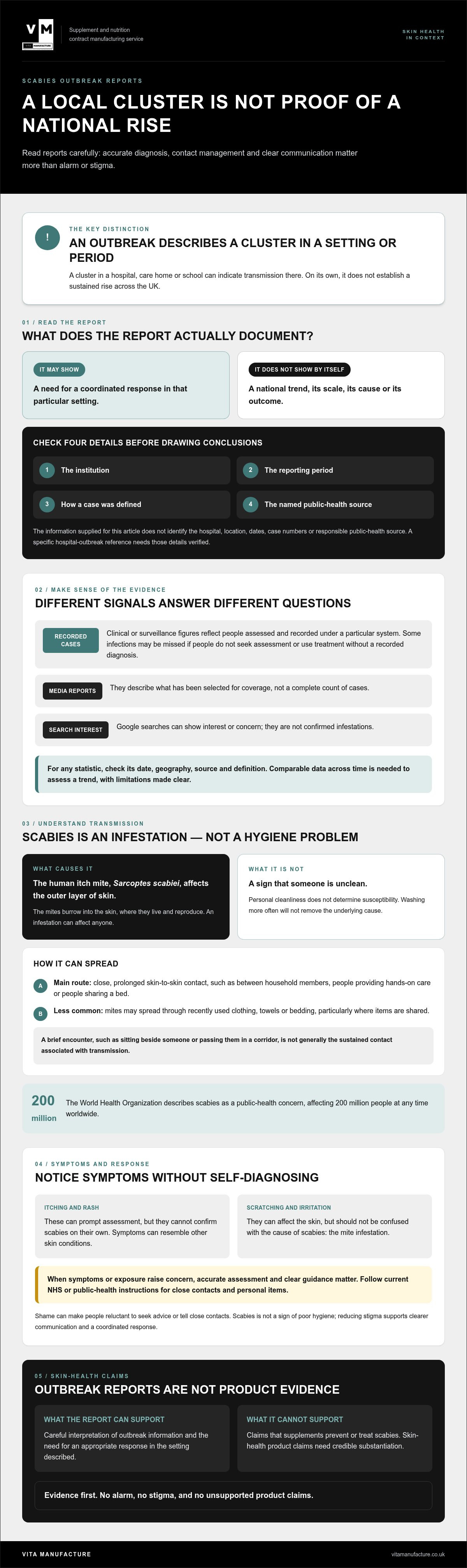
The practical lesson is to check what an outbreak report actually documents before drawing conclusions. A local cluster can show a need for a coordinated response in that setting, but it doesn’t automatically establish a sustained national trend or support claims about skin-health products.
Table of Contents
What do rising scabies cases and outbreak reports actually tell us?
Scabies is an infestation caused by the human itch mite, Sarcoptes scabiei. The mites affect the outer layer of skin, and the infestation can spread between people. For a general overview of the mite and the condition, see Scabies.
A reported increase deserves attention, but its meaning depends on what was counted, where and over what period. A cluster in a hospital, care home or school can indicate transmission in that setting. By itself, it doesn’t show that scabies is rising across the whole UK or that a national trend is sustained.
An outbreak is a cluster of cases linked to a particular setting or period; it is not, on its own, proof that prevalence is rising nationally.
How should readers interpret a hospital outbreak report?
Before treating a headline as evidence of a wider surge, look for the institution, reporting period, case definition and named public-health source. These details help establish whether the report describes confirmed cases, suspected cases or a broader response to a possible cluster. Don’t infer the cause, scale or outcome if the source doesn’t provide them.
The information supplied for this article doesn’t identify the hospital, location, dates, case numbers or responsible public-health source. It therefore can’t substantiate a specific hospital-outbreak reference. That limitation matters: retain “hospital outbreak” as a factual claim only when those details can be verified. It shouldn’t be used as shorthand for rising national prevalence.
Why are scabies trends difficult to measure?
Different indicators answer different questions. Confirmed clinical or surveillance cases reflect people who were assessed and recorded under a particular system. Media reports describe what has been selected for coverage. Google searches show interest or concern, not confirmed infestations. These measures can move in different directions, so they shouldn’t be combined as if they were equivalent.
Clinic figures may also miss infections if people don’t seek assessment or use treatment without a recorded diagnosis. That’s a possible source of undercounting, not proof of its scale. Check reporting arrangements and current UK notification rules against up-to-date official guidance before making claims about what must be reported.
For any statistic, check its date, geography, source and definition. A figure from sexual health services, for example, describes diagnoses in that service context, not every case in the population. The headline Scabies Cases Are Rising: What the Latest Hospital Outbreak Teaches Us About Skin Health should invite careful interpretation, not certainty. A credible trend assessment needs comparable data across time, with the limitations made clear.
How scabies spreads, and why it is not a hygiene problem
The mites that cause scabies burrow into the outer layer of skin, where they live and reproduce. An infestation can affect anyone. Personal cleanliness doesn’t determine whether someone is susceptible, and washing more often won’t remove the underlying cause.
Scabies is a mite infestation, not a sign of poor hygiene or simply dirty skin. That distinction matters. Shame can make people reluctant to seek advice or tell close contacts, delaying the coordinated response that helps limit further spread. The World Health Organization describes scabies as a public health concern, affecting 200 million people at any time worldwide.
Which kinds of contact can pass scabies between people?
The main route is close, prolonged skin-to-skin contact. This can occur between people who share a household, provide hands-on care or share a bed. A brief encounter, such as sitting beside someone or passing them in a corridor, is not generally the kind of sustained contact associated with transmission.
Less commonly, mites may spread through recently used clothing, towels or bedding. This possibility is most relevant where items are shared. It isn’t a reason to assume that every surface or casual contact poses a risk. If scabies is suspected or confirmed, follow current NHS or public-health instructions on handling personal items rather than relying on blanket cleaning advice.
Who may be affected during a scabies outbreak?
Households and settings where people live or receive close, hands-on care can be affected because contact is more sustained and repeated. Shared accommodation can also involve close contact between residents. An outbreak reflects patterns of contact and the challenge of recognising and responding to cases, not a failure by an individual or group.
Itch may take weeks to appear after a first infestation, so someone can be affected before they realise what is happening. That delay isn’t evidence of carelessness. It helps explain why clear, non-judgemental advice and attention to close contacts matter when cases are identified. The concern raised by Scabies Cases Are Rising: What the Latest Hospital Outbreak Teaches Us About Skin Health is best understood through transmission and response, not assumptions about cleanliness.
For brands exploring broader skin-health products, the same evidence-first approach applies: don’t present supplements as a way to prevent or treat scabies. If you’re considering a different skin-health concept, evidence-led supplement development can include product formulation and regulatory guidance, with claims assessed responsibly.
Scabies symptoms, diagnosis and treatment: what to do next
Itching and a rash can be reasons to seek clinical advice, but they can’t confirm scabies by themselves. Eczema, insect bites and other skin conditions can cause similar symptoms. A clinician can consider the pattern, affected areas and contact history before advising what to do. Self-diagnosis may lead to unnecessary treatment or delay the right assessment.
What symptoms should prompt a clinical conversation?
Scabies commonly causes intense itching, often worse at night, and an itchy rash. Small raised spots or fine burrow marks may appear, including between the fingers, around the wrists, or on the waist and other areas. The signs can vary, and symptoms may take four to six weeks to appear after a first infestation. If you’re concerned, contact your GP, a pharmacist or an NHS service as appropriate. Don’t rely on symptoms alone to diagnose it.
Why might treatment seem not to have worked?
Correct use matters. The product, how and when it’s applied, and whether close contacts follow advice can all affect efforts to stop the infestation spreading or recurring. Itching can also continue after treatment, so ongoing symptoms don’t automatically prove that treatment has failed. If they persist, worsen or return, seek professional advice rather than repeating treatment without guidance.
A measured next-step plan is more useful than guessing:
Seek advice: Describe your symptoms, when they began and whether anyone close to you has similar symptoms.
Follow the recommended treatment instructions: Use the advised treatment as directed, including its application and timing. Don’t add or repeat treatment independently.
Coordinate contact management: Follow clinician or public-health advice about household members and other close contacts, even if they don’t have symptoms.
UK guidance may be updated, and the right advice can depend on the person and circumstances. Check current NHS instructions or ask a healthcare professional about treatment and contact management, particularly if symptoms continue or you suspect reinfestation. The practical lesson behind Scabies Cases Are Rising: What the Latest Hospital Outbreak Teaches Us About Skin Health is to act on reliable advice, not headlines or assumptions. Assessment, correct treatment and coordinated follow-up help replace uncertainty with a clear plan.
Preventing spread without stigma: practical outbreak lessons
Effective outbreak control depends on timely recognition, clear advice and coordinated action. Blame gets in the way. People who feel judged may delay asking for help or sharing information with close contacts, making it harder to manage possible spread. Scabies isn’t a moral failing; a coordinated, respectful response helps people get appropriate advice and reduces the risk of ongoing transmission.
What should households and close contacts consider?
If scabies is suspected or confirmed, ask a healthcare professional which household members or other close contacts should be assessed or treated. Follow their instructions, even if some contacts have no symptoms. Symptoms can take time to appear, so managing contacts together when advised may help reduce the chance of reinfestation.
Don’t rely on assumptions about laundry, bedding or cleaning routines. Follow current NHS or public-health instructions for any environmental measures, including how to handle recently used clothing or bedding. Advice may depend on the circumstances; avoid unverified temperatures, timings or intensive cleaning steps.
What can institutions learn from an outbreak?
In hospitals, care environments and other shared settings, a practical response should make it easy for people to raise concerns and obtain timely clinical assessment. Staff, residents and families need consistent information about what is known, what they should do and where to ask questions. If advice changes, communicate the update clearly rather than allowing conflicting messages to circulate.
Protect privacy and dignity. Share personal information only as appropriate, avoid identifying or blaming individuals, and use accessible language that doesn’t assume scabies is linked to poor hygiene. People need to understand the recommended next steps without being made to feel responsible for an outbreak.
Institutional responses should be tailored to the specific situation. Follow instructions from the responsible clinical or public-health authority, and don’t apply outbreak measures from another setting without confirmation. The practical message behind Scabies Cases Are Rising: What the Latest Hospital Outbreak Teaches Us About Skin Health is that well-coordinated communication is as important as prompt recognition. People need reliable guidance they can act on, without stigma.
For brands developing broader skin-health products, keep public-health advice separate from product promotion. Outbreak reports aren’t evidence that supplements prevent or treat scabies; any other skin-health claims need appropriate substantiation and regulatory review. Explore evidence-led supplement development for concepts grounded in responsible claims.
What scabies outbreaks mean for skin health, and what they do not
Scabies is an infestation caused by mites, not evidence of poor hygiene or a weakened skin barrier. Outbreak coverage can draw attention to skin health, but it shouldn’t turn a specific infestation into a broad claim about someone’s skin or personal care.
How can scabies affect skin and wellbeing?
The infestation can cause intense itching and irritation. Scratching may further damage already irritated skin, whilst visible marks and concern about passing scabies on can cause distress or embarrassment. These effects are real, but they don’t show that a person has a general skin-barrier problem.
Cosmetic products and supplements aren’t substitutes for clinical assessment or recommended treatment. If you’re worried about symptoms, seek advice from an appropriate healthcare professional and follow their guidance. Trying to manage a suspected infestation with products not intended for it may delay appropriate care.
What should skin-health brands learn from outbreak coverage?
An outbreak report is public-health context, not proof of demand for a product, evidence that a product works or validation of a health claim. For brands, that distinction supports better decisions: assess a product concept on its own evidence, intended use and applicable requirements, rather than building claims around headlines.
Any proposed skin-health product or claim needs appropriate substantiation and regulatory review. In particular, scabies coverage mustn’t be used to suggest that supplements prevent, treat or cure the infestation. Clear boundaries protect consumers and help brands communicate responsibly.
The central lesson in Scabies Cases Are Rising: What the Latest Hospital Outbreak Teaches Us About Skin Health is to respond to evidence at the right level. For individuals, that means seeking clinical advice about possible symptoms rather than relying on cosmetic or supplement claims. For brands, it means treating outbreak news as a prompt for careful review, not a shortcut to a product proposition.
Vita Manufacture works with brands on product formulation, regulatory guidance and manufacturing support. If you’re exploring a broader skin-health supplement concept, these services can support development with claims assessed carefully and never presented as scabies treatment.
Turn outbreak headlines into informed action
Scabies reports matter, but their meaning depends on the evidence behind them. A local outbreak doesn’t automatically establish a sustained national rise, and search interest isn’t the same as confirmed cases. For individuals, the practical response is to seek professional advice about possible symptoms and follow current guidance on treatment and close contacts.
Scabies is an infestation, not a hygiene failing or a reason for shame. Clear, coordinated communication helps people act promptly and reduces the risk that stigma will stand in the way of care. The key message of Scabies Cases Are Rising: What the Latest Hospital Outbreak Teaches Us About Skin Health is to distinguish sound public-health guidance from unsupported assumptions or product claims.
For supplement brands exploring broader skin-health concepts, outbreak coverage is not evidence that a product can prevent or treat scabies. Vita Manufacture supports brands with product formulation and regulatory guidance, alongside an ISO 22000:2018-certified manufacturing operation. Explore Vita Manufacture’s product development support to take a considered approach to your next concept. Get in touch to discuss a product idea grounded in evidence and responsible claims.
Frequently Asked Questions
Is scabies caused by poor hygiene?
No. Scabies is an infestation caused by the human itch mite, and anyone can get it, regardless of personal cleanliness. Washing regularly doesn’t prevent or clear an infestation, so there’s no reason to feel ashamed or blame someone affected. The idea that scabies signals poor hygiene can make people hesitate to seek advice or tell close contacts. A calm, practical response is more useful than judgement.
How does scabies spread between people?
Scabies mainly spreads through close, prolonged skin-to-skin contact, such as sustained contact between household members or people providing hands-on care. Brief contact, like sitting beside someone, is not generally the typical route. Less commonly, mites can spread through recently used clothing, towels or bedding. If you’re affected, follow current NHS or public-health advice about close contacts and handling personal items rather than relying on assumptions.
What are the first signs of scabies?
Itching, often worse at night, and an itchy rash are common signs. Small raised spots or fine burrow marks may also appear, often between the fingers, around the wrists or near the waist. These symptoms can have other causes, including eczema or insect bites, so they can’t confirm scabies by themselves. If you’re concerned, contact a GP, pharmacist or NHS service as appropriate for advice and assessment.
Can scabies symptoms take weeks to appear?
Yes. In a first infestation, symptoms can take around four to six weeks to develop, so someone may not realise they’re affected straight away. Itching can appear sooner after a previous infestation. The delay means that timing alone can’t rule scabies in or out, and close contacts may not have symptoms when a case is identified. Follow professional advice about whether contacts should be assessed or treated.
Why can scabies seem to come back after treatment?
Symptoms may persist for a time after treatment, so ongoing itching doesn’t always mean the infestation remains. Scabies can also seem to return if treatment wasn’t used as instructed, close contacts weren’t managed at the same time when advised, or reinfestation occurred. Don’t repeat treatment or change the schedule on your own. Ask a healthcare professional for advice if symptoms persist, worsen or return.
Can supplements prevent or treat scabies?
No. Supplements shouldn’t be presented as a way to prevent, treat or cure scabies; seek clinical advice and follow recommended treatment instead. The headline “Scabies Cases Are Rising: What the Latest Hospital Outbreak Teaches Us About Skin Health” doesn’t provide evidence for a supplement claim or product concept. For broader skin-health products, brands need appropriate substantiation and regulatory review, and must communicate benefits responsibly.