Private Label Manufacturers: A UK Supplement Brand’s Guide to Choosing the Right Partner
Updated: Oct 24
What if the biggest risk in choosing a supplement partner isn’t your product concept, but whether it can be made consistently and scaled? A directory listing may show that private label manufacturers exist, but it won’t tell you whether their development, quality systems, regulatory guidance and production capabilities fit your plans. The right partner should help turn a promising idea into a workable product, with clear responsibilities at each stage.
It’s understandable to focus first on the formula, format or launch opportunity. But early decisions can affect label readiness, production planning and your ability to respond to future demand. This guide gives you a practical framework for comparing manufacturers, understanding the journey from product brief to production, and assessing the capabilities that matter at your brand’s current stage.
You’ll also learn how to look beyond supplier-directory claims and assess quality processes, regulatory guidance and supply-chain planning. Vita Manufacture connects product development with manufacturing, logistics and distribution, with a customer portal that supports project visibility. Use the guidance below to identify the support your project needs and plan a clear route towards launch.
Table of Contents
What private label manufacturers do for supplement brands
A brand sells a supplement under its own identity, while a third-party manufacturer makes it. That is the core of private label manufacturing. The arrangement may cover production to an agreed specification, or extend to product development, packaging and distribution. The scope is agreed between the brand and manufacturer, so the term “private label” alone doesn’t tell you how much technical or operational support is included.
Private label manufacturing means developing or specifying a product for sale under your brand, rather than simply buying finished goods that carry another company’s branding. For supplement businesses, your product brief, ingredient choices, format and brand positioning all need to connect to a production plan. A general overview of What is private label manufacturing? provides useful context, but a supplement project also needs clear decisions about the product and responsibilities behind it.
Some manufacturers focus on production against a specification supplied by the brand. Others contribute to development and coordinate stages such as regulatory guidance, sourcing or distribution. Compare the actual scope of support with what your team needs to manage. For example, if you already have a defined formula and packaging brief, you may need a different level of development input than a founder turning an early idea into a manufacturable specification. In specialised health and scientific sectors, providers such as ReadyPep demonstrate how pre-filled formats and dedicated manufacturing can streamline the path to finished products.
How private label manufacturing works for supplements
The process starts with a brief: what the product is intended to be, who it is for and what the brand wants it to communicate. For vitamins, minerals and other dietary supplements, the project then develops the product specification, including ingredient requirements, format and presentation, before production is planned. The manufacturer contributes production knowledge, while the brand makes and approves its commercial choices.
Put decisions and approval points in writing. A shared specification should capture the agreed product details, responsibilities and sign-offs, so both sides work from the same version. This is particularly useful when a concept moves from development into repeat production. Clear records make it easier to see what the brand approved and what the manufacturer is expected to produce.
Private label, white label and custom development
Private label generally starts with a brand-led specification. White label typically offers a more standardised starting point that can be presented under the brand’s identity. Custom development shapes a product around a more specific brief. The boundaries can vary, so focus on how much input you need over the product and where specialist support will help.
Your choice depends on your business stage and how distinctive you want the product to be. A standardised starting point can simplify early product decisions, while a tailored brief gives your brand more involvement in defining the offer. Explore the private label and white label comparison guide for a closer look at how these approaches differ.
From product brief to production: how a private label manufacturer supports launch
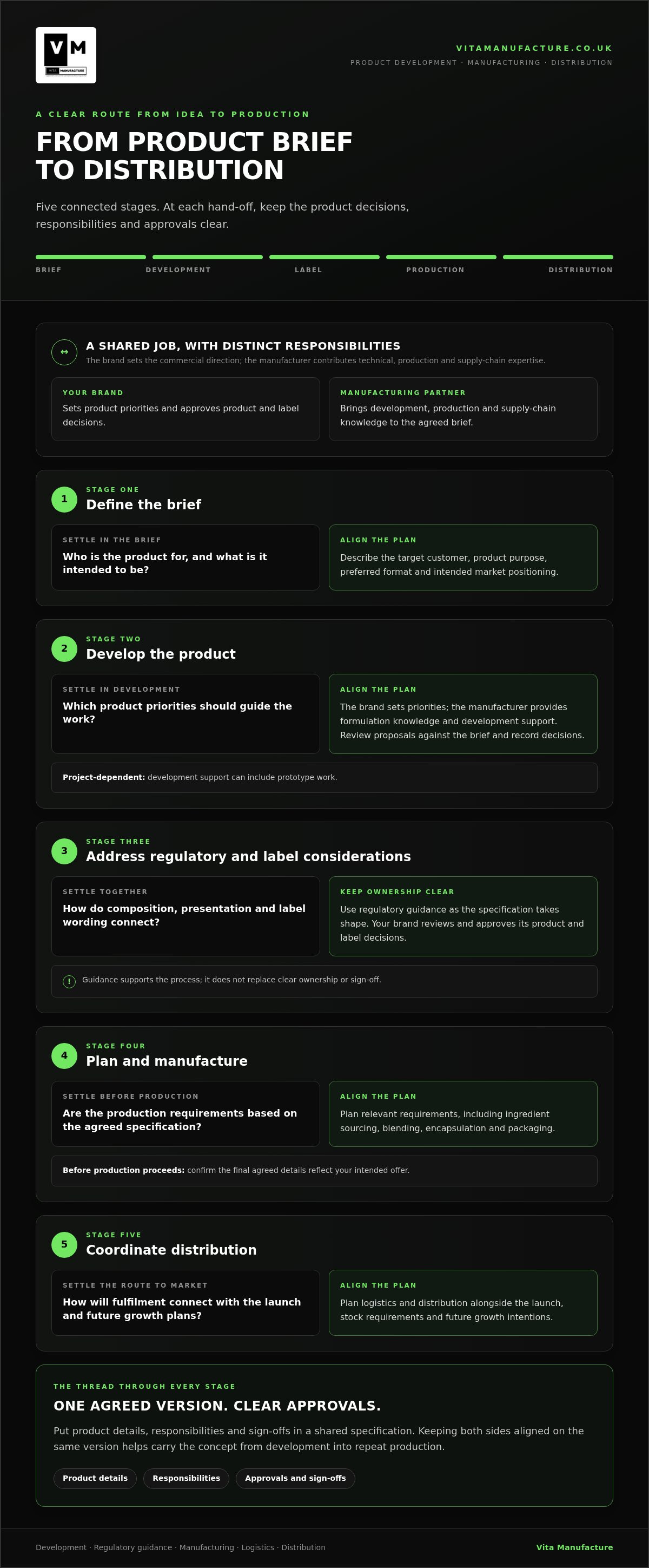
A supplement launch moves through connected stages. Each hand-off is an opportunity to keep decisions clear or let assumptions build. Your brand sets the commercial direction and approves the product; the manufacturer contributes technical, production and supply-chain expertise. Agreeing the brief, specifications and approval points early gives both sides a shared basis for the work.
Define the brief. Describe the target customer, product purpose, preferred format and intended market positioning. Vita Manufacture uses this information to understand the development needs and how the concept could become a workable product specification.
Develop the product. Your brand sets product priorities, while Vita Manufacture provides formulation knowledge and development support. Depending on the project, this can include prototype work. Review proposals against the brief and record decisions, so the work stays focused on what your brand is trying to achieve.
Address regulatory and label considerations. Product composition, presentation and label wording are connected decisions. Regulatory guidance can inform them as the specification takes shape. Your brand should review and approve its product and label decisions. Guidance supports that process but doesn’t replace clear ownership or sign-off.
Plan and manufacture. Once the product specification is agreed, relevant production requirements can be planned, including ingredient sourcing, blending, encapsulation and packaging. Confirm that the final agreed details reflect your intended offer before production proceeds.
Coordinate distribution. Production needs to connect with your route to market. Plan how logistics and distribution fit your launch, stock requirements and future growth intentions, so manufacturing decisions are considered alongside fulfilment.
Turning a brand brief into a production-ready product
A useful brief guides decisions without assuming every detail is already settled. Include who the supplement is for, its intended purpose, preferred format and how it should fit within your brand’s range. The supplement formulation development guide offers further context on formulation work. Regulatory guidance can also inform product and label decisions. For your project, make sure those decisions have clear review and approval points.
Planning manufacturing, packaging and distribution
Turn the agreed specification into a shared reference for production planning. Record the approved product details and any points that need sign-off before work moves forward. This helps align sourcing, blending, encapsulation and packaging with the launch brief, while leaving room to consider how future demand could affect supply-chain planning. Industry bodies such as the Private Label Manufacturers Association (PLMA) provide broader context on private label, but a supplement project still needs decisions tailored to its specification and route to market.
For brands comparing private label manufacturers, the key is to understand who owns each decision and how information passes between stages. Vita Manufacture connects product development with regulatory guidance, manufacturing, logistics and distribution. Explore Vita Manufacture’s supplement manufacturing support to see how connected services can fit your launch plan.
How to assess private label manufacturers: capabilities, quality and fit
A strong assessment goes beyond a list of services. Check whether a manufacturer’s capabilities fit your product brief, your team’s expertise and the direction you want the brand to grow. The right fit is a manufacturer whose documented capabilities align with the practical needs of your product brief.
Use the comparison below to identify where you need hands-on support and where your team can lead. Treat each capability as a distinct part of the working relationship, rather than making assumptions based on a supplier’s general description.
Quality systems and compliance support
Documented quality processes and clear product specifications give the brand and manufacturer a shared reference for agreed requirements. Vita Manufacture is ISO 22000:2018 certified. This is a company credential, not a guarantee of a particular product outcome or a substitute for understanding how responsibilities are divided within a project.
Manufacturing support can inform product and label decisions, but your brand still needs to make and approve its product and marketing choices. Build review points into the project so the agreed specification and label direction remain aligned as development progresses.
Service scope, transparency and growth readiness
Assess development, production, packaging, logistics and distribution separately when deciding what support your brand needs. Where specialist packing is required alongside bulk production, contract packers such as Simplepack Ltd support businesses across the supplement and health sectors. A team with in-house product expertise may prioritise manufacturing, while an early-stage team may benefit from connected support across more stages. Consider whether the proposed scope fits your launch plan and can accommodate changing requirements.
Project visibility also matters. Vita Manufacture’s customer portal supports transparency by providing visibility into project progress. It complements clear communication and agreed approvals; it doesn’t replace either. For a broader assessment framework, explore this UK supplement manufacturer selection guide.
Common private label manufacturing concerns, and how to manage them
Outsourcing production doesn’t outsource your decisions. Your brand still needs to define the product, approve its specifications and make considered choices about positioning and marketing. A manufacturing partner brings expertise and processes, but the relationship works best when both sides understand who decides, who contributes and when approval is needed.
That balance matters when working with private label manufacturers. You gain access to specialist development and production support without building every capability in-house. Your project still depends on clear communication and coordination with the manufacturer’s processes. Agreeing responsibilities at the outset makes it easier to manage uncertainty as work progresses.
Will outsourcing mean losing control of your supplement brand?
No. Your brand owns its positioning and makes the key product decisions; the manufacturer contributes technical and operational expertise to bring the agreed specification into production. Keep control by documenting product requirements, decisions, approvals and agreed changes. This makes the current working version clear to everyone involved.
Set approval points for important milestones, such as the product specification and label direction. Your team can then review the details before the project moves to the next stage. Manufacturing support and regulatory guidance can inform decisions, but they don’t remove your brand’s responsibility for its product and marketing choices.
Can one partner support a brand as it grows?
A brand’s needs can change. Early on, it may need help shaping a product; later, coordinating production, packaging and distribution may become more important. A partner with connected development, manufacturing and logistics capabilities can help you plan across these stages. The right scope depends on your product requirements and growth plans.
Share future intentions as part of project planning, without treating growth as a guaranteed production outcome. Clarify which product details need to remain consistent, where changes may be considered and how those changes will be reviewed. This gives the manufacturer useful context for planning while your brand remains responsible for deciding how the offer develops.
These practical steps help make collaboration clearer:
Agree responsibilities: record who provides information, reviews materials and approves decisions.
Set milestones: identify the sign-offs needed before the project moves to its next stage.
Keep communication transparent: share updates and record decisions in an accessible project reference.
Plan for change: agree how specification updates will be discussed and documented.
These habits can reduce avoidable misunderstandings, but they don’t remove every operational dependency. Your project still relies on the manufacturer’s processes, so include that relationship in plans for sourcing, production and distribution. The supplement supply-chain management guide explores those operational considerations in greater depth.
Vita Manufacture provides connected support across product development, manufacturing, logistics and distribution. Plan your supplement project with Vita Manufacture.
Working with Vita Manufacture: turn your supplement concept into a plan
A strong manufacturing partnership starts with a clear product ambition and a practical route towards production. Whether you’re developing your first supplement or expanding an established range, Vita Manufacture connects product development, regulatory guidance, manufacturing, logistics and distribution. Bringing these services together helps keep product decisions and operational planning connected across project stages.
What Vita Manufacture brings to a private label project
Vita Manufacture is a UK-based contract manufacturer of vitamins, minerals and dietary supplements, serving clients worldwide. Its services include private label, white label and custom product development, alongside manufacturing and supply-chain support. Brands can work with Vita Manufacture across more than the production stage, from shaping a product concept to planning how finished goods move towards the intended route to market.
Regulatory guidance informs product and label decisions as a project develops. Logistics and distribution support connect production planning with the brand’s operational needs. Vita Manufacture is ISO 22000:2018 certified. This is a company credential, not a guarantee of a specific product outcome. A customer portal also supports project transparency by providing visibility into progress.
The right support depends on your project. A founder with an early concept may need development input, while an established brand with a defined specification may focus on manufacturing and distribution planning. Set clear priorities to make the working relationship more purposeful.
Prepare a useful brief for your manufacturing project
You don’t need every technical detail finalised before starting a conversation. A considered brief gives the project a useful foundation and helps identify where development input or production planning is needed. Include the essentials:
Concept and audience: describe the supplement idea and its intended customer.
Product goals: outline its purpose and how it should fit within your brand.
Format preferences: note the product format you have in mind, distinguishing firm requirements from preferences.
Launch priorities: explain the decisions or milestones that matter most to your plans.
Support required: identify whether you need help with development, manufacturing, logistics or distribution.
Growth intentions: share how you expect the product or brand to develop, so future requirements can inform early planning.
Use the brief to start a focused discussion, not to lock your business into assumptions before the product has been assessed. As you compare private label manufacturers, look for a partner whose capabilities connect your product goals with the practical steps towards production and distribution.
Ready to take the next step? Discuss your supplement product development project with Vita Manufacture and start shaping your concept into a clear project plan.
Take the next step towards a scalable supplement launch
Your next move doesn’t need to be a finished formula. Start with the opportunity you want to pursue, the customer you want to serve and the decisions your team needs help progressing. A focused conversation can turn those ambitions into a practical development plan, with responsibilities and priorities made clear from the outset.
When assessing private label manufacturers, consider how quality credentials, connected support and project visibility fit your requirements. Vita Manufacture’s ISO 22000:2018 certification, services across development, manufacturing and logistics, and customer portal are useful points to consider alongside your product goals and intended growth.
Bring your concept, questions and priorities to the next conversation. Discuss your supplement product development project with Vita Manufacture and take a confident step towards making your brand ambition a workable plan.
Frequently Asked Questions
What do private label manufacturers do?
Private label manufacturers make products that businesses sell under their own brands. For supplement brands, the work may be limited to manufacturing against an agreed specification or extend to development, ingredient sourcing and preparing the product for sale. The arrangement depends on the project. Set out who approves the formula, artwork and final product to prevent assumptions from becoming misunderstandings.
How do I choose a private label supplement manufacturer?
Choose a partner whose capabilities and working approach fit your product and team. For example, if your team has strong brand expertise but limited formulation knowledge, development input may matter more than a production-only arrangement. Assess how project decisions are recorded, how updates are shared and who is responsible for approvals. Compare these points with the manufacturing scope and the support your brand may need as it develops.
Is private label manufacturing suitable for a start-up supplement brand?
It can suit a start-up that wants to build a branded supplement business without establishing its own manufacturing operation. A founder can bring an early concept, audience insight and brand direction, then work with a manufacturer on development and production requirements. Suitability depends on the product brief, available expertise and launch plan. Clarify responsibilities and project stages before committing to a product direction or business timetable.
Can private label manufacturers help develop a supplement formulation?
Yes, some private label manufacturers support formulation and new product development as well as production. Vita Manufacture provides custom supplement development, including product formulation support. Share the intended customer, product purpose, preferred ingredients or format, and any non-negotiable requirements. Vita Manufacture can contribute development expertise, with formulation and related product decisions reviewed and agreed before moving towards manufacture.
What certifications should a private label supplement manufacturer have?
No single certification tells you whether a manufacturer is right for your project. Consider the relevant documented quality processes and what each certification covers. Treat this as a company credential, not a guarantee about a particular product or a replacement for product-specific quality information. Also consider how specifications, approvals and production records are managed.
Who owns the brand and product specifications in private label manufacturing?
The brand uses its own identity to market the product, but ownership and permitted use of product specifications should be set out clearly in the manufacturing agreement. Brand ownership doesn’t automatically settle who owns a bespoke formula, technical documents or related development work. Record the agreed position in writing, including how confidential information is handled and what happens if the relationship ends or the product specification changes.
Can a private label manufacturer support packaging and distribution?
Yes, support can extend beyond making the supplement. Vita Manufacture provides logistics and distribution services, connecting manufacturing with the product’s onward movement. Define packaging requirements as part of the project so the production plan reflects the agreed product presentation. Clarify how responsibilities are divided across packaging, dispatch and distribution, and how these steps fit your route to market.
How does private label differ from contract manufacturing?
Private label describes a branded product model: a business sells a product under its own brand. Contract manufacturing describes an arrangement in which a business contracts a manufacturer to make products. The terms can overlap, since a brand may use contract manufacturing to produce its private label supplement. Focus on the agreed specification, branding and division of responsibilities, rather than assuming the terminology defines the full service scope.