Pilot Study and Market Research: The Complete Product Validation Guide
An estimated 95% of the 30,000 new consumer products launched each year fail to achieve commercial success. You've likely spent months refining an innovative supplement concept, yet two pressing uncertainties remain: will consumers actually buy it, and can the formulation run cleanly across high-speed equipment? Conducting a synchronised pilot study and market research programme eliminates that risk before you commit significant capital. You already know that pouring budget into unverified demand or untested factory runs is the fastest route to stalled production and idle inventory.
Discover how combining commercial market research with technical pilot studies prevents costly manufacturing failures and accelerates product success. Ahead, we provide a clear framework to de-risk your formulations, master British regulatory compliance, and partner with a contract manufacturer capable of supporting your journey from initial bench prototype to commercial volume.
Table of Contents
What Is a Pilot Study and Market Research in Product Development?
Launching a new supplement brand without dual-track testing is an unnecessary operational gamble. Many founders assume that strong consumer interest guarantees a seamless factory rollout, but commercial appetite and mechanical feasibility are two entirely different hurdles. Conducting a synchronised pilot study and market research programme bridges the divide between theoretical demand and physical production reality. When you rely solely on consumer surveys, you create blind spots around ingredient flow, stability, and high-speed encapsulation behaviour.
Deconstructing Market Research: Gauging Demand and Consumer Behaviour
Market research is the systematic commercial validation of customer appetite, competitive positioning, and retail pricing viability before committing capital to formula development. Within the UK supplement sector, this process investigates emerging nutritional trends, retailer expectations, and clear category white spaces. It uncovers deep-seated consumer frustrations regarding capsule sizes, poor ingredient bioavailability, and artificial excipients. Most importantly, commercial analysis maps actual willingness to pay against target profit margins, ensuring you do not formulate a premium product that prices itself straight out of the market.
Deconstructing the Pilot Study: Validating Technical Feasibility
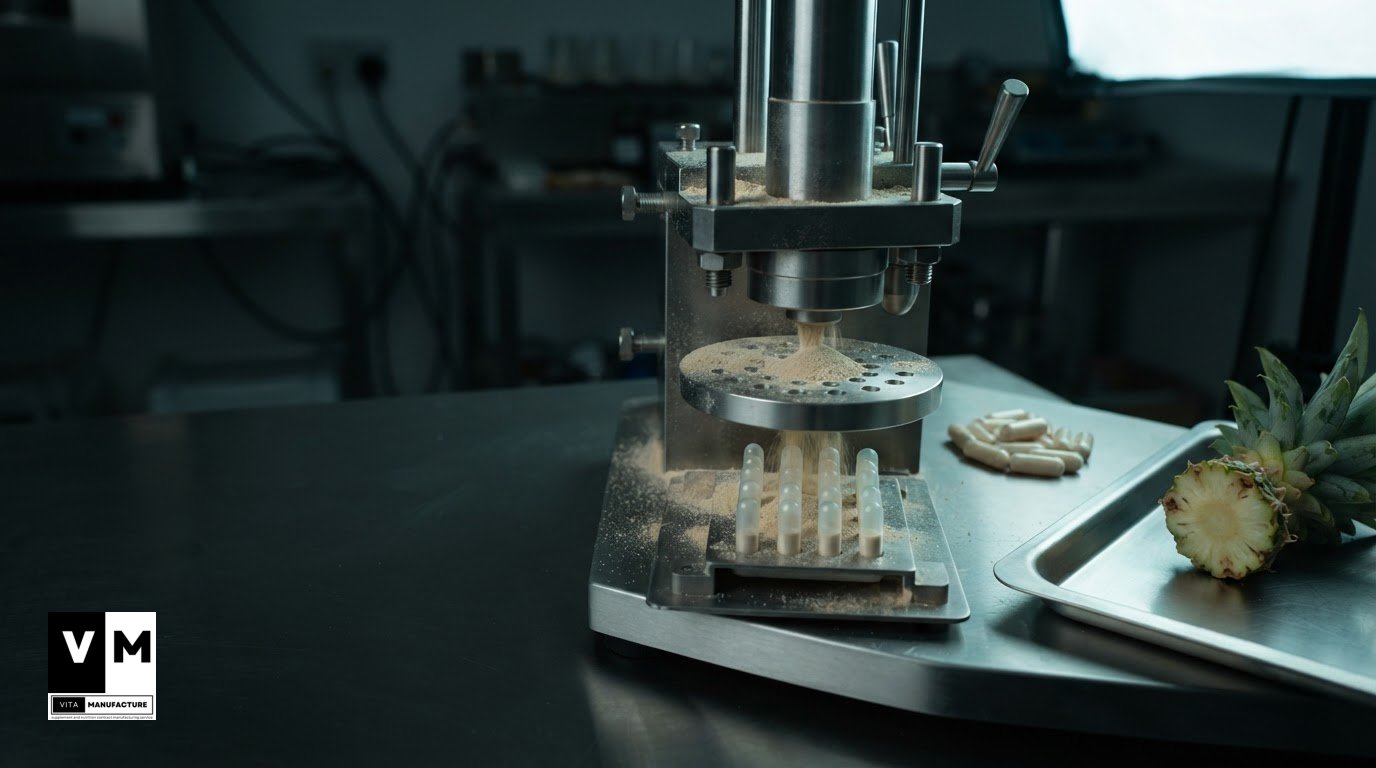
Where market analysis evaluates buyer psychology, a pilot study tests physical reality. Operating fundamentally as a controlled pilot experiment, this stage runs small-scale prototype formulations through high-speed manufacturing machinery. It determines whether hygroscopic botanical extracts flow smoothly through hoppers or cause catastrophic equipment blockages. A technical trial identifies volatile chemical interactions between active ingredients and capsule shells, verifies blending uniformity across batches, and pinpoints realistic material waste metrics. Benchtop chemistry rarely mirrors factory-floor conditions; a pilot trial proves your formula can survive automated production.
True commercial validation demands that you evaluate both disciplines simultaneously. By marrying commercial pilot study and market research processes, you protect your venture against expensive packaging write-offs, unsellable inventory, and production delays.
Why Early Formulation Testing Outweighs Standalone Consumer Surveys
Consumer surveys measure stated intent, but physical manufacturing tests unyielding reality. Digital respondents readily endorse high-dose, clean-label botanical concepts without understanding the daily sensory experience or swallowability of a size 00 capsule. As highlighted by the National Center for Complementary and Integrative Health regarding the true purpose of a pilot study, early trials must evaluate practical operational feasibility rather than statistical significance alone. Relying solely on questionnaires creates an expensive disconnect between market aspiration and factory floor capability.
The Pitfalls of Theoretical Surveys in Physical Product Development
Consumers regularly exhibit stated preference bias; they declare a desire for potent organic formulations, yet abandon products that smell overly pungent or arrive clumped. Questionnaires cannot predict how high-potency extracts react inside barrier packaging over a twelve-month shelf life. Committing to packaging runs before validating moisture absorption leads directly to compromised product integrity and customer returns.
Assessing Organoleptic Qualities and Raw Material Interactions
Physical prototypes evaluate critical sensory benchmarks like swallowability, dissolution rates, and aroma. Botanical powders often display severe hygroscopicity, absorbing ambient moisture and turning gummy under processing heat. Pilot blending trials test excipient ratios, flow agents, and particle size distribution, ensuring active ingredients remain thoroughly mixed without clumping during mechanical runs.
Regulatory Feasibility and Food Standards Agency Compliance
Market trends often chase novel ingredients long before British regulators approve them for sale. Every formulation must align with the Food Standards Agency (FSA) novel food catalogue and the Great Britain Nutrition and Health Claims Register. Bridging a dual-track pilot study and market research initiative ensures that trendy formulations meet permissible daily dosage limits without triggering statutory product recalls. If you want to de-risk your next formulation before full-scale commercialisation, explore how Vita Manufacture supports pilot trials and formulation testing.
De-Risking Capital: Commercial Viability vs Technical Scalability
Commercial viability proves that consumers want your supplement, but technical scalability proves you can produce it profitably. A concept boasting exceptional survey demand quickly becomes a commercial liability if manufacturing yields collapse on high-speed encapsulation lines. When you run a synchronised pilot study and market research initiative, you reconcile customer expectations with physical manufacturing realities. True margin protection relies on knowing your real-world factory losses before printing cartons or purchasing bulk raw ingredients.
Unit Economics: Evaluating Ingredient Yields and Production Waste
Theoretical recipe costing rarely matches actual production spend. During industrial blending and encapsulation, complex botanical extracts cling to machinery contact parts, causing material scrap that drains working capital. A pilot run establishes verified baseline yields, testing whether dense, oily active ingredients require anti-caking excipients that inflate your cost of goods. By measuring machine throughput and material loss early, you protect operating margins and establish accurate retail price points long before committing to commercial scale orders.
Packaging Integrity, Barrier Protection, and Shelf-Life Expectations
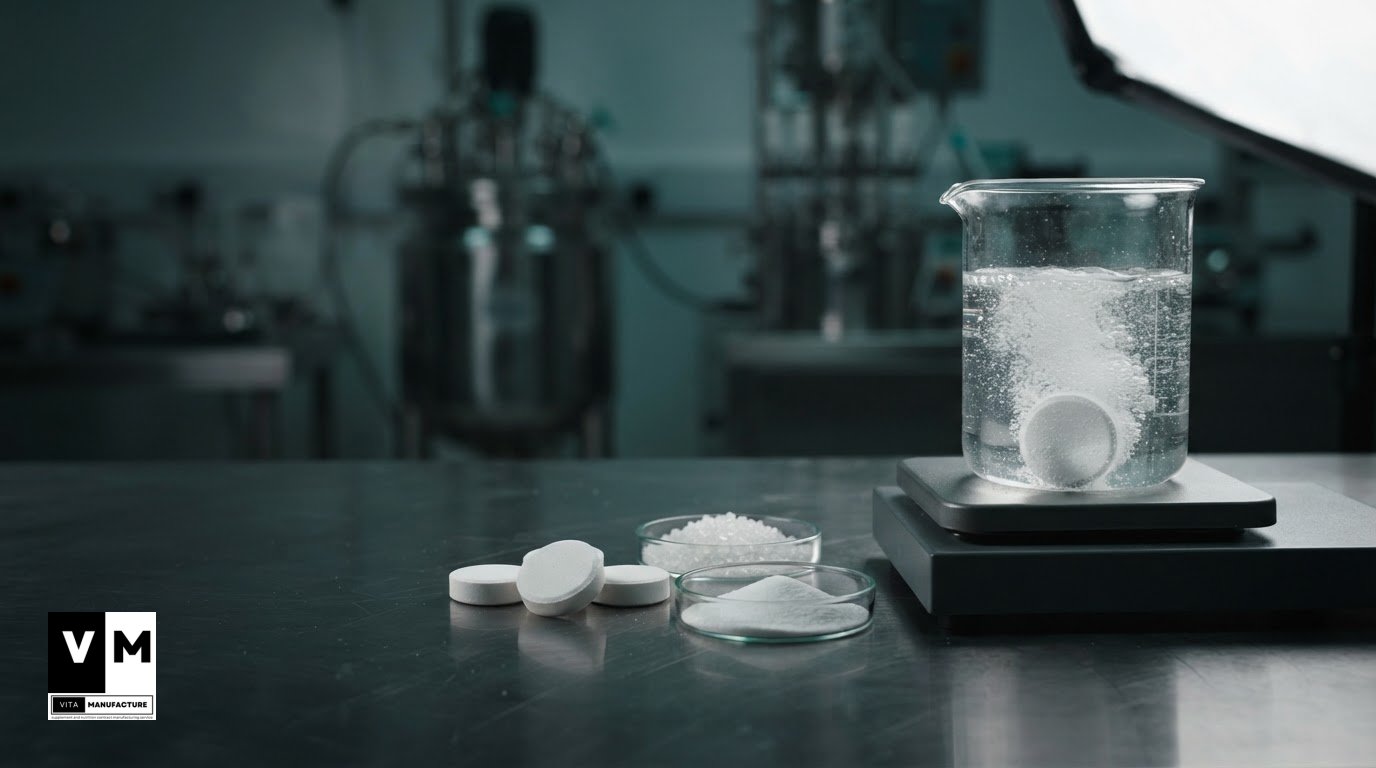
Choosing secondary packaging based solely on digital aesthetic appeal risks product stability. Active ingredients like probiotics, botanical extracts, and effervescent minerals degrade rapidly when exposed to ambient moisture and oxygen. Conducting a mechanical pilot run paired with early barrier testing reveals how your product behaves across different formats:
High-Density Polyethylene (HDPE) Bottles: Provide robust moisture barriers and cost-effective bulk packing, though they require induction seals to maintain active potency.
Blister Packaging: Offers superior unit-dose protection against humidity and oxidation, especially useful for highly hygroscopic herbal formulas.
Pouches and Sachets: Popular for single-serve drink mixes, yet multi-layer laminate barriers must be heat-tested during pilot runs to prevent seal delamination.
Subjecting pilot batches to accelerated stability conditions validates your label potency claims across the complete lifecycle. Catching degradation or seal failure in a trial run prevents you from ordering tens of thousands of custom-printed containers that fail to protect the formula inside.
Aligning physical manufacturing metrics with consumer sentiment guarantees that scale does not compromise profitability. By validating both economics and container engineering through a structured pilot study and market research process, you secure sustainable commercial growth.
A Step-by-Step Validation Framework for New Formulations
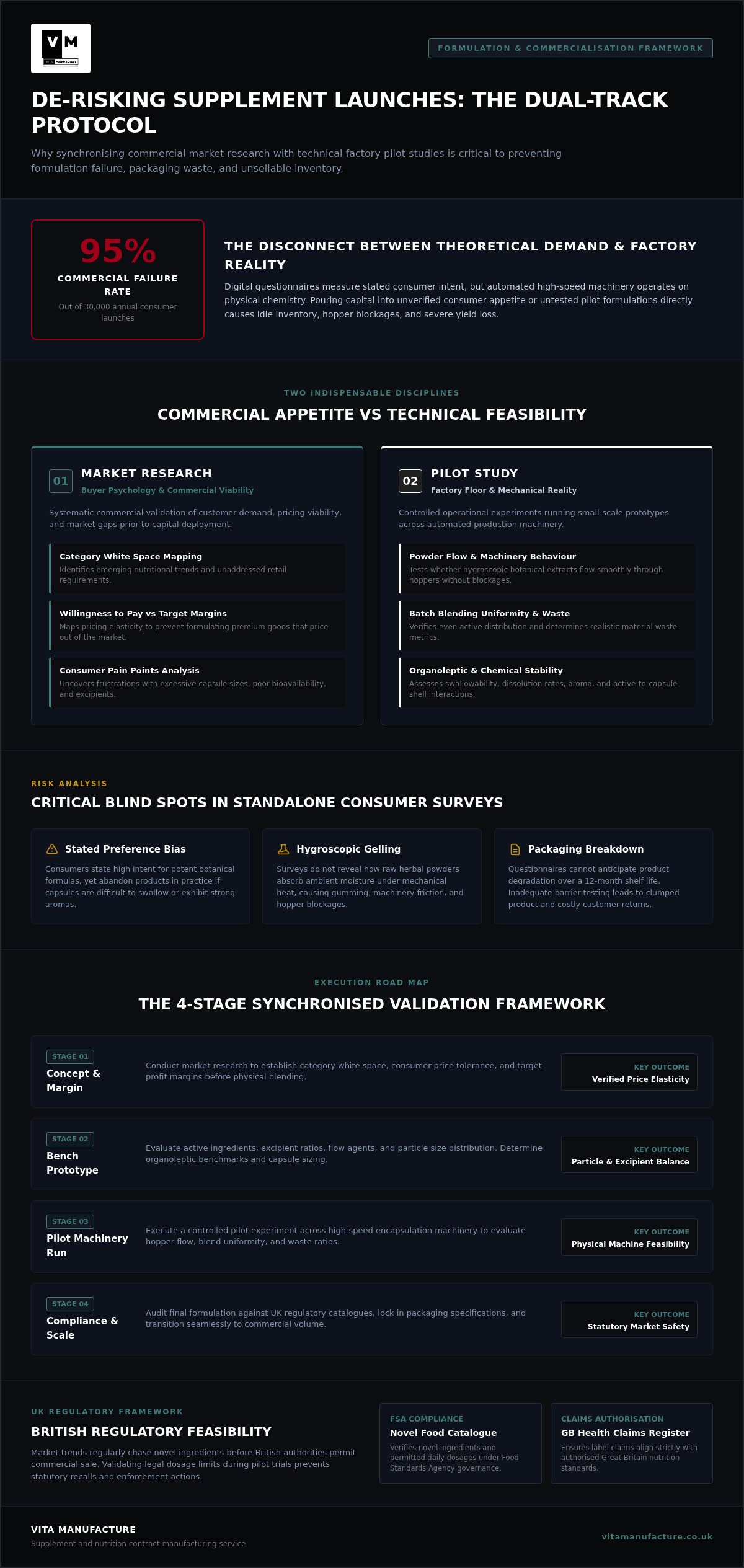
De-risking a novel health product requires more than isolated surveys or speculative factory runs. You need a structured stage-gate framework that links market intelligence directly with engineering milestones. Progressing methodically from commercial discovery to physical machine calibration prevents you from sinking capital into unviable concepts. By integrating each phase of your pilot study and market research, you confirm product viability before issuing large-scale purchase orders.
Stage 1: Market Intelligence, Audience Profiling, and White-Space Mapping
Begin by analysing national retail category performance to spot clear commercial gaps. Profile your core consumer demographics, detailing their daily supplement routines, preferred delivery methods, and price tolerance. At this stage, map these consumer preferences against Great Britain regulatory boundaries to guarantee every targeted active ingredient is legally compliant before starting development work in the laboratory.
Stage 2: Bench Formulation, Prototyping, and Sensory Panels
Once commercial viability is defined, transition into benchtop formulation. Experienced formulation scientists blend initial laboratory samples, balancing active nutritional density with physical stability. Internal sensory review panels evaluate particle cohesion, natural flavour masking, and powder colour. Testing multiple recipe variants at this small scale ensures your team resolves aroma or taste issues without incurring factory downtime.
Stage 3: Industrial Pilot Line Trial and Machine Calibration
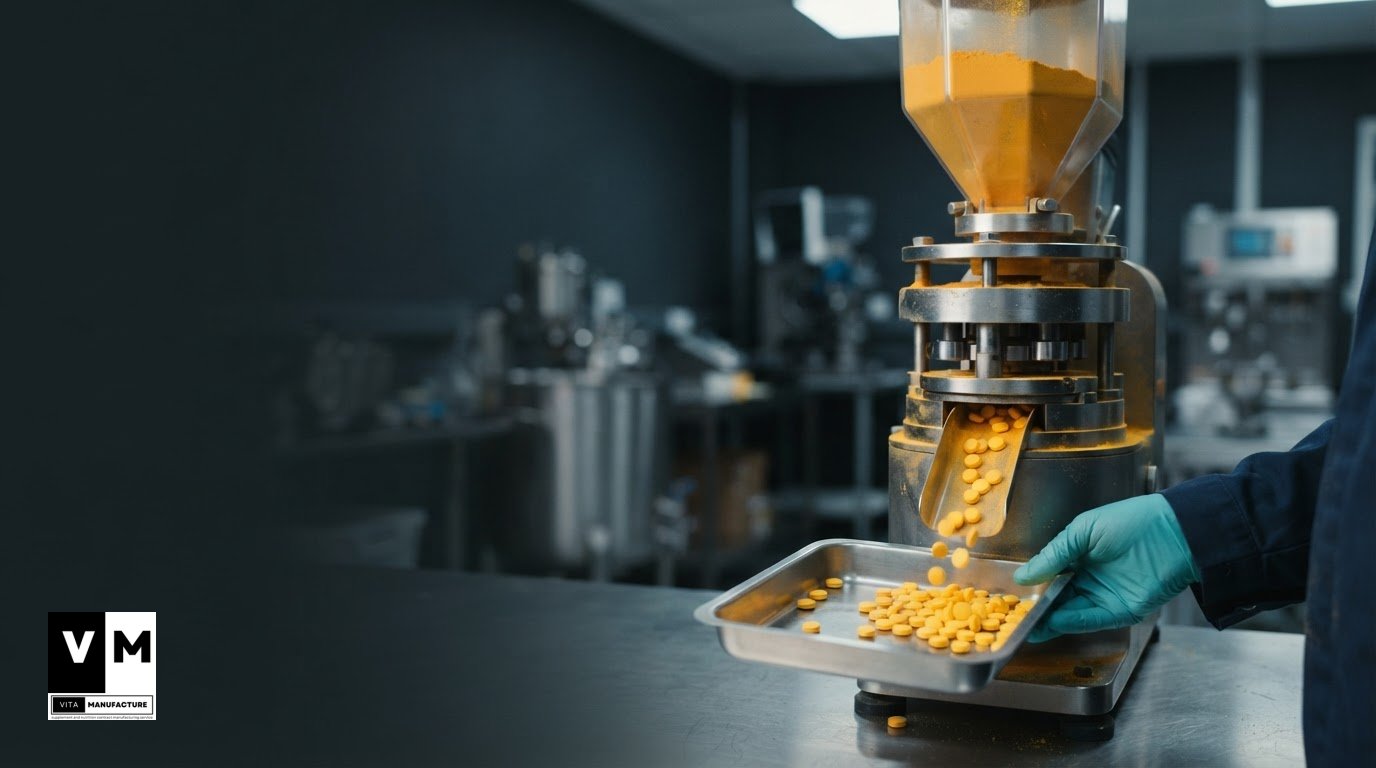
Next, move successful bench formulations onto commercial encapsulation, tabletting, or powder-filling equipment. Operating high-speed machinery under controlled pilot conditions provides crucial production data:
Fill-Weight Precision: Verifies that dosing remains uniform across thousands of units without active ingredient settling.
Disintegration and Dissolution: Confirms tablets or capsules break down within exact statutory pharmacopoeial timeframes.
Mechanical Line Speed: Pinpoints the optimal operational velocity to prevent line blockages, excessive heat buildup, or tablet capping.
Completing this phase locks in your master manufacturing records and establishes precise commercial batch specifications. If you are ready to implement this validation process for your supplement brand, partner with Vita Manufacture for new product development and pilot trials.
Finally, distribute physical pilot samples to targeted consumer cohorts for real-world usage feedback. Combining genuine sensory responses with proven engineering metrics gives you total confidence as you scale into mass production.
Bridging Research and Production with a Unified UK Manufacturing Partner
Decoupling your consumer research from technical production creates expensive operational frictions. When external research agencies work in isolation from the factory floor, founders receive conceptual product briefs that machinery simply cannot run. Unifying your pilot study and market research under one roof eliminates miscommunication, prevents launch delays, and aligns commercial ambitions directly with engineering capability.
Eliminating the Silo Between Market Insight and Factory Capabilities
Formulation revisions late in development drain working capital. Engaging development chemists whilst analysing market demand ensures your ingredient selections are mechanically viable from day one. You don't have to guess whether an on-trend botanical will withstand automated capsule filling or pass British regulatory thresholds. An integrated partner grounds bold marketing claims in validated stability data, turning raw consumer insights into production-ready specifications without friction between disparate suppliers.
Scaling with Confidence Under ISO 22000:2018 Quality Standards
Manufacturing integrity protects your brand reputation as commercial volumes increase. Operating within an ISO 22000:2018-certified facility guarantees that food safety management and batch-to-batch consistency meet stringent British standards. Through a transparent customer portal, you gain full visibility into ingredient sourcing, pilot trials, and active production schedules across capsules, tablets, and advanced powder blends. Ready to validate your next health product? Review your custom formulation with our technical team at Vita Manufacture.
Transitioning from a low-volume trial to nationwide commercial distribution shouldn't require restarting your operational groundwork. By executing a cohesive pilot study and market research strategy alongside a dedicated British manufacturing partner, you safeguard your capital and build a resilient foundation for long-term brand growth.
Scale Your Product Vision with Proven Validation
Bringing a standout nutritional supplement to market requires far more than theoretical optimism. By unifying an evidence-led pilot study and market research strategy, you eliminate the threat of unproven demand and protect your working capital against preventable factory-floor failures. You verify genuine consumer willingness to pay, ensure full regulatory compliance under British standards, and confirm mechanical flowability before scaling up.
Operational success ultimately hinges on choosing the right manufacturing ally. Operating from an ISO 22000:2018-certified British facility, our dedicated team provides comprehensive pre-production R&D and pilot batch capabilities designed to eliminate scale-up risk. Through our transparent customer portal, you maintain end-to-end oversight across formulation milestones, raw material sourcing, and trial yields. Ready to build a commercially resilient brand? Validate your next supplement formulation with Vita Manufacture and enter the market with complete technical confidence.
Frequently Asked Questions
What is the primary difference between a pilot study and market research?
Market research validates commercial intent, whereas a pilot study validates mechanical and chemical feasibility. Conducting market research identifies target demographics, willingness to pay, and retail appetite before you formulate. A technical pilot study tests the physical recipe under automated conditions, confirming powder flowability, shelf stability, and blending yield. Bridging a pilot study and market research ensures your product satisfies real consumer demand whilst remaining viable on high-speed factory lines.
Why is a physical pilot study necessary if consumer market research is positive?
Positive consumer research proves interest, but it cannot predict whether active ingredients will separate or clump during production. Consumers evaluate conceptual benefits and packaging visuals, not the physical rheology of hygroscopic botanicals or excipient interactions. Running a physical trial confirms that lab-scale samples translate reliably to automated industrial machinery. Without this step, you risk severe machine blockages, off-spec fill weights, and extensive production downtime when executing your first commercial run.
How long does a typical supplement pilot study and formulation trial take?
A comprehensive formulation trial and pilot run typically takes between four and twelve weeks depending on complexity. Benchtop prototyping and internal sensory review panels usually require two to four weeks. Sourcing specialised raw materials, testing machine calibration on pilot lines, and conducting preliminary stability testing require an additional several weeks. Allocating appropriate time during pre-production development prevents multi-month supply chain disruptions and costly packaging recalls after your national launch.
What technical parameters are measured during a manufacturing pilot run?
Manufacturing pilot runs evaluate powder flowability, blend uniformity, fill-weight consistency, and mechanical line speed tolerances. Engineers monitor tablet hardness, disintegration time, and friability to ensure dosage forms withstand packaging friction. For encapsulated formulations, trials confirm capsule shell integrity and seal resistance against ambient humidity. Calculating real-world scrap percentages and net yields during this trial provides the exact cost-of-goods baseline required for accurate retail pricing.
Can a small-scale pilot formulation run directly on commercial manufacturing lines?
Not without calibration, because benchtop blenders behave very differently from industrial high-speed encapsulation machinery. Small prototype batches demonstrate proof-of-concept in controlled laboratory environments, but commercial production introduces centrifugal heat, high compression forces, and vibration. A structured pilot run tests your recipe on intermediate or calibrated commercial machinery to identify flow restrictions, ensuring the blend performs smoothly once full-scale production schedules begin.
How does market research inform dietary supplement regulatory compliance in the UK?
Market research highlights popular consumer trends, but commercial teams must verify these desires against statutory UK regulatory frameworks. In Great Britain, consumer demand for novel botanicals or high-potency vitamins must be reconciled with the Food Standards Agency novel foods catalogue and permissible health claim registers. Integrating your commercial pilot study and market research ensures that on-trend marketing claims remain legally defensible, avoiding immediate enforcement action from Trading Standards or the ASA.
What happens if a new formulation fails during the pilot study phase?
If a formulation fails during pilot trials, technical teams re-engineer the recipe before committing to commercial batch production. Common failures include poor powder flow, capsule brittleness, or rapid ingredient oxidation. Development chemists resolve these challenges by adjusting excipients, refining particle sizes, or altering humidity controls in the production suite. Discovering these technical vulnerabilities at pilot scale saves thousands of pounds compared to experiencing an active line stoppage.