Personalised Vitamin Manufacturing UK: 2026 Trends and Brand Opportunities
With the UK vitamin market reaching an estimated USD 7.11 billion in 2026, why is the most significant growth happening in bespoke, data-driven formulas rather than standard off-the-shelf bottles? This shift represents a fundamental change in consumer behaviour, where generic supplements are being replaced by regimes tailored to individual biomarkers. If you are looking to capitalise on this, finding the right partner for personalised vitamin manufacturing UK is no longer just an operational choice; it's a core strategic requirement for any brand aiming for longevity.
You've likely found that the path to market is often blocked by high minimum order quantities and the sheer technical difficulty of maintaining product stability across thousands of unique combinations. It's a daunting challenge to balance innovation with the strict UK food safety regulations that govern bespoke blends. This guide will provide you with the strategic insights needed to overcome these hurdles and identify a manufacturing partner that scales with your ambition. We’ll examine the 2026 trends, the essential technological requirements for custom packs, and a methodical roadmap to move your brand from prototype to commercial success.
Table of Contents
The Evolution of Personalised Vitamin Manufacturing in the UK
Personalised vitamin manufacturing UK is undergoing a radical transformation. It's no longer about selling a generic bottle of multivitamins; it's about engineering a unique solution for a single individual. This shift from "one-size-fits-all" mass production to precise, data-led customisation is the defining trend of 2026. Brands are moving away from broad demographics and focusing instead on the specific physiological needs of the consumer. This isn't just a niche movement. It's a fundamental change in how supplements are designed, produced, and delivered.
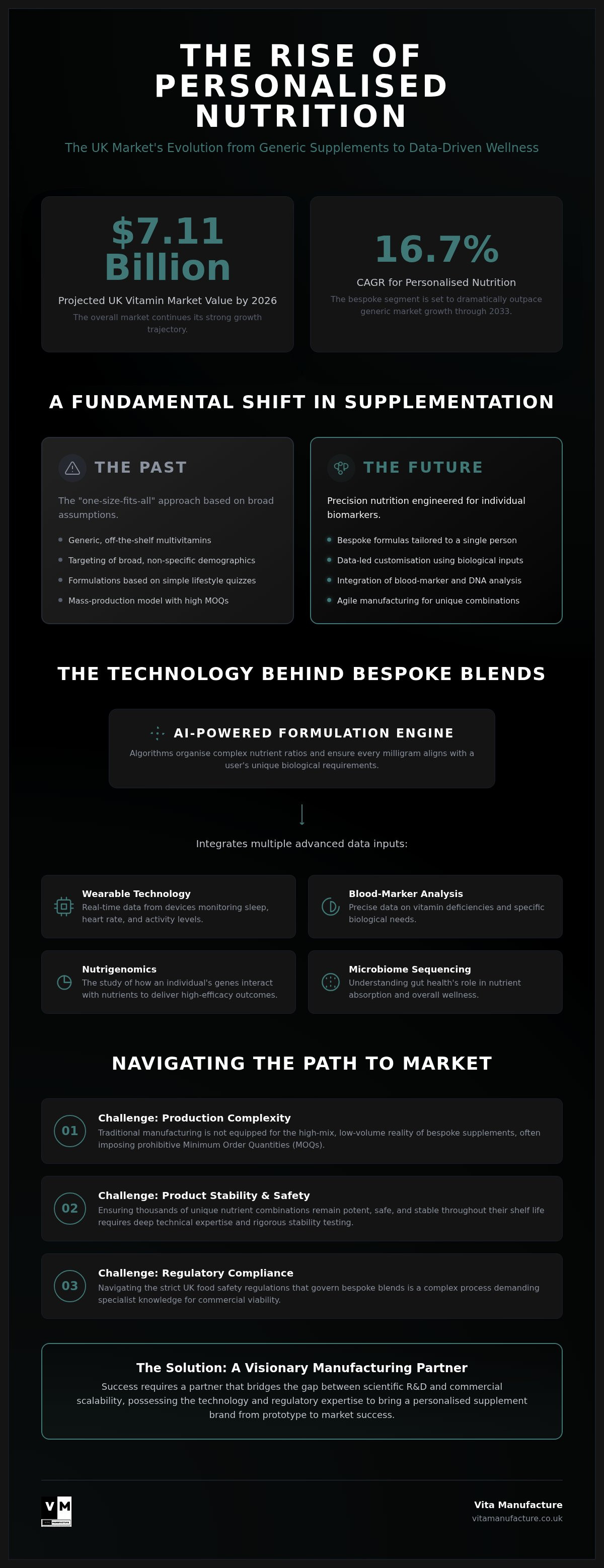
The UK market is primed for this evolution. Whilst the overall vitamin sector is expected to reach USD 7.11 billion in 2026, the personalised nutrition segment is projected to grow at a CAGR of 16.7% through to 2033. Traditional off-the-shelf supplements are losing ground because they can't compete with the efficacy of a tailored regime. Consumers want results, not guesses. They're increasingly looking for products that address their unique health profile rather than a generic standard. To meet this demand, manufacturers must align their processes with the three pillars of personalisation: lifestyle assessments, biological data, and DNA testing. These elements provide the essential blueprint for every bespoke blend.
The Shift from Lifestyle Quizzes to Biological Data
Early attempts at personalisation were often limited to basic online questionnaires that barely scratched the surface of a user's actual requirements. By 2026, the industry has matured significantly. We've moved beyond simple quizzes to integrating blood-marker analysis and microbiome sequencing directly into the production cycle. This allows for a level of accuracy that was previously impossible to achieve at scale. Precision Nutrition is the intersection where granular biological data meets targeted dietetic intervention.
Consumer Behaviour and the Demand for Transparency
Today's UK consumer is more informed and more sceptical than ever before. They prioritise ingredient provenance and clean labels, demanding to know exactly what is in their custom blend and why it's there. This has led to a sharper focus on the ratio of "active" ingredients versus "inactive" fillers or binders. In the bespoke sector, trust is the primary currency. Brands that provide full transparency regarding their sourcing and manufacturing processes are the ones winning long-term loyalty. They don't just sell a product; they provide a transparent service that proves its value through data-backed results.
Data-Driven Formulations: The Science Behind Custom Supplements
Precision is the new standard. In the sophisticated world of personalised vitamin manufacturing UK, the ability to translate raw data into a physical product is what separates market leaders from also-rans. AI algorithms now act as the primary architects, organising complex nutrient ratios that would be impossible to calculate manually at scale. These systems ensure that every milligram of an active ingredient aligns perfectly with a consumer's unique biological requirements.
How does your brand stay relevant? By integrating wearable tech data and nutrigenomics into the production cycle. Real-time insights from devices monitoring sleep, heart rate, and activity levels allow for supplements that adapt to a user's changing needs. When combined with nutrigenomics, the study of how genes interact with nutrients, the result is a high-efficacy product that delivers measurable health outcomes. This level of scientific rigour isn't just a marketing claim; it's a technical necessity for any brand aiming to thrive in 2026.
The Role of R&D in Personalised Product Development
Launching a bespoke range without a solid foundation in Research and Development is a high-risk strategy. Pilot studies are essential to validate your concept before moving to full-scale production. One of the biggest challenges in this sector is stability testing. With thousands of potential nutrient combinations, ensuring that a blend remains potent and safe throughout its shelf life requires deep technical expertise. Partnering with a specialist for new product development ensures that your formulations are both innovative and commercially viable.
Delivery Formats: Beyond the Standard Capsule
While capsules remain a staple, the 2026 market demands more variety. Consumers are increasingly gravitating towards functional powders and liquids that offer a more enjoyable experience. Custom-dosed sachets of flavoured powders are particularly popular, allowing for higher dosages of bulky ingredients like collagen or electrolytes that won't fit in a pill. Manufacturing flexibility is vital here. Your production partner must have the capability to pivot between different delivery systems whilst maintaining the precise dosing that personalisation requires.
Manufacturing Challenges: Navigating MOQs and Complex Production
Scaling a bespoke brand introduces what we call the Personalisation Paradox. You want to offer total customisation, but traditional manufacturing is built for volume and repetition. How do you maintain efficiency when every customer order is technically a new product? This complexity extends to inventory management. Holding hundreds of raw ingredients, from common vitamins to rare botanical extracts, requires a sophisticated supply chain. A partner with robust bulk sourcing capabilities is essential to prevent stockouts and the lead-time delays that often plague the personalised vitamin manufacturing UK sector.
Current data suggests that custom formulations can take between 8 to 16 weeks from order to finished product. This timeline is often dictated by the complexity of sourcing specific ingredients and the rigorous testing required for unique blends. Navigating these timelines whilst managing consumer expectations is a primary hurdle for any growing brand. It's not just about making the product; it's about orchestrating a complex web of logistics and quality checks that ensure every bespoke pack is perfect.
Overcoming the Hurdle of Minimum Order Quantities
Traditional factories thrive on long runs. They often struggle with the "batch of one" model because the setup time for machinery frequently outweighs the production time for a single custom pack. However, modern contract manufacturers have re-organised their facilities to solve this. By using automated dispensing systems and digital integration, they can support smaller runs that were once commercially unviable. For a founder, this is vital for cash flow. Instead of sinking capital into thousands of identical units, you can invest in pilot studies to test market fit. This flexibility allows you to scale based on actual demand rather than optimistic forecasts.
Regulatory Compliance and Quality Assurance in the UK
The UK regulatory landscape is rigorous. The Food Standards Agency (FSA) has strict requirements for labelling, especially when health claims are involved. For bespoke packs, every individual label must accurately reflect the specific blend inside, which adds a significant layer of complexity to the packaging process. Quality isn't just about labels. ISO 22000:2018 is the gold standard for supplement safety, ensuring that every step meets international food safety management criteria. You must also ensure your partner utilises third-party testing for ingredient purity. This guarantees that what's on the label is exactly what's in the pack, protecting both your customers and your brand's reputation.
Strategic Framework for Launching a Personalised Supplement Brand
Success in the bespoke supplement market isn't accidental. It's the result of a methodical framework that balances scientific innovation with commercial viability. When you enter the world of personalised vitamin manufacturing UK, your first task is to define your territory. Will you focus on the booming cognitive health sector, or perhaps target the specific requirements of prenatal nutrition? By narrowing your focus, you can develop more effective data input methods, whether that's a high-tech DNA kit or a sophisticated AI-driven questionnaire. Once your niche is defined, the next step is to translate that vision into a tangible product through rigorous prototyping.
How do you transition from a concept to a scalable business? You need a manufacturing partner who thinks like a founder. Developing a prototype isn't just about mixing ingredients; it's about validating the entire delivery system. This includes ensuring the data from your consumer interface flows seamlessly into the production line. Your go-to-market strategy must then be built on these data insights, allowing you to speak directly to the specific pains and goals of your target audience with authority and precision.
Phase 1: Market Research and Pilot Studies
How do you know your concept will actually perform in a competitive market? Market research is your primary tool for validation. Before committing to a full production run, conducting a pilot study and market research allows you to test your formulations with a real audience. This phase is critical for reducing manufacturing risk and refining your product based on actual user feedback. By focusing on a specific health outcome first, you build a foundation of efficacy that supports long-term brand growth and investor confidence.
Phase 2: Sourcing and Supply Chain Management
A personalised brand is only as strong as its supply chain. In the UK, consumers increasingly demand ethical ingredient sourcing and full transparency. Your logistics and distribution centres must be equipped to handle individualised fulfilment, ensuring that one customer receives their unique blend whilst another receives theirs, with zero margin for error. A transparent customer portal is no longer a luxury; it's a requirement. It allows you to track production in real-time and provides the operational clarity needed to scale a venture from a few hundred orders to tens of thousands without compromising on quality.
Partnering for Success: Scaling with Vita Manufacture
Vita Manufacture stands as a visionary growth partner rather than a mere service provider. For founders entering the personalised vitamin manufacturing UK space, the journey from a brilliant concept to a commercially viable brand is fraught with operational complexities. We understand the high stakes involved in scaling a venture. Our role is to act as your strategic ally, providing the technical infrastructure and scientific rigour required to move seamlessly from initial R&D to mass production. By choosing a partner that thinks like a business owner, you ensure that every decision, from ingredient sourcing to final fulfilment, is aligned with your long-term commercial outcomes.
Our Littleport-based facility is designed to handle the intricate requirements of bespoke supplement production. We don't just manufacture; we innovate alongside you. Whether you're refining a prototype or preparing for a national launch, our end-to-end support system is engineered to absorb the technical burden, allowing you to focus on brand building and consumer engagement. This transition from a small-scale pilot to mass distribution is the most critical phase for any brand, and it requires a partner capable of maintaining precision at every volume.
Why ISO 22000:2018 Certification Matters for Your Brand
In a market increasingly crowded with generic claims, how do you prove your product's safety and quality? ISO 22000:2018 certification is the answer. This isn't just a badge on a website; it's a comprehensive food safety management system that builds immediate consumer trust. For a personalised brand, where you might be managing thousands of unique nutrient combinations, this certification ensures that every single blend meets the highest international standards. We apply these rigorous protocols to every custom order, providing the reliability that only a UK-based manufacturing centre can offer. It gives your customers the confidence that their bespoke regime is produced in a facility that prioritises safety as much as they do.
End-to-End Solutions: From Factory Floor to Customer
True scalability requires more than just a production line. It requires a total solution. Vita Manufacture provides a seamless transition from the factory floor to the customer's doorstep through integrated logistics and distribution services. We act as strategic consultants, helping you navigate the complexities of the UK market whilst ensuring your supply chain remains resilient. To maintain total transparency, our partners utilise a dedicated customer portal. This tool provides real-time project management and tracking, ensuring you're always informed about your production status. It's about creating a narrative of total support, where your manufacturing partner is as invested in your brand's success as you are.
Lead the Precision Health Revolution
The transition from generic multivitamins to data-led precision nutrition represents the most significant commercial opportunity in the UK supplement sector today. You've seen how the convergence of biological data and AI is reshaping consumer expectations, demanding a higher standard of efficacy and transparency. Success in this space requires more than just a good idea; it demands a partner who can bridge the gap between scientific R&D and the operational complexities of personalised vitamin manufacturing UK.
Scaling doesn't have to be a bottleneck. By leveraging an ISO 22000:2018 certified facility and comprehensive pilot study support, you can mitigate the risks associated with small-batch customisation whilst ensuring product stability. The path from prototype to mass production is rarely linear, but with strategic end-to-end logistics and distribution, your brand is positioned for sustainable growth. Are you ready to lead the shift towards precision health?
Partner with Vita Manufacture for your personalised supplement launch and turn your vision into a commercial reality. We're here to help you build a brand that defines the future of wellness.
Frequently Asked Questions
What is the minimum order quantity for personalised vitamins in the UK?
Minimum order quantities for personalised vitamin manufacturing UK typically start between 2,500 and 5,000 units for powdered supplements. However, the "batch of one" model for bespoke daily packs requires a different operational setup. Modern contract manufacturers often utilise automated dispensing to support smaller, more frequent runs. This allows you to scale without the burden of excessive inventory. Always check if your partner can offer flexible terms for pilot studies before committing to mass production.
How long does the R&D process take for a custom supplement formulation?
The R&D phase for a custom formulation generally takes between 8 and 16 weeks. This timeline covers ingredient sourcing, laboratory testing, and stability analysis. Custom blends require more time than private label products because every ingredient interaction must be verified. If your brand relies on rare botanical extracts, lead times might extend further. A methodical approach during this phase ensures your final product is both safe and commercially viable for the competitive UK market.
Is a personalised vitamin brand more profitable than a generic one?
Personalised brands often command higher margins because they offer a data-led service rather than just a commodity product. Whilst the initial manufacturing and R&D costs are higher, the long-term customer lifetime value is typically greater. Consumers are willing to pay a premium for solutions that solve their specific health pains. By focusing on precision, you build a loyal community that values results over price, leading to more sustainable profitability than generic alternatives.
What UK regulations apply to bespoke vitamin manufacturing?
Bespoke manufacturing is governed by the Food Standards Agency (FSA). You must comply with strict labelling requirements, ensuring every individual pack accurately reflects its specific contents. If your formula includes CBD or other novel ingredients, you'll need to navigate the latest 2026 guidance on food hygiene and product identity. Ensuring your facility is ISO 22000:2018 certified is the most effective way to demonstrate compliance with these rigorous national safety standards.
Can I use DNA data to formulate supplements in the UK?
Yes, using DNA data is a primary trend for 2026. This biological input allows you to create truly bespoke regimes based on a user's genetic predispositions. Your manufacturing partner must be able to integrate this data into their production software to ensure the correct nutrient ratios are dispensed. This level of precision is what defines the shift from lifestyle-based quizzes to "Precision Nutrition," offering a significant competitive advantage in the current personalised vitamin manufacturing UK landscape.
How do manufacturers ensure the stability of custom nutrient blends?
Manufacturers ensure stability through rigorous laboratory testing that simulates various environmental conditions. With thousands of potential nutrient combinations, it's vital to check for ingredient interactions that could lead to degradation. Specialist R&D teams analyse the compatibility of vitamins, minerals, and botanicals within their delivery format, whether that's a capsule or a functional powder. This process guarantees that the product remains potent and safe for the consumer throughout its stated shelf life.
What certifications should I look for in a UK supplement manufacturer?
You should prioritise ISO 22000:2018 certification, as it is the gold standard for food safety management. Additionally, look for Good Manufacturing Practice (GMP) and Hazard Analysis and Critical Control Points (HACCP) compliance. These certifications prove that the facility operates under strict quality controls and maintains high hygiene standards. Partnering with a certified manufacturer protects your brand from regulatory scrutiny and builds essential trust with your customers, who demand transparency in their bespoke supplements.
Do I need my own warehouse for a personalised vitamin brand?
You don't necessarily need your own warehouse if you partner with a manufacturer that provides end-to-end logistics. Many contract manufacturers now offer fulfilment and distribution services, handling the individualised shipping of bespoke packs directly to your customers. This model reduces your overheads and simplifies your supply chain. It allows you to focus on growth and marketing whilst your partner manages the complexities of inventory control and global distribution from their facility.