Novel Food Supplement Manufacturing UK: Navigating Compliance and Innovation in 2026
Could your most ambitious supplement formulation be a legal liability before it even reaches a customer? In the current market, the line between a disruptive breakthrough and a regulatory non-compliance seizure is thinner than ever. If you're looking for novel food supplement manufacturing UK, you aren't just looking for a factory; you're looking for a strategic ally who can navigate the Food Standards Agency's evolving requirements. It's understandable to feel hesitant whilst the industry faces post-Brexit divergence and the "under assessment" status of popular ingredients like NMN.
You deserve a clear path from concept to commercial viability without the constant threat of stock being pulled from shelves. This guide provides the strategic roadmap you need to master the complexities of the UK novel food landscape and discover how to safely manufacture and launch innovative formulations. You'll learn the essential steps for novel food validation, from leveraging ISO 22000:2018 certified standards to utilising pilot studies for market research. We'll preview the exact roadmap required to find a certified partner and ensure your unique product achieves a successful, compliant market entry in 2026.
Table of Contents
What Defines a Novel Food Supplement in the UK?
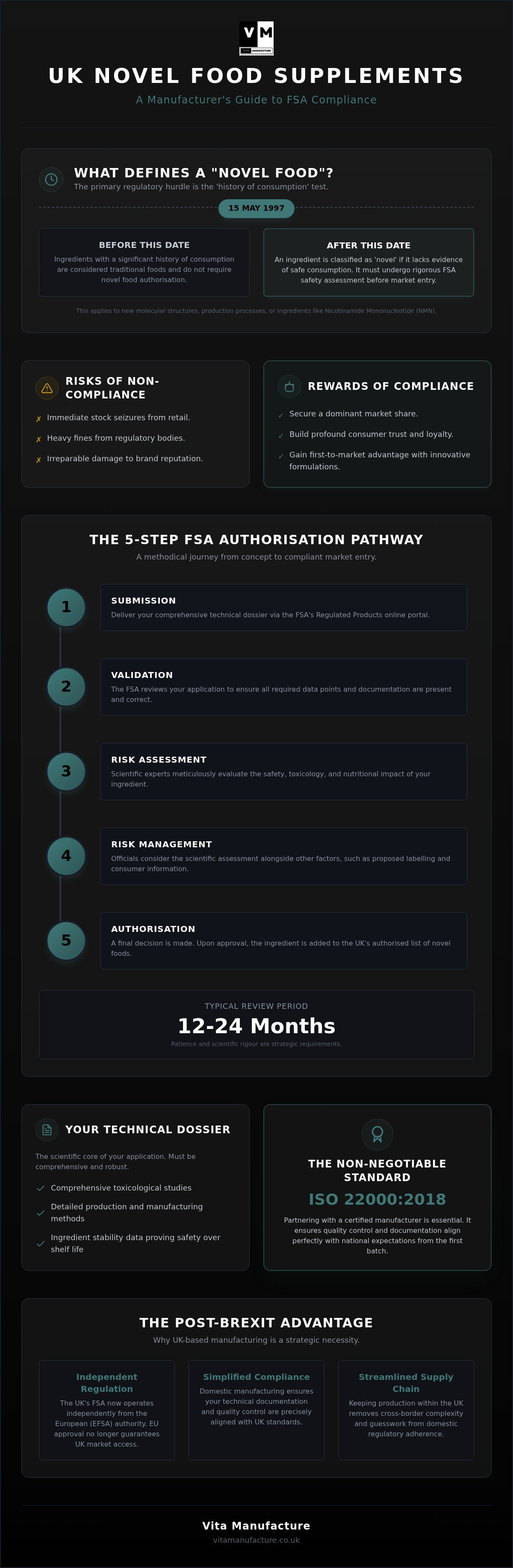
Establishing the regulatory status of an ingredient is the primary hurdle in novel food supplement manufacturing UK. According to the Food Standards Agency (FSA), What Defines a Novel Food is essentially any substance that doesn't have a significant history of consumption within the UK or EU prior to 15 May 1997. This isn't just a suggestion; it's a hard legal boundary. If you can't provide evidence that your ingredient was safely eaten by the public before this date, it's automatically classified as novel. This rule ensures that any "new" substance undergoes rigorous safety testing before it reaches a consumer's cupboard.
Modern science often outpaces old records. High-demand ingredients like Nicotinamide Mononucleotide (NMN) or specific concentrated botanicals often fall into this category because their current form or usage levels didn't exist thirty years ago. Why bother with the regulatory hassle? The rewards are substantial. Brands that successfully navigate these waters secure a dominant market share and consumer trust before competitors can even clear the regulatory starting blocks. Being first-to-market with a compliant, innovative formulation is a powerful commercial lever in a crowded industry.
The Legal Threshold for Novel Ingredients
The FSA uses specific criteria to judge novelty, including new molecular structures or production processes that significantly change the food's nutritional value or metabolism. You'll find the status of most ingredients in the FSA Novel Foods Catalogue, but this is a living document that requires constant monitoring. Launching a product without verifying this status is a massive risk. It can lead to immediate stock seizures, heavy fines, and irreparable damage to your brand's reputation. It's a gamble that rarely pays off in such a transparent market.
Why the UK Market is Unique Post-Brexit
Since the UK regulatory environment diverged from the European Food Safety Authority (EFSA), an approval from overseas bodies no longer guarantees a spot on British retail shelves. Whilst retained EU law still forms the backbone of our standards, the FSA now operates its own independent authorisation portal. This makes novel food supplement manufacturing UK a strategic necessity for domestic brands. By keeping production within the country, you ensure your quality control and technical documentation align perfectly with national expectations from the very first batch. It simplifies the supply chain and removes the guesswork from domestic compliance.
The FSA Authorisation Pathway for New Formulations
Securing approval for a new ingredient requires a methodical approach that prioritises consumer safety and data transparency. The FSA Authorisation Pathway is the gold standard for bringing innovative products to the British market. Whilst the process might seem daunting, it's a structured journey designed to protect your brand's long-term reputation. If you're unsure whether your ingredient qualifies as "novel," your first step should be a formal Consultation Request. This prevents wasted investment by confirming your regulatory status before you commit to full-scale novel food supplement manufacturing UK.
Once novelty is confirmed, the authorisation moves through five distinct stages:
Submission: Delivering your application through the Regulated Products portal.
Validation: The FSA reviews your dossier to ensure all required data points are present.
Risk Assessment: Scientific experts evaluate the safety and nutritional impact of your ingredient.
Risk Management: Officials consider the assessment alongside other factors like labelling.
Authorisation: The final decision is made, and the ingredient is added to the authorised list.
Patience is a strategic requirement here. The review period typically spans 12 to 24 months. Although there is no fee for the application itself, the real cost lies in the time and scientific rigour required to satisfy the regulators. It's a significant commitment, but one that builds a high barrier to entry for your competitors.
Preparing Your Technical Dossier
Your technical dossier is the heartbeat of your application. It must include comprehensive toxicological studies, detailed production methods, and stability data that proves the ingredient remains safe throughout its shelf life. This is where your choice of manufacturing partner becomes critical. A strategic ally can assist in gathering production-related evidence and providing the scientific R&D necessary to satisfy FSA queries. Working with specialists in new product development ensures your dossier is robust enough to withstand intense scrutiny during the novel food supplement manufacturing UK process.
Transition Periods and Public Lists
For ingredients already on the market before certain regulatory shifts, a transition period may apply. You can check the FSA public list to see if a specific supplier's application is currently "under assessment." For example, NMN is currently being reviewed, allowing products to remain on shelves whilst the final verdict is reached. This "on-market" status is a vital lifeline for brands. Monitoring these lists ensures you don't inadvertently partner with a non-compliant source or miss critical updates regarding retained EU law and its influence on British standards.
Case Study: Manufacturing NMN Supplements in the UK
Is your brand ready to lead the longevity market? Nicotinamide Mononucleotide (NMN) is currently the ultimate test for any founder involved in novel food supplement manufacturing UK. As of August 2026, NMN remains in a state of regulatory flux, officially listed as "under assessment" by the Food Standards Agency (FSA). This creates a complex landscape where consumer demand is skyrocketing, yet the legal framework requires careful treading. You need a manufacturing partner who doesn't just follow instructions but understands the strategic weight of launching an ingredient whilst it's under the microscope.
At Vita Manufacture, we treat these regulatory challenges as opportunities for superior New Product Development. The primary hurdle with NMN isn't just the law; it's the chemistry. NMN is highly hygroscopic, meaning it greedily absorbs moisture from the air. If your manufacturer doesn't have the right climate-controlled environment, your premium powder will degrade into a useless, clumpy mess before it even reaches the bottling line. We bridge the gap between high-level ambition and scientific reality by prioritising stability from day one.
Formulation Stability and Bioavailability
How do you ensure your customers actually feel the benefits of your product? Stability is the foundation of efficacy. NMN requires specific encapsulation techniques and high-barrier packaging to remain potent throughout its shelf life. We utilise our Pilot Study and Market Research services to conduct accelerated stability testing, ensuring your formulation survives the "on-market" period whilst the FSA completes its review. It's also vital to choose complementary ingredients carefully. Adding the wrong botanical could inadvertently change the safety profile of your NMN, potentially jeopardising your novel food status. We guide you through these formulation choices to keep your product both effective and compliant.
Ethical Sourcing of Novel Raw Materials
Purity is the only currency that matters when dealing with the FSA. The market is currently flooded with low-quality bulk NMN, but sourcing on price alone is a recipe for disaster. Contaminants like heavy metals or residual solvents won't just fail an audit; they'll destroy your brand's reputation. This is why a transparent supply chain is non-negotiable. Every batch we handle for novel food supplement manufacturing UK must be accompanied by a rigorous Certificate of Analysis (CoA). Adhering to ISO 22000 Quality Standards ensures that every link in your supply chain is documented and defensible. When the regulators come knocking, your dossier will be your greatest asset.
Quality Standards: Why ISO 22000 is Non-Negotiable
Why settle for "good enough" when your brand's future is at stake? In the high-stakes world of novel food supplement manufacturing UK, ISO 22000:2018 is the absolute baseline for survival. This international standard provides a comprehensive framework for Food Safety Management Systems (FSMS). It doesn't just check the final product; it scrutinises every process from ingredient intake to final distribution. By integrating Hazard Analysis and Critical Control Points (HACCP) principles, it ensures that risks are identified and neutralised before they ever compromise your formulation.
Novel foods, by definition, lack a long-term track record of safety in the British market. This creates a unique set of hazards that standard manufacturing protocols might miss. Vita Manufacture's adherence to these benchmarks means your project is handled within a system designed for high-stakes innovation. We don't just manufacture; we protect your intellectual property and your customers' health through rigorous scientific oversight and a culture of continuous improvement.
Risk Mitigation in the Cleanroom
Handling unestablished ingredients requires more than just a clean space. It demands absolute control over the manufacturing environment. Cross-contamination is a primary concern when introducing novel substances into a facility. ISO standards mandate strict environmental monitoring, including air filtration and surface testing, to prevent unwanted interactions. This level of precision doesn't just satisfy regulators; it builds the consumer trust necessary for a new brand to thrive. When customers see that your product was born in an ISO-certified environment, their perceived risk drops significantly. It's a powerful endorsement of your commitment to quality.
Traceability and Documentation
If an inspection occurs, can you prove where every milligram of your ingredient came from? End-to-end traceability is a mandatory requirement for novel food supplement manufacturing UK audits. Whether it's a routine check by Trading Standards or a deep dive by the FSA, your documentation must be flawless. Vita Manufacture simplifies this through a transparent customer portal. Every batch record, CoA, and stability report is available at your fingertips, ensuring you're always prepared for scrutiny. This transparency is what transforms a simple supplier into a strategic growth partner who thinks like a business owner.
Ready to secure your product's future? Partner with an ISO 22000:2018 certified facility for your Contract Manufacturing needs and ensure your brand is built on a foundation of safety.
From Prototype to Market: Your Manufacturing Strategy
Launching an innovative supplement isn't a single event; it's a calculated sequence of strategic moves. Moving from a laboratory concept to a national retail shelf requires more than just a large production run. It demands a manufacturing strategy that accounts for the inherent risks of "newness." If you're involved in novel food supplement manufacturing UK, your priority should be speed-to-market without compromising on regulatory safety. How do you bridge the gap between a promising idea and a commercially viable product? You start small, validate your data, and scale with confidence.
Effective scaling often begins with a Medical Device Product Prototype or a high-fidelity supplement sample. This allows you to test the physical properties of your formulation, such as flowability and capsule integrity, before committing to tens of thousands of units. Low Minimum Order Quantities (MOQs) are a vital tool here. They give you the flexibility to test market appetite and gather real-world feedback without tying up your entire capital in unproven stock. Once the concept is proven, your partner should have the infrastructure to scale production seamlessly whilst maintaining the ISO-certified standards discussed previously.
The Importance of Pilot Studies
Why should you never go straight to full-scale production with a novel food? The answer lies in the data. A Pilot Study and Market Research phase allows you to refine your manufacturing process based on actual production performance rather than theoretical models. You'll discover how your novel ingredients behave under industrial pressure, whilst also gauging consumer response to flavour profiles or delivery formats. This iterative approach reduces waste and ensures that when you finally launch UK-wide, your product is perfected. It's about being right the first time, not just being the first to try.
Choosing an All-in-One Partner
Consolidating your supply chain is the most efficient way to reduce time-to-market. When you work with a single partner that handles New Product Development, manufacturing, and Logistics and Distribution, you eliminate the communication gaps that often lead to delays. A strategic ally thinks like a business owner, anticipating regulatory hurdles and logistical bottlenecks before they impact your bottom line. This end-to-end support is what transforms a risky venture into a scalable success story. It allows you to focus on branding and customer acquisition whilst we manage the technical complexities of production. Are you ready to take the next step? You can partner with Vita Manufacture for your novel food launch and secure your place in the future of the UK supplement market.
Securing Your Competitive Edge in the UK Market
Success in the innovative supplement sector requires a blend of scientific rigour and regulatory foresight. By mastering the FSA authorisation pathway and adhering to the ISO 22000:2018 standards discussed, you don't just launch a product; you build a defensible asset. The complexities of ingredients like NMN prove that technical stability is just as vital as legal compliance for long-term commercial viability. Choosing the right partner for novel food supplement manufacturing UK is the single most important decision for your brand's trajectory.
Vita Manufacture stands ready as your strategic ally, offering an ISO 22000:2018 Certified Factory, an Expert Product Development & R&D Team, and Comprehensive UK-wide Logistics Support. We understand the high stakes of launching unestablished formulations and provide the end-to-end transparency you need to scale with confidence. It's time to transform your visionary concept into a market-leading reality. Begin your novel food manufacturing journey with Vita Manufacture and take the first step towards a compliant, successful launch. Your innovation deserves a foundation of reliability.
Frequently Asked Questions
Is NMN legal to sell as a food supplement in the UK in 2026?
Yes, NMN is legal to buy and sell as a food supplement in the UK as of August 2026. It's currently classified as "under assessment" within the UK Novel Foods Catalogue, meaning the Food Standards Agency is actively reviewing authorisation applications. Whilst you can retail these products, they must strictly adhere to UK food labelling regulations and cannot be marketed with any medicinal or therapeutic claims.
How long does the FSA novel food authorisation process actually take?
The authorisation process typically spans between 12 and 24 months from the initial submission. This duration accounts for the validation of your technical dossier and the subsequent scientific risk assessment performed by the FSA. You should factor this timeline into your commercial strategy, as the regulators require extensive data regarding the safety, stability, and nutritional impact of any new ingredient before granting full approval.
Can I manufacture a novel food in the UK before it is fully authorised?
You can manufacture novel substances for research and development purposes or pilot studies, but you cannot place them on the market for public consumption without prior authorisation. The only exception applies to specific ingredients that are currently "under assessment" and have been granted a transition period. It's vital to confirm the exact status of your formulation before starting any large-scale novel food supplement manufacturing UK project.
What is the difference between a novel food and a traditional supplement?
A traditional supplement uses ingredients with a proven history of consumption in the UK or EU prior to May 1997. Novel foods are substances that lack this established track record or are produced using innovative methods that change their molecular structure. This distinction is the primary driver for novel food supplement manufacturing UK, as novel ingredients require a much higher level of safety evidence and technical documentation.
How much does it cost to apply for a novel food authorisation in the UK?
There is no fee for submitting a novel food authorisation application to the Food Standards Agency in Great Britain. Whilst the submission itself is free, the actual cost of the process lies in the scientific R&D required to build your dossier. You'll need to invest in toxicological studies, stability testing, and detailed production analysis to satisfy the FSA's requirements for consumer safety and ingredient purity.
Does my manufacturer need special certification to handle novel foods?
Whilst no specific "novel food license" exists, your manufacturer should hold ISO 22000:2018 certification to manage the unique risks involved. This standard ensures a robust Food Safety Management System is in place to prevent cross-contamination and maintain ingredient integrity. Working with a certified facility provides the scientific oversight necessary to handle unestablished substances whilst ensuring your brand remains compliant with national safety expectations and international benchmarks.
What happens if I sell a supplement that is later classified as a novel food?
If an ingredient's status changes, you might face immediate enforcement action, including the seizure of stock and a requirement to withdraw the product from the market. You would then need to navigate the full authorisation pathway to resume sales. This is why we recommend a proactive Consultation Request with the FSA to confirm novelty status early, protecting your investment from sudden regulatory shifts or unexpected reclassifications.
Can Vita Manufacture help with the R&D for my novel food dossier?
We provide specialist support for your technical requirements through our dedicated new product development and R&D teams. Whilst we don't manage the legal submission, we generate the critical production data, stability reports, and formulation analysis required for a successful dossier. Our pilot studies are specifically designed to test your novel concept on a small scale, ensuring your formulation is stable and effective before you scale to mass production.