
New Product Development: The Strategic Guide to Formulating and Launching Supplements in 2026
Updated: Sep 27
A brilliant supplement formula perfected on a laboratory benchtop is completely worthless if it can't survive high-speed commercial machinery. You already know consumer appetite for premium wellness is surging, but the financial risk of scaling an unproven blend can quickly derail an ambitious venture. Successful new product development demands far more than an eye-catching label and on-trend active ingredients. It requires bridging the technical divide between creative prototyping and factory-floor viability, all whilst satisfying rigorous UK Novel Foods compliance and approved health claim standards.
Are you prepared to take your formulation from concept to shelf without risking catastrophic batch failures? In this strategic guide, you'll master a repeatable, de-risked framework for launching commercially viable dietary supplements. We explore how to source compliant raw ingredients, conduct disciplined pilot trials, and ensure shelf-life stability before committing substantial capital. Here's your clear roadmap for moving from benchtop prototypes into seamless, full-scale contract manufacturing.
Table of Contents
What Is New Product Development in the Health and Wellness Industry?
Formulation Science and Regulatory Alignment: The Foundation of Safe NPD
The True Risks of Skipping Pilot Studies in Product Development
The 5-Step Framework to Engineering a Market-Ready Supplement
Selecting the Right Contract Manufacturing Partner for Scalable NPD
What Is New Product Development in the Health and Wellness Industry?
In tech, innovators embrace the ethos of moving fast and breaking things. In wellness manufacturing, that mindset is financial suicide. Physical consumable formulation doesn't allow for post-launch software patches or hotfixes. As an overarching discipline, New product development (NPD) represents the structured journey from raw consumer insight to a physical, shelf-stable product. In the dietary supplement sector, successful execution requires a rare balance: aligning consumer market trends with uncompromising chemical stability, international safety protocols, and factory-floor feasibility.
The Core Stages of the Nutraceutical NPD Lifecycle
Every commercial launch begins by solving a clear consumer need, but a concept must survive rigorous operational screening to become viable:
Commercial feasibility screening: Evaluating active ingredient supply chains, cost of goods sold, and minimum viable margin profiles before entering the laboratory.
Formulation and delivery architecture: Balancing active botanical synergy with realistic fill weights, matching targeted doses to suitable delivery systems like two-piece capsules, sachets, or powders.
Rigorous new product development ensures these phases progress sequentially rather than haphazardly, protecting your capital at every step.
Why Physical Product R&D Requires Uncompromising Rigour
A single technical miscalculation during physical product R&D can trigger an entire batch rejection. When an unstable botanical blend reacts inside a warehouse container or hygroscopic powders clump on high-speed encapsulators, the resulting sunk costs fall squarely on the brand owner. Unlike general merchandise, consumable products carry profound safety responsibilities. Formulations must consistently satisfy strict microbiological thresholds, pesticide controls, and heavy metal specifications before leaving cleanroom production.
Beyond compliance, brand equity depends entirely on organoleptic consistency and declared potency. If your target customer opens a bottle of capsules to find discolouration, foul odour, or inconsistent fill levels, repeat purchase rates evaporate instantly. True development rigour ensures that your finished product delivers its promised therapeutic benefit from the first unit to the last, long after commercial dispatch.
Formulation Science and Regulatory Alignment: The Foundation of Safe NPD
Great formulations collapse when regulatory parameters and chemical realities are treated as afterthoughts. In supplement new product development, biological efficacy and statutory compliance must align from your very first bench trial. If a promising compound cannot legally carry an authorised health claim, or clogs automated equipment due to poor flowability, commercial rollout halts immediately. Designing a successful product means engineering within verified legal boundaries and physical material constraints from day one.
Navigating UK Regulations and Food Standards Agency Mandates
Domestic brand owners must confirm whether active botanicals trigger Novel Foods authorisation under the Food Standards Agency before committing capital. Under domestic law, all commercial packaging claims must strictly mirror authorised wording on the Great Britain Nutrition and Health Claims Register. While international exporters study how the FDA regulates dietary supplements in the United States, selling within Britain requires disciplined active overages. These calculated excesses ensure every capsule meets its declared label potency right through its expiration date without exceeding statutory safety ceilings.
Ingredient Sourcing, Purity Testing, and Bioavailability
Securing reliable raw materials requires meticulous vetting. Every incoming batch demands third-party verification through comprehensive Certificates of Analysis (COA) to screen for heavy metals, residual solvents, and microbial contamination. However, chemical purity is only half the battle; powder physics often dictates manufacturing viability:
Particle size distribution: Uniform micronisation prevents heavier minerals from settling unevenly during blending.
Bulk density and flowability: Hygroscopic herbal extracts absorb atmospheric moisture quickly, causing powder bridging in industrial funnels.
Excipient selection: Strategic use of plant-derived lubricants, like magnesium stearate or clean-label rice extracts, prevents friction without hindering active breakdown in the gut.
Organoleptic balancing: Potent botanicals frequently introduce bitter flavours that require clean masking agents, especially in powdered drink mixes and chewables.
Efficacy remains meaningless if active ingredients degrade within six months of production. Collaborating with an experienced specialist like Vita Manufacture helps brand owners align raw ingredient sourcing, physical compressibility, and compliant labelling long before full-scale commercial manufacturing commences.
The True Risks of Skipping Pilot Studies in Product Development
Assuming a formulation that works smoothly in a glass beaker will behave identically on an automated factory line is an expensive mistake. In nutraceutical new product development, pilot batches represent the critical bridge between theoretical science and industrial reality. Skipping this phase to expedite market entry regularly transforms calculated ventures into operational crises. Running small, disciplined pilot batches exposes hidden chemical reactions, thermodynamic shifts, and mechanical bottlenecks before you commit hundreds of thousands of pounds to raw materials.
Laboratory Benchtop Formulations vs Commercial Machine Realities
Hand-blending small test amounts in an R&D lab generates negligible friction and zero mechanical stress. Transfer those same botanical powders into an industrial ribbon blender rotating hundreds of kilogrammes, and friction creates significant thermal energy. This sudden heat spike can degrade heat-sensitive compounds like probiotics, live enzymes, and specific vitamins before encapsulation even begins.
High-speed automated encapsulators process tens of thousands of units per hour, requiring exacting bulk density, uniform particle geometry, and uninterrupted flow. While gentle manual lab testing permits forgiving handling, automated manufacturing pressures instantly expose poor powder fluidity through severe machine jamming, fractured capsule shells, and erratic fill weights. Without small-scale machine calibration, hygroscopic ingredients rapidly draw ambient humidity, causing powder bridging inside industrial funnels that brings entire factory floors to an abrupt standstill.
The Hidden Operational Costs of Premature Mass Production
Bypassing pilot trials turns your inaugural commercial run into an unhedged gamble. When an untested batch fails post-production dissolution tests because excipients bound too tightly under mechanical compression, the entire batch must be destroyed. Scrapping tonnes of high-grade raw ingredients wipes out operating margins overnight.
The resulting supply chain gridlock damages commercial relationships instantly:
Emergency reformulations: Re-engineering a failed mix forces sudden factory retooling and extended machine downtime.
Contractual stockouts: Missing agreed distribution windows with retail buyers destroys hard-won commercial trust.
Premature degradation: Products that bypass real-time or accelerated stability trials risk falling below label potency before their stated expiry date.
Brands targeting overseas expansion must also recognise that resolving mechanical errors becomes vastly more complicated once formal regulatory dossiers are submitted; modifying an active recipe after initiating the FDA's new dietary ingredient notification process can restart costly regulatory countdowns from scratch. Disciplined pilot studies remain the most cost-effective insurance policy available in modern supplement manufacturing.
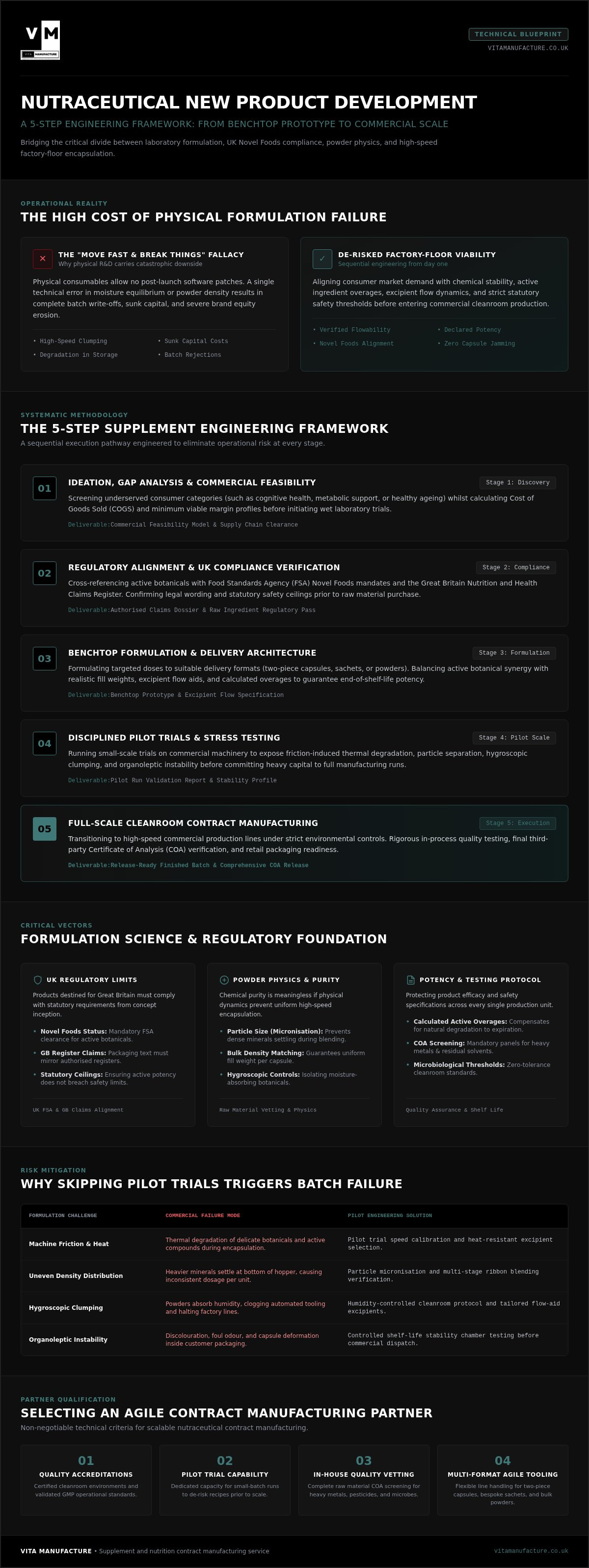
The 5-Step Framework to Engineering a Market-Ready Supplement
Transforming an ambitious wellness concept into a profitable commercial reality requires a structured, milestone-driven process. Without a disciplined roadmap, teams waste capital chasing unfeasible recipes or rushing unverified mixtures into mass production. A modern new product development strategy balances commercial instinct with rigorous physical engineering across five sequential phases.
Phase 1 to Phase 3: Conception, Formulating, and Pilot Sampling
The journey starts by identifying clear market white space and de-risking the fundamental concept before committing significant financial resources:
Step 1: Market intelligence and positioning: Pinpoint unmet consumer demands through search intent and competitive benchmarking. During this initial step, you establish commercial margin targets and choose the ideal delivery format, whether two-piece hard capsules, compressed tablets, functional powders, or softgels.
Step 2: Prototype formulation and optimisation: Formulate laboratory benchtop samples that balance botanical synergy with clean-label excipients. Active nutrient levels are refined to support substantiated label claims while staying safely within statutory limits.
Step 3: Analytical pilot batch trials: Move the benchtop recipe onto pilot machinery to establish real-world run rates. This step validates flowability, capsule fill uniformity, and seal integrity under genuine factory stresses.
Phase 4 and Phase 5: Analytical Testing and Commercial Scale-Up
Once mechanical flow is verified, development shifts toward real-world stability, packaging integrity, and volume production:
Step 4: Accelerated stability and barrier testing: Finished pilot samples enter environmental chambers under elevated heat and relative humidity. This testing verifies that active compounds remain potent throughout their shelf life whilst testing container materials against moisture, oxygen, and ultraviolet degradation.
Step 5: Commercial scale-up and documentation: Lock final standard operating procedures before authorising full production runs in certified cleanroom facilities, generating complete batch records and release documentation.
Are you ready to engineer your next formulation with complete confidence? Connect with Vita Manufacture to launch your supplement range through our fully integrated formulation, pilot testing, and cleanroom manufacturing pipeline.
Selecting the Right Contract Manufacturing Partner for Scalable NPD
Building an internal manufacturing plant requires millions of pounds in cleanroom infrastructure, high-speed encapsulation machinery, and specialised quality teams. For emerging and scaling wellness brands, that capital exposure is entirely unnecessary. Outsourcing production shifts operational overhead away from your balance sheet, letting your internal team focus on brand equity, retail distribution, and commercial strategy. However, successful new product development hinges on selecting a true strategic partner rather than a transactional toll blender.
Critical Certifications and Facility Standards to Demand
Never compromise on operational accreditations. Your manufacturing partner must operate cleanrooms certified to international food safety management systems, specifically ISO 22000:2018. This framework guarantees rigorous hazard analysis, cross-contamination controls, and clean air filtration throughout production.
Demand uncompromising internal quality assurance protocols that enforce complete isolation of incoming ingredients:
Strict raw material quarantine: Active compounds and excipients must remain locked until analytical identity and purity assays clear.
Granular lot traceability: Every individual batch requires full digital genealogy, linking every finished container to specific botanical harvests, capsule lot numbers, and primary packaging materials.
Independent release criteria: Quality assurance teams must operate independently of production schedules, holding authority to reject non-conforming goods without commercial pressure.
End-to-End Capabilities from R&D to Complete Fulfilment
Fragmenting your supply chain across isolated vendors creates administrative friction and costly miscommunication. When an independent formulation consultant hands off a recipe to a separate mixing facility, who then ships bulk units to an external packager, accountability dissolves the moment a defect surfaces. The most dependable path through new product development is partnering with an agile manufacturer capable of managing the full lifecycle under one roof, spanning raw ingredient sourcing, benchtop R&D, pilot studies, cleanroom encapsulation, and secondary packaging.
Transparency should be absolute. Modern operators provide digital client portals that display real-time updates across production milestones, raw material receipts, and stability data. By aligning with an agile UK contract manufacturer equipped for both small pilot validation and high-volume commercial scaling, your brand builds a resilient supply chain capable of sustaining long-term retail growth.
Transform Your Wellness Concept into a Shelf-Ready Reality
Launching a breakthrough supplement brand requires matching ambitious market vision with methodical operational discipline. Navigating statutory compliance, excipient chemistry, and pilot machinery trials isn't simply about ticking bureaucratic boxes; it's how successful founders de-risk capital and secure long-term consumer trust. Mastering a structured new product development process ensures your formulations maintain verified label potency, run smoothly on automated equipment, and earn a permanent place on competitive retail shelves.
You don't need to shoulder these complex technical hurdles in isolation. Partnering with an ISO 22000:2018-certified UK production facility provides comprehensive in-house capabilities, supporting your product from initial bespoke formulation directly through to final packaging and distribution. With a dedicated digital client portal giving you live visibility across every batch milestone and stability test, scaling becomes transparent and predictable. Accelerate your next formulation with Vita Manufacture's NPD experts and build a commercially resilient wellness brand engineered for sustainable growth.
Frequently Asked Questions
What is the typical timeline for new product development in the supplement industry?
A comprehensive timeline typically ranges from four to nine months from initial concept to commercial dispatch. Prototype formulation and raw ingredient sourcing usually require four to six weeks. Pilot batch testing and analytical stability trials run concurrently over several months to confirm real-world shelf life. Finally, full-scale commercial manufacturing, quality quarantine, and final batch release add another four to eight weeks to the schedule.
Can my brand launch a custom supplement formulation without prior pilot testing?
Technically you can, but doing so exposes your business to enormous financial and operational risk. Without pilot trials, you cannot verify how powder blends behave under the mechanical heat and shear stress of high-speed encapsulation equipment. A single formulation flaw can trigger capsule cracking, weight variation, or total batch rejection. Running pilot batches remains the most sensible insurance policy for protecting capital.
How much does the new product development phase cost for a custom dietary supplement?
Total expenditure depends entirely on formulation complexity, ingredient rarity, and analytical testing requirements. A bespoke recipe featuring premium trademarked botanicals, complex organoleptic masking, and extensive stability assays naturally demands greater investment than a streamlined single-mineral blend. Because costs scale with raw material minimums and pilot testing scope, budgets should reflect your long-term commercial goals rather than generic off-the-shelf estimates.
What is the difference between custom formulation NPD and white-label manufacturing?
Custom new product development creates a bespoke, proprietary formulation engineered specifically for your brand from the ground up, granting complete ownership over dosages, active synergy, and delivery mechanisms. White-label manufacturing, conversely, allows brands to apply their label to pre-existing, tested stock recipes. While custom development takes longer, it provides defensible market differentiation that standard white-label products cannot match.
Is stability testing mandatory before bringing a new supplement formulation to market?
Yes, robust stability validation is vital to ensure your product meets its declared label claims throughout its entire shelf life. Under UK food regulations, selling a degraded supplement that falls below stated potency breaches consumer protection laws. Accelerated stability testing exposes samples to elevated temperature and humidity chambers, verifying active compound resilience and ensuring packaging materials properly barrier against oxygen and moisture.
How do UK Novel Foods regulations affect the new product development roadmap?
The UK Novel Foods framework determines whether an ingredient requires pre-market authorisation from the Food Standards Agency before it can be legally sold. If an active botanical or compound lacks a documented history of widespread consumption within the UK or EU before May 1997, it requires extensive safety dossiers. Formulating with unauthorised novel ingredients risks complete product bans and costly packaging write-offs.
What happens if a custom powder formulation fails during machine encapsulation?
Production halts immediately to diagnose the root chemical or physical failure. When powders exhibit bridging, uneven flow, or high hygroscopic clumping, cleanroom engineers evaluate particle distribution and moisture levels. Formulators then adjust excipient ratios, incorporating clean lubricants or adjusting flow aids to restore mechanical compressibility. Catching these mechanical friction problems during pilot development prevents catastrophic losses on high-speed commercial lines.