Microcrystalline Cellulose in Supplements Explained
A tablet’s active ingredient is only part of its formulation. Amoxicillin and clavulanate potassium 875 mg / 125 mg is one example of a medicine containing microcrystalline cellulose, used as a binder or diluent. This fine white powder is made from cellulose, and its formulation properties can influence how tablets are formed and behave.
If you’re developing a supplement, it’s reasonable to want more than an ingredient name on a label. You need to understand what microcrystalline cellulose does and how its specifications relate to the finished product. This guide explains where it is used, how it is made, and how particle size, crystallinity and moisture are described. It also explores how microcrystalline cellulose characteristics can inform formulation decisions.
Table of Contents
Microcrystalline Cellulose: What is it and where is it used?
This ingredient is the isolated, colloidal crystalline portion of cellulose fibres. It appears as a fine white powder and is also called cellulose gel. Its food additive identifier is INS 460. These details describe the material, but its function depends on the formulation. In foods and cosmetics, it can help manage texture, stability and the distribution of other ingredients.
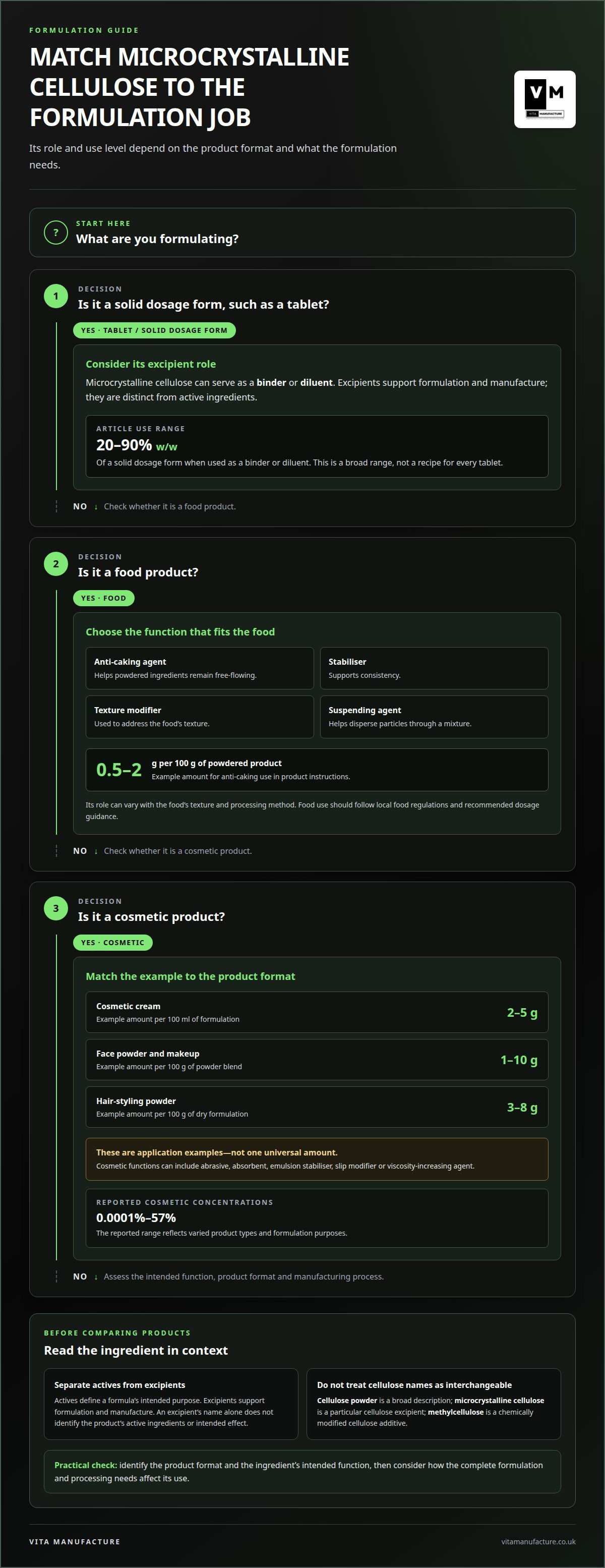
In processed foods, microcrystalline cellulose can act as an anti-caking agent, stabiliser, texture modifier or suspending agent. Those roles address different formulation needs. An anti-caking agent helps powdered ingredients remain free-flowing; a stabiliser supports consistency. As a suspending agent, it helps disperse particles through a mixture. Product instructions give an example amount of 0.5-2 g per 100 g of powdered product for anti-caking use.
Its properties help explain why it may suit particular mixtures. Microcrystalline cellulose is insoluble in water, ethanol, ether and dilute mineral acids, and slightly soluble in sodium hydroxide solution. This behaviour matters when considering how an ingredient will disperse or remain suspended. It can be used as an emulsifier, stabiliser, anti-caking agent or dispersing agent, depending on the food’s texture and processing method.
Cosmetic formulations use the material for several practical functions. It can act as an abrasive, absorbent, emulsion stabiliser, slip modifier or viscosity-increasing agent. For example, a slip modifier affects how a product feels during application, while an absorbent can help manage surface moisture. The Cosmetic Ingredient Review has deemed it safe for cosmetic use. Reported cosmetic concentrations range from 0.0001% to 57%, reflecting varied product types and formulation purposes.
Product instructions provide separate formulation examples for creams, powders and hair styling products. For a cosmetic cream, they recommend measuring 2-5 g per 100 ml of formulation. For face powder and makeup, they recommend 1-10 g per 100 g of powder blend. Hair styling powder has a different example: 3-8 g per 100 g of dry formulation. These figures are application examples, not one universal amount for every cosmetic.
The ingredient’s purpose shapes how it is used. A cream may need emulsion stability, while a face powder may rely on absorbency or texture. A dry hair-styling powder has different formulation needs from a cream, and the other ingredients also affect the final result. As an excipient, microcrystalline cellulose contributes to the formulation technically; it is not necessarily the active ingredient.
Food and cosmetic applications both focus on formulation performance, but their requirements differ. A powdered food may need improved flow, while a cosmetic cream may need controlled viscosity. Start by identifying the intended product and the ingredient’s function. Then consider which properties and example use levels are relevant to development.
Products containing microcrystalline cellulose
Product labels identify ingredients but rarely explain their technical purpose. When developing a supplement, distinguish active ingredients from excipients. Actives define the formula’s intended purpose, while excipients support formulation and manufacture. This distinction helps you interpret a tablet’s ingredient list without treating every listed material as an active component.
In tablet development, an excipient must suit both the product format and the manufacturing process. Formulators consider how a powder behaves as it becomes a finished tablet and what properties the tablet needs. A binder serves a different purpose from a diluent, so the ingredient’s role should be assessed within the complete formula.
The amount used can vary with the formulation. The material typically makes up 20-90% w/w of a solid dosage form when serving as a binder or diluent. This broad range describes use across solid dosage forms; it does not specify the composition of every tablet or supplement. The intended function and the rest of the formulation affect the proportion selected.
Food applications need a separate assessment. An ingredient in a powder blend may address processing needs, while a tablet formulation has different manufacturing objectives. Food use should follow local food regulations and recommended dosage guidance. This guidance concerns use in food products, not a personal daily intake target.
Cellulose-related names can refer to different materials. “Cellulose powder” is a broad description; microcrystalline cellulose identifies a particular cellulose excipient, while methylcellulose is a chemically modified cellulose additive. These terms are not interchangeable in a formulation specification. The ingredient declaration and intended function help clarify which material is present.
For a supplement concept, the practical question is not simply whether another product contains the ingredient. Consider whether its role suits the format you are developing. A tablet, for example, needs a formula designed for its processing requirements and finished structure. The same ingredient name does not mean two products share a composition or formulation objective.
There is no single recommended daily amount that applies across all uses. In food, the relevant use level depends on the product and must follow local food regulations and recommended dosage guidance. Supplement formulation is a different matter: the ingredient’s function and the complete formula determine how it is used.
To assess a product, read its ingredient list alongside its dosage form and purpose. A cellulose excipient in a tablet does not tell you which active ingredients it contains, their amounts or the product’s intended effect. Considering each detail separately gives a clearer understanding of the finished product and the role of each component.
Cellulose sources and isolation methods
The starting material affects how cellulose is obtained before processing. Microcrystalline cellulose is synthesised from an α-cellulose precursor, which can come from plant fibres or agricultural residues. Cotton contains 93 wt.% cellulose, while softwood contains 40-44 wt.%. Hardwood contains 43-47 wt.%, and jute contains 61-71 wt.%. These differences help explain why manufacturers consider the source alongside the intended application.
Alternative feedstocks include rice hulls, which contain 30.98 wt.% cellulose. Agricultural waste from banana, corn, sugarcane and soybean farming can also be used. Oil palm fibres provide another extraction source. Feedstock composition matters because cellulose is part of plant material, not the whole plant. Processing isolates and refines it before the material can be used in different industries.
Acid hydrolysis is one method of isolating the crystalline portion from cellulose fibres. Other production methods include reactive extrusion, enzyme-mediated processes, mechanical grinding, ultrasonication and steam explosion. Each processes the starting material differently, influencing the characteristics of the resulting material. Source and method are therefore useful context when interpreting a specification.
Hydrolysis also produces cellulose fibres with varied dimensions. Reported diameters range from around 30 nm to 20 μm, and fibres can reach hundreds of microns in length. Those measurements describe fibres produced by hydrolysis, rather than a single universal powder size. They help illustrate how processing can create materials with different physical dimensions from a cellulose source.
“Assay” refers to assessing whether a material meets a stated composition requirement. For this ingredient, the specification requires at least 97% carbohydrate, calculated as cellulose on the dried basis. The dried-basis calculation expresses the carbohydrate requirement after accounting for moisture in the sample. It provides a compositional measure, distinct from the starting plant’s cellulose percentage or the processing method used.
These figures answer different questions. A feedstock percentage describes cellulose content in a source, such as cotton or rice hulls. An assay requirement describes the finished ingredient’s composition, while a production method explains how the source material is processed. Keeping these categories separate prevents source composition from being mistaken for the finished powder’s assay result.
In practical terms, compare the feedstock, isolation route and finished-material assay as separate parts of the production picture. For example, cotton’s 93 wt.% cellulose content does not itself establish that a finished batch meets the 97% carbohydrate requirement. The assay addresses that requirement directly, while the source and method explain how the material was produced.
MCC particle size, crystallinity and moisture
Particle size, polymer length and moisture are separate measures of different powder characteristics. Together, they help explain how a particular grade may behave during formulation and tablet production.
Grades and Particle Size
A grade describes material against defined characteristics, including particle-size distribution. For this ingredient, particles smaller than 5 μm must make up no more than 10% of the particles. That limit describes the fine-particle fraction, not the average size. Comparing this measure with other grade specifications helps show whether materials are alike.
Degree of polymerisation, or DP, describes the number of linked units in a cellulose polymer. This ingredient typically has a DP below 400. Particle size and DP are related to different structural features, so one value cannot substitute for the other. A powder’s particle distribution describes its physical dimensions, while DP describes polymer-chain length.
Tablet findings show why these distinctions matter. Tablets containing material with DP values of 244 and 299 were twice as strong as tablets containing material with a DP of 199. In another studied tablet formulation, a 32 μm decrease in particle size, measured as d50, significantly increased disintegration time. These results show that formulation behaviour can vary with material characteristics.
Crystallinity and Moisture
Crystallinity describes the ordered regions within cellulose, while moisture describes water associated with the material. The crystalline portion distinguishes this ingredient from less refined cellulose materials. Moisture is assessed separately, so neither measure substitutes for particle size or polymer length when comparing specifications.
Loss on drying provides a defined measure of moisture-related weight loss. The specification states a maximum loss on drying of 7.0% when tested at 105 ° for 3 hours. This value is a test limit, not a description of the powder’s particle distribution. Read it alongside the other specification measures.
These measurements describe different points in material assessment. The particle-size limit controls the proportion below 5 μm; DP characterises polymer length, typically below 400. The drying test sets a moisture-related limit. Keeping each measure distinct makes a grade comparison more meaningful than relying on a single headline property.
In product development, these parameters matter when connected to the intended format. Findings on tablet strength and disintegration illustrate how degree of polymerisation (DP) and particle size can influence performance in studied formulations. A moisture result, by contrast, reports the outcome of a drying test. Together, the measures provide a more complete technical picture.
Examples of medicines containing microcrystalline cellulose
A listed medicine example is amoxicillin and clavulanate potassium 875 mg / 125 mg. This shows the ingredient can appear in a pharmaceutical tablet alongside named active ingredients. The figures identify the medicine’s strength, not the amount of cellulose in its formulation. That distinction matters: the active ingredients and the tablet’s other materials have different roles.
In a tablet, cellulose can function as a binder or diluent. Its compressibility helps powdered material form a tablet during processing. A suitable formulation can produce tablets that are hard yet dissolve quickly. These functions explain why the excipient may be present, but the example alone does not establish its precise purpose in a particular medicine.
The example also illustrates why an ingredient name should be read in context. Amoxicillin and clavulanate potassium identify the medicine, while the cellulose is an additional formulation material. The stated 875 mg / 125 mg strength belongs to the named medicine, not to the excipient. It should not be interpreted as a cellulose dose or as the total tablet weight.
Across solid dosage forms, this material typically makes up 20-90% w/w when used as a binder or diluent. That broad range describes use in solid dosage forms, not the composition of the named amoxicillin and clavulanate potassium medicine. It also shows why one medicine example cannot define the amount used in another product. Formulation needs shape the material’s role and proportion.
Processing characteristics help explain its use in pharmaceuticals. Compressibility supports tablet formation, while formulation design affects the balance between tablet hardness and dissolution. The medicine example makes the use recognisable; the material’s properties explain why formulators may select the excipient. Neither tells you the exact composition of an individual tablet.
Distinguish medicine examples from supplement formulations. Both may contain excipients, but a medicine’s active ingredients and stated strength do not explain how a supplement is formulated. The amoxicillin and clavulanate potassium example shows use in a medicine; it is not a template for supplement composition or a recommended intake.
The clearest takeaway is to separate three details: the medicine’s name, its stated strength and the excipient’s formulation function. For the named example, 875 mg / 125 mg identifies the medicine strength. Cellulose may support tablet manufacture as a binder or diluent, but those figures do not quantify it. This distinction keeps a familiar medicine example informative without overstating what it reveals.
Vita Manufacture
Vita Manufacture can help turn ingredient knowledge into practical decisions for a supplement concept. If you’re considering cellulose as an excipient, consider its role in the formula, the intended product format and how its specifications fit your development goals.
For a new supplement, New Product Development can support the work of shaping the concept and formulation. Contract Manufacturing, Private Label Supplements and White Label Supplements offer routes for brands developing products for their own markets. The right starting point depends on whether you already have a formula or are developing one.
Bring your product concept and formulation priorities into the conversation, including the function you expect from each ingredient. Contact Vita Manufacture to discuss the next step for your supplement project.
Shape your next supplement decision
The next step is to connect ingredient choices with the product you want to bring to market. Consider the intended format, the role of each excipient and how the finished formulation should work. Understanding microcrystalline cellulose is one part of the process; translating technical choices into a commercially coherent product is another.
Vita Manufacture supports this work through New Product Development, Contract Manufacturing and Private Label Supplements. These services can help move an early concept towards a defined supplement project, whether you are developing a new product or planning production for your brand.
Bring your priorities into focus, including the product format and the formulation questions you need to resolve. A clear starting point makes the next development conversation more purposeful. Contact Vita Manufacture to discuss your supplement plans and explore a practical way forward.
Frequently Asked Questions
Does MCC cause digestive issues like bloating or constipation?
Bloating or constipation cannot be attributed to one ingredient alone. A supplement contains a complete formula, and digestive symptoms can have several possible causes. If symptoms appear after starting a product, note when they occur and review the full ingredient list, including active ingredients and excipients. Persistent or severe symptoms warrant medical attention, particularly if they disrupt eating, drinking or daily activities.
What is it?
Microcrystalline cellulose is a purified cellulose material used as an excipient, meaning a non-active ingredient that helps make a product. In a tablet, an excipient can support manufacturing or the tablet’s physical structure. Its presence does not identify the active ingredient or explain the product’s intended effect. Read the product information alongside the ingredient list to understand each component’s role.
What is microcrystalline cellulose (MCC) and how is it made?
Microcrystalline cellulose is a crystalline fraction isolated from cellulose fibres. Production starts with an α-cellulose precursor, which is processed to separate and refine the material. Methods include acid hydrolysis, reactive extrusion, enzyme-mediated processing, grinding, ultrasonication and steam explosion. The plant source and method influence the resulting material, so its specification provides useful context beyond the ingredient name.
What are the main uses of microcrystalline cellulose in food, pharmaceuticals and cosmetics?
Its role depends on the product. In food, it can help control powder flow or texture; in pharmaceutical tablets, it can function as a binder or diluent. Cosmetic formulations may use it to influence absorbency, slip or viscosity. These are formulation functions, not claims about a product’s active effects. The intended format helps explain why a formulator selects a particular role.
Is microcrystalline cellulose safe to consume, and what are its potential side effects?
It is generally regarded as safe when used in normal quantities. At least one allergic reaction has been documented, so a reaction is possible, though it is not expected in everyone. When considering a suspected sensitivity, review the complete ingredient list, since cellulose may appear alongside active ingredients, flavourings or other excipients.
How is microcrystalline cellulose labelled on UK food ingredient lists, and what is its E number?
Look for cellulose or cellulose gel in the ingredient information; its identifier is E460, also expressed as INS 460. The ingredient’s name and identifier help you recognise it, but neither tells you how much is present in a particular food. For a product-specific question, consider the full ingredient declaration and the food’s intended use rather than interpreting the number alone.
What UK and EU rules govern microcrystalline cellulose as a food additive or pharmaceutical excipient?
Food-additive use and pharmaceutical-excipient use sit within different regulatory frameworks. E460 identifies the additive, but that identifier alone does not establish that every use or product is permitted. Requirements depend on the product category and the market where it is placed, including whether it is sold in the UK or EU. A food-additive designation should not be treated as proof of pharmaceutical suitability.
Does microcrystalline cellulose affect digestion, blood sugar, cholesterol or nutrient absorption?
Its presence as an excipient does not, by itself, establish an effect on digestion, blood sugar, cholesterol or nutrient absorption. Its formulation role differs from the intended purpose of active ingredients. To interpret a supplement, distinguish its active ingredients from its excipients, then assess any health effect based on evidence for the complete product rather than assuming one from an ingredient’s name.