MHRA Food Supplement Guidelines: UK Compliance Guide 2026
You don’t usually need MHRA approval to sell a food supplement in the UK, but a product that crosses the line into medicine can create serious compliance problems. The MHRA guidelines for dietary supplements help you understand how a product’s claims, ingredients, intended use and presentation can affect its classification.
The rules can be confusing because different responsibilities apply: the FSA oversees food safety and relevant food requirements, while the MHRA assesses whether a borderline product should be treated as a medicine. Misjudging the distinction can put a product’s legal status at risk, particularly if marketing claims go beyond what is allowed for food.
This guide explains how the boundary is assessed, when MHRA approval may be relevant, and what to consider when developing labels and marketing claims. It also covers permitted health claims, novel food rules and why regulatory thinking matters from the prototype stage. Vita Manufacture supports brands with New Product Development and end-to-end regulatory guidance as they build their products.
Table of Contents
Understanding the Regulatory Landscape: Food vs Medicine
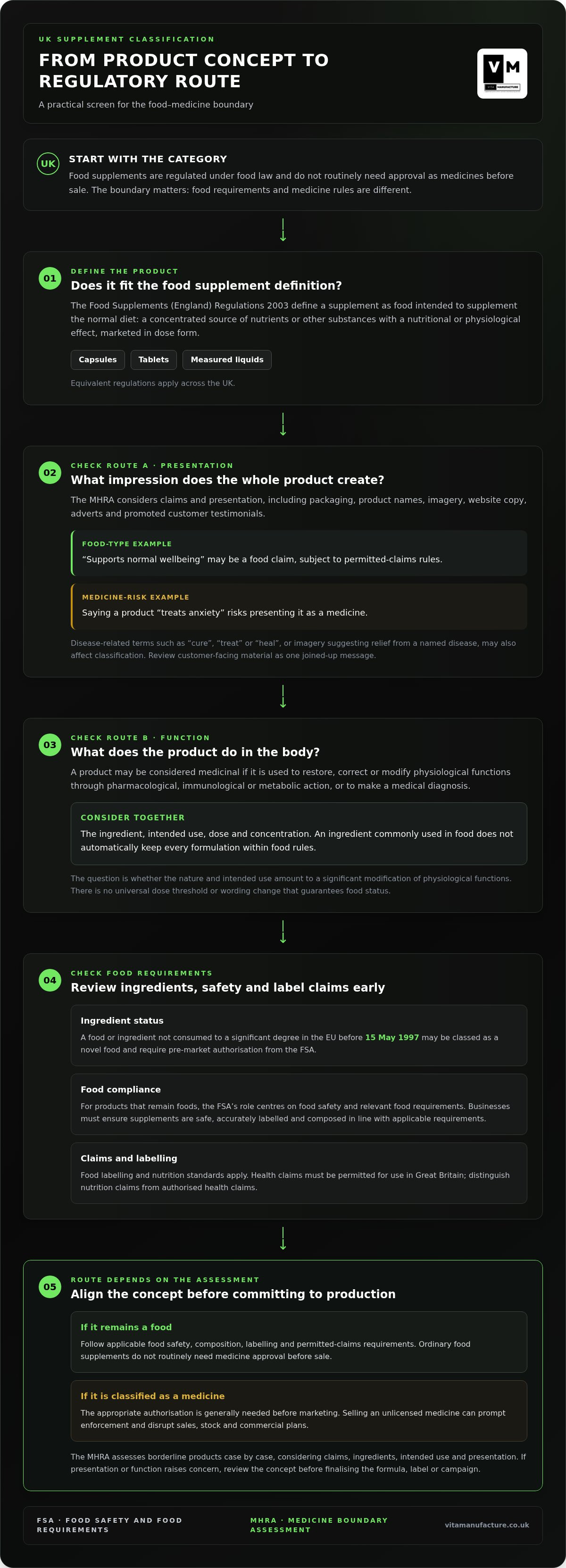
Establish the product category before committing to production. In the UK, food supplements are regulated under food law and do not routinely need approval as medicines before sale. The Food Standards Agency (FSA) oversees food safety and relevant food requirements, while the Medicines and Healthcare products Regulatory Agency (MHRA) assesses whether a product should be treated as a medicine. The distinction affects which rules apply to ingredients, claims, labelling and market access.
The Food Supplements (England) Regulations 2003 define a food supplement as a food intended to supplement the normal diet. It must be a concentrated source of nutrients or other substances with a nutritional or physiological effect, marketed in dose form. This includes capsules, tablets and measured liquids, whether they contain one ingredient or a combination. Equivalent regulations apply across the UK.
The Role of the MHRA in UK Health Products
The MHRA regulates medicines, with safety, quality and efficacy at the centre of its responsibilities. Its remit includes products whose claims or function may place them on the medicinal side of the boundary. The agency assesses products case by case, taking account of claims, ingredients, intended use and presentation. Its wider responsibilities are outlined by the Medicines and Healthcare products Regulatory Agency (MHRA).
A supplement may attract scrutiny if its packaging or advertising says it can prevent, treat or cure a disease. For example, claiming that a product supports normal wellbeing is different from saying it treats anxiety. The first may be a food claim, subject to the rules on permitted claims; the second risks presenting the product as a medicine. A product classified as a medicine generally needs the appropriate authorisation before it can be marketed. Selling an unlicensed medicine can prompt enforcement and disrupt sales, stock and a brand’s commercial plans.
Food Standards Agency (FSA) Jurisdiction
For products that remain foods, the FSA’s role centres on safety and compliance with food rules. Businesses must ensure supplements are safe, accurately labelled and composed in line with applicable requirements. Food labelling and nutrition standards apply, and health claims must be permitted for use in Great Britain. A compliant label is therefore more than a design decision: its wording can influence how regulators interpret the product.
Ingredients need an early regulatory review, too. A food or ingredient not consumed to a significant degree in the EU before 15 May 1997 may be classed as a novel food, requiring pre-market authorisation from the FSA. This can affect formulation choices and development plans. Check ingredient status before finalising a product or committing to manufacture.
The MHRA guidelines for dietary supplements are best understood as guidance on the medicine boundary, not as a separate approval route for ordinary food supplements. Establish the product category at the concept and prototype stages, then align ingredients, intended use, claims and label design. Vita Manufacture’s New Product Development support and regulatory guidance help brands address these decisions early, before they become obstacles to launch.
The Borderline Line: When Does a Supplement Become a Medicine?
A supplement can cross the medicine boundary through its claims, its effects, or both. The MHRA assesses borderline products case by case, considering their presentation and function. These are separate routes to medicinal classification: a product may appear to be a medicine because of how it is marketed, even if its ingredients are familiar in foods. Alternatively, its effects in the body may be medicinal regardless of cautious wording.
Use this practical screen early in development. Ask what the product promises, what it is intended to do, and whether its ingredients and dose could produce a medicinal effect. If either the presentation or function raises a concern, review the concept before finalising the formula, label or campaign. There is no simple wording change or universal dose threshold that guarantees a product remains a food.
Medicinal by Presentation: Claims and Branding
Look beyond the main label. Product names, imagery, website copy, adverts and customer testimonials can all shape the impression a reasonable consumer receives. Terms such as “cure”, “treat” and “heal”, or images that suggest relief from a named disease, may present a supplement as a medicine. Testimonials can create the same risk when a brand republishes or promotes claims about treating symptoms.
Review every customer-facing touchpoint as part of one joined-up message. A restrained claim on the pack may be undermined by a social post that promises disease treatment. The UK Government Guidance on Food Supplements is a useful reference for food supplement requirements, but borderline status still depends on the full product presentation and context.
Medicinal by Function: Pharmacology and Dosage
Function concerns what a substance does in the body. A product may be considered medicinal if it is used to restore, correct or modify physiological functions through pharmacological, immunological or metabolic action, or to make a medical diagnosis. The question is not simply whether an ingredient has an effect, but whether its nature and intended use amount to a significant modification of physiological functions.
Dose and concentration matter. An ingredient commonly used in food does not automatically keep every formulation within food rules: a concentrated amount could raise different questions about action, safety and intended purpose. High-dose glucosamine, for example, should be treated as a formulation that needs careful borderline assessment, not as a guaranteed classification precedent. Don’t assume that an ingredient has a fixed legal status at every dose.
Traditional herbal ingredients need particular care, too. A product presented as a traditional herbal medicinal product may require a Traditional Herbal Registration (THR); this is not a blanket requirement for every supplement containing a herb. Classification depends on the product’s presentation, purpose and composition, so establish the intended category before building medicinal-style claims around traditional use.
Keep a record of the formula, dose rationale, intended use and proposed claims, then assess them together as the product develops. Vita Manufacture’s regulatory guidance and supplement product development can bring these checks into the prototype stage, supporting decisions before packaging and marketing are finalised.
Navigating MHRA Determination Processes for Brands
Resolve classification concerns before packaging is printed. If a product sits near the food and medicine boundary, early assessment can help avoid changes to its formula, claims or brand presentation. The MHRA’s Borderline Products team offers a route for seeking advice on whether a product may be a medicine. The advice depends on the information supplied, so a clear, consistent submission matters.
Prepare a useful product dossier
Before approaching the MHRA, assemble a concise dossier that describes the product as it will actually be developed and marketed. Include:
The full ingredient list, quantities or concentrations, and relevant product specifications.
The intended purpose, recommended use and target consumer.
Proposed label wording, product name, packaging and promotional claims.
Scientific or technical evidence relevant to the ingredients’ action and intended use.
Examples of planned online content, including social media posts and testimonials the brand may use.
Work with your manufacturer to gather accurate formulation and technical details. An incomplete picture can result in advice that does not reflect the final product. The MHRA Guidance on Borderline Products explains the factors the agency considers. Use it alongside product-specific information rather than treating a general example as a decision on your formula.
Use the advisory route strategically
First, define the precise question you need answered. Identify any uncertainty about ingredients, intended use or claims, and make sure all submitted materials tell the same story. Advice received for one formulation or presentation may not apply if you later change the dose, packaging or marketing. Keep a record of the version assessed and review the product again after material changes.
Don’t rely solely on EU or US classification, advice or precedent. Requirements and regulatory decisions may differ, and overseas status does not settle how a product will be assessed under UK rules. Classification is not determined by the pack alone, either. A product’s website, advertising, influencer content and social media can contribute to its overall presentation, so include these in your review.
Understand determinations and review options
An MHRA determination may follow an enquiry or investigation in which the agency considers the available evidence and product presentation. If contacted, respond accurately and promptly, provide requested supporting material, and avoid making unreviewed changes to claims while the issue is being assessed. A product considered to be an unlicensed medicine can face enforcement action, so take formal correspondence seriously.
If you disagree with a decision, read the decision letter and current MHRA instructions for the applicable independent review process. Set out the specific grounds for review and support them with relevant evidence; disagreement alone may not change the outcome. The MHRA guidelines for dietary supplements are most valuable when they inform development decisions from the outset. Vita Manufacture’s New Product Development and regulatory guidance help founders organise formulation and claims decisions during prototyping, before launch materials are finalised.
Compliance Standards for UK Supplement Manufacturers
A compliant formula needs an accurate label and a controlled manufacturing process. Food supplement requirements cover what a product contains, how consumers should use it and what the brand can say about its benefits. The MHRA guidelines for dietary supplements help clarify the medicine boundary, while food businesses must also meet applicable food labelling, safety and claims rules. Build these checks into product development, not just the final artwork review.
Labelling Requirements and Statutory Information
Check the finished pack against the applicable rules for the product and its format. Required particulars can include the designation “food supplement”, the recommended daily portion, the amount of relevant nutrients or substances per daily portion, and the percentage of the nutrient reference value where applicable. Labels must also carry the required warnings, including that the recommended daily dose should not be exceeded, supplements should not replace a varied diet, and products should be kept out of reach of young children.
Other food labelling particulars may apply, such as an ingredients list, allergen emphasis, net quantity, the responsible food business operator’s details, and a batch or lot identifier. Include a best-before date where required. Use the prescribed names for vitamins and minerals, and verify that the ingredient source and quantity stated on the label match the final specification. A well-designed pack is useful only if every detail is accurate and legible.
Nutrition and Health Claims Regulations
Nutrition and health claims are not interchangeable. A nutrition claim describes a food’s nutritional properties, such as being a “source of vitamin D” or “high in protein”. These phrases may only be used when the product meets the conditions set for that claim. A health claim suggests a relationship between a food or one of its constituents and health. In Great Britain, health claims must be authorised and appear on the GB Nutrition and Health Claims Register.
Use authorised wording accurately. Don’t embellish a permitted claim into a stronger promise, such as turning a statement about a nutrient’s normal function into a claim that the product prevents or treats a condition. General, non-specific references to health or wellbeing need to be accompanied by an appropriate specific authorised health claim. Review the whole message, including headings and nearby images, rather than assessing individual phrases in isolation.
Manufacturing Controls and Quality
Good manufacturing practice supports consistent production, traceability and product safety. Food businesses must have suitable food safety controls, while documented procedures can help keep ingredients, production records and finished-product specifications aligned. Quality systems also support batch identification and investigation if a concern arises. ISO 22000:2018 certification provides a structured food safety management framework; Vita Manufacture holds this certification as a UK contract manufacturer.
Make compliance part of the development brief. Vita Manufacture’s supplement manufacturing support can help align formulation, specifications and label design as a product takes shape, giving your team stronger quality and compliance foundations.
Future-Proofing Your Brand with Vita Manufacture
Build compliance into the product, not around it. A strong supplement concept needs to work as a formula, a food product and a commercial proposition. Vita Manufacture brings regulatory guidance into New Product Development, helping you consider ingredients, intended use, claims and production requirements while the product is taking shape. Early alignment can make later decisions about labels, sourcing and scale more informed.
Regulatory Support in Product Development
Good development isn’t about chasing the highest possible dose or making the boldest promise. It’s about shaping a responsible, viable product around its intended nutritional purpose. Regulatory considerations can inform ingredient selection and formulation from the prototype stage, while scientific evidence and applicable food rules guide the claims a brand can make. No formulation decision alone guarantees a particular regulatory classification, so consider the product and its presentation together.
Ingredient sourcing is part of that foundation. Accurate specifications and clear information about ingredient identity and quality help inform formulation decisions and production planning. Vita Manufacture supports ingredients and bulk sourcing as well as product development, connecting technical choices with practical considerations such as consistency and supply. This joined-up approach helps founders assess whether a concept can progress from an initial sample to a product suitable for commercial manufacture.
Plan for the next stage, too. A pilot study or market research can help a brand evaluate its proposition before planning wider production. As demand grows, specifications, records and quality controls need to remain aligned with the product that was developed. A manufacturing partner who understands operational realities and commercial goals can help keep compliance in view as your business moves from prototype to pilot and towards larger production volumes.
The Standard of Excellence: ISO 22000
Food safety needs a system, not just a checklist. ISO 22000:2018 sets out a food safety management framework that supports a structured approach to identifying and managing food safety risks across relevant processes. Vita Manufacture is ISO 22000:2018-certified, providing a foundation for its contract manufacturing work. Certification supports confidence in food safety management, but it doesn’t replace a brand’s responsibility to ensure its own product, claims and labels comply with applicable requirements.
This distinction matters: the MHRA guidelines for dietary supplements concern whether a product falls on the food or medicine side of the boundary, while a food safety management system supports controlled manufacturing. One does not substitute for the other. Bringing both perspectives into development helps you plan a responsibly formulated product made within a considered quality framework.
Vita Manufacture’s end-to-end regulatory guidance and manufacturing support help founders manage technical decisions alongside commercial priorities. If you’re shaping a new supplement or preparing to scale, explore compliant supplement development with Vita Manufacture.
Turn Your Supplement Concept into a Confident Launch Plan
Translate regulatory understanding into decisions your team can act on. Before committing to a final formula or launch campaign, define the product’s intended purpose, review how its claims will appear across customer touchpoints, and align development with a clear commercial plan. The MHRA guidelines for dietary supplements are most useful when they inform these choices early, rather than becoming a last-minute hurdle.
That takes more than reading guidance in isolation. It calls for joined-up thinking across product development, manufacturing and brand growth. A strategic manufacturing partner can help address technical questions while keeping the wider business objective in view, so your next steps are deliberate and grounded.
Ready to move your supplement idea forward? Partner with Vita Manufacture for compliant, high-quality supplement production and take the next step towards building a brand with a strong foundation for growth.
Frequently Asked Questions
Does the MHRA approve all dietary supplements before they go on sale?
No. Ordinary food supplements don’t go through routine MHRA pre-market approval, but they must comply with food law before sale. The MHRA becomes relevant if a product’s claims, presentation or effects suggest it should be classified as a medicine. The MHRA guidelines for dietary supplements help clarify that boundary; they aren’t a blanket approval scheme for every vitamin or mineral product.
What is the difference between a food supplement and a traditional herbal medicine?
A food supplement is marketed as food to supplement the diet, whereas a traditional herbal medicine is presented for medicinal use and may need a Traditional Herbal Registration (THR). The THR route is distinct from food supplement compliance and relates to qualifying herbal medicines. A plant ingredient alone doesn’t determine the category: intended purpose, claims, formulation and presentation all matter. Don’t assume that calling a product “traditional” makes it a food.
Can I use a health claim if it is approved in the USA but not the UK?
Not on that basis alone. A US-authorised claim doesn’t automatically qualify for use on a food supplement in Great Britain. Check the GB Nutrition and Health Claims Register and confirm that the product meets the conditions attached to the relevant claim, including any required nutrient amount. A claim permitted for a qualifying product in the USA may still be unavailable or worded differently under UK rules.
What happens if the MHRA decides my supplement is an unlicensed medicine?
If the MHRA classifies a product as a medicine, it generally can’t be marketed as an unlicensed medicine. The agency may take enforcement action, which could affect sales and stock and require the business to address the product’s status. Treat formal correspondence seriously: retain the product specification and marketing materials, respond accurately, and don’t assume that a food label alone resolves the issue.
Are there specific MHRA guidelines for Vitamin D supplements?
There isn’t a separate blanket MHRA pre-approval route simply because a product contains vitamin D. Its status depends on factors such as the product’s intended use, dose, claims and presentation. For a food supplement, check that its composition and labelling meet applicable food requirements, and use only permitted claims in the appropriate context. A claim that suggests treatment or prevention of disease may raise a classification concern.
How do I know if my ingredient is considered a “Novel Food”?
Check whether the ingredient, in the relevant form, was consumed to a significant degree in the EU before 15 May 1997. If not, it may be a novel food and require pre-market authorisation. Review the FSA’s novel food information and consider the ingredient’s history, preparation and intended use. A familiar source doesn’t automatically mean every extract or new production method has the same status. Keep supporting evidence with your product records.
Does the MHRA regulate the manufacturing process of supplements?
Not as the routine regulator of food supplement manufacturing. The MHRA’s role is relevant if a product may be a medicine; food safety and food business requirements apply to products sold as supplements. Food businesses are responsible for safe products and appropriate controls, including registering as a Food Business Operator with the local authority. A quality certification can support confidence in a management system, but it doesn’t replace legal food safety duties.
Can I mention a disease in my supplement marketing if I have scientific proof?
Scientific evidence doesn’t by itself make a disease claim permissible for a food supplement. Saying a product treats, prevents or cures a condition could present it as a medicine, while food health claims must meet the relevant UK authorisation and use conditions. Review the full message, including testimonials, adverts and social posts, not just the pack. Keep disease-treatment language out of food marketing unless the product is lawfully authorised for that medicinal purpose.