Logistics and Fulfillment Guide: Scaling Your Supplement Brand in 2026
Generic freight handling will quietly ruin a scaling supplement brand. When you treat active botanicals, live cultures, and delicate softgels like ordinary dry parcels, an unspecialised approach to logistics and fulfillment will generate catastrophic stock write-offs far quicker than repeat revenue.
You already understand the acute frustration of watching hard-won operational margins erode under climbing storage surcharges, ruined batches from fluctuating climate controls, and the exhausting friction of coordinating between disconnected manufacturers and external warehouse teams. How do you establish dependable distribution across the United Kingdom and international markets without constantly worrying about product degradation, customs documentation hurdles, or regulatory failure?
In this guide, you will discover how to master specialist supplement distribution strategies to protect product integrity, satisfy rigorous safety standards, and scale smoothly. We explore how automated sales-channel syncing, end-to-end batch traceability, and disciplined environmental management turn everyday dispatch into an efficient operational engine built to power your growth through 2026 and beyond.
Table of Contents
What Defines Logistics and Fulfillment in the Modern Supplement Industry?
Critical Storage and Quality Standards for Nutritional Product Distribution
Decoupled 3PL Warehouses vs Integrated Manufacturer Distribution
How to Build an Agile Supplement Fulfilment Workflow for National and Global Reach
Scaling Your Brand with Vita Manufacture: Seamless Production to Delivery
What Defines Logistics and Fulfillment in the Modern Supplement Industry?
Specialist supplement distribution is fundamentally different from standard retail warehousing. When dealing with ingestible products, logistics and fulfillment cannot be treated as a simple pick-and-pack exercise. Nutritional powders, softgels, and botanical capsules are delicate biological compounds sensitive to moisture, oxidation, and thermal variation. While conventional retail prioritises transit speed and volume, nutraceutical distribution demands documented temperature integrity, strict hygienic environments, and exact lot tracking at every checkpoint.
Freight Logistics Versus Direct-to-Consumer Order Fulfilment
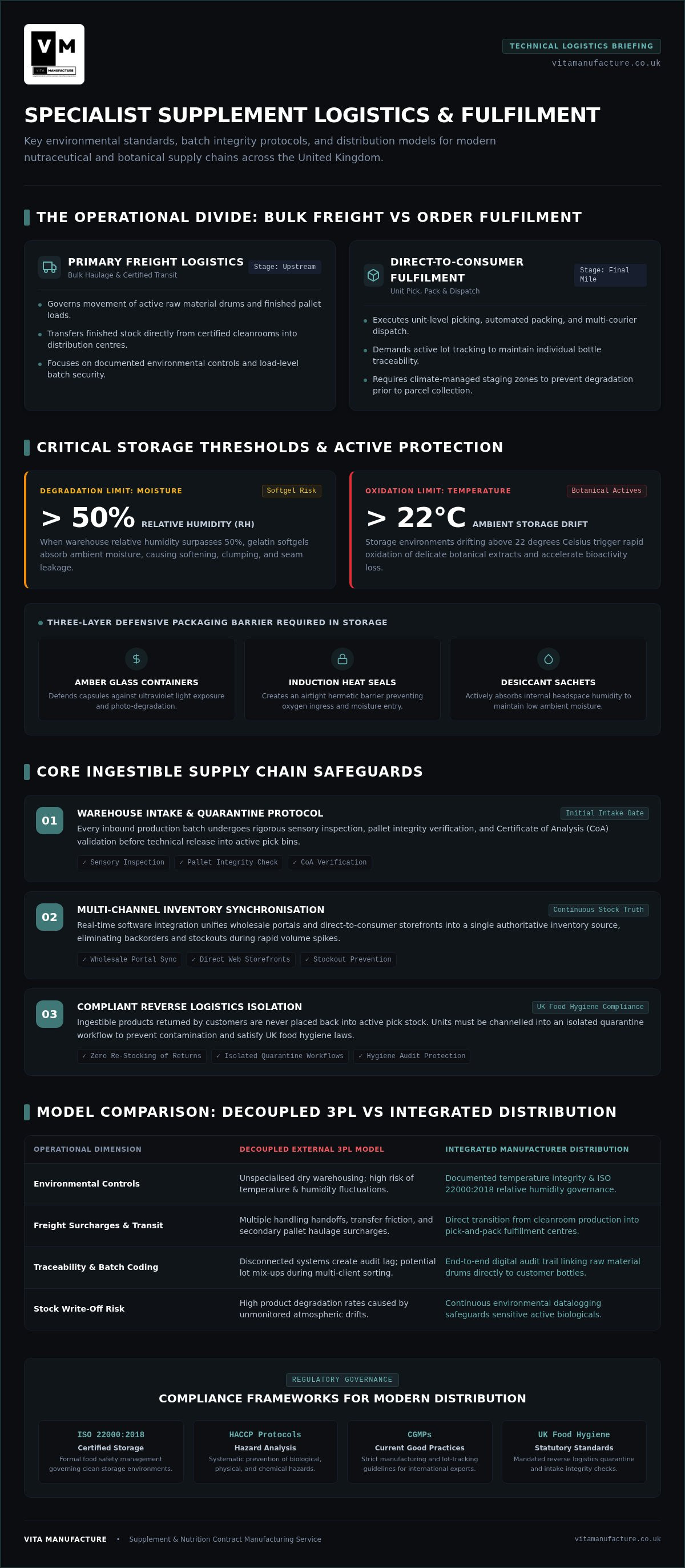
Founders often blur the operational line between primary freight handling and direct-to-consumer dispatch. Freight logistics governs the bulk haulage of active raw materials and finished pallet loads moving safely from certified cleanrooms into distribution centres. In contrast, e-commerce order fulfilment manages unit-level picking, automated packing, and final-mile parcel delivery. Many brands rely on conventional third-party logistics (3PL) providers to handle domestic distribution across the United Kingdom. However, generalist facilities rarely enforce the pharmaceutical-grade climate containment and batch segregation protocols essential for safeguarding premium formulations.
The Core Components of an Ingestible Supply Chain
Are your operational controls rigorous enough to survive a spot regulatory audit? A compliant supplement chain relies on three non-negotiable operational safeguards:
Warehouse Intake and Quarantine: Every inbound production run must undergo immediate sensory inspection, pallet integrity checks, and certificate of analysis verification before technical release into active pick bins.
Multi-Channel Inventory Synchronisation: Real-time software integration connects wholesale portals and direct online storefronts to a single source of inventory truth, eliminating backorders and stockouts as order volume accelerates.
Compliant Reverse Logistics: Returned ingestibles cannot simply be returned to stock. Returned units must be directed into an isolated quarantine workflow to prevent contamination risk and comply with UK food hygiene regulations.
Executing modern logistics and fulfillment requires total cohesion between the manufacturing facility and customer delivery pipelines. When physical warehousing and batch tracking communicate effortlessly, your brand secures both regulatory protection and commercial longevity.
Critical Storage and Quality Standards for Nutritional Product Distribution
Poor climate governance can silently ruin a premium supplement line before a single parcel reaches the consumer. A warehouse that works well for consumer electronics or apparel will often prove disastrous for delicate botanical compounds, active probiotics, and gelatin softgels. Managing compliant logistics and fulfillment demands active adherence to food safety legislation, including HACCP protocols and ISO 22000:2018 certification, ensuring that physical storage environments actively preserve nutritional bioactivity rather than compromising it.
Climate Control and Environmental Protection Protocols
Temperature and moisture spikes represent the primary threat to ingestible shelf-life stability. Softgels soften, clump, and leak when relative humidity exceeds 50%, whilst botanical extracts risk rapid oxidation if ambient storage drifts above 22 degrees Celsius. Packaging must serve as an active defensive barrier; amber glass, induction heat seals, and moisture-absorbing desiccant sachets defend capsules against ambient humidity and ultraviolet exposure during storage. Establishing robust supplement supply chain management UK frameworks ensures continuous environmental datalogging across all warehousing stages, preventing costly batch spoilage before stock enters consumer circulation.
Traceability, Batch Coding, and Regulatory Compliance
Every commercial batch requires an unbroken digital audit trail linking individual customer bottles back to original raw material drums. Both UK regulatory bodies and international standards such as Current Good Manufacturing Practices (CGMPs) require rigorous lot tracking and rapid audit readiness across the entire distribution network. Protecting your commercial standing requires disciplined stock control:
First-Expired, First-Out (FEFO) Rotation: Conventional inventory models pick the newest pallet first, which invites costly stock expiration. FEFO prioritises the dispatch of lots with the nearest expiry dates, completely eliminating warehouse obsolescence.
Digital Lot Segregation: Inventory management systems must capture batch codes, quarantine dates, and cleanroom release notes automatically upon intake.
Mock Recall Simulations: Routine internal audits must locate every distributed unit of an assigned batch across UK wholesale partners and e-commerce subscribers within four hours.
Maintaining regulatory peace of mind starts by choosing an accredited operational partner. If your current storage processes fall short of audited food safety benchmarks, you can explore certified contract handling with Vita Manufacture to protect product integrity right from manufacturing through to customer dispatch.
Decoupled 3PL Warehouses vs Integrated Manufacturer Distribution
Splitting production from dispatch creates operational friction that quietly drains your bottom line. In a fragmented setup, your contract facility blends and bottles your vitamins, loads pallets onto a third-party haulier, and shuttles them to an external warehouse. This separated approach to logistics and fulfillment forces you to juggle multiple vendors, pay redundant handling markups, and accept substantial delays before inventory becomes available for purchase.
Evaluating the Pitfalls of Multiple Disconnected Vendors
Managing disparate suppliers introduces avoidable financial and operational vulnerabilities:
Transit Damage and Thermal Shocks: Every inter-facility transfer exposes sensitive softgels and plant capsules to vibration, moisture, and road heat inside unmonitored curtain-side lorries.
Administrative Drag: Juggling separate billing cycles, reconciling split warehouse management dashboards, and manually chasing receiving paperwork consumes precious founder hours.
Accountability Gaps: If bottles arrive at the customer with micro-cracks or loose seals, external warehouses typically blame the packaging line, whilst the manufacturer points to rough courier handling. You end up absorbing the loss.
Industry research highlighted by the Council of Supply Chain Management Professionals (CSCMP) repeatedly underlines how reducing handling steps across the supply chain improves order accuracy and reduces operating waste. Every intermediate loading dock simply introduces another point of failure.
The Commercial Advantages of an End-to-End Partner
Unifying manufacturing and storage under one roof completely changes the economics of brand scaling. When freshly packaged bottles roll off an accredited cleanroom line directly into temperature-governed inventory racks, intermediate domestic haulage expenses instantly fall away. Batch records, certificates of analysis, and stock levels populate into a single live dashboard simultaneously, freeing up cash flow and making stock immediately sellable.
Consolidated operations also eliminate finger-pointing. Quality control, seal verification, and final parcel dispatch remain the sole responsibility of one strategic partner. When evaluating potential collaborators, review our advice on choosing a UK supplement manufacturer to ensure your selected facility can support integrated, long-term commercial growth.
Streamlining your physical pipeline protects working capital. Consolidating your production with integrated logistics and fulfillment ensures that regulatory traceability remains pristine, stock release happens without transit friction, and your operational margins stay intact.
How to Build an Agile Supplement Fulfilment Workflow for National and Global Reach
Scaling order volumes without a resilient operational workflow invites chaotic dispatch backlogs and crushed packaging. Achieving high customer satisfaction requires an intentional, step-by-step pipeline designed specifically for ingestibles:
Sales Channel API Syncing: Unify e-commerce platforms and wholesale portals with your central warehouse management system to track live inventory fluctuations dynamically.
Automated Batch Allocation: Direct incoming customer orders to assign specific lot numbers at the moment of order processing, locking in precise consumer-to-batch records.
Specialised Protective Packaging: Select container-specific protective packaging, utilising tamper-evident seals, corrugated dividers for amber glass dropper bottles, and thermal bubble sleeves for softgels. Sourcing durable outer cartons and packaging solutions from established providers like OEM Materials & Supplies helps protect fragile goods from physical damage during transit.
Margin-Optimised Carrier Routing: Deploy automated courier-selection software that balances regional delivery commitments against escalating fuel surcharges and package dimensions.
International Document Preparation: Pre-generate export declarations, accurate HS tariff codes, and commercial invoices to ensure rapid cross-border customs clearance.
Technical Integration and Order Management Systems
Are your inventory alerts dynamic enough to prevent sudden out-of-stock notices? Modern multi-channel operations depend on real-time API synchronisation between consumer-facing web shops, retail wholesale hubs, and physical warehouse racks. Modern inventory portals track daily sales run-rates and calculate replenishment milestones against manufacturing lead times, allowing founders to reorder before reaching critical stock thresholds. This technical automation ensures every parcel leaves the bay on time with branded, tamper-evident tape and accurate tracking credentials delivered instantly to the customer. For operational teams setting up packing benches with dedicated printing hardware and media, specialist suppliers like DymoOnline provide reliable thermal labelling equipment and accessories to maintain rapid dispatch workflows.
Navigating International Logistics and Export Requirements
Expanding outside the domestic UK market opens significant revenue pipelines, yet cross-border supplement distribution presents complex regulatory challenges. Ingestibles do not clear customs like ordinary consumer commodities. What qualifies as an over-the-counter dietary supplement in the United Kingdom might be classified as an unapproved pharmaceutical or novel compound in parts of continental Europe, North America, or Asia. A single non-compliant botanic extract or incorrectly phrased active ingredient claim can result in border confiscations, administrative fines, and total stock destruction.
A resilient international workflow requires meticulous export paperwork. Your logistics team must formulate spotless commercial invoices, obtain relevant export health certificates, and apply precise harmonised system (HS) commodity codes. By calculating local import duties, regional VAT, and customs processing fees in advance, you avoid unexpected surcharges that quickly erode your foreign market profit margins.
Are friction and administrative delays slowing your international distribution? You can eliminate these operational bottlenecks and protect your margins by partnering with Vita Manufacture to streamline your supplement distribution under an experienced, end-to-end framework.
Scaling Your Brand with Vita Manufacture: Seamless Production to Delivery
Scaling a nutritional venture requires an operational framework that accelerates distribution without compromising product safety. When you unify contract blending, encapsulation, and palletised warehousing with a single strategic partner, your operational complexity collapses into a streamlined competitive advantage. Vita Manufacture provides founders across the United Kingdom with an end-to-end operational engine, managing every phase from initial laboratory formulation through to domestic haulage and international freight.
Eliminating Operational Friction with an All-In-One Partner
Why divide your operational oversight between disconnected vendors when a single partner can manage your entire product journey? At Vita Manufacture, your dietary capsules, tablets, and powders transition straight from accredited ISO 22000:2018 cleanroom environments into our integrated, climate-controlled warehousing facilities. Consolidating production and delivery under one accredited standard removes transfer delays, prevents transit-related physical damage, and eliminates the double-handling fees typical of fragmented setups.
This closed-loop methodology frees your executive team from the daily grind of chasing shipping notices and reconciling disparate manifests. Whether you are creating bespoke formulations or expanding your line through our agile catalogue of private label supplements, our infrastructure handles the heavy operational lifting so your team can focus on marketing, retail relationships, and commercial growth.
Initiating Your Integrated Supply Chain Partnership
True operational control relies on transparent data. Rather than chasing fragmented email updates across separate suppliers, our partners manage their entire inventory lifecycle through a dedicated digital portal. This intuitive interface gives you real-time visibility over:
Live Stock Metrics: Monitor real-time inventory levels across private label and white label supplement lines from a single dashboard.
Granular Batch Traceability: Access production logs, certificates of analysis, and cleanroom quarantine sign-offs instantly for absolute regulatory compliance.
Consolidated Dispatch Management: Oversee national wholesale distribution and international freight dispatches through a single point of operational contact.
Partnering with Vita Manufacture gives your brand the foundation to scale confidently. By bringing custom formulation, ISO-certified contract manufacturing, and compliant logistics and fulfillment under one roof, we equip your brand to conquer technical hurdles, safeguard margins, and expand seamlessly across the UK and overseas.
Future-Proofing Your Supplement Distribution for 2026 and Beyond
Scaling a successful nutritional brand requires far more than energetic marketing; it demands an uncompromising distribution engine. Protecting delicate active ingredients from thermal variation, enforcing disciplined First-Expired, First-Out rotation, and eliminating transfer friction between disconnected suppliers protect both your customer reputation and commercial margins. Mastering specialist logistics and fulfillment transforms daily dispatch from an operational vulnerability into your brand's greatest growth catalyst.
You don't have to navigate fragmented vendor networks alone. At Vita Manufacture, we eliminate operational friction by combining custom formulation, cleanroom encapsulation, compliant packaging, and managed distribution under one roof. Operating within ISO 22000:2018 certified facilities, we ensure immaculate food safety at every touchpoint. Our transparent digital portal provides round-the-clock stock oversight and granular batch traceability, giving your executive team complete regulatory peace of mind.
Ready to scale without the headache of shipping delays and compromised stock? Partner with Vita Manufacture for integrated production and logistics, and build the dependable operational foundation your supplement venture deserves.
Frequently Asked Questions
What is the difference between standard logistics and supplement fulfilment?
Standard retail handling focuses purely on moving durable consumer goods without sensitive environmental parameters. In contrast, supplement logistics and fulfillment prioritises ingestible product safety, climate containment, and complete regulatory traceability. Health formulations require monitored temperature thresholds, continuous batch tracking, and audited food-grade hygiene protocols that conventional distribution centres simply aren't equipped to maintain.
Can regular commercial couriers safely deliver ingestible vitamin products?
Yes, provided your packaging provides adequate structural and thermal defence. Most parcel couriers don't operate temperature-controlled delivery vans, meaning shipments encounter short-term thermal shifts. To protect delicate capsules, powders, and softgels, brands utilise insulated mailers, tamper-evident seals, and shock-absorbing corrugated boxes. Choosing express domestic services also significantly shortens transit times, preserving formula bioactivity.
Why is ISO 22000 certification vital when selecting a fulfilment partner?
ISO 22000:2018 certification verifies that an operational facility controls food safety hazards through strict, audited management systems. For ingestible products, this accreditation guarantees cleanroom-adjacent storage, allergen segregation, pest prevention, and validated hygiene standards. Working with an ISO-certified distribution partner ensures your brand consistently satisfies UK food safety standards and shields your business from cross-contamination risks.
How do temperature fluctuations during transport affect nutritional supplements?
Thermal spikes can degrade active ingredients and ruin the physical integrity of finished products. Unregulated heat often causes softgels to clump together, live cultures to lose potency, and botanical extracts to oxidise prematurely. Uncontrolled relative humidity also weakens capsule shells and degrades moisture barriers. Maintaining disciplined environmental controls throughout storage and bulk movement prevents unrecoverable inventory losses.
What happens to customer returns in a certified health supplement warehouse?
Returned ingestibles must never be restocked into active saleable inventory. Because storage conditions and tamper integrity cannot be guaranteed once a bottle leaves the supply chain, returned items are routed directly into an isolated quarantine hold. Warehouse teams log the return against batch numbers for regulatory reporting before executing safe disposal in line with food hygiene legislation.
How does batch tracking function during national and international product distribution?
Batch tracking maps each production run to individual client dispatches through digital inventory management software. When an order is processed, the system logs the exact lot number and expiration date assigned to that customer or wholesale stockist. This granular record-keeping delivers total transparency across United Kingdom distribution pipelines, ensuring rapid response times if an audit occurs.
Can an integrated manufacturer manage international customs documentation for export?
Yes, an end-to-end manufacturing partner manages production alongside global export paperwork. A qualified provider compiles compliant commercial invoices, export health certificates, and relevant HS commodity codes matched to destination markets. Consolidating your export requirements within an integrated logistics and fulfillment framework prevents customs rejections, minimises border delays, and safeguards your international trading margins.