Lampard Inquiry: What to Know About Mental Health
What can evidence about deaths in one part of England tell us about mental health care more widely? Understanding the lampard inquiry and what we need to know about mental health starts with separating the Inquiry’s investigation from conclusions it has yet to reach. It is examining around 2,000 deaths of mental health inpatients in the care of NHS trusts in Essex between 2000 and 2023.
It’s understandable to feel concerned when reports raise questions about patient safety, staff practices or the care people received. But allegations, evidence heard in public and final findings aren’t interchangeable. The Inquiry’s conclusions shouldn’t be treated as a verdict on every mental health service. The Lampard Inquiry is an active statutory inquiry, with public hearings running from 5 to 16 October 2026. Current sessions are examining observation methods, including monitoring technology, and emergency resuscitation procedures.
This article explains the Inquiry’s remit and limits, what the current hearings may clarify, and how to follow reliable updates without mistaking claims for established findings. It also points to appropriate mental health information and support, so you can stay informed while keeping the wider questions in perspective.
Table of Contents
What is the Lampard Inquiry into mental health deaths?
The Lampard Inquiry is an independent statutory investigation into the deaths of mental health inpatients in Essex. Its published remit covers deaths between 2000 and 2023 in the care of Essex Partnership University NHS Foundation Trust (EPUT) and its predecessor trusts. The final Terms of Reference, published on 10 April 2024, set out the questions the Inquiry is tasked with examining.
An inquiry looks beyond an individual event to examine the circumstances, decisions and systems surrounding it. This can include how deaths were investigated, how the trusts were governed, and how they interacted with other public bodies. These are areas for scrutiny, not proof that a failure occurred or that a particular person is responsible. Conclusions must be based on the evidence the Inquiry considers and any findings it publishes.
Who and what does the Lampard Inquiry cover?
The Inquiry’s focus is specific: inpatient deaths in Essex during the stated period and within the trusts identified in its remit. It is also examining the trusts’ culture, governance and practices, the quality of death investigations, and relevant relationships with other public bodies. The remit helps distinguish these questions from wider national debates about mental health services. Evidence may raise issues with broader relevance, but the formal investigation remains defined by the Terms of Reference.
That boundary matters when considering lampard inquiry and what we need to know about mental health. Evidence about care in Essex may prompt important questions elsewhere, but it cannot, by itself, establish what happened in every NHS service or prove that the same conditions exist nationally.
Why does a statutory inquiry matter?
The Inquiry was converted from a non-statutory inquiry to a statutory one on 27 October 2023 under the Inquiries Act 2005. This gives it legal powers to require evidence and witness participation within its remit. Those powers support a fuller examination of relevant records and accounts. They do not mean that disputed claims have already been tested or that conclusions have been reached.
An inquiry examines events and systems; a criminal trial determines whether a defendant is guilty of an offence. The Lampard Inquiry is not a criminal court, and it does not provide mental health treatment. Its work is not a finding of guilt or a judgement on all mental health care. Any responsibility, recommendations and wider implications should be assessed against the Inquiry’s published conclusions, not assumed in advance.
How does the Lampard Inquiry examine evidence and reach conclusions?
An inquiry’s evidence develops over time. Public hearings are one visible part of the process, alongside a broader examination of material relevant to the remit. When following the work, distinguish evidence being gathered and considered from conclusions the Inquiry has formally published.
Set the scope: The Terms of Reference define the issues the Inquiry can examine.
Gather and review material: Relevant documents and witness evidence can help build the evidential record.
Examine evidence: Hearings may allow evidence within the remit to be explored in public.
Publish updates and conclusions: Rulings, interim updates and final findings serve different purposes. Check what each document actually says.
This is a guide to understanding the process, not a claim that every item follows the same path or is made public. For the Inquiry’s own descriptions, hearing information, transcripts, rulings and updates, consult the Official Lampard Inquiry Website.
What happens during a public hearing?
A public hearing is an opportunity to examine evidence relevant to the Inquiry’s questions. Witnesses may give accounts or respond to questions, and their roles and participation can differ. The Inquiry’s notices and hearing materials provide context about who is giving evidence and in what capacity. A hearing is not a complete record of all evidence-gathering: not every case, witness or piece of material will necessarily be heard in public.
A transcript records what was said in a particular hearing. On its own, it doesn’t show that the Inquiry has accepted every statement as fact or reached a conclusion about it.
How should readers understand evidence and findings?
Evidence is material the Inquiry considers; findings are conclusions it publishes after assessing that material. An account, document or question raised during proceedings may be relevant without being a settled determination. An interim update or ruling can address a particular matter without representing the Inquiry’s final conclusions.
Before sharing a claim, check its date and source, then look for the underlying transcript, ruling or official update. Establish whether it reports testimony, summarises evidence, describes an interim step or states a published finding. This helps readers understand lampard inquiry and what we need to know about mental health without turning an allegation or provisional development into a conclusion.
Clear, compliant communication also matters when developing products. Vita Manufacture supports supplement brands with supplement product development and formulation.
What can the Lampard Inquiry tell us about mental health inpatient care?
An inquiry can help explain how events unfolded in particular cases and what the surrounding care arrangements looked like. That means examining individual decisions alongside relevant records, communication and organisational practice. The Lampard Inquiry’s published scope includes the trusts’ culture, governance and practices, the quality of investigations into deaths, and interactions with other public bodies.
These are lines of examination, not confirmed failures. For example, a timeline assembled from records may help clarify what information was available to staff at a particular point, or how an event was reviewed afterwards. Organisational context can help explain how decisions were made, but it does not, by itself, prove that a system was at fault. Current hearings have also examined observation methods and emergency resuscitation procedures in inpatient settings. Scrutiny of these topics is not a finding that a particular practice caused a death.
Why might an inquiry examine care systems as well as individual events?
Records, accounts and timelines can be considered together to build a clearer picture of a specific case. The Inquiry may examine how the trusts investigated deaths, how their practices and governance operated, and relevant communication with other public bodies. This wider context can help test whether decisions were connected to broader organisational arrangements. It doesn’t establish systemic fault in advance; the evidence must support any conclusion.
What should readers avoid assuming about mental health services?
Deaths under investigation are serious, and each deserves careful consideration. But readers shouldn’t assume that every death had the same cause, that a particular death was preventable, or that negligence has been established unless authoritative findings say so. Nor can cases within the Inquiry’s remit represent every inpatient’s experience or every mental health service.
Examining systems can reveal questions about practice; it doesn’t justify generalising about all services. This distinction is central to lampard inquiry and what we need to know about mental health: the Inquiry may offer evidence-based insight into the events and organisations it examines, but its findings should not be stretched beyond their scope. Until conclusions are published, treat claims about causation, responsibility or wider patterns with care.
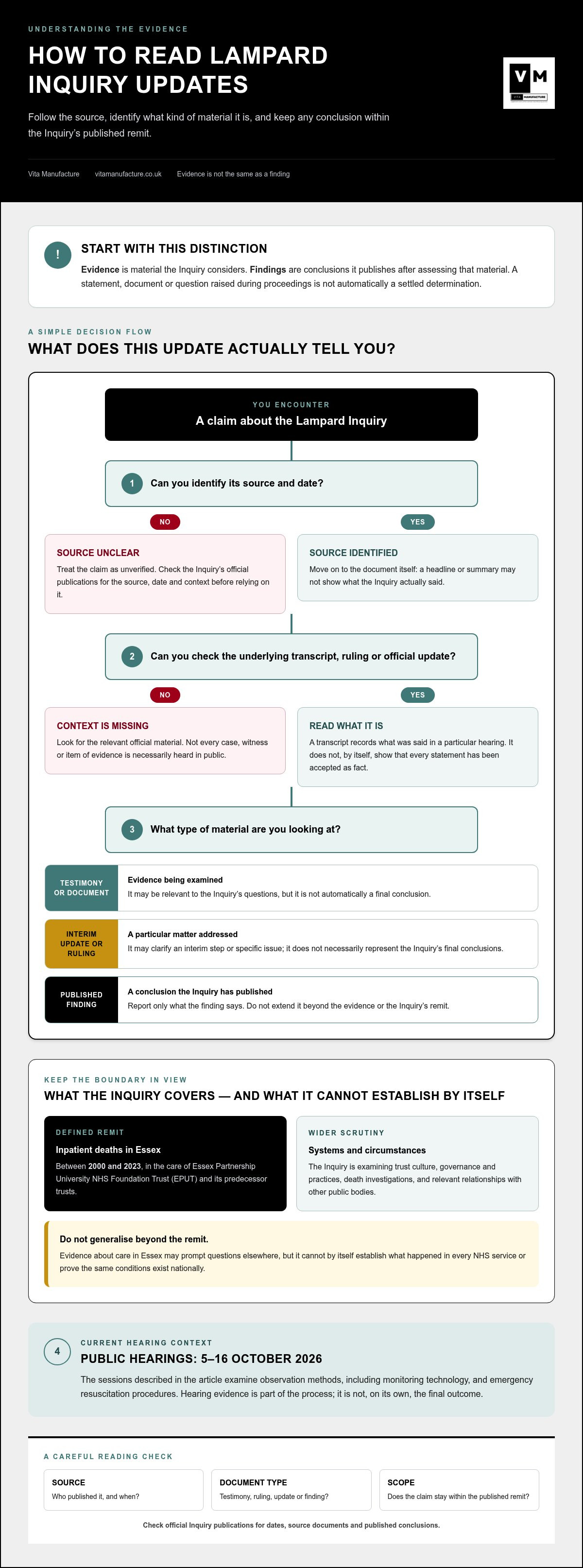
How can you follow Lampard Inquiry updates without mistaking speculation for fact?
Before accepting or sharing an update, verify its date, find the original source, and identify whether it reports evidence, an interim development or a published conclusion. Coverage can move quickly, while a headline or social media post may leave out important context.
Start with the official Lampard Inquiry website for its remit, hearing schedule, transcripts, rulings and formal updates. Reputable journalism can provide useful context, particularly when it links directly to the relevant Inquiry material. Legal commentary may help explain a development, but it remains interpretation, not an official conclusion from the Inquiry.
Which sources are most useful for checking an update?
Check primary material first: the Inquiry’s published documents, hearing records and rulings. Then compare reporting or commentary with the original source. If a report doesn’t identify where a claim came from, or the source document doesn’t support the headline, treat the claim cautiously. A transcript records evidence given; it doesn’t necessarily mean the Inquiry has accepted it as fact.
How can headlines or early reports mislead?
Look closely at the wording. Does the item describe testimony, an interim update, a ruling on a specific issue, or a final finding? These are different stages, and presenting one as another can make an untested allegation sound settled. Check the publication date, too: older schedule information may no longer reflect the latest arrangements.
As at 7 October 2026, public hearings are being held from 5 to 16 October. Current sessions are examining observation methods and emergency resuscitation procedures in mental health inpatient settings. Schedules and published material can change, so verify the latest hearing dates and any new rulings or findings directly with the Inquiry before publication or sharing. Don’t circulate unverified names, allegations or personal details.
For a careful approach to lampard inquiry and what we need to know about mental health, keep these distinctions clear:
Source: Is this an official document, reputable report, commentary or social media post?
Status: Is the information evidence, provisional material or a formal finding?
Context: Does the original document support the claim being made?
Date: Is the update current?
Careful, substantiated communication matters in other contexts, too. If your brand is developing supplements, explore responsible supplement product development.
What should readers do next, and where can they find mental health support?
Stay informed, but give yourself permission to step back. Check primary sources when new claims appear, avoid sharing speculation as fact, and take breaks if coverage feels distressing. The Inquiry’s work may raise difficult questions, but you don’t need to read every update to understand its conclusions.
If you or someone close to you is affected by mental health concerns, seek support from an appropriate health professional. You could start with a GP or, if you’re already receiving care, contact your mental health team. Support routes differ across the UK, so use current official guidance for your nation rather than relying on an old article or social media post.
Where can someone seek mental health support in the UK?
For non-urgent concerns, consult your GP or the official health service for your nation: NHS.uk for England, NHS inform for Scotland, NHS 111 Wales, or nidirect for Northern Ireland. These sources explain current routes to care and urgent mental health help. Availability and referral pathways can differ, so check the relevant guidance directly.
If someone is in immediate danger, call 999 or go to an accident and emergency department. For an urgent mental health crisis that isn’t an immediate emergency, follow the current crisis guidance from the relevant health service in your nation. If you’re unsure which route applies, official health-service information can help clarify the next step.
What is a responsible next step for supplement brands?
The Lampard Inquiry does not validate supplements or establish that any product can prevent or treat mental illness. Its evidence and conclusions must not be used to imply otherwise. Brands discussing wellbeing should base product communications on appropriate evidence, regulatory review and careful wording. Keep general wellbeing statements distinct from claims to diagnose, prevent or treat a condition.
This is separate from mental health advice. Vita Manufacture supports supplement brands with product development, formulation and regulatory guidance. If you’re developing a supplement, explore Vita Manufacture’s product development support as a separate commercial matter, not as a response to the Inquiry or a substitute for professional care.
Ultimately, lampard inquiry and what we need to know about mental health means keeping two things in view: follow the evidence carefully, and seek personal support through appropriate health services rather than drawing conclusions about care or treatment from developing Inquiry coverage.
Stay informed, grounded and focused on what matters
Understanding lampard inquiry and what we need to know about mental health means keeping the Inquiry’s defined remit in view, distinguishing evidence from published findings, and avoiding broad conclusions about every mental health service. Check official updates for current information, and take a break from coverage if it becomes distressing. If mental health concerns affect you or someone close to you, seek appropriate professional support rather than relying on Inquiry reporting for care.
Separately, supplement brands should approach product development with evidence and careful, compliant communication. Vita Manufacture supports brands with product development, formulation and regulatory guidance, and operates with ISO 22000:2018 certification. The Inquiry does not validate supplements or establish treatment claims.
Explore Vita Manufacture’s responsible supplement product development as a separate step for your brand. Stay curious, check the evidence and move forward with care.
Frequently Asked Questions
What is the Lampard Inquiry?
The Lampard Inquiry is an independent statutory inquiry investigating the deaths of mental health inpatients in Essex between 2000 and 2023. Its role is to examine evidence within its published remit, not to provide treatment or conduct a criminal trial. It isn’t a final judgement on every case or mental health service. For its precise scope and any changes, consult the Inquiry’s official Terms of Reference and latest updates.
What is the Lampard Inquiry investigating?
The Inquiry is investigating mental health inpatient deaths in Essex between 2000 and 2023, as defined by its remit. Hearings may examine specific issues and evidence connected with that scope, but individual cases can have different circumstances. Don’t assume that every death, service or allegation is the same, or treat questions raised during proceedings as findings. The Inquiry’s official publications are the best source for understanding what it is examining.
Has the Lampard Inquiry published its findings?
As of October 2026, the Inquiry is ongoing and its final report is expected by 2028. Check the official Inquiry website for the latest report, interim updates and publication information before relying on a status update, as plans can change. A hearing, witness statement or procedural decision isn’t automatically a final finding. When discussing a document, give its date and say whether it presents evidence, an interim position or final conclusions.
What happens at a Lampard Inquiry hearing?
Public hearings allow relevant evidence to be examined within the Inquiry’s remit. Depending on the session, the published record may include witness evidence, documents, transcripts or procedural rulings. Not all evidence or participation is necessarily public. To understand a particular hearing day, check the official schedule and available materials, including the transcript where published. A headline or brief social media post may omit context or confuse evidence given with a conclusion reached.
Can the Lampard Inquiry make recommendations about mental health care?
Describe any recommendations or intended outputs using the Inquiry’s Terms of Reference and official statements. Don’t assume a recommendation has been made until it appears in an official publication. If recommendations are published, consider what they say, whom they address and which setting they cover. An inquiry’s recommendations may inform relevant practice, but they don’t settle every question about mental health care or automatically describe all services.
How can I find reliable updates about the Lampard Inquiry?
Start with the official Inquiry website for its Terms of Reference, hearing schedule, updates, transcripts, rulings and published findings. Reputable journalism can add context, but check its date and whether it links to the original material. Treat commentary and social media claims as interpretation unless verified against primary sources. For hearing dates or expected publication timing, check the latest official update, since schedules and plans can change.
Where can I get mental health support after reading about the Inquiry?
If the coverage has affected you, consider taking a break and speaking with someone you trust or a qualified health professional. NHS support routes vary across England, Scotland, Wales and Northern Ireland, so consult the relevant official health service for current options. If someone is in immediate danger, follow the current emergency guidance for their location, such as calling 999 or going to an accident and emergency department. An article isn’t a substitute for professional support.