In-House vs Outsourced Supplement Manufacturing: A 2026 Guide
The option that gives you the most control may not be the one that puts production under your own roof. In-house vs outsourced supplement manufacturing is a decision about much more than who runs the production line: it shapes your investment, operational workload and ability to scale. It’s understandable to weigh the appeal of direct oversight against concerns that an external partner could influence quality, timelines or product decisions. But control depends on clear responsibilities and processes, not simply ownership of the equipment.
This guide compares what each model requires beyond a production run, from people and facilities to quality oversight and ongoing commitments. You’ll learn how to assess the full resource picture, compare costs using the same product requirements and weigh your current capabilities against future plans. We’ll also look at how support spanning formulation planning, manufacturing and logistics can help you develop and produce supplements with roles and decisions clearly defined. The right model is one your business can manage reliably now and adapt as it grows.
Table of Contents
In-house vs outsourced supplement manufacturing: what is the real choice?
Control, expertise and quality: compare the day-to-day realities
Which model makes commercial sense as your supplement brand grows?
Use this decision framework to choose your manufacturing model
How Vita Manufacture supports outsourced supplement development and production
In-house vs outsourced supplement manufacturing: what is the real choice?
The decision is not simply about who makes your product. It is about whether your brand will own and operate production capability or access it through an external partner. That distinction affects control, expertise, infrastructure, operating responsibilities and capacity to scale. A dietary supplement can take different forms, so the production requirements depend on the product you plan to bring to market.
What does in-house supplement manufacturing involve?
In-house production means your brand operates its own manufacturing capability. You’re responsible for suitable production space, equipment and processes, as well as staffing, production planning and quality procedures. Your team has direct day-to-day oversight of how work is organised and carried out. That visibility also brings an operational workload: the business must manage the people, facilities and systems that keep production running, not just define the product brief.
What does outsourced supplement manufacturing involve?
Outsourced production means engaging an external manufacturer to make products on your brand’s behalf. The arrangement can cover a selected stage or a wider workflow, depending on the project and support required. Outsourced supplement manufacturing gives a brand access to an external manufacturer’s production capability while the brand retains ownership of its identity and commercial direction. A partner may contribute manufacturing expertise, but your business remains responsible for product positioning and customer relationships.
The scope can be tailored. You might outsource manufacturing while keeping product planning and marketing in-house, or work with a partner across development, production and logistics. Outsourcing doesn’t automatically mean handing over every decision. It changes who operates production; the agreed responsibilities determine where input, approvals and information sit.
To understand the real choice, separate two questions: who runs production, and how much visibility or influence does your team need? Ownership and oversight are not the same. A brand can agree clear communication and access to production information without owning the facility. Equally, owning equipment doesn’t guarantee that every specialist skill or resource is available internally.
Control: Who makes day-to-day production decisions, and where does your team provide input?
Expertise: Which technical and operational capabilities are already in your business?
Infrastructure: What space, equipment and processes must be in place?
Responsibility: Who plans production, manages staff and maintains quality procedures?
Scalability: Can the model adapt as your product range or demand changes?
These questions make the in-house vs outsourced supplement manufacturing comparison more useful than a simple preference for independence or convenience. Start by listing the tasks your brand wants to own, then compare them with the capabilities and resources it can realistically maintain.
Control, expertise and quality: compare the day-to-day realities
Control is not an all-or-nothing choice. In-house production puts operational decisions closer to your team, while outsourcing gives you access to an external manufacturer’s processes and expertise. In either model, define how production information is shared, which decisions need your approval and how quality responsibilities are recorded. For example, agree how a change to a product specification is raised, reviewed and approved. This helps protect standards without confusing oversight with ownership.
How much control does each model give your brand?
With in-house production, your team can be directly involved in schedules and operating processes, but must also manage them. An outsourced arrangement can use agreed communication, project oversight and approval points to keep your team informed. Documented product specifications and sign-off stages, for example, give your team a defined role in decisions without requiring it to operate the production facility.
Operational controlIn-house: Direct involvement in production schedules and processes.Outsourced: Agreed oversight and communication, with the manufacturer managing production operations.
Specialist expertiseIn-house: The brand develops and maintains the capabilities needed for its products.Outsourced: The brand accesses an external manufacturer’s production expertise.
Quality responsibilitiesIn-house: The brand establishes and follows its own procedures.Outsourced: Responsibilities are shared according to the arrangement and should be clearly documented.
Management demandsIn-house: Internal teams coordinate people, processes and production activity.Outsourced: The brand manages the relationship, specifications and agreed approvals.
Direct production control concerns how manufacturing is run. Responsibility for product specifications, positioning and brand decisions is separate from who operates production. Outsourcing doesn’t automatically remove your role in decisions. Clear specifications, approval stages and communication routines help your team retain meaningful input while an external partner handles agreed production tasks.
Where do specialist knowledge and quality responsibilities sit?
Internal manufacturing means building relevant expertise within your own operation. With an external partner, production capability sits with the manufacturer, but your team still needs to communicate requirements and understand its responsibilities. In either model, document procedures, decision rights and how issues are managed. For brands selling into the US, the FDA’s Current Good Manufacturing Practices (CGMPs) provide a reference for that market’s supplement manufacturing framework.
Certification can be a useful point of reference, but it does not replace clearly assigned responsibilities or effective processes. Vita Manufacture is ISO 22000:2018-certified. Consider that credential as part of the wider quality arrangements for a project, not as a guarantee of a particular product outcome.
For brands considering external production, contract manufacturing support can connect manufacturing with formulation planning and other project needs. In the in-house vs outsourced supplement manufacturing decision, consider whether your team wants to operate production itself or manage a defined partnership while retaining product and brand decisions.
Which model makes commercial sense as your supplement brand grows?
The lowest visible production charge doesn’t necessarily mean the lowest total commitment. In-house manufacturing places more costs and responsibilities within your business, while outsourcing brings project and production fees in return for access to an external operation. Neither route is universally cheaper. The commercial case depends on expected volume, existing capabilities and the work each option covers.
What belongs in a total-cost comparison?
Build the comparison around the full operating model, not a single production quote. Separate initial set-up commitments from recurring expenses and project-specific charges. Include management time and specialist capability, even when they don’t appear as a manufacturing invoice.
For an in-house assessment, account for the resources needed to establish and maintain production, including:
Production space and its ongoing operation.
Equipment purchase, maintenance and servicing.
Staffing, training and production planning.
Quality systems, procedures and their continuing management.
Internal time spent coordinating production and addressing operational needs.
For outsourcing, map the scope of work before comparing fees. A project may include formulation, ingredient sourcing, production, packaging and logistics, or only selected stages. Costs reflect the agreed scope and production plan, so compare equivalent work: an internal estimate for manufacturing alone is not like-for-like with an outsourced arrangement that also covers development or logistics.
A useful model separates set-up, recurring overhead and per-project or production charges. Apply the same product specification and expected demand to each option. Include work your team would still manage, such as product planning or coordinating approvals. This brand-specific comparison is more useful than broad averages that may not reflect your product or operating needs.
How do volume and growth plans affect the decision?
Volume changes the economics. If demand is uncertain or uneven, internal equipment and staffing still need to be managed when production requirements fluctuate. If demand grows, your team must plan for the capacity and resources required. Outsourcing gives you access to external production capacity, while your commitments depend on the agreed project and production arrangements.
Test more than one scenario before deciding. Compare current demand with a cautious growth case and a stronger, plausible one. For each, consider production frequency, required capacity, staffing and equipment use, alongside external fees and management time. This won’t predict the future, but it can show where fixed operating commitments or project-based charges may become more significant.
The in-house vs outsourced supplement manufacturing decision should reflect the business you’re building, not just the next production run. If you plan to expand your product range, include the added requirements for each product in your assessment. Comparing scope, volume and responsibilities helps you judge whether internal capability is sustainable or an external manufacturing model better fits your resources and growth plans.
Use this decision framework to choose your manufacturing model
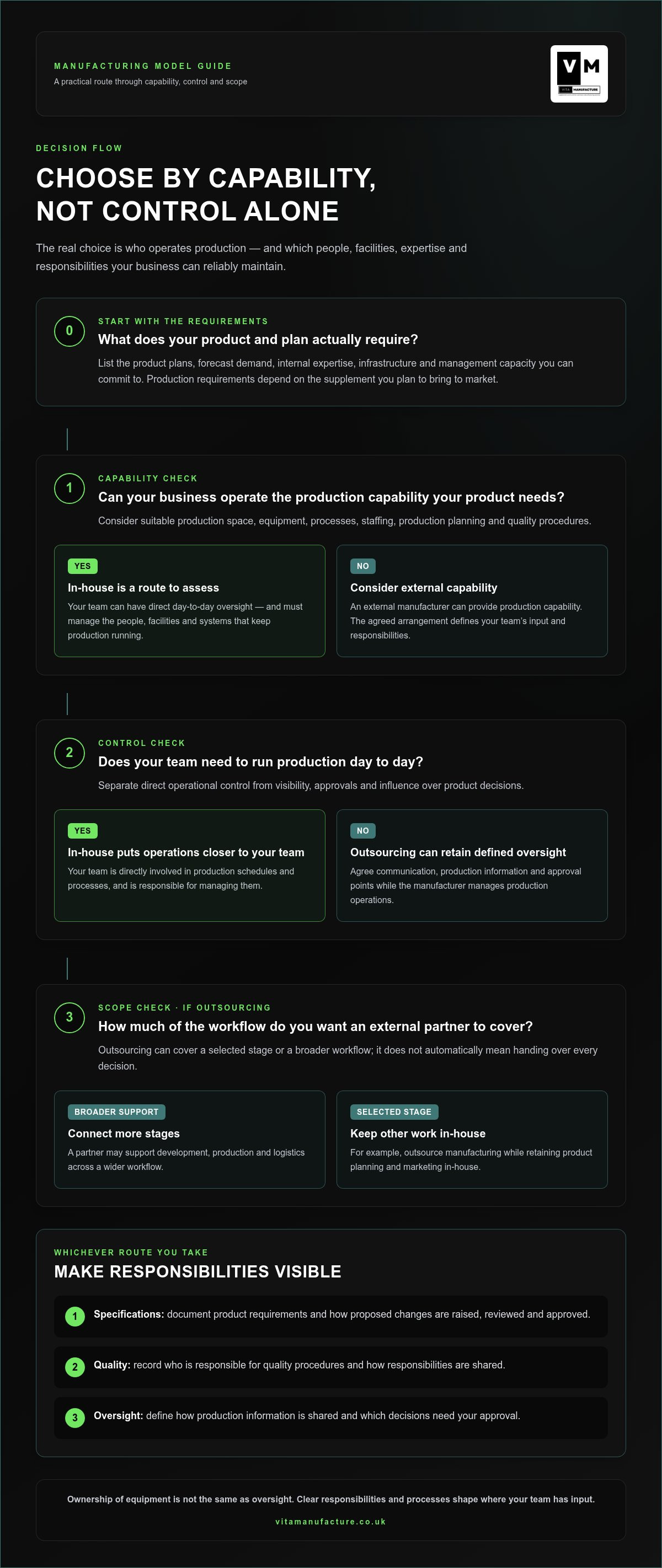
Make the choice against your actual product requirements, not an abstract preference for control or convenience. This framework helps you assess what your brand can operate today, what it needs to access externally and where a hybrid arrangement could make sense.
Set out your product plans. Identify the products you intend to launch or develop, their formats and the capabilities needed to take them from concept to production. Separate firm plans from ideas that may change.
Forecast demand. Estimate the production volume your current plan requires, then consider how it could change as the brand grows. Note where uncertainty might affect production planning or resource commitments.
Map your existing capabilities. Assess internal expertise, suitable infrastructure, equipment, quality systems and management capacity. Be specific about what your team can sustain, not simply what it could take on.
Identify capability gaps. For each product requirement, record whether it can be handled internally, assigned to an external partner or shared. Include development and sourcing needs as well as manufacturing.
Compare operating models. Consider the responsibilities, costs and oversight each option involves, then check whether your preferred approach still fits under different demand scenarios. Revisit the assessment if your product plans or internal resources change.
When might in-house production fit your business?
In-house manufacturing may suit a brand with established production expertise and a strategic need for direct operational oversight. The key test is whether that capability is sustainable: can your business support the facilities, staffing, quality processes and management workload over time? Internal production isn’t inherently more authentic or higher quality. Its value depends on whether your team can operate it effectively and consistently alongside other business priorities.
When might outsourced production fit your business?
External manufacturing may suit a business that needs specialist production or development capabilities without building every function internally. It can also provide a way to adjust the scope of support as product plans evolve, while your team focuses on brand and commercial priorities. If formulation needs are shaping your decision, explore professional supplement formulation services as part of your planning.
Consider a hybrid model. You might retain selected planning or approval responsibilities internally while assigning specific production stages to an external partner. Map each requirement to an owner and define how work passes between teams. This makes the arrangement easier to assess than treating in-house and outsourced production as two indivisible choices.
For a deeper view of partner selection, use this UK supplement manufacturer selection guide alongside your framework. If external support aligns with your capabilities and plans, discuss your supplement manufacturing requirements with Vita Manufacture.
How Vita Manufacture supports outsourced supplement development and production
Choosing outsourced production doesn’t have to mean treating development, manufacturing and logistics as disconnected tasks. Vita Manufacture is a UK-based contract manufacturer of vitamins, minerals and dietary supplements, supporting brands through product development and production. This makes the make-or-buy decision a question of which capabilities to retain internally and which to access through an external manufacturing relationship.
From product development to contract manufacturing
A product concept needs to become a practical set of requirements before production can be planned. Formulation support helps shape development, while regulatory guidance, manufacturing and logistics connect other parts of the project. You may need support with development as well as production, or a manufacturing relationship for a concept that is already established.
Vita Manufacture’s support spans formulation, regulatory guidance, manufacturing and logistics. A transparent customer portal provides visibility across the relationship. Together, these capabilities can help brands coordinate project information and production activity without developing every operational function internally. Your product and plans shape the appropriate formulation and production scope, so set out your goals and responsibilities from the outset.
Quality credentials are another part of the picture. Vita Manufacture is ISO 22000:2018-certified. This is a factual credential to consider when assessing an external manufacturing relationship, not a guarantee of a particular product outcome. Quality expectations, product specifications and responsibilities still need to be clear within the project itself.
Coordinating production also means considering how ingredients, production planning and logistics connect. For a deeper look at these stages, explore the supplement supply chain management guide. Understanding their links can help you judge whether an external partner’s scope complements your own capabilities and growth plans.
Plan a practical next step for your brand
Before starting a discussion, prepare a concise outline of your product concept, intended market, key requirements and forecast demand. Note what is still being developed and which decisions have already been made. This gives the conversation a practical starting point and helps clarify which capabilities your brand needs to retain.
Be clear about your preferred level of control, too. Which product decisions will stay with your team? What expertise or operational capacity do you already have, and where would external support add value? These answers make the in-house vs outsourced supplement manufacturing decision more specific and help define a workable scope, rather than assuming every stage must sit entirely inside or outside your business.
If you’re ready to explore how development and production support could fit your plans, discuss your supplement development plans with Vita Manufacture.
Turn your manufacturing decision into a clear next step
Your operating model should support the business you’re building, not lock you into assumptions that no longer fit. Treat in-house vs outsourced supplement manufacturing as a decision you can revisit as your product plans, demand and internal capabilities develop. Start by identifying what your team needs to retain, where external support could add capacity and how responsibilities will be defined.
You don’t need every operational detail settled before exploring a development plan. A clear product concept, intended market and outline of your priorities can turn broad ambitions into a practical discussion about formulation and production. The aim is to choose a model that gives your brand the right balance of ownership, expertise and room to grow.
Discuss your supplement development plans with Vita Manufacture and take the next step towards developing your product.
Frequently Asked Questions
Can a supplement brand keep control of its formula when manufacturing is outsourced?
Yes, the brand can retain product decision-making, but the details depend on the agreed development and manufacturing arrangements. Before work begins, document the formula specifications, who can approve changes, each party’s responsibilities and how the formula may be used. Don’t assume ownership or intellectual property terms: these depend on the project agreement. Clear written terms help prevent misunderstandings if you later change production plans or develop related products.
Is outsourced supplement manufacturing suitable for a start-up?
It can suit a start-up if external support matches its product concept, expertise, operating capacity and launch plan. Outsourcing may let a new brand access development and manufacturing capabilities without establishing every production function itself. It isn’t automatically the right choice, though. Map the skills and resources your launch requires, then compare them with what your business can sustain and the responsibilities it would take on under an external arrangement.
Can a supplement company use a hybrid manufacturing model?
Yes. A brand might keep product specifications, positioning and approval decisions in-house while assigning production to an external manufacturer. It might also retain some development activities internally and outsource selected production stages. The workable division depends on the product and operating agreement. Before settling on a hybrid model, map each task to an owner, including who provides information, approves changes and coordinates handovers, so responsibilities don’t fall between teams.
How do you compare the cost of in-house and outsourced supplement manufacturing?
Compare the full operating commitment, not just the charge for a production run. For in-house work, include facilities, equipment, staffing, maintenance, quality systems and management time. For outsourced work, account for the agreed project and manufacturing fees and the scope they cover. Because requirements vary by product and business, generic averages can mislead. Model expected volumes and operating needs using your own assumptions, then compare equivalent scopes.
Does outsourcing supplement production mean losing quality oversight?
No. Outsourcing changes who runs production, but your brand still needs to define specifications, communicate requirements and understand responsibilities within the project arrangement. For example, agree how product changes are documented and which decisions require your approval. Vita Manufacture is ISO 22000:2018-certified, a credential to consider when assessing its quality framework. Certification alone doesn’t guarantee a particular outcome, so clarify how oversight is handled for your project.
What information should I prepare before discussing outsourced supplement manufacturing?
Prepare a working outline, not necessarily a finished brief. Include your product concept, intended format, target market and expected demand, along with any known formulation, packaging or logistics considerations. Note which capabilities you already have and which you want to retain, such as product approvals or brand decisions. This context helps shape a useful discussion about project scope and development needs, even if some specifications are still being refined.