How to Launch Your Brand with White Label Supplements in the UK: A 2026 Strategic Guide
Launching a premium wellness brand in 2026 doesn't require a laboratory or a decade of R&D; it requires the right strategic alliance. You've likely looked at the booming market, projected to reach nearly $19.5 billion this year, and felt the familiar sting of entry barriers like prohibitive minimum order quantities and the labyrinth of UK food safety regulations. It's frustrating to have a vision for white label supplements uk consumers will love, only to be stalled by the fear that off-the-shelf means low-quality or, worse, non-compliant with the latest FSA standards.
This guide changes that. You'll master the exact step-by-step process to select, brand, and launch high-quality supplements whilst ensuring 100% compliance with new 2026 mandates, such as the latest purity criteria for Magnesium L-threonate and mandatory folic acid fortification. We'll explore how to find a partner that scales with you, moving from small-batch white label launches to mass production without compromising your brand's reputation. From navigating the GB Nutrition and Health Claims Register to leveraging ISO 22000:2018 certified facilities, we're providing the blueprint to take your brand from concept to shelf in weeks, not months.
Table of Contents
The Strategic Advantage: Why Choose White Label Supplements in the UK?
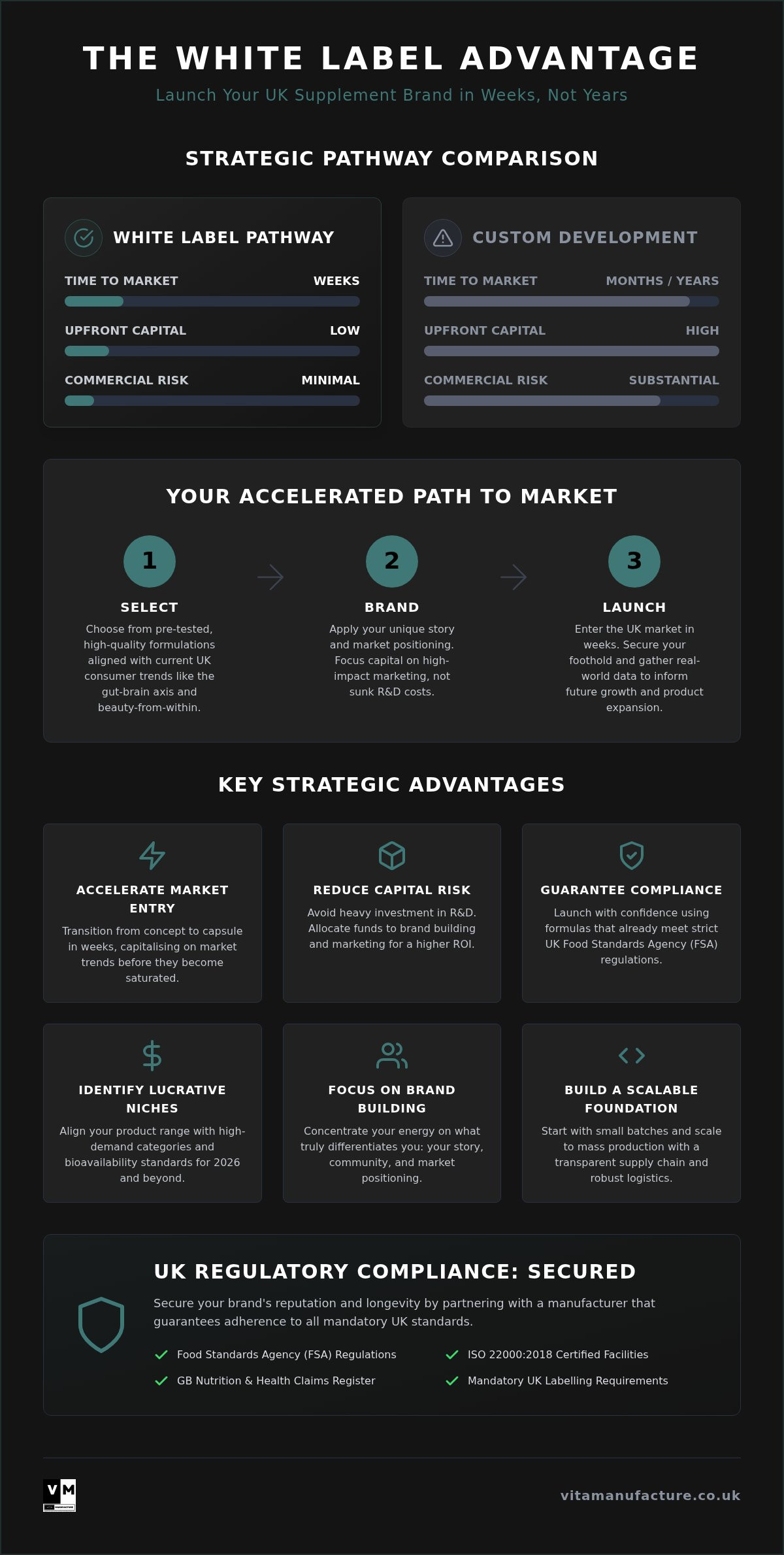
Success in the wellness industry is often a race against time. A White-label product is a pre-formulated, rigorously tested supplement manufactured by a specialist but sold under your brand. This model allows you to bypass the arduous years of scientific development and move straight to the commercial phase. Why wait for a laboratory to perfect a formula when you can leverage existing, high-stability products that already meet UK safety standards? It's the most efficient way to secure your foothold in the British market.
Choosing white label supplements uk providers isn't about cutting corners; it's about strategic resource allocation. You're essentially inheriting a proven recipe that has already cleared the hurdles of stability testing and ingredient sourcing. This allows you to focus your energy on what truly differentiates a brand: your story, your community, and your market positioning.
Speed to Market vs. Custom Development
Developing a supplement from scratch often takes many months of iterative testing. Can your business afford to wait? By choosing white label, you compress the "concept to capsule" timeline into just a few weeks. You aren't sacrificing quality for speed. Instead, you're using off-the-shelf formulations that have already undergone the necessary quality control protocols whilst maintaining high standards. This agility is vital for entrepreneurs who want to capitalise on emerging health trends before the market becomes oversaturated.
Reducing Capital Risk for New Brands
Capital is the lifeblood of any new venture, and misallocating it can be fatal. Custom manufacturing usually requires heavy investment in New Product Development and pilot study fees before a single bottle is sold. White labelling eliminates these upfront costs entirely. You avoid the "sunk cost" trap of investing thousands into a unique formula that might not resonate with your audience. Instead, you can invest that capital into high-impact marketing and brand building, ensuring that when your product launches, people are actually ready to buy it. It's a low-risk, high-reward entry strategy that allows for rapid market validation.
Think of white label as your proof of concept. It gives you the data you need to understand what your customers truly want from white label supplements uk brands. Once you've established a loyal following and consistent revenue with these proven formulas, you have the financial stability to transition into Private Label Supplements or bespoke R&D. You're building your empire on a foundation of facts, not assumptions.
Selecting Your Range: How to Choose Winning Formulations
Strategy dictates success. You aren't just picking bottles; you're building a portfolio. In 2026, the UK market has shifted heavily towards preventative healthcare and precision nutrition. This means your choice of white label supplements uk must reflect a sophisticated understanding of consumer needs. Are you targeting an ageing demographic looking for mobility or a professional seeking cognitive enhancement? Matching the delivery format, such as liquid shots for fast absorption or traditional capsules for daily staples, is a critical part of this alignment.
It's vital to distinguish between general wellness and targeted health support. Using resources like the NHS Understanding Food Supplements guide helps you understand how ingredients are categorised and ensures your range remains within legal definitions. This clarity is essential before you commit to any inventory. You'll want to ensure every formula in your range has been vetted for bioavailability and long-term stability.
Identifying High-Demand Supplement Categories
While multivitamins remain a steady baseline, 2026 is the year of the gut-brain axis and beauty-from-within. Consumers now look for specific probiotic strains and collagen formulations that promise visible results. You don't need to reinvent the wheel to capture this interest. By selecting "tried and tested" white label formulas, you're offering products with established stability and safety profiles. This builds immediate trust with a discerning UK audience that values evidence-based wellness. Focus on staples like Vitamin D and Magnesium, but leave room for emerging niches like nootropics to differentiate your brand.
Assessing Manufacturing Quality and Potency
Transparency is your brand's greatest asset. Every product in your range should be backed by a Certificate of Analysis (CoA), proving that what's on the label is exactly what's in the capsule. Consistent potency across batches isn't just a regulatory requirement; it's the foundation of customer loyalty. You should ensure your partner operates from an ISO 22000:2018 certified facility to guarantee the highest safety standards. If you want to see how these quality controls are managed in real-time, you can explore the transparent customer portal provided by Vita Manufacture. This level of oversight ensures your brand remains beyond reproach as you scale.
White Label vs. Private Label: Determining the Best Strategic Fit
Deciding between these two models is often the most significant fork in the road for a wellness founder. While both allow you to sell under your own brand name, the fundamental difference lies in who owns the intellectual property of the formulation. With white label supplements uk, you're licensing a high-quality, pre-existing recipe. In contrast, private label involves creating a bespoke formulation that belongs exclusively to you. The operational complexity shifts significantly between the two; white label removes the burden of R&D and regulatory filings, whereas private label requires deeper involvement in the scientific validation process. Which path aligns with your current resources?
Profitability is a primary driver in this decision. White label products typically offer a higher immediate ROI because they bypass the expensive pilot study and development phases. You aren't paying for the trial and error of a new recipe. However, as your brand scales, a bespoke private label formula can eventually offer better long-term margins through ingredient optimisation and unique market positioning that justifies a premium price point. It's a choice between immediate market entry and long-term proprietary control.
When White Label is the Correct Choice
It's the ideal entry point. If you're a startup with limited capital or an established brand looking to test a new category quickly, this is your best path. You can focus entirely on your brand identity and marketing strategy without getting bogged down in the technical minutiae of manufacturing. It's about agility. Launching with white label supplements uk allows you to gather real-world consumer data before you commit to the heavy investment of custom development. This model ensures you remain lean and responsive whilst building your initial customer base.
The Path to Private Label and Customisation
Differentiation becomes vital as your market share grows. When your data shows a specific consumer preference that off-the-shelf products don't fully meet, it's time to consider customisation. Vita Manufacture acts as a strategic ally in this transition, supporting you through the move from white label staples to proprietary custom R&D. This evolution allows you to protect your unique selling proposition (USP) with a formula that no competitor can replicate. You're no longer just selling a product; you're owning the science behind it, providing a level of brand security that generic formulas cannot match.
Navigating UK Compliance: A Step-by-Step Labelling and Regulatory Guide
Compliance is the non-negotiable foundation of your business. In the post-Brexit landscape of 2026, the UK Food Standards Agency (FSA) has established rigorous parameters that every brand owner must respect. You are legally classified as the "Responsible Person" if your brand name is on the bottle, meaning you carry the ultimate accountability for the product’s safety and claims. This isn't a burden to carry alone; it's a framework that ensures the longevity of white label supplements uk brands by filtering out substandard operators. You must ensure your labels include mandatory elements: a full list of ingredients, highlighted allergens, precise dosages, and the address of the UK business responsible for the product.
What you say on your packaging is just as important as what's inside. The GB Nutrition and Health Claims Register dictates exactly what benefits you can attribute to your supplements. For example, whilst you can state that Vitamin D contributes to the normal function of the immune system, you cannot claim it "cures" or "prevents" a disease. Straying into medicinal territory invites swift action from the Medicines and Healthcare products Regulatory Agency (MHRA). Are your current drafts strictly adhering to these authorised claims?
Step 1: Label Review and Artwork Compliance
Organising your label layout requires more than just aesthetic flair. You must meet statutory requirements for font sizes, ensuring that mandatory information is easily legible. If you intend to export, you'll need to consider bilingual requirements for your target markets. Your branding must be distinct from your regulatory text, and most importantly, it must not conflict with medical claim restrictions. A professional review at this stage prevents costly reprints and potential recalls.
Step 2: Regulatory Notifications and Documentation
Every product in your range requires a comprehensive Technical File. This document should include specifications, Certificates of Analysis, and proof of full traceability from your manufacturer. In 2026, you must also stay abreast of specific ingredient changes, such as the new purity criteria for magnesium L-threonate monohydrate or the official approval of the first government-approved CBD food products. If you're using newer ingredients, you'll need to verify their status under the Novel Food regulations. Ensuring your partner provides detailed batch records is essential for maintaining this gold standard of transparency.
Don't let regulatory complexity stall your progress. You can partner with Vita Manufacture to ensure your entire range is built on a foundation of 100% compliance and scientific rigour.
From Launch to Scale: Partnering for Long-Term Commercial Success
Scaling a brand requires more than just a successful launch; it demands a robust infrastructure that can withstand the pressures of rapid growth. Your choice of a partner for white label supplements uk becomes even more critical as you transition from a startup to an established market player. Reliability is the currency of this industry. If you can't manage inventory and lead times effectively, you risk the dreaded out-of-stock scenario that alienates customers and damages your search rankings. Success isn't just about the first sale; it's about the tenth, the hundredth, and the thousandth.
Transparency is no longer a luxury. It's a requirement. By utilising a transparent supply chain, you gain the visibility needed to make informed decisions about your stock levels. The Vita Manufacture customer portal provides this real-time oversight, allowing you to track project milestones and logistics with precision. This level of data-driven management ensures your business remains agile, even when market fluctuations or global shipping delays occur. You're empowered to think three steps ahead of your competition.
The journey typically begins with low Minimum Order Quantities (MOQs) to preserve capital, but success will eventually necessitate a move toward high-volume contract manufacturing. A strategic ally supports this evolution, providing the technical expertise and facility capacity to scale alongside you. This progression allows you to transition from standard white label formulas to bespoke solutions that further solidify your competitive edge. You're building a legacy, not just a product line.
Leveraging the "Made in Britain" mark offers significant international brand prestige. UK manufacturing standards are respected worldwide, providing a passport for global distribution. When you partner with an end-to-end provider, you aren't just getting a factory; you're gaining a logistics and distribution network that can carry your products into new territories with confidence. This global reach is what separates a local business from an international wellness authority.
Utilising Modern Manufacturing Technology
Real-time data is the heartbeat of a successful modern brand. Portals and digital tracking systems improve communication between you and your manufacturer, reducing the risk of human error. An end-to-end partner who manages everything from initial ingredients and bulk sourcing to global logistics provides a seamless experience. This integration builds a resilient supply chain that can adapt to the shifting demands of the 2026 wellness market. It's about having total control over your commercial destiny.
Establishing a Long-Term Strategic Alliance
Your manufacturer shouldn't be a mere vendor. They should be a visionary growth partner who thinks like a business owner. This relationship involves planning a product roadmap for the next 12 to 24 months, identifying which new categories to enter and when to refine your existing formulas. This collaborative approach ensures that your brand isn't just surviving the current quarter but is positioned for sustained commercial success over the coming years.
Enquire about our white label solutions and start your journey with Vita Manufacture today to secure your position in the future of the UK wellness industry.
Securing Your Future in the UK Wellness Market
The UK wellness market in 2026 offers unparalleled opportunities for visionary founders who prioritise quality and compliance. By leveraging white label supplements uk formulations, you can bypass the capital-intensive R&D phase and focus entirely on building a brand that resonates with a discerning audience. Success hinges on more than just a great label. It requires a foundation of scientific rigour and operational transparency.
Are you ready to transform your concept into a commercial reality? Partnering with an expert ensures your range is produced in an ISO 22000:2018 certified facility, giving you total peace of mind. With a transparent customer portal for real-time project tracking and end-to-end logistics support, you can scale from your first small batch to international distribution with confidence. Don't let manufacturing hurdles delay your ambition. It's time to build a legacy in the supplement industry with a partner that thinks like a business owner.
Start your supplement brand with Vita Manufacture and take the first step towards a scalable, compliant, and highly profitable wellness venture today.
Frequently Asked Questions
What is the difference between white label and private label supplements?
White label involves branding a pre-formulated, off-the-shelf product that has already undergone stability testing. Private label requires creating a bespoke, custom-formulated product where you own the intellectual property. While white label is faster and more cost-effective for market entry, private label offers higher differentiation for established brands. You choose white label when speed to market is your priority and private label when you require a unique scientific edge for your range.
Do I need a special licence to sell white label supplements in the UK?
You don't need a specific supplement licence, but you must register as a Food Business Operator with your local authority. This is a mandatory UK requirement for anyone selling food products, including supplements. You are also legally responsible for ensuring your white label supplements uk products comply with the Food Safety Act and the latest 2026 FSA labelling regulations regarding health claims, ingredient purity, and allergen declarations.
What are the typical minimum order quantities (MOQs) for white label products?
MOQs vary depending on the specific product format and packaging, but they're significantly lower than custom manufacturing. White label products are designed to lower the barrier to entry, often allowing you to start with smaller batches to test market demand. This flexibility is ideal for wellness startups that want to manage their initial capital whilst maintaining high quality standards. You can scale these quantities as your brand presence grows.
Can I customise the packaging of a white label supplement?
Yes, you have full control over the visual branding, including the label design and outer packaging. While the formula itself remains standard, your brand story and aesthetic are what differentiate you in the market. You'll need to ensure your design accommodates all mandatory UK regulatory information, such as allergen warnings and dosage instructions. This allows you to create a premium feel that aligns perfectly with your brand core values.
How long does it take to launch a white label supplement brand in the UK?
Launching a brand typically takes between four to eight weeks, depending on the complexity of your label design and regulatory checks. Because the formulas are already tested and ready for production, you bypass the months of R&D required for custom development. This accelerated timeline is a major strategic advantage for entrepreneurs looking to capitalise on current health trends quickly. Efficiency is key to capturing market share in the 2026 wellness landscape.
Are white label supplement formulas as high-quality as custom ones?
Absolutely. White label formulas are often the best-sellers of a manufacturer, meaning they've already undergone extensive stability testing and market validation. They're produced in the same ISO 22000:2018 certified facilities as bespoke products. You're essentially using a proven, high-stability recipe that has already been refined for efficacy and safety, ensuring your brand reputation remains beyond reproach from the very first bottle you sell to your customers.
Can I sell UK-manufactured white label supplements internationally?
Yes, UK-manufactured supplements carry significant international prestige due to the country's rigorous safety standards. However, you must ensure your products comply with the specific regulations of each target market, particularly regarding labelling and permitted ingredients. An end-to-end manufacturing partner can often support you with global distribution and logistics, helping you navigate the complexities of international trade whilst maintaining the respected "Made in Britain" quality mark for your white label supplements uk brand.
What should I look for in a UK white label supplement manufacturer?
Prioritise manufacturers that offer total transparency and hold recognised certifications like ISO 22000:2018. You should look for a partner that provides a digital portal for project tracking and has the capacity to scale from small batches to mass production. A strategic ally who understands the UK regulatory landscape will help you avoid costly compliance errors. Ensure they offer comprehensive support, from initial ingredients and bulk sourcing to final logistics and distribution.