Cost to Start a Supplement Business UK: The 2026 Founder’s Guide
Did you know that nearly two-thirds of UK adults now incorporate a daily supplement into their health regime? As the market moves toward a projected value of over £14 billion by the end of 2026, the opportunity for new founders to capitalise on this growth is substantial. However, as you calculate the cost to start a supplement business UK founders often find that regulations and manufacturing variables quickly complicate their initial financial projections. It's easy to feel stalled by the complexities of post-Brexit FSA compliance or the fear that high minimum order quantities will drain your capital before you even launch.
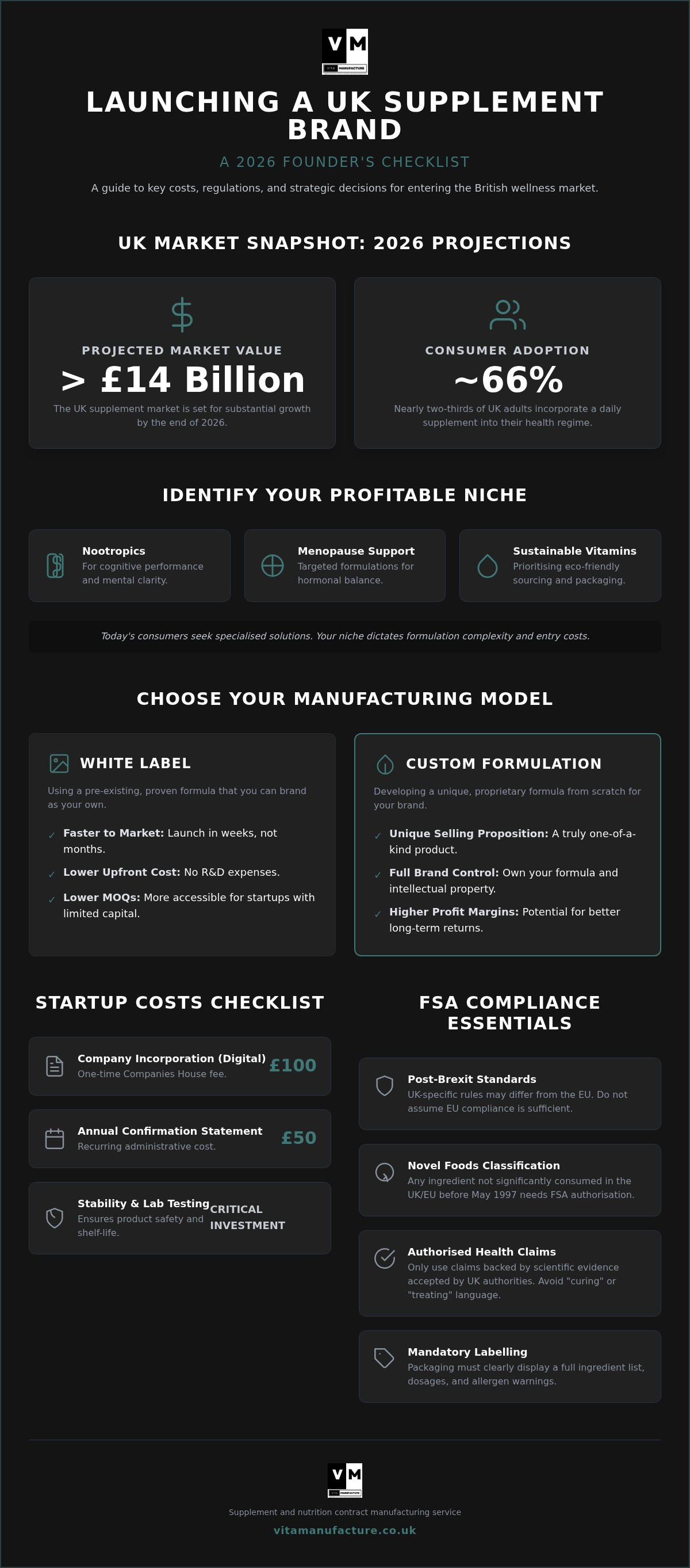
You want a clear, jargon-free path to market that balances scientific rigour with commercial scalability. This guide provides the definitive roadmap you need to navigate the financial, legal, and operational requirements of launching a successful vitamin brand. We'll break down essential startup expenses, from the £100 Companies House incorporation fee to the strategic nuances of custom formulation versus white label models, ensuring your venture is both legally sound and positioned for long-term growth.
Table of Contents
The 2026 UK Supplement Market: Commercial Viability and Entry Costs
The British wellness economy is no longer a niche sector; it's a cornerstone of the modern consumer's lifestyle. In 2026, we're seeing a fundamental shift from reactive healthcare to proactive longevity. This evolution directly impacts the cost to start a supplement business UK entrepreneurs face, as consumer demand for transparency and efficacy necessitates higher initial standards. According to a dietary supplement overview, these products bridge the gap between nutrition and medicine, a gap that British buyers are now filling with increasingly sophisticated choices. Success in this climate requires more than a high-quality product; it demands a strategic understanding of where the market is moving and what it costs to stay ahead of the curve.
Identifying Your Profitable Niche
Generic multivitamins are losing ground to specialised formulations. Today's buyers seek targeted solutions that address specific physiological needs. High-growth leaders in 2026 include nootropics for cognitive performance, menopause support for hormonal balance, and sustainable vitamins that prioritise biodegradable packaging. To establish a unique value proposition, you must look beyond the shelf. Who is your underserved demographic? Whether it's magnesium blends for high-stress professionals or creatine for the growing female strength-training market, your niche dictates your formulation complexity and, consequently, your entry costs. Clean label transparency is now a non-negotiable standard amongst UK buyers; they don't just want to know what's in the capsule, but where it was sourced and how it was manufactured.
Budgeting for Your Supplement Startup
Distinguishing between startup capital and operational liquidity is the difference between a launch and a legacy. Your initial overheads will include branding, legal setup, and your first production run. For instance, the digital company incorporation fee in the UK is now £100 as of February 2026. Beyond these administrative basics, you must account for the scientific validation that builds trust. Laboratory testing, including microbiological analysis and stability testing, ensures your product is safe and shelf-stable. Whilst these are essential investments, they shouldn't drain your entire budget. Smart founders reserve a portion of their capital for the first 12 months of operational liquidity. This covers the "hidden" costs like annual confirmation statements, which rose to £50 in early 2026, and the marketing spend required to build brand equity in a competitive digital landscape. By prioritising these foundational expenses, you create a commercial runway that supports sustainable growth rather than a one-off product launch.
Navigating UK Regulations: FSA Compliance and Mandatory Standards
The Food Standards Agency (FSA) remains the primary guardian of consumer safety in the 2026 British market. Since Brexit, the divergence between UK-specific rules and EU standards has become more pronounced. You cannot assume that a formula legal in Paris will automatically pass muster under UK regulations. This regulatory landscape directly influences the cost to start a supplement business UK entrepreneurs must budget for, as it necessitates rigorous ingredient vetting and specific legal counsel. According to the latest UK food supplement regulations, any ingredient not consumed significantly in the UK or EU before May 1997 is classified as a "novel food." Whilst the FSA currently charges no fee for a novel food application, the research and time required to secure authorisation represent a vital strategic investment for any innovative brand.
Health claims are another area where precision is mandatory. What you say on your packaging is as strictly regulated as what is inside the capsule. You must only use authorised claims that are backed by scientific evidence accepted by UK authorities. Vague promises of "curing" or "treating" medical conditions are illegal and can lead to immediate enforcement actions or costly product recalls. Your brand's reputation depends on staying within these legal boundaries from day one.
UK Labelling Requirements for 2026
Compliance starts with the label. Your packaging must feature a comprehensive ingredient list, precise dosages, and clear allergen warnings. In 2026, the nutrition panel must be organised logically to meet legal standards, ensuring consumers can easily identify active compounds and their percentages of the Nutrient Reference Value (NRV). Transparency is paramount. Batch coding and expiry dates are not just operational details; they are mandatory requirements for traceability. If a safety issue arises, these codes allow you to isolate and manage specific production runs without compromising your entire inventory.
The Significance of ISO 22000 and GMP
Trust is the currency of the supplement industry. Partnering with a manufacturer that holds ISO 22000:2018 certification provides a gold standard of assurance that your products are handled within a globally recognised food safety management system. Good Manufacturing Practice (GMP) ensures consistency and quality at every stage of production, from raw material sourcing to final bottling. These certifications protect your brand from liability and build long-term consumer loyalty. To navigate these complexities with a partner who understands the high stakes of compliance, you can explore our contract manufacturing services to ensure your brand meets every mandatory British standard.
Manufacturing Models: Comparing White Label vs Custom Formulation
Selecting your production route is a pivotal decision that dictates both your initial capital expenditure and your long-term competitive advantage. Are you looking to test a market hypothesis quickly, or are you building a proprietary brand from the ground up? Your answer determines the cost to start a supplement business UK founders must prepare for. White label and custom formulation represent two distinct philosophies of entry. Whilst one offers speed and lower financial barriers, the other provides the intellectual property necessary for significant market differentiation. Understanding these trade-offs is essential for maintaining operational liquidity during your first year.
White Label: The Strategic Fast Track
White label manufacturing allows you to launch rapidly using pre-existing, scientifically proven formulations. This model is ideal for entrepreneurs who want to validate a concept without the heavy R&D costs associated with new product development. In 2026, high-demand categories like vegan collagen, high-absorption magnesium, and vitamin D are particularly suited to this approach. One of the primary benefits is the accessibility of low Minimum Order Quantities (MOQs), which often range from 150 to 500 units for white label products. This allows you to preserve capital whilst refining your branding and digital presence. As your sales grow, you can seamlessly transition into private label agreements, adding bespoke branding to these established base products to deepen consumer loyalty.
The Power of Custom Product Development (NPD)
If your goal is to disrupt the market with a "hero" product, custom formulation is the necessary path. This involves working directly with scientists and R&D specialists to create a proprietary blend tailored to a specific underserved demographic. This route requires a higher initial investment, but it secures your brand's future through unique intellectual property. R&D is vital here. It ensures ingredient stability, optimal bioavailability, and a sensory profile that sets you apart from generic competitors. By investing in custom development, you aren't just selling a supplement; you're building a commercially viable asset with long-term equity. This bespoke approach allows you to address the rising demand for specialised formulations targeting the gut-brain axis or cognitive health with precision.
Balancing these options requires a clear-eyed view of your commercial runway. Speed-to-market is a powerful tool for capturing trends, but brand differentiation is what prevents your business from becoming a commodity. Many successful founders begin with a white label range to generate immediate cash flow, using those profits to fund the development of a proprietary custom formula. This hybrid strategy allows for low-risk scaling whilst maintaining the ambition of a visionary brand. Choosing the right manufacturing partner is the first step in ensuring your chosen model translates into a commercially viable product.
The 6-Step Roadmap: From Concept to Retail Capsule
Moving from a visionary concept to a physical product requires a methodical approach to avoid the common pitfalls that inflate the cost to start a supplement business UK founders face. This roadmap ensures your capital is deployed efficiently, prioritising validation before high-volume commitment. By following these steps, you transform a creative idea into a commercially viable asset.
Step 1: Conceptualisation and Market Research Validation. Use data to identify underserved demographics. Don't guess; confirm that your niche, such as gut-brain axis support, has a ready audience in the British wellness market.
Step 2: Prototype Development and Ingredient Sourcing. Create initial samples to test the synergy of your ingredients. This is where you first evaluate the physical characteristics and potential bioavailability of your formula.
Step 3: Conducting Pilot Studies. Execute a small-scale production run to test the manufacturing process. This step is vital for identifying potential issues with stability or taste before scaling up.
Step 4: Regulatory Audit and Final Label Approval. Submit your final formulation and packaging for a compliance review. Ensuring your health claims meet FSA standards prevents costly post-launch legal challenges.
Step 5: Full-Scale Manufacturing and Quality Control. Once validated, move to mass production within an ISO 22000-certified facility to ensure every capsule meets your quality benchmarks.
Step 6: Packaging, Logistics, and Market Launch. Finalise your biodegradable packaging and integrate your inventory into a distribution network ready for the British consumer.
Mitigating Risk with Pilot Studies
Many founders rush from prototype to mass production, only to discover that their powder doesn't dissolve correctly or the taste profile changes at scale. Small-scale runs are a strategic necessity. By conducting a pilot study, you can test for solubility, texture, and shelf-life stability without the financial burden of a full manufacturing run. This phase allows you to gather consumer feedback from a select group, providing the data needed to refine your formula. It's far more cost-effective to adjust a recipe during a pilot phase than to deal with thousands of units of unsellable stock. If you're ready to validate your concept with scientific precision, you can start your pilot study with our expert R&D team today.
Bulk Sourcing and Ingredient Quality
The quality of your raw materials directly dictates your retail margins and brand reputation. In 2026, UK consumers are more informed than ever, often demanding proof of purity and sustainable sourcing. Ensuring your ingredients meet stringent British safety standards is non-negotiable. Whilst premium ingredients may increase your initial outlay, they reduce the risk of batch failure and increase the perceived value of your brand. Sustainable sourcing also meets the rising demand for ethical wellness products, allowing you to position your brand as a leader in the eco-conscious market.
Scaling Your Brand: Logistics and Strategic Partnerships
Launching your first capsule is a significant milestone. However, scaling that initial success into a sustainable enterprise requires a robust logistical infrastructure. Inefficient supply chains often inflate the cost to start a supplement business UK founders must manage; hidden fees in third-party fulfilment or lost stock due to poor storage can quickly erode startup margins. Transitioning from local UK sales to international distribution demands more than just a courier; it requires a strategic approach to inventory management and global compliance. By integrating your logistics early, you ensure that your brand is prepared for the rapid growth that follows a successful market entry.
Optimising Your Supply Chain
How do you maintain product integrity whilst accelerating your growth? Climate-controlled warehousing is non-negotiable for maintaining the potency and longevity of your formulations. Supplements are sensitive to environmental shifts; poor storage can lead to degradation that compromises both safety and consumer trust. Efficient manufacturing schedules also play a vital role in reducing lead times, allowing you to react to market trends without over-investing in dormant stock. Proactive stock management prevents "out of stock" scenarios that can stall your momentum during a critical growth phase. By synchronising your production cycles with your sales data, you maintain the operational liquidity needed to fund your next innovation.
Choosing a Strategic Manufacturing Ally
A visionary growth partner does more than just fill bottles. They think like a business owner, prioritising long-term scalability over simple transactions. Evaluating a partner’s technological support is essential; our transparent customer portal allows you to track project progress in real-time, providing the clarity needed for informed decision-making. This level of transparency is rare but vital for founders who need to manage their time and capital with precision. Vita Manufacture, based in our ISO 22000:2018-certified facility in Littleport, provides the end-to-end support required to move from your first pilot study to global distribution.
End-to-End Integration: We manage everything from R&D and bulk sourcing to logistics and distribution.
Scientific Rigour: Our ISO 22000:2018 certification ensures your brand equity is built on a foundation of international food safety standards.
Scalable Growth: We specialise in low MOQ options that allow you to scale with confidence, reducing the financial risk of expansion.
Working with an all-in-one partner simplifies your operations and reduces the administrative burden of managing multiple vendors. This synergy allows you to focus on building your brand whilst we handle the technicalities of production and supply chain management. If you are ready to evolve your brand from its first capsule to a global scale, explore our logistics and distribution services to see how we can support your journey.
Building Your Future in the British Wellness Economy
The 2026 UK supplement market presents a rare window of opportunity for founders who prioritise scientific rigour and regulatory precision. Success in this evolving landscape depends on moving beyond generic offerings to embrace high-growth niches like cognitive health and longevity. Whilst the total cost to start a supplement business UK entrepreneurs face varies based on your choice between white label speed or custom formulation depth, the ultimate return on investment is secured through quality and transparency. By navigating FSA standards and leveraging a methodical six-step roadmap, you can transform a visionary concept into a commercially viable retail reality.
Are you ready to turn your formulation into a market leader? Partnering with a strategic ally who understands the high stakes of production is essential for sustainable scaling. Scale your vision with Vita Manufacture’s expert contract manufacturing. From our ISO 22000:2018-certified facility, we provide end-to-end R&D and logistics support, alongside specialised low MOQ options designed specifically for ambitious British founders. Your journey from first capsule to global distribution starts with a foundation of reliability and shared ambition. Let's build a brand that lasts.
Frequently Asked Questions
How much does it cost to start a supplement brand in the UK?
The initial investment depends on your chosen manufacturing model. White label launches typically range from £5,000 to £15,000, whilst custom formulations require £20,000 to £40,000 for a single product. You must also account for the £100 digital company incorporation fee and essential stability testing. By managing these variables, you can accurately project the cost to start a supplement business UK founders encounter during their first year of operation.
Is it legal to sell supplements in the UK without a special license?
You don't need a specific "supplement license," but you must register as a food business with your local authority at least 28 days before trading. All products must comply with the Food Safety Act 1990 and the latest FSA guidelines. Whilst there is no central pre-approval for formulations, the responsibility for safety and legal labelling rests entirely with the brand owner. Partnering with a certified manufacturer ensures your production meets these mandatory standards.
What is the difference between white label and private label supplements?
White label supplements are pre-formulated products that are ready for immediate branding and sale, offering a rapid route to market. Private label typically involves adding bespoke branding to an established base product, sometimes allowing for minor adjustments. Both models allow you to capitalise on proven formulations without the high R&D costs of custom development. Choosing between them depends on your need for speed versus your desire for brand differentiation in the British market.
Can I start a supplement company with a low MOQ?
Yes, starting with a low Minimum Order Quantity (MOQ) is a strategic way to mitigate financial risk. White label options often allow for orders as low as 150 to 500 units, which significantly lowers the cost to start a supplement business UK startups must manage. This approach enables you to test market demand and gather consumer feedback before committing to the larger volumes required for custom proprietary formulations.
How do I ensure my supplement labels are FSA compliant?
Compliance requires strict adherence to UK labelling laws, which dictate that ingredients, dosages, and allergen warnings must be clearly visible. You must use a standardised nutrition panel that includes Nutrient Reference Value (NRV) percentages for all active compounds. Crucially, you must only use health claims that are authorised by the FSA. Vague or medicinal claims are prohibited and can lead to immediate enforcement action or costly product recalls.
Do I need a science degree to start a vitamin business?
You don't need a scientific background to launch a successful brand. Many visionary founders focus on marketing and business strategy whilst partnering with a contract manufacturer for technical expertise. An experienced manufacturing ally like Vita Manufacture provides the R&D, scientific formulation, and regulatory guidance necessary to ensure your products are safe and effective. This partnership allows you to focus on scaling your brand whilst we handle the complexities of biochemical stability and ingredient synergy.
How long does the manufacturing process take from concept to launch?
The timeline depends on the complexity of your product. A white label launch can be achieved in as little as four to eight weeks, as the formulations are already tested and approved. Custom formulations typically take six to twelve months, as they require new product development, stability testing, and pilot studies. This methodical pace ensures that your proprietary "hero" product is commercially viable and ready for global distribution upon launch.
Can I manufacture supplements at home for sale in the UK?
Manufacturing supplements at home is not a viable option due to the stringent hygiene and safety standards required by the FSA. Commercial production must take place in a facility that follows Good Manufacturing Practice (GMP) and holds relevant certifications like ISO 22000:2018. These environments ensure the purity of your ingredients and prevent cross-contamination, protecting both your customers and your brand from the significant legal liabilities associated with non-compliant production.