Contract vs In-House: Guide for UK Supplement Brands
Is the desire for total control over your production line actually the biggest barrier to your brand’s growth? Whilst an internal facility feels like the ultimate mark of success, the choice between contract manufacturing vs in-house production is rarely about ego; it’s about strategic survival. High upfront machinery costs and the complex web of UK food safety regulations can quickly stall a promising venture before it even reaches the shelf. You want to ensure every capsule meets your exacting standards and that your supply chain remains resilient in a UK market projected to reach over 10 billion dollars by 2033. It’s a logical ambition for any founder who prioritises quality and long-term commercial viability.
This guide provides the clarity you need to navigate these options, focusing on what truly drives scalability and compliance. We will break down the financial implications of both models, provide a roadmap for scaling without compromising on quality, and clarify the latest regulatory hurdles you must clear to succeed. Discover whether outsourcing or internal production offers the best path to commercial success for your supplement brand.
Table of Contents
Understanding the Models: Contract Manufacturing vs In-House Production
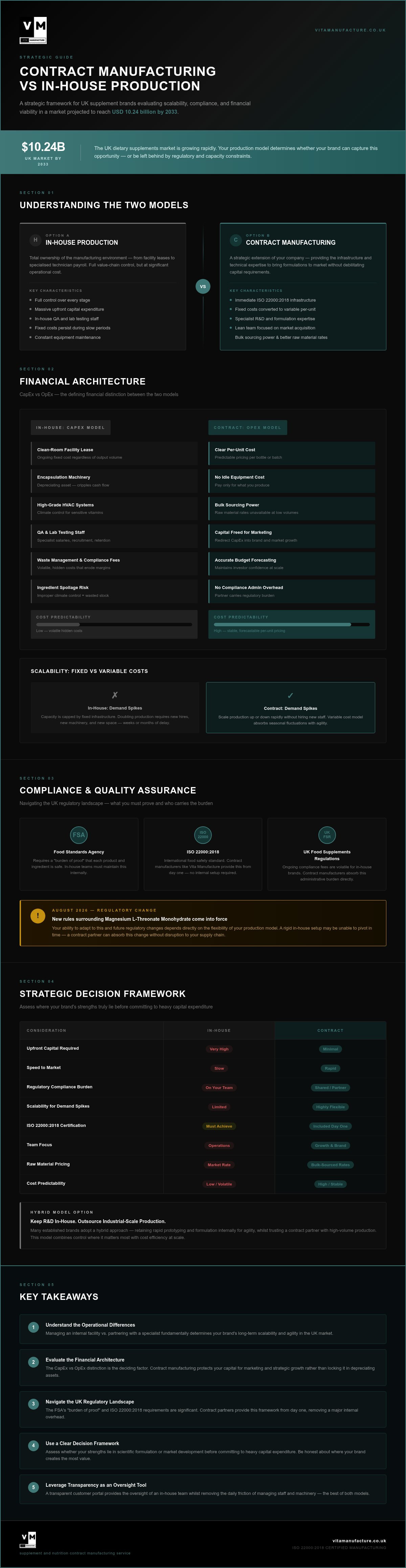
Choosing between contract manufacturing vs in-house production isn't just an operational preference; it's a foundational business decision that dictates your brand's agility. In-house production involves total ownership of the manufacturing environment, from the lease on a clean-room facility to the payroll of specialised technicians. Conversely, a Contract Manufacturer serves as a strategic extension of your company, providing the infrastructure and technical expertise required to bring formulations to market without the debilitating capital requirements of physical expansion.
The In-House Production Landscape
Owning the entire value chain offers unparalleled control over every milligram of powder and every bottle seal. However, this control comes with the weight of managing specialised blending and encapsulation equipment that requires constant maintenance and calibration. You'll need to recruit and retain internal quality assurance teams and lab testing staff capable of navigating stringent UK Food Standards Agency (FSA) guidelines. For many, the operational friction of managing a factory floor can quickly overshadow the creative work of brand building.
The Contract Manufacturing Advantage
Partnering with an ISO-certified ally like Vita Manufacture allows you to bypass these barriers to entry. You gain immediate access to existing ISO 22000:2018 infrastructure, ensuring your products meet international safety standards from day one. This model lets you leverage specialist R&D and formulation expertise whilst keeping your team lean and focused on market acquisition. It’s about converting fixed costs into variable ones, a move that's essential for commercial viability as the UK supplement market evolves through 2026 and beyond.
Evaluating the merits of contract manufacturing vs in-house production often leads established brands to a hybrid model. This involves keeping R&D in-house for rapid prototyping whilst trusting a partner with the industrial-scale volume. Regardless of the path you choose, the decision remains pivotal for your 2026 scalability. With the UK dietary supplements market projected to reach USD 10.24 billion by 2033, your ability to adapt to new regulations, such as those surrounding magnesium L-threonate monohydrate coming into force in August 2026, will depend on the flexibility of your production model.
The Financial Architecture: Comparing CapEx and OpEx
How much capital are you willing to lock into a factory floor before you've sold a single bottle? When evaluating contract manufacturing vs in-house production, the distinction between Capital Expenditure (CapEx) and Operational Expenditure (OpEx) becomes the deciding factor for your long-term commercial viability. In-house production requires massive upfront CapEx for clean-rooms, high-grade HVAC systems, and encapsulation machinery. These aren't just one-time investments; they're depreciating assets that can weigh heavily on a brand’s balance sheet, limiting your ability to pivot or reinvest in market acquisition.
Beyond the visible machinery, hidden costs often erode margins. Waste management for manufacturing by-products, ingredient spoilage due to improper climate control, and the constant fees for maintaining compliance with the UK Food Supplements Regulations can be volatile. Contract manufacturing offers a more stable path by converting these unpredictable expenses into a clear per-unit cost. This predictability is essential for accurate budget forecasting and maintaining investor confidence as you scale.
Investment Realities for Supplement Brands
Maintaining climate-controlled storage for sensitive vitamins isn't just a regulatory hurdle; it's a significant utility and maintenance expense. If your machinery sits idle during a slow quarter, you're still paying for its footprint and the staff required to maintain it. This is where many founders find that the depreciation of specialised equipment cripples their cash flow. By partnering with a large-scale manufacturer, you tap into their bulk sourcing power, often securing raw materials at rates an individual brand simply cannot access at low volumes.
Scalability: Fixed vs Variable Costs
Does your current model allow you to double production in a week without hiring new staff? In-house models struggle with seasonal demand spikes because their capacity is capped by physical floor space and equipment. This creates a high "cost of failure" for new product prototypes. Contract manufacturing transforms your production into a variable cost that grows precisely in line with your revenue. With the UK dietary supplements market projected to grow at a CAGR of 8.9% from 2026 to 2033, your financial structure must support rapid expansion without the drag of fixed overheads.
This flexibility is vital for brands testing the waters with pilot studies and market research before committing to full-scale production. It ensures you aren't stuck with an empty factory if a particular formulation doesn't hit the mark. Choosing the right financial architecture means your brand remains lean and ready to seize new opportunities as they arise.
Compliance and Quality Assurance: Navigating the UK Regulatory Landscape
Compliance isn't merely a box to tick; it's the primary shield for your brand's reputation. In the UK, the burden of proof regarding ingredient safety and label accuracy rests entirely on the brand owner. When weighing contract manufacturing vs in-house production, you must consider who carries the weight of this scientific and legal oversight. Under The Food Supplements (England) Regulations 2003, every batch must align with strict compositional standards. An in-house error in formulation or a failure in cross-contamination protocols doesn't just lead to waste; it can trigger a product recall capable of bankrupting a burgeoning brand.
By 2026, ISO 22000:2018 has emerged as the definitive gold standard for consumer trust. This certification isn't just about clean floors; it's a comprehensive food safety management system that ensures every link in the production chain is documented. Whilst an in-house facility would need to build these systems from scratch, partnering with an established manufacturer gives you immediate access to this infrastructure. You also benefit from real-time traceability through a transparent customer portal, allowing you to track a batch from the arrival of raw ingredients to the moment it leaves the warehouse.
De-risking Your Brand through Outsourcing
Outsourcing transfers the operational risk of compliance to a partner whose core competency is regulatory adherence. You leverage their existing relationships with third-party auditors and their history of passing rigorous inspections. This professional documentation doesn't just satisfy the Food Standards Agency (FSA); it simplifies the logistics of global distribution. When your paperwork is bulletproof, entering international markets becomes a strategic step rather than a regulatory nightmare.
The Complexity of Formulation and R&D
Modern supplement brands face a maze of "Novel Foods" authorisations and stability testing requirements. If you're manufacturing in-house, you're responsible for validating shelf-life and ensuring that sensitive ingredients don't degrade over time. Expert regulatory guidance is essential to avoid costly labelling mistakes, especially with new ingredients like magnesium L-threonate monohydrate entering the market in August 2026. Choosing contract manufacturing vs in-house production often comes down to whether you want to manage a laboratory or build a brand.
Strategic Decision Framework: When to Outsource
How do you determine the exact moment to transition from a conceptual startup to a professional production line? The decision between contract manufacturing vs in-house operations requires a cold, analytical look at your business model. It's about identifying where your time generates the most value. If you're a visionary marketer, every hour spent troubleshooting a capsule machine is an hour lost on customer acquisition. You must audit your internal resources to ensure they align with your long-term commercial goals.
Success in the UK supplement market depends on a four-step evaluation:
Step 1: Evaluate your core competency. Are you a scientist who thrives on laboratory precision, or a strategist focused on market share?
Step 2: Analyse your volume projections. If your growth is exponential, an in-house facility might become a bottleneck before it's even fully operational.
Step 3: Conduct a risk assessment. Can your brand survive the financial and reputational impact of a regulatory breach or a failed inspection?
Step 4: Audit your required speed-to-market. In a competitive landscape, being second to market often means being forgotten.
The "Low MOQ" Myth-Busting
Many founders mistakenly believe they must be industry giants to work with a professional partner. This isn't the case. Modern contract manufacturing is increasingly agile, offering low Minimum Order Quantities (MOQs) that serve as a bridge for emerging brands. By utilising pilot study and market research services, you can validate your formulations with real consumers before committing to mass production. This small-batch approach allows for agile pivots based on actual market feedback, reducing the risk of being stuck with thousands of units of an unpopular product whilst protecting your initial capital.
Speed to Market: The Competitive Edge
Launching a supplement brand in 2026 requires speed. Setting up an in-house facility in the UK typically involves a 12-month lead time for site acquisition, clean-room construction, and equipment calibration. Conversely, partnering with a strategic ally can move your product from concept to shelf in as little as 12 weeks. You gain immediate access to pre-formulated white label options or bespoke new product development pathways. This speed is further enhanced by leveraging the manufacturer’s established supply chains, which helps you bypass global ingredient shortages that often cripple independent operations. When comparing contract manufacturing vs in-house speed, the winner is clear for those who prioritise a first-mover advantage.
Partnering for Success: How Vita Manufacture Scales Your Brand
Choosing the right partner is the final, most critical step in your journey towards market leadership. Whilst the debate over contract manufacturing vs in-house production often focuses on costs, the real differentiator is the depth of the partnership. Vita Manufacture doesn't just operate as a service provider; we act as a strategic, ISO-certified ally. We understand that your success depends on more than just a finished product. It requires a partner who thinks like a business owner, prioritising long-term commercial viability and scientific rigor over simple transactions.
Many founders fear losing oversight when they move away from an in-house model. We solve this through our transparent customer portal. This tool provides real-time production oversight, allowing you to track your batches from the moment raw ingredients arrive to the final dispatch. You gain the visibility of an internal team without the friction of managing machine maintenance or staff rotas. It’s a sophisticated solution designed for brands that demand reliability and total transparency in their supply chain.
Sophisticated Solutions for Modern Founders
Our scientific formulation expertise ensures that your products aren't just innovative, but commercially viable. We provide end-to-end support that spans the entire product lifecycle, including initial R&D, pilot studies to test market appetite, and complex global logistics. By integrating distribution services into our core offering, we remove the operational silos that often slow down growing brands. This holistic approach ensures your supplements meet the highest standards of sophistication and reliability, regardless of the scale of your ambition.
Your Next Steps to Scaling
The transition from a concept to a capsule should be a narrative of total support. We specialise in custom supplement development, helping you navigate the complexities of the UK market with confidence. Whether you're launching your first product or scaling a multi-SKU range, our UK-based production and logistics provide the resilience you need. Our shared ambition is the foundation of every partnership we build, ensuring your brand is positioned for success in a market projected to reach over 10 billion dollars by 2033. Are you ready to focus on your brand’s visionary growth whilst we handle the operational depth?
Organise a consultation with our experts today and discover how a strategic manufacturing partnership can accelerate your path to commercial success.
Future-Proofing Your Supplement Brand’s Growth
The choice between contract manufacturing vs in-house production defines your brand’s ability to navigate the complexities of the UK market in 2026 and beyond. Whilst in-house models offer direct control, they frequently introduce operational friction and capital constraints that can stifle rapid innovation. By transitioning to a strategic partnership, you convert high fixed costs into variable growth, ensuring your internal resources remain focused on market capture and brand equity. You aren't just outsourcing production; you're securing a foundation of compliance and scientific excellence that protects your reputation.
As you evaluate your next steps, consider the value of an ISO 22000:2018 certified facility that prioritises total transparency. Vita Manufacture provides the oversight you need through a dedicated customer portal and the flexibility to validate new concepts via specialised pilot studies. We are here to ensure your journey from concept to capsule is both seamless and commercially successful. Discuss your manufacturing strategy with our UK experts today. Your brand’s potential is limitless when you have the right strategic ally by your side.
Frequently Asked Questions
Is it cheaper to manufacture supplements in-house or outsource?
Outsourcing is typically more cost-effective for brands focused on scaling without heavy upfront capital. Whilst in-house production offers direct control, it requires significant investment in machinery and clean-rooms. When comparing contract manufacturing vs in-house, consider that a partner removes the burden of fixed overheads like rent and specialised labour. This allows you to reinvest your capital into marketing and customer acquisition, which are the primary drivers of commercial success.
How do I ensure quality control when using a contract manufacturer?
You ensure quality control by selecting a partner with accredited food safety management systems and transparent oversight tools. Look for facilities that hold ISO 22000:2018 certification, as this represents a rigorous commitment to international safety standards. Utilising a real-time customer portal allows you to monitor production stages and verify batch records without being physically present on the factory floor. This level of transparency bridges the gap between outsourcing and internal production.
What are the minimum order quantities (MOQs) for UK supplement manufacturing?
MOQs vary significantly across the industry, but many specialist manufacturers now offer flexible options to support emerging brands. Whilst some large-scale facilities require tens of thousands of units, others provide low MOQ pathways or pilot studies. These smaller runs are essential for validating new formulations before committing to mass production. It’s a strategic way to test market appetite whilst protecting your cash flow and reducing the risk of excess inventory.
Can a contract manufacturer help with supplement formulation and R&D?
Yes, a comprehensive manufacturing partner provides end-to-end support for new product development. This includes scientific formulation, stability testing, and ensuring your product meets UK regulatory standards. Accessing this expertise allows you to create bespoke supplements without hiring an internal R&D team. It’s particularly valuable for navigating the complexities of Novel Foods or incorporating newly authorised ingredients like magnesium L-threonate monohydrate, which enters the market in August 2026.
How long does it take to launch a new supplement with a contract partner?
A typical launch timeline with a strategic partner ranges from 12 to 16 weeks, depending on the complexity of the formulation. This is considerably faster than the 12-month lead time usually required to establish an in-house facility. The process includes R&D, ingredient sourcing, and production. Choosing a UK-based partner further accelerates this timeline by removing the delays associated with international shipping and customs, giving you a distinct speed-to-market advantage.
Who owns the intellectual property (IP) when using a contract manufacturer?
IP ownership depends on the specific agreement, but most professional manufacturers allow brands to retain ownership of their bespoke formulations. It’s vital to clarify these terms during the initial consultation. When debating contract manufacturing vs in-house, remember that a reliable partner operates as a strategic ally, not a competitor. They focus on the operational depth of production whilst you retain the brand equity and proprietary rights to your unique products.
Is ISO 22000 certification necessary for my supplement brand?
Whilst not a legal requirement for all food supplements, ISO 22000:2018 is the gold standard for consumer trust and safety. It demonstrates that your manufacturer follows a globally recognised food safety management system. For brands targeting national growth or international distribution, this certification is essential. It provides the documented proof of quality that retailers and distributors demand, ensuring your products meet the highest standards of reliability and sophistication in the industry.