Choosing a Manufacturing Partner: 2026 Growth Guide
What if the manufacturer that gets your first supplement run off the ground can’t support your next product? Choosing a manufacturing partner for long-term growth means looking beyond an initial order. Assess whether development, production and supply-chain support fit your current needs and can adapt as your product range and plans change.
It’s natural to focus on getting a product ready for market. But a changing product brief, new development work or different logistics needs can affect how production is planned. If communication and quality processes don’t keep pace with those changes, coordination can become harder.
This guide gives you a practical framework for comparing manufacturing arrangements. You’ll assess product development, manufacturing, quality and supply-chain support, then weigh each capability against what your business needs now and may need next.
At Vita Manufacture, support connects new product development, regulatory guidance, manufacturing and logistics. Vita Manufacture is ISO 22000:2018-certified for its food safety systems, and its transparent customer portal supports project visibility. Use these details alongside your own priorities when assessing whether a partner’s approach fits your plans.
Table of Contents
Why choosing a manufacturing partner for long-term growth matters
A manufacturing relationship affects more than what gets made. It can shape how a supplement concept becomes a production-ready product, how quality expectations are carried through the work, and how confidently you can plan next steps. When development, manufacturing and supply-chain needs are handled as separate conversations, changes can be harder to coordinate.
A production supplier may focus on fulfilling an agreed specification. A broader manufacturing partner can connect production with development, regulatory guidance and logistics, making it easier to consider how decisions in one area affect another. The Contract Development and Manufacturing Organization (CDMO) model is one example of combining development and manufacturing expertise. For a supplement brand, the practical question is whether a partner’s scope fits the work you need done and the way your team operates.
That distinction matters whether you’re developing a first product or managing an established range. A founder may need help turning a product brief into a manufacturing plan. An established brand may be working on another formulation, a wider portfolio or logistics coordination. These needs don’t automatically call for the same arrangement. Assess your requirements now and the changes you can reasonably anticipate, rather than assuming every brand follows the same growth path.
What changes as a supplement brand develops?
As a business learns more about its market and its priorities, the product brief may change. An initial idea can become more specific, a portfolio plan can shift, and operational priorities can evolve as the brand builds experience. Growth isn’t only about producing more units. It may also involve developing another product concept or refining how a product is made.
These changes don’t happen on a fixed timetable. Write down what’s known and what could plausibly change, such as the product range, formulation objectives or logistics requirements. This gives you a clear basis for discussing fit, without treating a possible future plan as a certainty.
What does long-term fit mean in practice?
Long-term fit means a partner’s capabilities match your priorities, communication supports informed decisions, and connected work is coordinated rather than treated as a series of unrelated tasks. Look for practical processes: a clear way to record the agreed brief, set out responsibilities, communicate decisions and explain how quality processes are managed. General assurances about supporting growth are less useful without a clear working approach behind them.
Consider whether development and manufacturing are discussed together, and whether responsibilities and next steps are clear. Documented quality systems can support consistent processes. Vita Manufacture is ISO 22000:2018-certified for its food safety systems. This is one quality-related detail to weigh alongside the working practices relevant to your project.
A durable manufacturing relationship connects clear processes, aligned capabilities and open communication as your brand’s needs evolve. Use that as your central test: does the relationship address today’s requirements and give you a practical basis for planning what may come next?
Assess development, quality and regulatory support before committing
A product’s formulation, manufacturing method and intended presentation are connected decisions. A change to the brief may affect ingredient choices, production planning and the information needed for product presentation. Assessing these areas together can help you identify questions early, rather than treating development and production as unrelated stages.
Can the partner support product development as well as production?
Start with a clear development brief. Describe the product’s purpose, target audience, preferred format and essential requirements. This gives development and manufacturing teams a shared reference for discussing how the concept could translate into a production plan. Supplement formulation services can connect formulation aims with practical development considerations and the route towards manufacture.
Prototype work and pilot studies can inform decisions before you commit to a broader production plan. Learning from early development may prompt you to refine the brief, revisit product priorities or clarify production requirements. Ingredient selection is part of this discussion, but it should be considered alongside the wider product and manufacturing needs, rather than as an isolated choice.
How should quality and regulatory support be assessed?
Look for clear, documented working practices. How is the brief recorded? How are decisions communicated? How are quality processes managed? A documented system can support repeatable work by giving teams defined processes to follow. Certification is one piece of evidence, but its scope matters. Vita Manufacture is ISO 22000:2018-certified for its food safety systems. This is a relevant food-safety trust signal, not proof that every product or brand automatically meets every requirement.
Regulatory guidance can inform development and presentation decisions, but it doesn’t remove the brand’s own responsibilities. In the UK, relevant requirements depend on the product and how it is presented. Clarify which decisions need regulatory consideration and how guidance will be shared with your team. Avoid relying on broad statements such as “fully compliant” without understanding what they cover and which responsibilities remain with your business.
Quality and regulatory decisions also connect with sourcing and continuity. A manufacturing plan depends on more than the finished product: ingredient availability and supply-chain arrangements can affect operational planning. The NIST Supply Chain Resources for Manufacturers discuss supply-chain development and management from a manufacturing perspective. They’re useful background, though they aren’t UK regulatory guidance.
Consider whether development, regulatory guidance, manufacturing and logistics can be coordinated around your project. Vita Manufacture brings these areas together for supplement brands, with a transparent customer portal supporting visibility. Explore Vita Manufacture’s supplement development and manufacturing support to see how connected support may fit your product plans.
Compare manufacturing partners by flexibility, continuity and transparency
A useful comparison reflects the work your business needs, not the longest list of services. Some brands benefit from connected development, manufacturing and logistics; others already have development processes in place and need a narrower production arrangement. Neither model is automatically better. The question is whether the scope, communication and support match your priorities and plausible plans.
Compare capabilities against your requirements and mark each as essential, important or not currently needed. This helps prevent attractive extras from outweighing a gap in a capability your plans depend on.
Development: Do you need support with product development, or are you bringing a production-ready brief?
Manufacturing: Does the production arrangement fit your product requirements, with responsibilities clearly set out?
Regulatory guidance: Is the guidance relevant to the product and its intended presentation, and are responsibilities understood?
Logistics: Does the support fit how you plan to manage product movement and distribution? For more context, explore supplement supply-chain management.
Communication: Can your team access project information and follow decisions and next steps?
Which capabilities matter at different business stages?
An early-stage brand may put more weight on shaping a product brief, development and prototype learning. An established brand may prioritise coordination across an existing range, manufacturing and logistics. These are different operating needs, not fixed steps in a universal growth path. Consider your planned product work and your team’s existing capabilities to decide which areas should carry the most weight.
Integrated support can make connected discussions easier to coordinate. A production-focused arrangement may suit a brand with development expertise already in place. Consider the hand-offs each model involves and whether they fit how your team makes decisions.
How do transparency and communication support continuity?
Accessible project information helps your team understand what has been agreed and which decisions remain open. A clear routine for updates can also help you flag changes to the brief or priorities before they affect related work. Vita Manufacture’s transparent customer portal supports project visibility.
Shared visibility helps teams coordinate decisions before small changes become disconnected actions. To assess continuity, consider how project details can be accessed and how updates are communicated, rather than relying on broad promises of flexibility.
For additional background on manufacturing programmes and supply-chain resources, Manufacturing.gov resources offer a wider perspective on manufacturing support. Keep your comparison grounded in your priorities and operating context. Vita Manufacture connects development, manufacturing and logistics for supplement brands, giving you a joined-up model to consider against those needs. Explore Vita Manufacture’s supplement manufacturing support as you assess your options.
Use a practical framework to judge long-term manufacturing fit
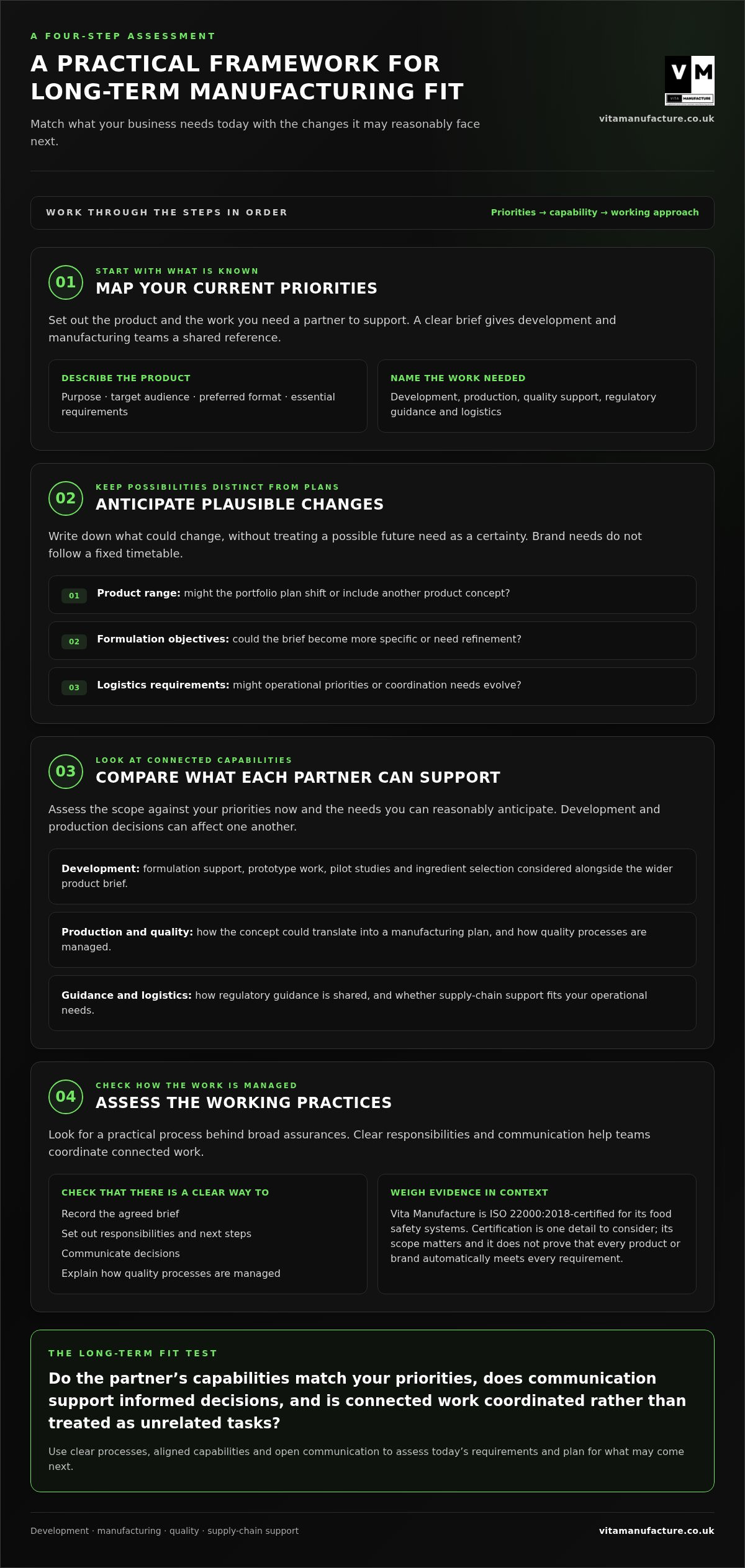
A consistent evaluation turns a broad impression into a decision you can explain. You don’t need to predict every future change. Instead, assess whether a manufacturing relationship fits your priorities now and can accommodate plans you consider plausible. This makes choosing a manufacturing partner for long-term growth a structured exercise, rather than a decision based on promises or a long service list.
Map your priorities. Record what the project needs today, from product development to production and logistics. Mark each requirement as essential or useful.
Identify possible future needs. Note realistic changes, such as developing another product or coordinating a wider range. Treat these as possibilities, not fixed forecasts.
Compare capabilities. Assess how each arrangement addresses your essential needs and where responsibilities or hand-offs sit.
Assess working practices. Consider how decisions, project information and next steps are communicated, and whether responsibilities are clear.
Give the most weight to capabilities that matter to your operating plan. If you already have a settled product brief, development support may be less central than production coordination. If your concept is still taking shape, development may be essential. There’s no universal weighting: your scorecard should reflect your business strategy, not an industry average.
What should a manufacturing-partner scorecard include?
Use the blank scorecard below to compare arrangements against your priorities. Rate each area as strong fit, partial fit or needs discussion, then add a note explaining your rating. These labels aren’t benchmarks. They help show where a capability aligns with your project and where you need a clearer picture.
Development: Rating: ______ | Priority: ______ | Notes: ______
Quality systems: Rating: ______ | Priority: ______ | Notes: ______
Regulatory guidance: Rating: ______ | Priority: ______ | Notes: ______
Production: Rating: ______ | Priority: ______ | Notes: ______
Logistics: Rating: ______ | Priority: ______ | Notes: ______
Communication and project visibility: Rating: ______ | Priority: ______ | Notes: ______
Coordination across connected services: Rating: ______ | Priority: ______ | Notes: ______
Look at the pattern, not just the ratings. A partial fit in an optional area may be acceptable; a gap in an essential one deserves attention. For broader UK supplier context, see the UK supplement manufacturer guide.
How can you test fit without overcommitting?
Begin with a defined project brief and a discussion about how decisions will be made. Set out the product goals, current assumptions, key responsibilities and information your team needs to progress. Clear expectations can reveal different interpretations early and give everyone a shared reference for outlining next steps.
Use those discussions to assess how well the proposed working approach fits your needs, rather than relying on general assurances. Vita Manufacture provides connected support across development, manufacturing and logistics. Explore Vita Manufacture’s supplement manufacturing support.
Build your next growth stage with Vita Manufacture
Use your scorecard to return to your own priorities: what product you want to bring to market, what support your team needs now and what may change as your plans develop. There’s no single model for every supplement brand. Choose an arrangement whose capabilities and working approach fit your project, rather than assuming growth follows a fixed path. That is the practical aim of choosing a manufacturing partner for long-term growth.
How Vita Manufacture connects development with manufacturing
Vita Manufacture provides new product development and contract manufacturing, connecting product creation with production. Its broader support includes regulatory guidance and logistics, linking development decisions with supply-chain needs. This scope can suit new founders shaping an initial concept and established brands working on further product development. It supports planning around your project without promising a particular commercial outcome.
Quality and visibility matter alongside capability. Vita Manufacture is ISO 22000:2018-certified for its food safety systems, and its transparent customer portal provides project visibility. Consider these details alongside how the support fits your priorities and how information is shared during the work.
What to prepare for a first project conversation
A focused brief makes it easier to discuss the project and identify decisions still to be made. You don’t need every detail finalised. Bring what you know, distinguish firm requirements from open questions, and explain which areas may change as the project develops.
Product concept: Describe the supplement you have in mind and its intended purpose.
Target market: Share where you plan to position the product and how you expect to present it.
Development priorities: Note the most important aims for formulation, product format or development work.
Known constraints: Identify requirements or limitations that could shape the project.
Future considerations: Outline possible product or operational changes, making clear what is planned and what remains exploratory.
Use the discussion to align on responsibilities, decision-making and the information needed to set out next steps. A clear starting brief helps focus on the questions that matter while keeping future possibilities in view without treating them as commitments.
Ready to discuss your product concept and priorities? Discuss your supplement project with Vita Manufacture.
Turn your product plans into a clear next step
Your next manufacturing decision doesn’t need to account for every future possibility. Start with the product you want to develop, the support your team needs now and the changes you can reasonably anticipate. This gives you a stronger basis for choosing a manufacturing partner for long-term growth, while leaving room to refine plans as your business evolves.
Vita Manufacture brings development, regulatory guidance, manufacturing and logistics into a connected support offer. Its ISO 22000:2018 certification for food safety systems and transparent customer portal provide useful reference points as you consider quality and project visibility.
Bring your product concept, priorities and open questions to a project discussion. Whether you’re shaping an initial idea or planning the next stage for an established brand, a focused conversation can help turn broad ambitions into practical next steps. Discuss your supplement project with Vita Manufacture.
Frequently Asked Questions
How do you choose a manufacturing partner for long-term growth?
Choose a partner whose capabilities and working approach fit your current project and plausible future plans. When choosing a manufacturing partner for long-term growth, consider what may need to change if early market feedback leads you to revisit the product brief. Compare how responsibilities, project information and decisions are handled, then prioritise essential needs over optional services. This grounds your decision in your business rather than assumptions about a standard growth path.
What should a supplement brand look for in a manufacturing partner?
Look for relevant capabilities, clear responsibilities and working practices that suit your team. Practical signs include a defined way to record changes to a brief, identify who owns each decision and communicate when information is needed. If your team is still refining the product concept, development input may matter more than additional operational support. If the brief is established, focus on whether production and supply-chain arrangements fit your priorities.
Can one manufacturing partner support product development and production?
Yes. One partner can provide both development and manufacturing support, helping keep the product brief connected to production discussions. Vita Manufacture offers new product development and contract manufacturing for vitamins, minerals and dietary supplements. Keeping related work within one relationship may simplify coordination, but clarify which decisions sit with your team and which the manufacturer supports. That shared understanding helps everyone work to the same project expectations.
Why does manufacturing quality certification matter when choosing a partner?
Certification can provide evidence that a defined management system has been assessed against a recognised standard. It doesn’t automatically certify every product or establish that a brand has met all its obligations. Consider what the certification covers and how documented processes relate to your project. Treat it as one part of your assessment, alongside the manufacturer’s quality practices and the responsibilities your business retains.
How can a manufacturing partner help a supplement brand scale?
A manufacturing partner may support a brand as its needs shift by connecting development, production and logistics discussions. For example, when considering a new product, you can examine how development priorities relate to manufacturing and distribution planning instead of treating each as an isolated decision. Support can help organise the work, but it can’t guarantee commercial growth. Your product strategy, market response and internal decisions remain central to how your brand develops.
What questions should you ask before starting a manufacturing partnership?
Ask questions that clarify the work and how decisions will be handled: What information is needed to define the project? Who is responsible for approving changes to the brief? How will development decisions connect with production planning? What project updates can your team access? Which responsibilities remain with your brand? Record the answers and any open points. This creates a practical reference and helps identify differing assumptions before they complicate the work.