Challenges of Sourcing Organic Supplement Ingredients: A Practical Guide
What if an ingredient that looks ideal on a supplier’s specification sheet becomes the biggest risk in your organic supplement launch? The challenges of sourcing organic supplement ingredients go beyond finding a suitable raw material. You also need evidence that supports the organic claim, confidence that quality and availability will hold between batches, and a specification that works in your formula and business plan.
It makes sense to look for ingredients that reflect your brand’s values and meet customer expectations. But an organic claim alone doesn’t answer every sourcing question. Documentation, batch consistency, supply continuity and commercial fit all deserve attention before you commit to a formulation.
This guide explains the key risks to assess, what evidence and supply details to include in a sourcing review, and how to weigh ingredient requirements against formulation and manufacturing needs. Because sourcing works best as part of a connected development plan, we’ll also explore how product development, regulatory guidance and manufacturing planning can help you establish a practical route from ingredient selection to an organic product launch.
Table of Contents
Why sourcing organic supplement ingredients creates distinct challenges
Organic certification, traceability and quality evidence: what brands need to understand
How to compare organic ingredient sourcing options without overlooking trade-offs
A practical process for reducing organic ingredient sourcing risk
How an integrated development partner can support organic supplement sourcing
Why sourcing organic supplement ingredients creates distinct challenges
Organic supplement ingredient sourcing means securing materials that meet a product’s requirements, come with relevant evidence and can be supplied with suitable continuity. It’s more than finding an ingredient described as organic. Brands also need to consider identity, strength, purity, formulation performance, documentation and commercial viability. These connected challenges can affect product decisions well before manufacturing begins.
Organic status and ingredient quality assurance are related, but they’re not the same. Certification may support an organic claim within its applicable scope; it doesn’t, by itself, establish that an ingredient meets every quality, technical or formulation requirement. For broader context, read about organic farming standards, then assess the evidence relevant to your particular ingredient and product.
What makes an ingredient suitable for an organic supplement?
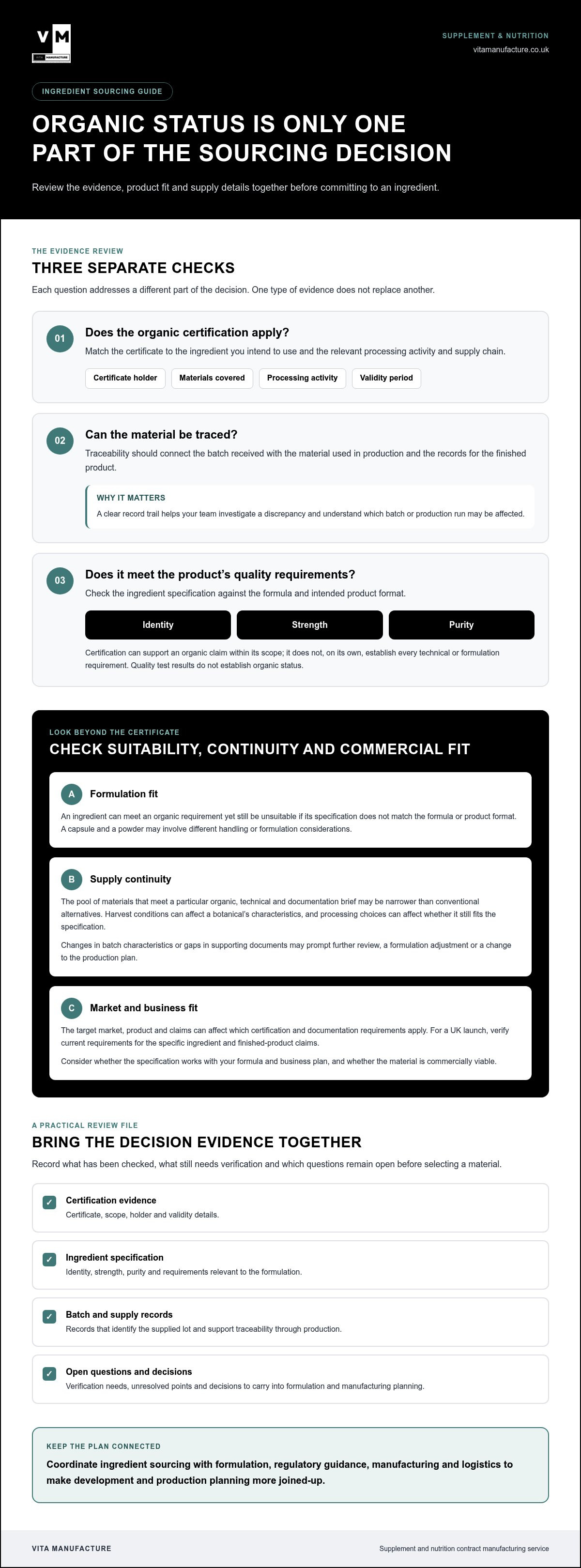
Start by separating organic status from the ingredient’s identity, strength, purity and intended function. A material may meet an organic requirement yet still be unsuitable if its specification doesn’t match the formula or its intended product format. For example, an ingredient selected for a capsule may need different handling or formulation considerations from one intended for a powder.
Your target market matters too. The product, its claims and the market where it will be sold can affect which certification and documentation requirements apply. For a UK launch, verify the current requirements for the specific ingredient and finished-product claims before committing. Build those checks into product development rather than treating them as a final label review.
Why organic sourcing can be less straightforward than standard procurement
The pool of materials that meet a particular organic, technical and documentation brief may be narrower than the pool of conventional alternatives. Availability can also vary: harvest conditions may affect a botanical’s characteristics, while processing choices can influence whether the material still fits the required specification. Records need to provide a clear basis for assessing the material and its supply history.
That can make repeatability a planning issue. A change in batch characteristics or a gap in supporting documents may prompt further review, a formulation adjustment or a change to the production plan. These are possibilities to account for, not reasons to assume an organic ingredient will be inconsistent.
The challenges of sourcing organic supplement ingredients are easiest to manage when sourcing is connected to formulation and manufacturing planning. Define the product requirements early, identify evidence that needs review, and record any open questions before selecting a material. This gives your team a clearer basis for weighing suitability, continuity and commercial fit, and can help limit avoidable revisions later in development.
Organic certification, traceability and quality evidence: what brands need to understand
Build your evidence review around three separate questions: does the organic certification apply, can the material be traced through the supply chain, and does the ingredient meet the product’s quality requirements? These checks support one another, but they are not interchangeable. A certificate doesn’t replace a specification or batch records, and quality test results don’t establish organic status.
Check an organic certificate against the actual ingredient, the relevant processing activity and the supply chain supplying it. Its relevance depends on details such as the certificate holder, the material covered and the validity period. A certificate for a supplier or a different activity may not, by itself, demonstrate that the ingredient you intend to use falls within its scope. Requirements can vary by product and market, so verify the current UK rules and applicable certification guidance for your intended claims.
How to review organic certificates and scope
Match the certificate details to the proposed ingredient and route through processing. Check who holds it, which materials and activities it covers, and whether it remains valid for the period relevant to your sourcing decision. Don’t assume that one certificate type or control body is sufficient for every product or market. For further context on challenges in formulating organic supplements, consider how ingredient choices can interact with product requirements.
How traceability and batch records support quality decisions
Traceability connects the batch received with the material used in production and the records for the finished product. This gives your team a practical way to investigate a discrepancy and understand which batch or production run may be affected. A clear record trail also supports more informed decisions if documentation or specifications change.
Assemble a review file that brings together:
Certification evidence: the certificate and details of its scope, holder and validity.
Ingredient specification: identity, strength, purity and other requirements relevant to your formulation.
Batch documentation: records that identify the supplied lot and connect it to production.
Suitable test documentation: evidence used to assess whether the material meets agreed quality criteria.
Reviewing these records together helps distinguish a missing document from a specification issue or a change in batch characteristics. For a broader view of how information and decisions connect across sourcing and supply operations, read the supplement supply chain management guide.
Make evidence review part of product development, not a last-minute check. If you’re planning a supplement, explore coordinated product development and manufacturing support as a way to connect sourcing decisions with formulation and production planning.
How to compare organic ingredient sourcing options without overlooking trade-offs
No sourcing route is automatically best. The right fit depends on your product brief, the evidence you need to review, the way the ingredient must work in the formula and your plans for repeat production. Compare each route against the same criteria, rather than judging it on price or initial availability alone.
Which sourcing criteria matter for a supplement brand?
Use a consistent review across each option. Does the ingredient identity and requested specification fit the product? Can you access the relevant documentation? Is the material compatible with the intended format, such as a powder or capsule? Consider whether the proposed supply arrangement fits expected volumes and repeat-order plans, rather than only the first production run.
Clarify how substitutions or specification changes will be communicated and assessed. A replacement material shouldn’t be treated as automatically equivalent: your team may need to review its evidence, formulation suitability and production implications before approving a change.
How to weigh continuity against formulation preference
A formula that relies on one specific material or source may have less room to respond if availability or batch characteristics change. That doesn’t mean you should weaken your product requirements. Instead, decide which characteristics are essential and where there may be controlled flexibility, with any alternative assessed against the same defined criteria.
These choices can influence future repeat orders, manufacturing plans and the scope for formulation revisions. Explore professional supplement formulation and R&D guidance to see how formulation decisions connect with ingredient selection. A structured comparison can make the challenges of sourcing organic supplement ingredients easier to assess against your product’s priorities, without assuming one route will suit every brief.
A practical process for reducing organic ingredient sourcing risk
Make sourcing decisions in sequence, so a promising ingredient is assessed against the product it needs to serve before production plans depend on it. A clear process helps your team distinguish confirmed information from assumptions, and gives each decision a place in the development record.
Write the product and ingredient brief. Record the intended format, target market, ingredient role and required material characteristics. Separate essential specifications from preferences. For example, identify which characteristics are necessary for the product to function as intended and which could be adjusted if sourcing constraints arise. Note documentation and regulatory questions that need review during development.
Review the evidence and open questions. Match available records to the ingredient, relevant supplier and intended use. Identify what has been verified, what still needs checking against current requirements, and who is responsible for resolving each question. Keep decisions and supporting documents together, rather than relying on informal updates.
Assess formulation fit. Consider how the material behaves in the intended format and alongside the other ingredients. A specification that appears suitable on paper may need further formulation review to assess practical performance. Record any proposed adjustment and its effect on the product brief before approving a change.
Review supply assumptions. Discuss expected availability, repeat-order needs and how a change in material or specification would be communicated and assessed. These are planning questions, not guarantees. If a proposed alternative is considered, evaluate it against the product’s defined requirements before treating it as a substitute.
Plan production with the evidence in view. Use formulation review or pilot work, where appropriate, to identify practical issues before larger production planning. Bring sourcing decisions, documentation status and any unresolved points into the manufacturing plan so teams can address them before committing to a material.
Keep a simple decision log throughout: record the question, evidence reviewed, decision, responsible person and any follow-up needed. This makes the challenges of sourcing organic supplement ingredients easier to manage as a connected development process, rather than a series of last-minute procurement decisions.
Planning an organic supplement from concept through sourcing and production? Discuss your supplement development project with Vita Manufacture.
How an integrated development partner can support organic supplement sourcing
Organic sourcing decisions have wider consequences than ingredient purchasing alone. A material’s requirements can affect the formula, product format, regulatory review and production plan. Coordinating these considerations through product development can reduce hand-offs between teams and make it easier to spot where an unresolved sourcing question could affect the next stage.
This doesn’t remove the need to assess evidence or plan for supply changes. It creates a shared view of the brief, decisions and outstanding checks, so sourcing, formulation and manufacturing planning can progress with the same product requirements in focus.
Bring sourcing decisions into product development early
Set ingredient requirements alongside the product concept. The intended use and format help shape discussions about which material characteristics matter and whether a preferred ingredient is workable in the formula. Sourcing and formulation teams can consider options together, while regulatory guidance helps identify questions about the intended market and product claims that need review.
Early coordination can make trade-offs visible before they become production issues. A change to an ingredient specification, for example, may require consideration of both the formula and the supporting documentation. For further guidance on evaluating manufacturing relationships, see the UK supplement manufacturer selection guide.
Move from sourcing brief to manufacturing plan
Once the brief, evidence review and formulation decisions are aligned, they can inform production planning. Teams can carry forward the agreed ingredient requirements, the documents reviewed and any matters still requiring attention. This keeps decisions connected as the project moves from concept towards manufacturing and logistics, rather than treating each stage as a separate handover.
Vita Manufacture supports supplement product development, ingredient and bulk sourcing, formulation, regulatory guidance, contract manufacturing and logistics. The company reports ISO 22000:2018 certification, which relates to food-safety management. It is not organic certification and should not be presented as evidence of an ingredient’s organic status.
Addressing the challenges of sourcing organic supplement ingredients calls for joined-up decisions, clear documentation and a development plan shaped around your product brief. If you’re ready to develop or refine an organic supplement concept, discuss your supplement development project with Vita Manufacture.
Build your organic supplement plan with confidence
The challenges of sourcing organic supplement ingredients are easier to assess when you look beyond the organic claim. Check that the evidence applies to the material and supply chain, then weigh specification fit, continuity and commercial needs against your product brief. Bringing these decisions into formulation and manufacturing planning can help your team identify questions early and prepare for repeat production.
Vita Manufacture connects product development, ingredient sourcing, manufacturing and logistics, with regulatory guidance considered alongside the project. The company is ISO 22000:2018-certified for food-safety management, not organic certification, and provides a transparent customer portal to support project visibility.
Ready to shape a new concept or refine an existing formula? Discuss your supplement development project with Vita Manufacture. With a clear brief and coordinated development plan, you can take the next step towards an organic supplement built around your brand’s priorities.
Frequently Asked Questions
What are the main challenges of sourcing organic supplement ingredients?
The main challenges of sourcing organic supplement ingredients include verifying that certification applies to the actual material and supply chain, maintaining suitable batch consistency, managing variable availability and finding an ingredient that fits the formula and commercial plan. Organic status alone doesn’t establish identity, strength, purity or performance in a finished product. Review relevant evidence, consider repeat-order needs and resolve open questions before production planning depends on the selected material.
Are organic supplement ingredients always higher quality?
No. Organic status relates to how an ingredient is produced and certified, but it doesn’t automatically mean the material is better suited to your product or meets every quality requirement. You’ll still need to assess identity, strength, purity and other relevant specifications, alongside suitable quality documentation. Consider whether the ingredient performs as intended in the formula and product format. Treat organic certification and product quality as related, separate assessments.
How can a brand verify an organic ingredient supplier's certification?
Review the certificate’s holder, scope, covered material and processing activities, and validity period. Check that the evidence relates to the ingredient and supply chain intended for your product, rather than relying on a certificate that may cover a different material or activity. Requirements can depend on the product and market, so verify current UK requirements and applicable certification guidance for the claims you plan to make.
Can organic ingredients be used in any supplement format?
Not necessarily. Suitability depends on the ingredient’s characteristics, the formulation and the intended format, such as a capsule, tablet or powder. A material may have the relevant organic status but still need assessment for its role and compatibility in the finished product. Consider the specification and any applicable claim requirements during formulation. Verify current UK requirements for the product and market before finalising organic claims.
Why can organic ingredient availability vary?
Availability can vary with harvest conditions, seasonal supply, processing and the specific requirements a product brief sets for an ingredient. A material that meets the desired specification and documentation needs may not always be interchangeable with another source or batch. If you’re planning repeat production, discuss expected availability and how changes would be assessed. Build those questions into sourcing and production planning rather than assuming supply will remain unchanged.
Does organic certification replace supplement quality testing?
No. Organic certification and quality assessment answer different questions. Certification can support an organic claim within its relevant scope, but it doesn’t replace checks that the ingredient meets its identity, strength, purity and other agreed specifications. Suitable test documentation and batch records help your team assess material quality and traceability. Review these alongside certification evidence so each part of the product’s requirements has appropriate support.
When should a brand consider sourcing during supplement development?
Consider sourcing early, while defining the product brief and assessing formulation feasibility. The intended format, ingredient role, target market and required material characteristics can all shape which sourcing options are suitable. Reviewing evidence and supply assumptions at this stage can help identify open questions before they affect production planning. Vita Manufacture’s product development support connects sourcing with formulation, regulatory guidance and manufacturing as a project moves towards production.