Certificate of Analysis for Supplements: 2026 Guide
What if a polished Certificate of Analysis relates to the wrong batch, or reports results without showing whether they meet the agreed limits? A CoA can be valuable evidence, but only when its details are relevant and clear. If you’re looking for certificate of analysis for supplements explained, the key question isn’t simply whether a certificate exists. It’s what the document actually confirms.
It’s understandable to want one document that settles questions about quality, safety and compliance. But a CoA has limits: its findings apply to the sample and tests described, and it doesn’t, by itself, prove that a supplement is safe, effective or fully compliant. Checking the batch reference, testing scope and results against the correct specification helps you make a more informed decision.
This guide explains a CoA’s purpose, common sections and limitations. It also shows you how to assess whether the results match the ingredient or finished product batch under review, and what to ask a manufacturing partner about test methods, laboratory details and supporting documentation before approving production.
Table of Contents
What is a Certificate of Analysis for supplements, and what does it show?
Which supplement tests can a Certificate of Analysis report?
Certificate of analysis for supplements explained: how do you read and assess a CoA?
What should supplement brands request when a CoA is incomplete?
How does a CoA fit into supplement quality assurance and product development?
What is a Certificate of Analysis for supplements, and what does it show?
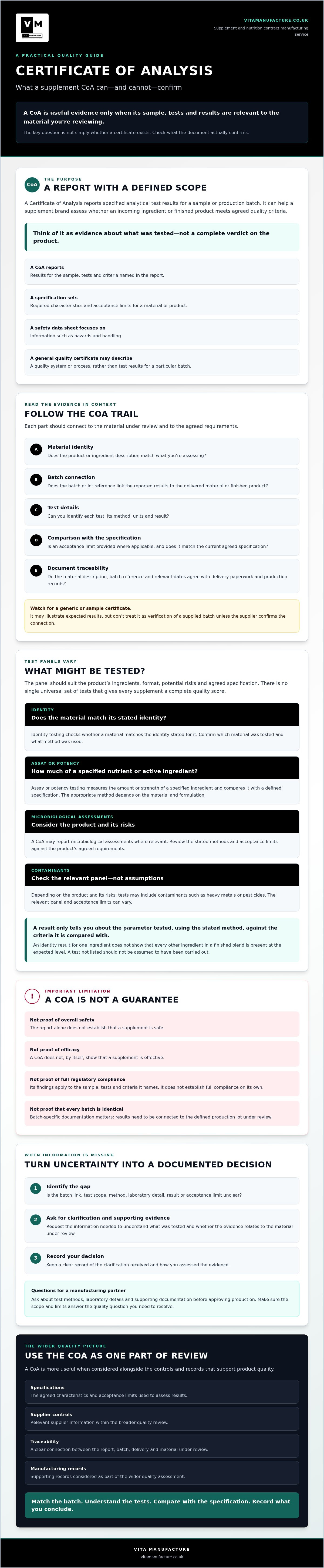
A Certificate of Analysis (CoA) is a report of specified analytical test results for a sample or production batch. For a supplement brand, it can help assess whether an incoming ingredient or finished product meets agreed quality criteria. The useful question isn’t just whether a CoA exists. Check whether it identifies the material under review and reports relevant results against clear limits.
A CoA is different from a specification, which sets out the required characteristics and acceptance limits for a material or product. It also isn’t a safety data sheet, which focuses on information such as hazards and handling, or a general quality certificate, which may describe a quality system or process rather than test results for a particular batch. For a general overview of the document’s purpose and typical contents, see this Certificate of Analysis reference.
Read the document within its stated scope. A CoA provides evidence only about the sample, tests and criteria it names. It doesn’t, by itself, establish that every batch is identical or guarantee a supplement’s safety, efficacy or full regulatory compliance.
What information is usually included in a supplement CoA?
Look for the product or material name, batch or lot reference, relevant dates and the organisation issuing the report. Each test should be identifiable, with its method, units, result and acceptance limit where applicable. A pass-or-fail statement can help, but check which criteria it refers to rather than relying on the label alone.
Layouts and test panels vary by supplier and product. One CoA may report a specific identity or potency result, while another may include different analyses. Missing details don’t automatically mean a document is invalid, but they can make it difficult to judge whether the evidence answers your quality question. Ask for clarification if the scope or limits aren’t clear.
Why does batch-specific documentation matter?
A batch number links the reported results to a defined production lot. Without that link, you may have a certificate for the right ingredient in general, but not evidence that relates to the material delivered to you. A generic or sample certificate can illustrate expected results. Don’t treat it as verification of a supplied batch unless the supplier confirms the connection.
Compare identifiers across the CoA, delivery paperwork and production records. Check the material description, batch reference and dates, and query any mismatch before relying on the document. This keeps quality discussions grounded in the actual ingredient or finished product under consideration.
Which supplement tests can a Certificate of Analysis report?
A CoA’s test panel should reflect the product, its ingredients, format, potential risks and agreed specification. There isn’t one universal set of tests that gives every supplement a complete quality score. A result is meaningful only in relation to the parameter tested, the method used and the acceptance criteria it is compared with.
A CoA confirms only the tests performed on the sample it identifies, against the criteria stated in the report. It doesn’t automatically cover untested ingredients or properties, or establish overall product quality. For example, an identity result for one ingredient doesn’t show that every other ingredient in a finished blend is present at the expected level.
Identity, strength and composition results
Identity testing checks whether a material matches its stated identity. Assay or potency testing measures the amount or strength of a specified nutrient or active ingredient, then compares that result with a defined specification. The appropriate method depends on the material and formulation, so check that the CoA states what was measured and how.
Results may be expressed in different units or refer to different sample types, such as an ingredient before manufacture or a finished product. Confirm that the result applies to the material you’re assessing and that its limits align with the current specification. Clear documentation helps you identify questions early in product development.
Microbiological and contaminant results
Depending on the product and its risks, a CoA may report microbiological assessments or tests for contaminants such as heavy metals or pesticides. The relevant panel and acceptance limits can vary. Don’t assume every product needs identical testing, or that a test not listed was carried out. Review the methods and limits against the product’s agreed requirements.
Test data also depends on measurement quality. NIST’s Dietary Supplement Laboratory Quality Assurance Program focuses on improving the accuracy and comparability of measurements in dietary supplement laboratories. This is useful context, but it doesn’t mean a particular CoA has been assessed or endorsed by NIST.
If you’re unsure which tests or limits are relevant, confirm them with qualified regulatory or quality specialists. Discussing testing scope and documentation early with a supplement product development and manufacturing partner can help clarify responsibilities before production decisions are made.
Certificate of analysis for supplements explained: how do you read and assess a CoA?
Start by checking whether the CoA belongs to the material you received, then assess each result against the relevant specification. A “pass” is useful only if you know what was tested and which acceptance limit was applied. This approach helps you distinguish relevant batch evidence from a document that looks complete but leaves key questions unanswered.
Check the sample, batch and issuing laboratory
Match the product or ingredient name, batch reference and sample description on the certificate to the supplier’s label and accompanying delivery or production records. Check the dates too. The report should make clear when the sample was tested, and the timing should make sense for the batch under review. A mismatch doesn’t automatically mean the results are invalid, but it needs clarification before you rely on them.
Identify who issued the document and whether the laboratory is named. If the CoA refers to laboratory accreditation, confirm the claim independently and check whether its scope covers the relevant test. A supplier’s quality credentials and a laboratory’s testing credentials are distinct. One shouldn’t be taken as proof of the other.
Compare methods, results and limits
Read each result alongside its test method, unit and acceptance limit. Confirm that the specification is the one agreed for that material and that the units are comparable. Don’t assume results from different methods are automatically equivalent, because methods can differ in what they measure and how they report it.
Pause if a result has no unit, a test description is vague, or “pass” appears without a visible limit. Ask the supplier to explain or provide the missing information, then document how you resolved the query. The aim isn’t to judge a certificate by appearance. Establish whether each result is traceable, interpretable and relevant to the batch and specification in front of you.
What should supplement brands request when a CoA is incomplete?
An incomplete CoA doesn’t always mean the evidence is unusable, but you need to resolve what’s missing before making an approval decision. Use a simple sequence: identify the gap, ask the supplier, review the response and supporting evidence, then record your decision. This makes CoA review a practical document-checking process rather than a tick-box exercise.
Questions to ask a supplier or manufacturer
Be specific about the information you need. A clear request makes it easier to establish whether the document supports the decision you’re making. Ask:
Does this CoA apply to the exact ingredient or finished-product batch supplied?
Can you provide the relevant specification, including test methods and acceptance limits?
What does an unclear result or pass statement mean, and which criterion was applied?
Who performed the testing, and can you identify the laboratory and any relevant method or accreditation details?
What supporting records are available to clarify the sample, batch link or testing scope?
Keep supplier due diligence broader than one certificate. Reviewing quality documentation, responsibilities and communication processes forms part of choosing a partner. This guide to choosing a UK supplement manufacturer offers a useful framework for that assessment.
When should a reviewer escalate a concern?
Don’t infer that a product meets requirements if the evidence is unclear. Escalate mismatched batch details, missing results that are important to the agreed specification, or unexplained out-of-specification findings. Ask the supplier for an explanation and supporting evidence. If the issue could affect product quality or regulatory decisions, seek advice from a qualified quality or regulatory specialist rather than deciding from an ambiguous CoA alone.
Record the gap you identified, the question you raised, the supplier’s response and the person responsible for the approval decision. If the evidence remains insufficient, document why the material or product hasn’t been approved and what information is needed next. This creates a clear decision trail for your team.
Document questions are also useful during development, before specifications and testing expectations are finalised. If you’re shaping a product and want to understand how those choices connect with formulation, explore supplement formulation services. To discuss product development and manufacturing, speak with Vita Manufacture about your project.
How does a CoA fit into supplement quality assurance and product development?
A CoA is one part of a wider quality picture. It reports analytical results for an identified sample or batch. It doesn’t replace the controls and records that help a business manage ingredients, production and traceability. A CoA shows what specified tests found in a particular sample; a management-system certification shows that an organisation’s system has been assessed against a defined standard. They provide different kinds of evidence.
CoA evidence versus certification and other quality records
Use each document to answer the question it is designed for. A batch CoA can show stated test results against listed criteria. A product specification sets the required characteristics and limits. Supplier approval records help demonstrate how suppliers are assessed, while traceability records connect materials to batches and manufacturing records document relevant production activity. Together, these records provide more context than a certificate alone.
Vita Manufacture’s ISO 22000:2018 certification relates to a food-safety management system. It isn’t laboratory accreditation and doesn’t prove individual CoA results. If a laboratory refers to ISO/IEC 17025 accreditation, check the accreditation and its scope independently to see whether it covers the laboratory and relevant tests in question.
Build quality questions into product development
Set expectations before formulation and production decisions are finalised. Agree which specifications apply, what testing evidence will be needed, how batch documentation will be linked to supplied materials, who is responsible for obtaining or reviewing records, and how gaps will be resolved. These discussions can prevent late-stage surprises and give your team a clearer basis for approval.
Vita Manufacture provides supplement product development, manufacturing and regulatory guidance. Confirm project-specific testing responsibilities and what documentation can be provided or arranged. Don’t assume that a manufacturing partner performs every test listed on a CoA. For further supplier-evaluation considerations, see this guide to health supplement manufacturers in the UK.
Clear responsibilities and documentation expectations support better-informed development decisions. To discuss supplement product development with Vita Manufacture, bring your product goals and quality-document questions into the conversation early.
Make CoA review part of a stronger product plan
Certificate of analysis for supplements explained in practical terms comes down to relevance: confirm the document matches the batch, understand what was tested, and compare each result with its stated specification. If information is missing or unclear, ask for supporting evidence and record how your team reached its decision. A CoA contributes useful batch-level evidence, but works best alongside broader quality records and controls.
Build these expectations into product development early. Agree what documentation is needed, who is responsible for it and how questions will be resolved before production decisions are made. Vita Manufacture offers product development, manufacturing and regulatory guidance, and is ISO 22000:2018 certified for its food-safety management system. This certification is not laboratory accreditation or a substitute for batch test results.
Ready to clarify quality-document responsibilities as you develop your supplement? Discuss your supplement development requirements with Vita Manufacture. Bring your product goals and documentation questions to the conversation.
Frequently Asked Questions
What is a Certificate of Analysis for supplements?
A Certificate of Analysis (CoA) is a report of specified analytical test results for an identified sample or batch of a supplement ingredient or finished product. It may state the tests performed, methods, results, units and acceptance limits. To assess a CoA in practical terms, check whether it identifies the material and batch you’re reviewing, and whether its results answer the quality questions relevant to that material.
Does every supplement need a Certificate of Analysis?
There isn’t one universal answer that applies to every supplement and situation. Brands should establish what batch-specific testing and documentation are appropriate for the product, its ingredients, agreed specifications and applicable requirements. A standalone document titled “Certificate of Analysis” may not be the only relevant record. Ask your supplier what evidence is available for the exact batch, what it covers and how it fits within the product’s wider quality documentation.
Can a Certificate of Analysis prove that a supplement is safe?
No. A CoA reports results for the sample and tests it identifies. It can’t prove overall safety, efficacy or full regulatory compliance. For example, a report covering an ingredient’s identity doesn’t establish that every other ingredient in a finished product was tested. Assess the results alongside the product specification, manufacturing and traceability records, and other relevant quality evidence. Seek qualified advice if the findings or their implications aren’t clear.
How do I check whether a supplement CoA is genuine?
Check that the product description, batch number and sample details match the supplied material and its delivery records. Confirm the document’s issuer and, where relevant, contact the supplier or named laboratory using independently verified contact details. Review whether methods, units and acceptance limits are stated. If accreditation is claimed, check the accreditation body’s records and confirm its scope covers the relevant laboratory activity. These checks support your review, but appearance alone can’t establish authenticity.
What is the difference between a CoA and a specification?
A specification sets out the characteristics and acceptance limits a material or product is expected to meet. A CoA reports test results for a particular sample or batch, which can then be compared with those requirements. For instance, a specification might define a potency range, while the CoA gives a measured result and, ideally, the units and method. Check that both documents refer to the same material and that the limits are applicable.
Does ISO 22000 certification mean a supplement has a CoA?
No. ISO 22000 relates to a food-safety management system. It isn’t a batch test report or laboratory accreditation, and it doesn’t confirm that a specific supplement has a CoA. Vita Manufacture is ISO 22000:2018 certified, which is a food-safety management-system credential. For a product-specific CoA, ask the relevant supplier or manufacturing partner whether batch documentation is available and clarify who is responsible for providing or arranging it.
What should I do if a supplier’s CoA has missing or unclear results?
Identify the gap and ask the supplier for clarification or supporting records before relying on the certificate. Request confirmation of the batch link, test method, units, acceptance limits, laboratory identity and meaning of any unclear pass statement. Compare the response with the agreed specification and record your review and approval decision. If batch details conflict, important results are missing or a result is outside limits, escalate to a qualified quality or regulatory specialist.