Caff Tablets: Contract Manufacturing Guide
Caff tablets can be safe when used as directed, but excessive caffeine can cause nervousness, irritability, sleeplessness and a rapid heartbeat. Product directions say not to exceed 400 mg of caffeine per day from all sources, including coffee, tea and energy drinks. Whether caff tablets are suitable depends on your total intake and how you respond to caffeine.
If you’re considering caff tablets for alertness, you’ll want clear answers about possible side effects, how soon they may work and whether they can support focus or memory. This guide covers those questions, sensible use and factors that influence product pricing, then explains what developing and manufacturing caffeine tablets for the UK market involves.
Table of Contents
Possible side effects and overdose symptoms
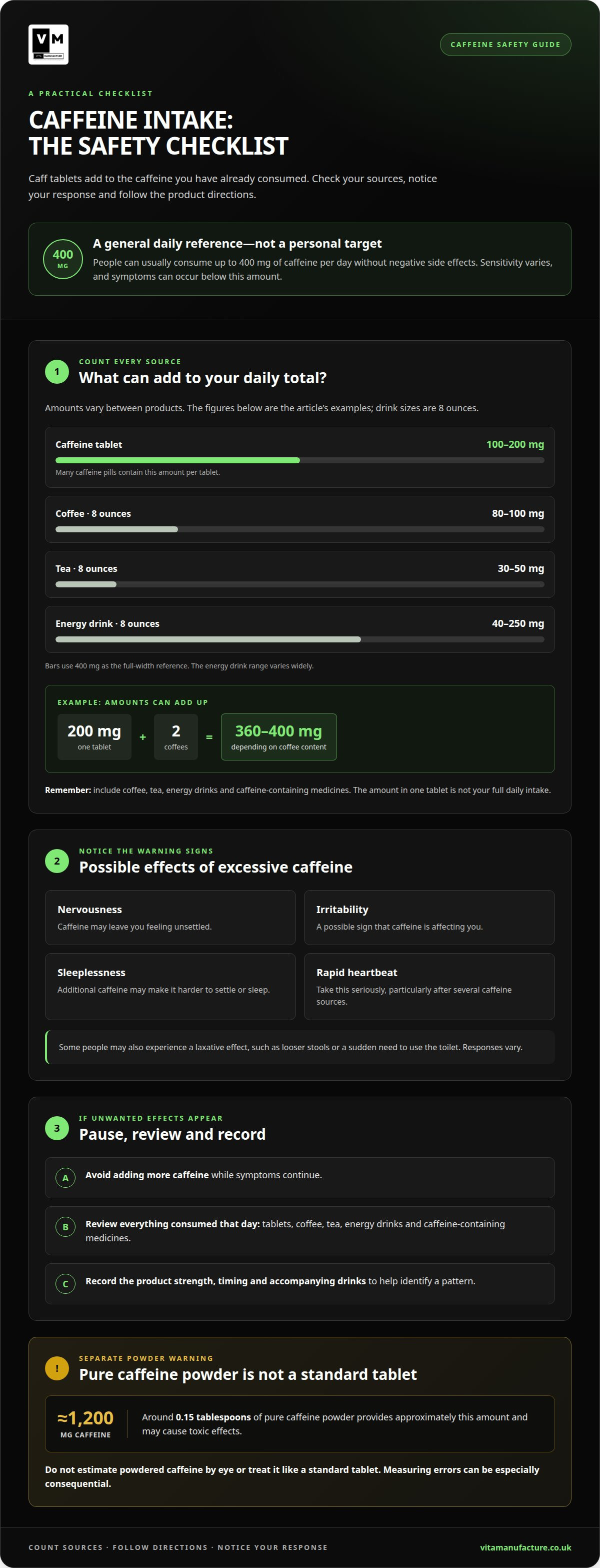
Caffeine can cause unwanted effects when intake is excessive. Warning signs include nervousness, irritability, sleeplessness and a rapid heartbeat. Caff tablets add to the caffeine you’ve already consumed, so count coffee, tea, energy drinks and caffeine-containing medicines toward your daily total. The amount in one tablet doesn’t reflect your full intake. You may feel alert after taking one, yet experience unwanted effects after adding other sources of caffeine.
Tablet strengths vary between products. Many caffeine pills contain 100 to 200 mg per tablet, while an 8-ounce cup of coffee contains 80-100 mg. An 8-ounce tea contains 30-50 mg, and an 8-ounce energy drink contains 40-250 mg. These amounts can add up: a 200 mg tablet and two coffees could provide 360-400 mg, depending on each coffee’s caffeine content.
People can usually consume up to 400 milligrams of caffeine per day without negative side effects. This general figure doesn’t mean everyone will tolerate that amount. Sensitivity varies, and symptoms can occur below it. Treat the product directions as essential, and count caffeine from drinks and medicines rather than viewing 400 mg as a personal target.
Nervousness or irritability: these may signal that caffeine is affecting you.
Sleeplessness: additional caffeine may make it harder to settle or sleep.
Rapid heartbeat: take this seriously, particularly after consuming several caffeine sources.
Some people may experience a laxative effect, such as looser stools or a sudden need to use the toilet. Responses vary, and caffeine from a tablet can add to caffeine from coffee or other drinks. If bowel changes begin after taking caff tablets, note when they occur and what else you consumed. This record may help you identify a pattern.
Pure caffeine powder carries a separate overdose risk because a small measure can contain a large amount. Around 0.15 tablespoons provides approximately 1,200 mg of caffeine and may cause toxic effects. Don’t estimate powdered caffeine by eye or treat it like a standard tablet. Its concentration makes measuring errors especially consequential.
If unwanted effects appear, avoid adding more caffeine and review everything you’ve consumed that day, including tablets, coffee, tea, energy drinks and caffeine-containing medicines. Don’t take another dose to counter tiredness while symptoms continue. Record the product strength, timing and accompanying drinks. This can help you identify whether symptoms follow a particular combination or pattern.
For a clearer picture, check the caffeine amount on the product label before use. Then consider how much coffee or tea you’ve already had that day. Caff tablets are just one part of your total intake. A simple record can help you spot when caffeine is adding up and make more informed choices about your routine.
Dissolvability and activation time
Two processes matter: whether a tablet breaks down and when you feel caffeine’s effects. They aren’t the same. A tablet may disintegrate after swallowing, while your body processes its caffeine afterwards. Water solubility alone doesn’t tell you how quickly you’ll feel more alert. Read the product directions carefully to see whether the tablet should be swallowed whole or prepared another way.
Caffeine tablets should be swallowed whole, not broken, crushed or chewed. Follow the product directions rather than trying to dissolve a tablet in a glass of water. Changing its form may alter how it is taken, and a tablet designed to be swallowed isn’t automatically suitable for mixing into water. When comparing formats, check the method of use, serving information and caffeine amount on the label.
“Activation time” usually means when someone notices an effect, not when a tablet starts dissolving. That experience can depend on the formulation, amount taken and individual response. Coffee offers a familiar comparison, but a drink and a tablet are different formats. Don’t use how quickly coffee seems to affect you as a precise guide to a tablet’s timing.
The body can take 4-6 hours to metabolise half of the caffeine consumed. That describes caffeine processing, not a guaranteed time for a tablet to dissolve or begin working. It also means the effects of an earlier dose can overlap with later caffeine. Consider the timing of your tablet alongside coffee, tea, energy drinks and medicines containing caffeine.
A practical way to assess a product is to follow three steps:
Read the label: note the directions and caffeine per tablet.
Take it as directed: swallow whole if instructed, rather than crushing or dissolving it.
Record the timing: note when you take it and when you notice an effect.
This record can help distinguish delayed effects from taking a dose too close to coffee or another caffeine source. For example, if you take a tablet and later drink coffee, you may not be able to attribute a change in alertness to either source alone. Keep the product packaging available so you can refer to its directions and strength.
For product developers, dissolving behaviour and perceived activation are separate design questions. Tablet format, directions and intended use all shape how a product should be assessed. A clear label should explain how to take the tablet correctly, rather than imply that faster dissolving means faster effects. This distinction helps set accurate expectations for anyone choosing or developing a caffeine tablet.
Potential benefits for focus and memory
Caffeine may help maintain alertness and aid concentration. Its stimulant effect can make you feel more awake and focused, which may be useful during a demanding task. That experience is not the same as improved memory or learning. If you’re considering caffeine tablets for a particular activity, identify the outcome you want: staying alert, concentrating on work or recalling information later.
Caffeine’s effect on attention is most relevant when drowsiness makes it harder to stay engaged. For example, someone reading a lengthy report may feel more awake after caffeine. That feeling may support concentration, but it doesn’t show that the reader has understood or retained the material. A practical measure is whether you complete the task more attentively, rather than assuming that an energy boost proves better performance.
Memory findings require a separate interpretation. In a study involving 160 adults, participants who took 200 milligrams of caffeine during a learning task performed better on memory tests 24 hours later than participants given a placebo. The result connects caffeine with performance on those tests after that specific task. It doesn’t establish that every dose, task or person will experience the same outcome.
The study’s timing also matters. The memory-test difference appeared 24 hours after learning, not simply as an immediate feeling of sharper recall. That distinction helps separate short-term alertness from later test performance. Feeling focused while studying is not proof that information will be remembered the next day. The study supports a limited finding, rather than a general promise of improved memory in everyday life.
To judge whether caffeine supports your focus, use a consistent task and record what happens. Note the task, tablet timing, perceived alertness and whether you completed the work without distraction. Keep other caffeine intake consistent when making comparisons. This makes it easier to tell whether a change followed the tablet or another source, rather than relying on your memory of how productive you felt.
For alertness: observe whether you feel more awake during the activity.
For concentration: assess attention to the task, not just physical energy.
For memory: distinguish immediate recall from performance tested later.
Caffeine tablets are not a substitute for sleep or effective study habits. A focused study session still benefits from clear goals, breaks and active recall, such as summarising a passage without looking at it. Treat the study involving 160 adults as evidence about one tested learning task, not as a guarantee for all situations. That measured approach keeps expectations realistic while helping you evaluate whether caffeine fits your routine.
Product price
The price of caffeine tablets depends on the product and pack, so compare like with like. Packs of 100 tablets and 250 tablets are available, but pack size alone doesn’t reveal value. Check the caffeine amount per tablet, total tablet count and serving directions. A larger pack may contain more tablets, but it may also have a different strength or format.
Use the label to calculate a comparable cost per tablet: divide the pack price by its tablet count, then compare products with the same caffeine amount per tablet. Comparing two packs by total price alone can mislead if one contains more tablets or has a different strength. This calculation helps you assess the listed retail price without assuming either pack is better value.
For a manufacturing project, the price depends on the project and is provided after a quote request. Factors include formulation, tablet format, ingredients, packaging, order volume and project requirements. A straightforward product brief may involve different development work from a custom formulation. Packaging choices also affect the project scope, as a simple container and a more tailored pack have different specifications.
Before setting a budget, define the product you intend to sell. Record the target caffeine amount per tablet, the number of tablets per pack and the intended format. Decide whether you need an existing formula or new product development. These choices shape the work required and make cost discussions more specific. Don’t compare a finished product’s shelf price directly with the cost of developing and manufacturing your own branded product.
Compare equal strengths: check caffeine per tablet before comparing pack prices.
Compare pack sizes: calculate the price per tablet for 100-tablet and 250-tablet packs.
Set product requirements: write down format, ingredients and packaging preferences.
Separate cost types: distinguish retail purchase price from development and manufacturing costs.
A clear brief can also identify which decisions remain open. For example, you might specify the tablet strength and pack count while comparing packaging formats. This keeps planning focused on the decisions that shape production, without treating every detail as fixed from the outset. It also provides a more useful basis for assessing whether the concept suits your intended market and commercial plan.
Retail prices can change between sellers and over time, so use current shelf prices when comparing products. Look at the full label, not just a headline price or tablet count. For a brand developing its own caffeine supplement, the product specification, packaging and production requirements determine the project scope. Start with those requirements, then assess the relevant costs against the product’s purpose and market position.
Recommended tablet use
Follow the product label and count caffeine from every source. For mental alertness or wakefulness, Mayo Clinic drug information gives adults and children aged 12 years and older a caffeine tablet dose of 200 milligrams. It says not to take tablets more often than every 3 to 4 hours. Product directions set a maximum of 400 mg per day from all sources. Don’t treat this maximum as a target.
Caff tablets provide a labelled amount, while coffee’s caffeine content can vary. Many caffeine pills contain 100 to 200 milligrams per tablet, so compare product labels rather than assuming equal strengths. Tea, energy drinks and caffeine-containing medicines also contribute. Before taking another tablet, write down earlier sources and check the total against the product’s directions.
Caffeine tablets are available with or without a doctor’s prescription. They’re not recommended for children younger than 12 years of age. The Mayo Clinic dose information applies to mental alertness or wakefulness for adults and children aged 12 years and older. It doesn’t replace the directions for a specific product. Check its age guidance and strength before use.
Use Caff tablets for alertness during drowsiness or unusual tiredness or weakness, not as a substitute for sleep. Swallow them whole; don’t break, crush or chew them. If one dose seems ineffective, don’t take extra tablets beyond the label directions. Recording when you take a dose and what else you consume can help you follow the product instructions consistently.
Other caffeine sources and medicines containing caffeine add to your daily total. Read medicine labels and include any listed caffeine in your tally. Don’t use Caff tablets to counteract alcohol or as a substitute for following the product directions. Follow the label, account for other caffeine sources and don’t use tablets as a replacement for rest.
For headache treatment, the American Migraine Foundation advises limiting caffeine to a maximum of 2 days per week. That advice concerns caffeine used for headaches, rather than a general schedule for alertness. If you use caffeine for this purpose, record which days you take it. This makes it easier to notice whether occasional use is becoming more frequent.
Before a dose: read the strength, age guidance and product directions.
Across the day: include coffee, tea, energy drinks and caffeine-containing medicines.
For use: swallow tablets whole and stay within the label’s daily limit.
If you’re developing a caffeine supplement and want to shape its intended use and product brief, discuss your supplement concept.
Vita Manufacture: New Product Development
Vita Manufacture’s New Product Development can help turn a caffeine supplement concept into a defined product brief. It’s a natural next step if you’re moving from researching tablet use to planning a product for your brand. Consider the intended format, formulation, label information and route to market before development begins.
For a project with an established specification, Contract Manufacturing may suit your production needs. Private Label Supplements offer another route for brands building a supplement range. The right approach depends on how much development your concept needs and the product you intend to bring to market.
A clear brief gives your project a practical starting point. Contact Vita Manufacture to discuss your supplement concept and next steps.
Shape your next product decision
Developing a commercial range of caff tablets is a different challenge from choosing a product for personal use. Start by defining the intended customer, product format and the role the supplement should play in your range. A focused brief gives development discussions a stronger starting point and helps you assess how the concept fits your wider business plans.
Vita Manufacture offers New Product Development for brands shaping a supplement concept, Contract Manufacturing for production and Private Label Supplements as another route to market. The right approach depends on your starting point and how developed your product idea is. You don’t need to have every detail settled before exploring the project.
Ready to move from research to a practical product conversation? Contact Vita Manufacture to discuss your product and take the next step with confidence.
Frequently Asked Questions
Are they safe?
Caffeine tablets can be used safely when you follow the product directions and account for other caffeine sources. According to the U.S. Food and Drug Administration, people can usually consume up to 400 milligrams of caffeine per day without negative side effects. Individual sensitivity varies, so this figure isn’t a target. If you notice an unwanted reaction, stop taking more caffeine and seek appropriate medical advice if symptoms concern you.
What are caffeine pills?
Caffeine pills are tablets containing caffeine, a stimulant that acts on the central nervous system. They provide caffeine in a measured tablet form rather than as a drink such as coffee. Product strengths vary, so check the label for the amount of caffeine in each tablet and how to take it. Review both details before comparing tablets or adding one to your daily routine.
What are Caff tablets and what ingredients do they contain?
Caff tablets are caffeine tablets, but the name alone doesn’t identify a standard formula. Caffeine is the active ingredient, while other ingredients can vary by product. Read the ingredients list and directions to understand the full formulation, including any ingredients you need to avoid. When comparing products, check their caffeine amounts and complete ingredient lists rather than relying on similar names or packaging.
What are Caff tablets used for, and how do they work?
Caffeine tablets are used to support alertness during drowsiness or unusual tiredness or weakness. Caffeine acts as a central nervous system stimulant, so its effects relate to wakefulness and alertness. For example, someone preparing for a demanding shift may consider them for temporary alertness. They aren’t a replacement for sleep, and feeling more focused doesn’t necessarily mean that learning or memory has improved.
What is the recommended dose of Caff tablets for adults in the UK?
For mental alertness or wakefulness, Mayo Clinic drug information gives adults a caffeine tablet dose of 200 milligrams. This is dosing information, not a direction to ignore a product’s own label. Check the strength per tablet and the stated use before taking one. Include caffeine from drinks and medicines when considering your total intake, since the dose from a tablet isn’t your whole-day amount.
How many Caff tablets can you take in 24 hours?
There isn’t one tablet count that applies to every product, because tablets can contain different amounts of caffeine. Product directions say not to exceed 400 mg of caffeine per day from all sources, so other tablets, drinks and medicines count towards the total. Work from the caffeine amount per tablet, not the pack’s serving size alone. Don’t take another dose more often than the label permits.
What are the side effects and risks of Caff tablets?
Possible effects include nervousness, irritability, sleeplessness and a rapid heartbeat. Some people may also experience a laxative effect. Combining tablets with coffee, energy drinks or medicines containing caffeine increases total intake. Avoid estimating doses of pure caffeine powder by eye, as small amounts can contain a concentrated dose. Stop adding caffeine if unwanted effects appear.
Who should avoid taking Caff tablets, including during pregnancy or breastfeeding?
Caffeine tablets aren’t recommended for children younger than 12 years. If you’re pregnant or breastfeeding, speak with a GP, midwife or pharmacist before using them, and include caffeine from drinks and medicines in that discussion. People who have experienced unwanted effects from caffeine should also be cautious about taking more. Check the product label for its age guidance and warnings, since directions can vary between products.