
Beta-Alanine: Formulation Guide for UK Brands
The performance case for beta-alanine starts with carnosine, not an instant boost. People take it because it helps the body produce carnosine in muscle, where carnosine helps regulate acid build-up during intense exercise. Beta-alanine may support performance in high-intensity efforts lasting between 1 and 10 minutes by helping delay fatigue.
For brands, understanding beta-alanine’s mechanism helps shape how the ingredient is explained, which product format to consider and what expectations to set with customers. It is a familiar sports-nutrition ingredient, but its role is more specific than a general energy claim. This guide covers how beta-alanine relates to carnosine and muscle fatigue, what the evidence suggests about exercise performance, and how supplement formats can affect the product experience. It also outlines practical considerations for developing a clear, credible proposition for the UK market and deciding whether beta-alanine fits your range.
Table of Contents
Effects on high-intensity exercise and muscle fatigue
Beta-alanine may support high-intensity efforts lasting between 1 and 10 minutes. Its relevance lies in muscle carnosine and the body’s response to acid build-up during demanding exercise.
Muscle buffering during intense exercise
Muscle buffering helps limit changes in acidity as exercise produces acid-related by-products. Carnosine contributes to this buffering capacity in muscle fibres. During demanding exercise, such as repeated hard cycling intervals, this role may matter as intensity rises and it becomes harder to sustain output. This helps explain why beta-alanine is associated with short, strenuous exercise rather than general energy.
Evidence on exercise performance
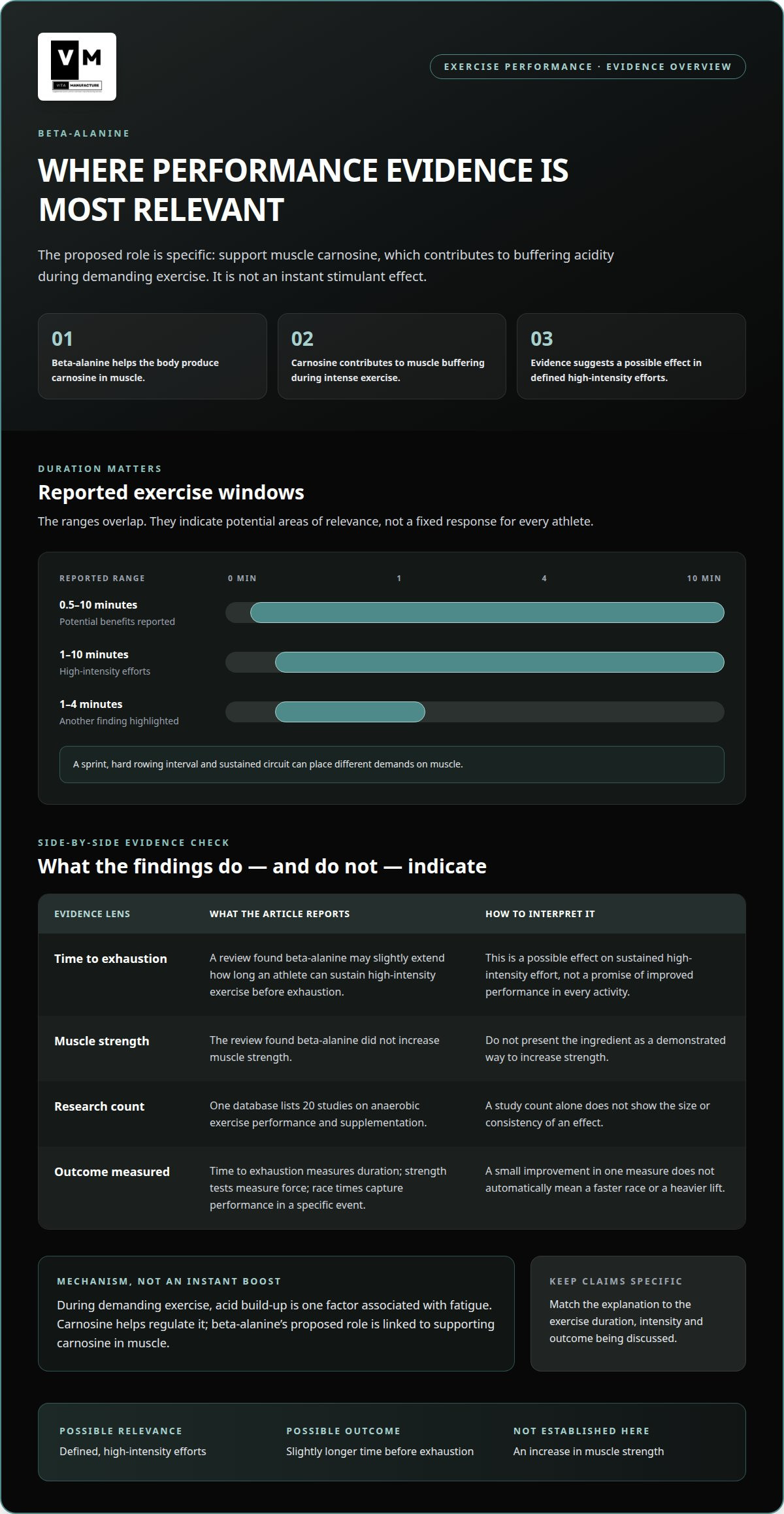
Evidence points to a possible, specific performance effect, not a broad increase in athletic ability. A review found beta-alanine did not increase muscle strength, but may slightly extend the time an athlete can sustain high-intensity exercise before exhaustion. One database lists 20 studies on anaerobic exercise performance and supplementation. Study counts alone don’t show the size or consistency of an effect, so match claims to measured outcomes.
Muscle fatigue
Muscle fatigue is the declining ability to maintain force or exercise output during effort. As intensity rises, acid build-up is one factor associated with fatigue, and carnosine helps regulate it. Beta-alanine’s proposed role relates to its connection with carnosine, rather than an immediate stimulant effect. This distinction matters: the potential benefit concerns fatigue during demanding exercise, not a guaranteed increase in strength.
The duration of an effort helps show where a performance effect may be relevant. Potential benefits have been reported for exercise lasting 0.5-10 minutes, with another finding pointing to intense sessions lasting 1-4 minutes. These ranges overlap, but describe potential areas of relevance, not a fixed response for every athlete. A sprint, hard rowing interval and sustained circuit can each place different demands on muscle.
Exercise performance depends on what is measured. Time to exhaustion measures how long someone can continue; strength tests measure force, while race times capture performance in a specific event. A small improvement in one measure does not automatically mean a faster race or heavier lift. When positioning a product, connect the evidence for beta-alanine to the intended activity and outcome, not to a blanket performance promise.
When assessing findings, focus on the activity’s duration and intensity, as well as the measured outcome. These details show whether a result relates to the exercise scenario an athlete cares about. They also help keep claims proportionate: research suggests a possible benefit in defined high-intensity efforts, while an increase in muscle strength has not been shown.
Why do people take beta-alanine supplements?
The main rationale is to support muscle carnosine levels, linking beta-alanine use to the body’s response during demanding exercise. This makes it relevant to training-focused products, rather than a general promise of improved health or energy.
Muscle carnosine loading
Muscle carnosine loading means gradually increasing carnosine stored in muscle through regular beta-alanine intake. Authors of the underlying research report that supplementation can increase muscle carnosine levels by up to 80%. The change relates to stored carnosine, not an immediate effect after one serving. For athletes, this distinction helps explain why beta-alanine is associated with consistent use rather than an instant pre-exercise boost.
The body uses beta-alanine to produce carnosine in skeletal muscle. Carnosine contributes to muscle buffering, which is why supplementation interests people who train with repeated intense efforts. The proposed rationale is to support the body’s own carnosine stores, not to supply a medicine or directly build strength. This distinction helps brands describe the ingredient’s intended role accurately.
Muscle health in ageing adults is a separate area of interest from sports performance. The carnosine mechanism does not establish that beta-alanine prevents age-related muscle decline or improves health in older people. A product designed for recreational training, for example, should not imply benefits for ageing adults without evidence relevant to that group. Keep the intended audience aligned with the supporting evidence.
Muscle buffering and fatigue
Muscle buffering is the regulation of acidity changes within muscle during demanding work. Carnosine contributes to this function, helping explain why people take beta-alanine to support training where fatigue can limit continued exercise. This mechanism offers a rationale, but it is not the same as directly increasing strength or treating fatigue outside exercise.
When positioning a product, distinguish the proposed mechanism from the outcome customers may expect. An athlete seeking support during intense training has a different use case from someone looking for general vitality. Explain beta-alanine in relation to muscle carnosine and exercise without implying a universal performance effect. Clear positioning starts with the intended user and the activity the product is designed to complement.
Regular intake is associated with gradual changes in muscle carnosine stores, so consistency is central to the loading rationale. Serving instructions should make the intended routine easy to follow. People taking medicine or managing a health condition should discuss supplementation with a qualified healthcare professional. These distinctions help separate exercise-focused product information from personal medical advice.
Beta-alanine supplement formulations
Beta-alanine is a non-essential amino acid produced naturally in the body, and it helps produce carnosine. Supplements provide beta-alanine to support muscle carnosine stores, which are linked with buffering during intense exercise.
For healthy individuals, according to the National Institutes of Health Office of Dietary Supplements, the ISSN recommends 4 to 6 g of beta-alanine daily, divided into doses of 2 g or less for at least 2 weeks. That recommendation gives brands a reference point for communicating serving size and use, rather than implying that one large serving is needed.
Formulation affects how customers take a product. Powder can be mixed into a drink, while capsules or tablets offer a pre-portioned format. Each option needs clear directions explaining the amount per serving and how servings contribute to the daily total. For example, a label can distinguish the amount in one capsule from the suggested daily intake.
Some formulations use slow-release tablets. In one study, participants taking 1.6 grams reported less frequent and less severe paraesthesia with a slow-release tablet than with a standard solution. That comparison matters because dose-dependent tingling can affect the user experience. It does not mean every delivery format removes the sensation or changes the ingredient’s purpose.
Tingling, also called paraesthesia, is a known effect associated with beta-alanine supplementation, particularly at larger doses. The sensation usually passes after a few minutes. Dividing intake into smaller servings can be a practical formulation consideration. The label should explain the intended serving clearly and avoid presenting tingling as evidence of improved exercise performance.
People under 18, those with known or suspected medical conditions, and those taking prescription or over-the-counter medicines should seek advice from a qualified healthcare professional before use. The ingredient may interact with some heart medicines and medicines for erectile dysfunction. It is not recommended for children or for pregnant or breastfeeding women.
For UK consumers, check that the label clearly gives the ingredient name, amount per serving, directions and relevant warnings. A pack designed for the US market may use terminology or directions intended for a different audience. UK brands should make the information clear for their intended customers rather than rely on unfamiliar wording.
Safety also depends on responsible use, not just format. Studies observed no adverse effects after 12 weeks of continuous use, but this finding should not replace clear directions or appropriate cautions. For product development, align the serving format, daily-use instructions and tingling information so customers can understand both what the supplement does and what to expect.
Potential effects on sports performance and endurance
For healthy individuals, the National Institutes of Health Office of Dietary Supplements says the ISSN recommends 4 to 6 g daily, divided into doses of 2 g or less for at least 2 weeks. Take it consistently; timing around exercise does not influence its effectiveness.
Sports performance effects depend on the activity and the outcome measured. The strongest rationale is for repeated, intense efforts where fatigue can limit continued work, rather than every endurance event. A 400-metre race study found no improvement in sprinters’ times. That example shows why results from one exercise format should not be applied automatically to another.
Combining beta-alanine with creatine may enhance its effectiveness, but the combination is not essential. Interpret the science by asking what each study measured: time to exhaustion, repeated efforts or a race result. These outcomes describe different aspects of exercise capacity. For product claims, a specific exercise context is more informative than a broad promise of improved sports performance.
The time to effect is linked to gradual changes in muscle carnosine stores, not an immediate pre-workout sensation. Daily use supports this gradual process, while taking a serving immediately before training is not required for effectiveness. Customers should understand the routine as consistent supplementation, rather than a dose taken only on training days.
The commonly reported side effect is paraesthesia, a tingling sensation that can follow supplementation. It is dose-dependent and usually disappears after a few minutes. Larger servings may make the sensation more noticeable, so clear serving directions help users understand what they might experience. Tingling itself is not evidence of improved exercise performance.
People taking some heart medicines or medicines for erectile dysfunction should consider potential interactions. Anyone under 18, managing a medical condition or taking prescription or over-the-counter medicine should seek advice from a qualified healthcare professional before use. The ingredient is not recommended for children or for pregnant or breastfeeding women. These considerations belong alongside performance information, not hidden behind it.
Antioxidant effects are separate from exercise outcomes. Keep any discussion of antioxidant activity distinct from claims about endurance or training capacity. The performance findings discussed here concern exercise measures, such as race times and sustained effort; they do not establish antioxidant benefits as a route to better sports results. Precise wording helps readers understand what a supplement is intended to support.
For brands, the practical step is to align serving directions with the intended routine, then match performance language to the activity and outcome. Describe paraesthesia plainly, explain the importance of consistent use, and avoid treating a single race result as proof of a universal effect. This gives customers a clearer account of potential benefits and tolerability.
Beta-alanine and carnosine production
The key formulation insight is that beta-alanine supplies a building block for carnosine rather than acting as carnosine itself. The body produces beta-alanine naturally and uses it alongside histidine to make carnosine in skeletal muscle. This distinction explains the ingredient’s purpose: supplementation aims to influence carnosine levels, not provide an immediate source of strength or protein.
Carnosine is present in muscle fibres, including the quadriceps. Reported human quadriceps concentrations are 17-25 millimoles per kilogram of dry muscle. Carnosine accounts for 10-20% of the total buffering capacity in type I and II muscle fibres. These details connect the compound’s presence in muscle with its role during demanding exercise, without suggesting that higher levels automatically mean greater strength.
Loading refers to building muscle carnosine through consistent intake over time. Taking the suggested dose for at least 2 weeks is associated with a 20% to 30% increase in muscle carnosine stores. For healthy individuals, the ISSN recommends 4 g daily; reported changes in stored carnosine are 40% to 60%, not direct measurements of strength, fitness or race performance.
The pace of change matters when setting product expectations. Unlike an ingredient presented for an immediate pre-training effect, beta-alanine is linked with gradual changes in muscle stores. A daily routine is therefore central to the loading concept. Supplementation approaches also use smaller servings across the day, distinguishing consistent intake from taking one serving only on training days.
Food is another source of beta-alanine and carnosine. Meat, fish and poultry contain these compounds, with white meat such as chicken breast among the cited examples. Dietary intake and supplementation are different ways of approaching the same compounds; neither establishes an individual’s muscle carnosine levels. Product information can explain this distinction without implying that food alone or a supplement guarantees a particular training outcome.
Some research suggests that muscle carnosine levels might rise more when supplementation is taken with a meal containing carbohydrates and protein. Evidence for this additional effect is limited, so it should not be a central product claim. The more established formulation takeaway is to explain beta-alanine’s precursor role, the gradual loading process and its relationship to muscle buffering. This gives customers a realistic basis for understanding why the ingredient is included.
For a new sports-nutrition concept, this pathway can inform the ingredient rationale and customer-facing language. Keep claims focused on carnosine production and its role in muscle, rather than promising increased strength. A formulation brief can also distinguish the active ingredient from dietary protein and explain why regular use matters to the proposed mechanism.
Vita Manufacture: New Product Development
Vita Manufacture’s New Product Development can help turn a beta-alanine concept into a clearly defined supplement proposition. It is a natural next step once you have assessed the ingredient’s mechanism, intended audience and exercise-performance positioning, and are ready to develop a product.
Whether you are building a new range or extending an established one, Vita Manufacture also offers Contract Manufacturing and Private Label Supplements. These services provide different routes from concept to finished supplement, while keeping the formulation and intended customer in focus. A clear brief can set out the format, serving approach and product rationale you want to bring to market.
To discuss your supplement idea, visit Vita Manufacture.
Turn your formulation concept into a clear next step
The next decision is how to translate the science into a product concept with a defined audience and purpose. For beta-alanine, that means making the rationale, format and customer-facing explanation work together, rather than treating the ingredient as a standalone selling point.
Start with a focused brief. Define who the product is for, how it fits their routine and what evidence supports its intended positioning. Then consider whether the concept belongs in a new range or strengthens an existing one. Clear choices at this stage give development discussions a practical direction and help keep the proposition coherent as it progresses.
Vita Manufacture can support you as you shape your supplement plans. Bring your concept and priorities to the team to explore how they can inform a product direction suited to your business.
Contact Vita Manufacture about your formulation concept and take the next step with confidence.
Frequently Asked Questions
Are there any undesirable side effects?
The most commonly described unwanted effect is paraesthesia, a tingling sensation that can follow a dose. It is dose-dependent and usually fades after a few minutes. A study using 1.6 g found participants reported less frequent and less severe tingling with a slow-release tablet than with a standard solution. People taking certain heart medicines or medicines for erectile dysfunction should consider potential interactions and seek qualified medical advice.
What are the evidence-based benefits of beta-alanine for exercise performance?
The clearest potential benefit relates to high-intensity exercise, rather than a general improvement across every sport. Studies suggest supplementation may slightly extend how long someone can sustain intense activity before exhaustion, particularly during efforts lasting 1 to 10 minutes. It has not been shown to increase muscle strength. A useful way to assess a claim is to ask whether its activity and measured outcome match the evidence behind it.
How long does beta-alanine take to work, and how long do its effects last?
Beta-alanine works through gradual changes in muscle carnosine, so it is not designed as an immediate pre-exercise boost. Regular use is associated with increased stores over time, and taking a serving just before training does not determine effectiveness. The evidence describes gradual loading, rather than a fixed post-exercise window. Product directions should therefore focus on consistent use, not promise an instant effect during a single workout.
Is beta-alanine safe to take with caffeine, creatine, or other supplements?
Combining supplements requires attention to the full formula and the person taking it. Creatine has been suggested as a potentially complementary ingredient, but a performance finding does not establish that every combination is suitable. Caffeine combinations should not be assumed safe for everyone. Anyone with concerns about taking beta-alanine alongside a medical condition or medication may wish to seek professional advice.
How does beta-alanine compare with creatine for sports performance?
Beta-alanine and creatine have different proposed roles, so compare them by the outcome a product is designed to support. Beta-alanine is associated with muscle carnosine and may help sustain certain high-intensity efforts; it has not been shown to increase strength. Available information also suggests that creatine may enhance its effectiveness when combined. This does not make the ingredients interchangeable or establish that one is better for every sport or training goal.