B-Alanine Formulation Guide for UK Brands
Supplementing with b-alanine has been shown to increase the body’s carnosine levels by as much as 80%. Beta-alanine is an amino acid the body uses to make carnosine, a compound found in muscle that helps buffer acidity during intense exercise.
That makes beta-alanine a familiar ingredient in sports nutrition, but sound formulation involves more than its potential exercise effects. Consider how daily use is explained, how the ingredient differs from dietary sources, and how the full ingredient list and allergen information shape the product.
This guide explains beta-alanine’s role, its relationship to food and the types of exercise studied in supplementation research. It also covers dosage, duration, formulation choices and allergen considerations, giving UK brands a clearer basis for developing a purposeful, commercially considered product.
Table of Contents
What is beta-alanine?
Beta-alanine is an amino acid that helps the body produce carnosine in skeletal muscle. Its role matters in sports nutrition because muscle carnosine helps buffer acidity during intense exercise.
Carnosine production and muscle buffering
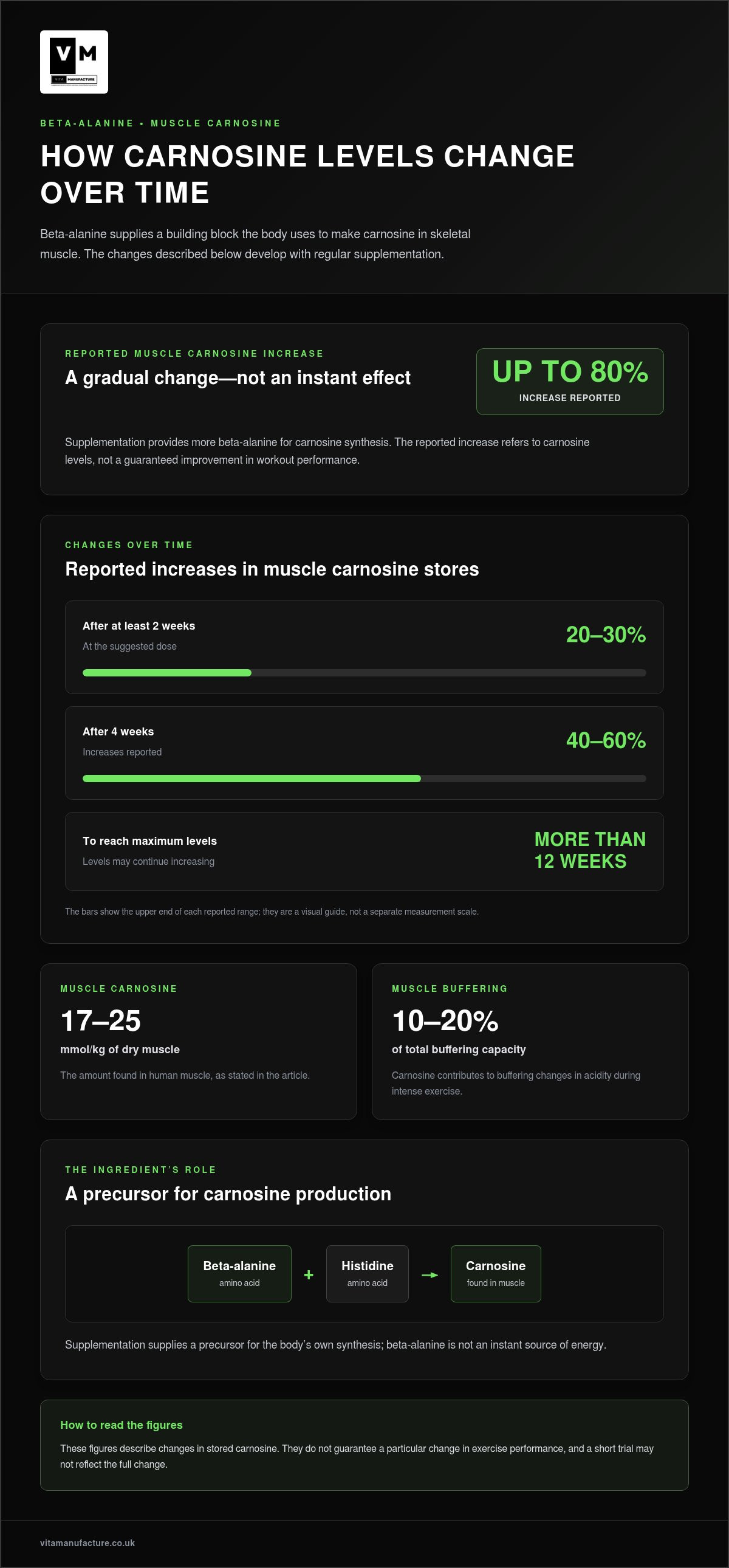
Beta-alanine supplies one of the two amino acid components the body combines to make carnosine. The other is histidine. Carnosine is found in type I and type II muscle fibres, where it contributes to buffering changes in acidity during intense exercise.
This matters during a demanding workout because buffering is one part of how muscle handles the conditions created by repeated high-intensity effort. Carnosine accounts for 10-20% of total buffering capacity in those fibre types. Supplementation provides more beta-alanine for carnosine synthesis, rather than acting as an instant source of energy.
Changes in muscle carnosine levels
Muscle carnosine levels can rise with regular beta-alanine supplementation, but the increase develops over time. Human muscle carnosine occurs at 17-25 mmol/kg of dry muscle, and supplementation has been shown to increase body carnosine levels by as much as 80%.
At the suggested dose, at least 2 weeks of use can increase muscle carnosine stores by 20% to 30%; after 4 weeks, increases of 40% to 60% have been reported. These figures describe changes in stored carnosine, not a guaranteed change in workout performance. Levels may take more than 12 weeks to reach their maximum, so a short trial may not reflect the full change.
Carnosine and anserine
Beta-alanine is a building block for carnosine and anserine, related compounds found in muscle. Carnosine combines beta-alanine with histidine, while anserine contains beta-alanine and a methylated form of histidine.
This distinction explains why beta-alanine’s role in a formulation is to supply a precursor, rather than carnosine itself. The body uses beta-alanine in its own synthesis processes, and muscle carnosine is the main outcome discussed in exercise research. Anserine helps explain the wider chemistry, but it is not interchangeable with carnosine. For researchers interested in exploring related amino acid compounds and scientific literature on cognitive enhancers, eurolabpetides.com offers detailed scientific reviews.
In the UK, regulatory status and quality testing are separate considerations: a supplement’s regulatory status does not, by itself, show what batch testing it has received. To assess quality information, look for clear ingredient identification, a complete ingredients and allergen declaration, and transparent details about product testing.
UK prices vary with format, pack size, serving count and formulation, so compare cost per stated serving rather than pack price alone. A clear label and accessible quality information also help you assess the product.
Dietary sources of beta-alanine
Beta-alanine is available through food and supplements, but dietary sources are linked to liver and carnosine-rich foods. For anyone considering sports nutrition, distinguishing food sources from a measured supplement serving helps clarify how an ingredient contributes to a product’s daily serving.
Food provides a varied source rather than a standardised amount in each serving. Liver and other carnosine-rich foods contribute to dietary intake, but the amount depends on the food and portion. Diet can inform an ingredient strategy, but it does not provide the same controlled quantity as a supplement serving.
Supplements provide a direct way to include beta-alanine as a defined ingredient. This can suit a product concept where the amount per serving and daily use need to be communicated consistently. Powder, capsules, tablets and gummies are possible formats. The format affects how consumers take the serving, not the ingredient’s dietary source.
Creatine is a separate ingredient, not a food source of beta-alanine. Combining beta-alanine with creatine may enhance its effectiveness, but that does not establish the same effect for every formula or user. BCAAs are also distinct amino acids. The available facts here do not establish an added effect from combining them with beta-alanine, so brands should not present the combination as a proven advantage.
Food and timing may shape how a formula is used. Taking beta-alanine with some carbohydrate increases its rate of absorption. A meal containing carbohydrates and protein, or caffeine, may also influence muscle carnosine levels, but research supporting those effects is limited. These are formulation considerations, not a reason to imply that a particular meal or caffeine is essential.
How does beta-alanine compare with creatine for sports performance? Beta-alanine supports carnosine production, while creatine is a different ingredient with a different role. Combining the two may enhance beta-alanine’s effectiveness, but they should not be presented as interchangeable or as having identical effects.
For a UK brand, the practical choice depends on the intended audience, format and role of each ingredient. Keep the label clear about what the formula contains and how its components relate. If you’re shaping a concept around dietary sources and complementary ingredients, supplement formulation decisions can be considered as part of the wider product plan.
Potential benefits for high-intensity exercise and muscle fatigue
Research on beta-alanine and performance focuses on intense exercise, where carnosine supports muscle buffering. The findings are most relevant to efforts lasting minutes, not every sport or endurance activity.
High-intensity exercise and muscle buffering
Muscle buffering helps manage changes in acidity during demanding exercise, and carnosine contributes to that process. The clearest performance relevance is for sustained high-intensity efforts lasting approximately 1 to 10 minutes, including hard intervals or a fast middle-distance race. That focus helps brands describe the ingredient for a defined use case, rather than implying broad benefits across all exercise.
Evidence of exercise-performance effects covers efforts lasting 0.5-10 min. One analysis estimates an average performance improvement of 2.85%. That figure describes an average, not a result that applies to every athlete or activity. A reported illustration is a runner completing a 4-minute mile improving their time by 7 seconds; it helps make the estimate tangible, but doesn’t establish an expected result for every runner.
Activity lasting 1-7 minutes is another context in which beta-alanine may be useful. Repeated bouts of intense training and a final intense effort near the end of an endurance event are also relevant scenarios. These examples are distinct from steady, lower-intensity exercise, where the performance rationale is less direct.
Muscle fatigue
Muscle fatigue is the reduced capacity to sustain effort, and beta-alanine’s proposed relevance centres on intense work lasting 1 and 4 minutes. In that window, buffering can matter as acidity changes during hard exercise. For a sports formulation, the practical distinction is the activity’s intensity and duration, not simply whether the user describes it as a workout.
This context helps clarify product positioning. A formula aimed at repeated intervals has a more direct rationale than one presented for every training session. Describe beta-alanine as a training aid, not a substitute for training and a balanced diet. Keep the intended use aligned with the evidence in product explanations.
Muscle building and body composition are separate outcomes from short-duration exercise performance. The findings described here do not establish that beta-alanine independently builds muscle or changes body composition. Formulation claims should not treat a performance effect during intense efforts as proof of broader changes in muscle size or body composition.
For ageing adults, muscle health is an important consideration, but the performance evidence outlined here concerns high-intensity exercise. It does not establish a specific benefit for age-related muscle changes. Keep claims focused on the exercise contexts studied, such as sustained intense efforts, rather than extending them to ageing or general muscle health.
Dose division and supplementation duration
Daily intake and consistency matter more than taking beta-alanine at a specific moment around training. Studies have used a broad range of doses, but exercise-performance research commonly examines regular intake divided across the day.
Research doses range from 1 to 7 grams per day, while doses used for exercise performance tend to range from 3.2 to 6.4 grams per day. A suggested approach for optimising muscle carnosine is 4 to 6 grams daily, divided into servings of 2 grams or less, for at least 2 weeks. These are study and guidance ranges, not a single amount that suits every product format.
Dividing intake can make a higher daily amount easier to use. For example, 6 grams per day can be split into four equal 1.5-gram servings. Another practical example is taking 2 grams with breakfast, lunch and supper. The serving schedule should make the total daily amount clear, whether a product is powder, capsules or tablets.
Timing does not influence beta-alanine’s effectiveness, so athletes need not treat it like a pre-workout ingredient that must be taken immediately before exercise. Blood levels rise and then fall within 2 hours of a dose, but the intended effect depends on regular supplementation and carnosine accumulation in skeletal muscle. A training-day schedule can therefore prioritise consistency over proximity to a session.
Duration is part of the formulation story. The full effect usually takes 2 to 4 weeks to develop as muscle carnosine stores are replenished; levels can take more than 12 weeks to reach their maximum. An initial serving or a single workout doesn’t represent the same process as sustained daily intake.
Beta-alanine can cause dose-dependent paraesthesia, commonly described as tingling. The risk is greater at higher doses, particularly above 10 mg/kg body weight. Several smaller servings or a sustained-release formulation might reduce the risk. One study compared a 1.6-gram dose in a standard solution with a slow-release tablet, illustrating why delivery format can matter alongside the stated amount.
For product design, the daily serving, number of units and period of use need to work together. If a label divides the daily amount across servings, make the total easy to understand. Protein intake and training remain separate parts of an athlete’s routine; beta-alanine is neither an essential amino acid nor a replacement for either. Its role relates to carnosine capacity, not supplying dietary protein.
Studies have reported no adverse effects after 12 weeks of continuous use. That observation describes the study period, not an unlimited duration. Clear serving directions help consumers understand how regular use differs from taking a supplement only before one workout.
Ingredients and allergens
A considered sports nutrition formula involves more than its headline amino acid. For a b-alanine supplement, the full ingredient list, serving format and allergen information all shape how clearly consumers can understand the product.
Start with the active ingredient, then assess each additional component against the product’s purpose. A powder might include flavouring or sweetener; a capsule may use a shell and flow agent. These ingredients affect the finished formula and must be accounted for in its ingredient declaration. Make sure supporting ingredients do not obscure the quantity or identity of beta-alanine.
Assess allergens across the complete formulation, not just the main amino acid. Review each ingredient, including flavourings, carriers and processing aids, and record relevant supplier information. For example, a flavoured powder requires review of both its beta-alanine and flavour system. Manufacturing and handling information also matters when assessing possible cross-contact with allergenic materials.
Keep consumer-facing information specific. Name ingredients plainly and present allergen information so readers can identify relevant components without interpreting vague claims. If a formula uses a compound ingredient, assess its constituent ingredients too. This connects the product specification, supplier documentation and label copy, while reducing the risk of overlooking a component in a later reformulation.
Formulation decisions can also affect use. A high serving quantity may suit a powder better than a small capsule, while flavour and texture influence how comfortably consumers can take the intended serving. Choose a format that accounts for daily dosage and any planned division of servings, rather than treating excipients as an afterthought. Changing from unflavoured to flavoured, for instance, can introduce ingredients that need another review.
Keep a controlled record for every formula version. A practical review can compare:
Each active and supporting ingredient against its specification.
Supplier allergen information against the complete formula.
Label wording against the actual ingredients and serving format.
Reformulation changes against the previous version’s allergen assessment.
This disciplined approach helps brands explain what a product contains without implying that alanine supplementation prevents fatigue or guarantees particular carnosine levels. Tingling is a recognised effect of beta-alanine intake, but it is distinct from an allergen reaction. Consumer information should make that distinction clear.
If you’re developing a formula, use ingredients and bulk sourcing to support informed ingredient selection and a coherent product specification.
Vita Manufacture: New Product Development
Vita Manufacture’s New Product Development can help turn a beta-alanine concept into a considered supplement product. It is a natural next step once you have defined the intended audience, ingredient approach, dosage format and allergen considerations, and want to develop those decisions into a product concept.
Whether you are building a new formula or developing a brand-ready supplement, Vita Manufacture also offers Contract Manufacturing and Private Label Supplements. The right route depends on how much of the product concept is already established and what support the project needs. Clear formulation decisions provide a stronger foundation for moving from idea to product.
If you are ready to explore your supplement concept, contact Vita Manufacture to discuss New Product Development.
Turn your concept into a product direction
The next decision is how to translate an ingredient idea into a product with a clear place in the market. For a b-alanine concept, align its intended audience, positioning and finished format before development. A focused brief gives each decision a purpose and helps keep the product story coherent.
Vita Manufacture offers New Product Development, Contract Manufacturing and Private Label Supplements, supporting different routes from product concept to market-ready supplement. The best starting point depends on how clearly defined your concept is and the development support you need. Refine your product direction, then explore the route that fits your brand’s goals.
Contact Vita Manufacture about formulation to discuss your supplement concept. A thoughtful next step can turn a promising idea into a stronger foundation for your brand’s growth.
Frequently Asked Questions
03 Are there any undesirable side effects?
The main undesirable effect identified is paraesthesia, a tingling sensation that can follow intake. It is dose-dependent, so the amount taken at once matters. For example, a large single serving may feel different from the same daily amount divided into smaller servings. Tingling is not the same as an allergic reaction. Product information should describe this possible effect clearly, without presenting it as evidence of improved exercise performance.
Did you know?
Beta-alanine might not act directly as an antioxidant, but it can increase carnosine levels. That distinction matters when explaining the ingredient: its role is associated with the body’s production of carnosine, rather than a direct antioxidant action. Carnosine is found in muscle, where its buffering function is relevant during intense exercise. Clear explanations help consumers distinguish the proposed pathway from broader claims about nutrition or recovery.
What is beta-alanine and how does it work?
Beta-alanine is an amino acid the body uses to produce carnosine. It supplies one component of that compound, which is found in skeletal muscle. To understand the process, distinguish the ingredient from its outcome: taking beta-alanine provides a precursor, while the body produces carnosine. This makes regular intake relevant to changes in muscle stores, rather than an immediate effect from one serving.
What are the evidence-based benefits of beta-alanine for exercise performance?
The evidence points most clearly to sustained, intense efforts, rather than every kind of training. Research has reported performance effects across exercise lasting 0.5-10 min, including repeated intense bouts and hard efforts near the end of endurance events. A practical example is an athlete choosing a supplement for interval sessions. These findings support a focused performance rationale, not a promise of improved results in every sport or workout.
What is the recommended beta-alanine dose and how should it be taken?
Research doses vary, so consumers should follow the directions for their specific product rather than combine serving suggestions from different labels. One study compared a 1.6-gram dose in standard solution with a slow-release tablet. That example shows why serving format can affect how a dose is delivered. Check the amount per serving and the stated daily schedule, especially if the product is part of a multi-ingredient sports formula.
How long does beta-alanine take to work, and how long do its effects last?
Changes develop as muscle carnosine stores build, rather than appearing as an immediate pre-workout effect. The full effect usually takes 2 to 4 weeks to develop, while carnosine levels can take more than 12 weeks to reach their maximum. Blood levels rise and then fall within 2 hours of a dose; that short-term change is different from the longer process of replenishing muscle stores.
What are the common side effects and risks of beta-alanine?
Tingling, known as paraesthesia, is the principal side effect described for beta-alanine, and its likelihood increases with dose. Higher amounts, particularly above 10 mg/kg body weight, carry greater risk. Dividing intake into smaller servings or using a sustained-release format may help reduce the chance of this sensation. Consumers should distinguish tingling from an allergy and follow the serving directions provided for the product they use.
Who should avoid beta-alanine or consult a doctor before taking it?
Anyone with a medical condition, taking regular medicines, pregnant or breastfeeding should seek individual clinical advice before starting a supplement. This accounts for personal health circumstances rather than assuming a sports supplement suits everyone. If you experience an unexpected or concerning reaction, stop taking the product and seek appropriate medical advice. For general use, read the label and follow its directions.