25 Crucial Questions to Ask a Supplement Contract Manufacturer Before You Sign
What if your most promising product launch isn't actually limited by your marketing budget, but by a manufacturing contract you haven't even signed yet? It's a sobering thought for any ambitious founder. You've likely spent months perfecting your formulation, only to feel a nagging anxiety about the "black box" of production. It's natural to worry about hidden costs, high MOQs, or the sudden sting of a regulatory fine that could derail your momentum. Knowing the specific questions to ask a supplement contract manufacturer is the vital difference between a seamless launch and a costly operational nightmare.
Mastering the art of partner evaluation is the only way to protect your brand and ensure long-term commercial scalability. This comprehensive checklist is designed to move you from uncertainty to total confidence whilst protecting your bottom line. We will examine how to verify UK regulatory compliance, assess strategic R&D support, and ensure your supply chain is truly ready to scale. By the end of this guide, you'll have the rigorous framework needed to secure a partner that prioritises your commercial success as much as you do.
Table of Contents
The Stakes of Selection: Why Your Choice of Partner Defines Your Brand Value
Decoding Compliance: Essential Questions About Standards and Certifications
From Formula to Market: Evaluating R&D and Product Development Expertise
Operational Resilience: Logistics, MOQs, and Supply Chain Transparency
The Strategic Ally: Why Vita Manufacture is the Logical Conclusion
The Stakes of Selection: Why Your Choice of Partner Defines Your Brand Value
Your manufacturer is the silent architect of your brand's future. Every capsule produced is a physical representation of your reputation, meaning a single batch error can erase years of hard-won consumer trust. Choosing the wrong partner isn't just a minor operational hiccup; it's a fundamental risk to your commercial viability. The market is saturated with "service providers" who offer the lowest initial quote, but these often hide the true costs of poor consistency, delayed shipments, and catastrophic recalls. A "cheap" batch becomes incredibly expensive when you factor in the cost of customer refunds and the permanent damage to your brand's authority.
Transitioning to a new facility whilst you're in a high-growth phase is a logistical nightmare that consumes time, capital, and mental energy. It involves re-validating formulas, auditing new sites, and managing stock gaps that could alienate your retailers. You don't just need someone to fill bottles; you need a strategic growth ally who anticipates hurdles before they arise. This is why the specific questions to ask a supplement contract manufacturer must focus on their long-term vision, not just their price per unit.
The Long-term Impact on Regulatory Governance
Documentation is the heartbeat of your business. The standards your partner maintains today dictate your ability to defend your brand in five years. Whilst UK regulations are distinct, many global standards are influenced by foundational frameworks like the Dietary Supplement Health and Education Act of 1994 (DSHEA), which established the importance of safety and labelling integrity. If a manufacturer lacks rigorous supplier controls, their failures become your legal responsibility. High-level documentation ensures that every ingredient is traceable and every claim is substantiated. Without this, your brand value remains fragile, susceptible to regulatory scrutiny that could halt your operations overnight. Robust governance is what separates a fly-by-night venture from a legacy brand.
Commercial Scalability and Resilience
Can your partner grow from a boutique run of 500 units to a national distribution of 50,000? Scalability isn't just about having larger vats; it's about the operational design that maintains quality at speed. When formulating your list of questions to ask a supplement contract manufacturer, you must look beyond the equipment. Resilience comes from proactive risk identification. A partner who offers end-to-end logistics and transparent tracking allows you to manage your supply chain with precision. If they can't provide real-time data or strategic R&D support, they'll eventually become a bottleneck. True commercial success requires a partner who builds for the 50,000th unit while they're still producing the 500th. Reliability is the ultimate currency in this industry.
Decoding Compliance: Essential Questions About Standards and Certifications
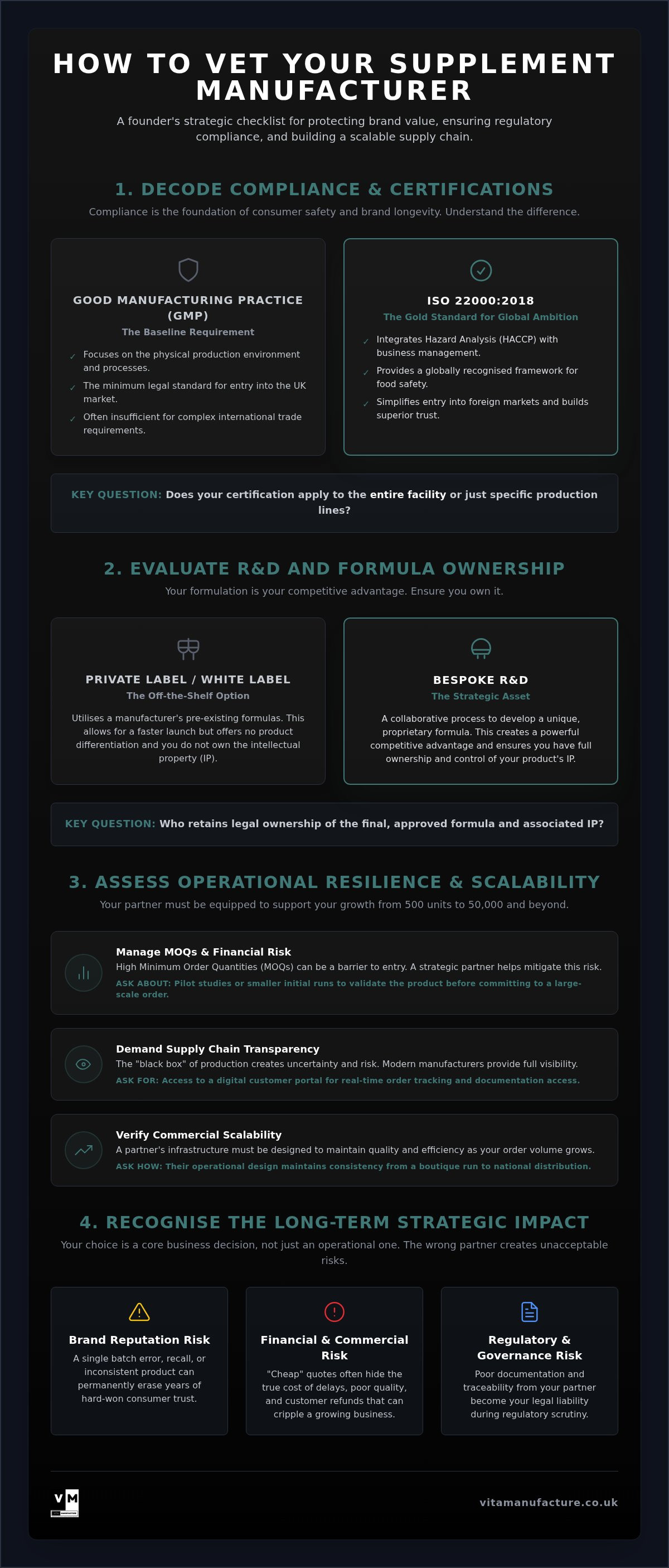
When compiling your list of questions to ask a supplement contract manufacturer, certifications should be at the very top of your agenda. Compliance isn't just a legal hurdle; it's the bedrock of consumer safety and brand longevity. In the UK market, basic adherence to Good Manufacturing Practice (GMP) is the minimum point of entry, but it's rarely enough for a brand with global ambitions. You need a partner who views quality as a dynamic management system rather than a static checklist. This is why ISO 22000:2018 has become the non-negotiable gold standard for food safety management. Whilst GMP focuses on the physical production environment, ISO 22000:2018 integrates Hazard Analysis and Critical Control Points (HACCP) with business management principles to ensure safety at every touchpoint. Crucially, ISO 22000 surpasses basic GMP for international trade by providing a globally recognised framework that simplifies entry into complex foreign markets.
One of the most vital questions to ask a supplement contract manufacturer is whether their certifications apply to the entire facility or just specific production lines. It's a common trap to assume a badge on a website covers every product your partner handles. Industry experts often emphasise that choosing a contract manufacturer requires a deep dive into these quality management systems to avoid future liability. You can review our ISO 22000:2018 certified facility standards to see how this level of scrutiny protects your brand's reputation.
Verifying Facility-Wide Quality Standards
Does the certification cover the specific dosage forms you need, such as capsules, powders, or tablets? You must distinguish between a manufacturer that is "compliant with" standards and one that is "certified by" an accredited third-party body. A certified facility undergoes regular, rigorous external audits, whereas "compliance" is often a self-declared status that lacks independent verification. Ask about their internal quality control protocols and the frequency of their audits. A transparent partner will gladly share their latest audit summary to prove their operational integrity and commitment to excellence.
Regulatory Guidance and Labelling Support
The UK supplement landscape is constantly evolving, particularly regarding Novel Foods and post-Brexit labelling requirements. Your manufacturer should act as a regulatory compass. Ask how they stay updated on FSA (Food Standards Agency) changes and whether they can assist with substantiating your health claims. If you're launching a product with a new ingredient, their experience with the Novel Foods authorisation process is invaluable. A partner who can't provide labelling guidance leaves you vulnerable to expensive redesigns or, worse, legal challenges from trading standards that could halt your sales overnight.
From Formula to Market: Evaluating R&D and Product Development Expertise
Your product's scientific integrity is the foundation of its commercial viability. Whilst many founders begin with a white label approach to test the market, the transition to custom contract manufacturing is where true brand differentiation happens. It isn't enough for a manufacturer to simply follow a recipe; they must possess the deep scientific expertise required to understand ingredient synergy and long-term stability. When refining your list of questions to ask a supplement contract manufacturer, you must probe their ability to bridge the gap between a visionary concept and a manufacturable reality. Can your formula withstand high-speed encapsulation? Will the botanical extracts remain stable throughout their shelf life? A partner with robust R&D capabilities ensures your product performs as promised in the hands of the consumer.
Custom Formulation and IP Ownership
Intellectual property is a critical asset that defines your company's valuation. One of the most vital questions to ask a supplement contract manufacturer is: "Who owns the IP for a formula we develop together?" If the manufacturer retains ownership, you're effectively locked into their facility, making it impossible to scale with other partners or sell your business later without significant legal friction. You should also evaluate their access to premium or patented ingredients. A sophisticated partner will proactively suggest high-bioavailability alternatives or patented compounds that can elevate your marketing claims and provide a genuine competitive edge in a crowded marketplace. Owning your custom formulation is the only way to ensure long-term strategic independence.
The Strategic Value of Pilot Studies
Mass production is a high-stakes environment where minor errors in solubility or flavouring become expensive disasters. This is why you should prioritise partners who offer dedicated pilot studies and market research phases. A pilot study acts as a crucial risk-mitigation tool, allowing you to produce a small, representative batch to test the physical characteristics of your supplement before committing to a full production run. Does the powder flow correctly through the machinery? Is the flavour profile palatable after the heat of processing? By creating prototypes, you can refine your final specification based on grounded data rather than guesswork. This methodical approach to new product development prevents the hidden costs of "cheap" manufacturing that we discussed earlier, ensuring your first major shipment is perfect. Resilience in your supply chain begins with a scientific proof of concept.
Operational Resilience: Logistics, MOQs, and Supply Chain Transparency
Operational resilience is the invisible engine of your brand's success. Whilst a competitive price per unit is attractive, it means very little if your stock is stuck in a production bottleneck or lost in a distribution vacuum. The "Low MOQ" dilemma is a classic trap for emerging brands; whilst lower entry costs preserve initial capital, you must ensure your partner has the capacity to support rapid scaling when a product goes viral. If they can't bridge the gap between 1,000 and 50,000 units, your growth will be strangled by your own success. Assessing the end-to-end supply chain, from raw material sourcing to final distribution, is essential for long-term stability. Real-time data access reduces brand anxiety by providing a window into the factory floor, ensuring you're never left guessing about your inventory levels.
Transparency and Real-Time Tracking
One of the most critical questions to ask a supplement contract manufacturer is: "How can I track my order status without chasing an account manager?" In the modern era, you shouldn't have to wait 48 hours for an email response just to know if your batch has passed quality control. A transparent customer portal solves the "black box" problem of manufacturing, giving you instant access to batch records and Certificates of Analysis (CoA). This level of digital infrastructure allows you to maintain a proactive communication rhythm with your own retailers and customers. If a manufacturer relies on manual spreadsheets and phone calls, they're likely to become a liability during a crisis. Transparency isn't a luxury; it's a fundamental requirement for commercial governance.
Logistics and Global Distribution Capabilities
Your partner's role shouldn't end at the loading dock. You need to assess their third-party logistics (3PL) and storage options to ensure your supply chain is truly end-to-end. When formulating your questions to ask a supplement contract manufacturer, probe their ability to manage supply chain shocks. Ask about their specific experience with international shipping and the complexities of customs documentation, especially in a post-Brexit landscape. A manufacturer with global distribution expertise can help you navigate ingredient shortages or shipping disruptions before they impact your bottom line. We've built our infrastructure to eliminate these operational blind spots; you can explore our logistics and distribution services here to see how we streamline your path to market. Resilience isn't just about surviving; it's about thriving amongst uncertainty.
The Strategic Ally: Why Vita Manufacture is the Logical Conclusion
Choosing a partner is the most consequential governance decision your brand will ever make. Throughout this guide, we've explored the rigorous questions to ask a supplement contract manufacturer to ensure your vision isn't compromised by operational mediocrity. From the intricacies of ISO 22000:2018 certification to the strategic necessity of pilot studies, the requirements for success are clear. Our facility serves as a national centre of manufacturing excellence, designed specifically to meet the demands of founders who refuse to compromise on quality or transparency. We don't just provide a service; we offer a sophisticated infrastructure that turns technical complexity into commercial advantage. By addressing every hard question with transparent data and scientific rigor, we allow you to focus on your brand's growth whilst we manage the intricate risks of production. This level of alignment is what separates a simple vendor from a true strategic ally.
End-to-End Support for Ambitious Brands
Scalability requires more than just high-capacity machinery. It demands an end-to-end ecosystem that supports your product from initial R&D through to global fulfilment. At Vita Manufacture, our entrepreneurial mindset matches your own ambition. We understand that your needs will evolve as you move from a successful pilot study to a national retail launch. This is why our dedicated customer portal is so vital for scaling businesses. It provides the real-time tracking and document accessibility you need to maintain total control over your supply chain without the need for constant manual follow-ups. Whether you're refining a custom formula or navigating complex international logistics, our team acts as your strategic consultant. We ensure your products aren't just compliant, but are positioned for long-term commercial viability and market dominance.
Taking the Next Step in Your Manufacturing Journey
The transition from a concept to a market-leading supplement requires a partner who thinks like a business owner. When you're ready to move beyond the initial list of questions to ask a supplement contract manufacturer, the next step is a focused, strategic conversation. Preparing a detailed brief is the best way to ensure a productive first meeting. Consider your target MOQs, your specific regulatory requirements, and your timeline for commercial launch. We invite you to experience a partnership built on transparency, scientific excellence, and shared ambition. You can organise a consultation with our strategic experts to discuss your specific needs and discover how our national infrastructure can support your brand's journey. Let's build a secure, scalable supply chain that reflects the true value of your brand whilst protecting your long-term success.
Securing Your Brand's Future through Strategic Partnership
Securing your brand's future requires more than just a production line; it demands a partner who understands the high stakes of commercial scalability. You now have the framework to move beyond surface-level quotes and interrogate the scientific and operational depth of your potential manufacturer. From insisting on ISO 22000:2018 certification to ensuring total formula ownership, these decisions define your brand's long-term value and resilience amongst competitors. Trust is built on data, not promises.
Having a rigorous set of questions to ask a supplement contract manufacturer protects you from the hidden costs of poor consistency and regulatory oversights. At Vita Manufacture, we eliminate production blind spots with our transparent customer portal for real-time tracking and specialise in low MOQ manufacturing designed for ambitious growth. We believe that your success is the only true measure of our performance, and our UK facility is engineered to support that ambition at every stage.
Download our Full Manufacturer Evaluation Checklist or Book a Consultation to begin your journey with a partner that prioritises your commercial outcomes. Your vision is ready for the next level, and we're here to ensure you get there with absolute confidence.
Frequently Asked Questions
What is the difference between a contract manufacturer and a private label provider?
A private label provider offers pre-formulated products that you simply brand as your own, whereas a contract manufacturer creates bespoke formulations based on your specific requirements. Private label is often ideal for rapid market entry with lower initial risk. Contract manufacturing allows for unique ingredient profiles and scientific differentiation. Most growing brands start with white label supplements and transition to custom development as they scale their commercial footprint.
Why is ISO 22000 certification more important than just being GMP compliant?
ISO 22000:2018 is a comprehensive food safety management system that incorporates HACCP principles and business management, whilst GMP primarily focuses on the physical production environment and hygiene. ISO certification provides a higher level of trust for international trade because it requires continuous improvement and rigorous external auditing. It ensures that every stage of the supply chain is managed with a focus on risk mitigation and consumer safety.
Do I own the rights to my supplement formula if the manufacturer develops it?
Formula ownership is a critical point in your commercial negotiations. Generally, if you pay for bespoke R&D and new product development, you should negotiate for full IP ownership in the final contract. If you use a manufacturer's existing private label formula, they typically retain the rights. One of the most vital questions to ask a supplement contract manufacturer is whether you can take your formula to another facility if you decide to scale elsewhere.
What are typical minimum order quantities (MOQs) for new supplement brands in the UK?
Minimum Order Quantities vary significantly depending on the dosage form and the manufacturer's infrastructure. For capsules and tablets, MOQs often range from 1,500 to 5,000 units, whilst complex gummies or liquids might require 10,000 units or more. We specialise in low MOQ manufacturing to help brands test the market whilst maintaining the ability to scale to national distribution levels without changing partners or sacrificing quality.
How long does the product development and manufacturing process usually take?
The timeline typically spans 8 to 16 weeks, depending on the complexity of the formulation and the availability of raw materials. The initial R&D and pilot study phase can take 4 to 6 weeks, followed by a similar duration for the actual production run and quality control testing. Efficient logistics and a transparent customer portal help reduce delays by providing real-time updates on each stage of the manufacturing journey.
Can a supplement manufacturer help with UK labelling and regulatory compliance?
A high-quality manufacturer should provide comprehensive regulatory guidance to ensure your products meet UK standards. This includes advice on Food Standards Agency (FSA) requirements, health claim substantiation, and mandatory labelling information. Whilst they don't usually provide final graphic design, they ensure that the technical data, such as the nutritional table and ingredient list, is accurate and compliant with current legislation to avoid costly market recalls.
What happens if there is a problem with a batch of my supplements?
If a batch failure occurs, a robust quality management system ensures full traceability through detailed batch records and Certificates of Analysis (CoA). Your manufacturer should have a clear protocol for quarantine, investigation, and corrective action. Transparency is essential; a partner with a digital customer portal allows you to see exactly where a batch is in the process, ensuring that any deviations are identified and addressed before the product leaves the facility floor.
Do supplement manufacturers provide third-party lab testing results?
Yes, reputable manufacturers provide Certificates of Analysis for every batch, which often include results from third-party laboratory testing. These tests verify the purity, potency, and safety of the final product, checking for heavy metals, microbial contamination, and active ingredient levels. Providing these results is standard practice for any partner that prioritises consumer trust and regulatory compliance, ensuring your brand remains protected against quality-related liabilities and scientific scrutiny.