2026 UK Supplement Business Plan: A Founder's Guide
Did you know the UK dietary supplements market is estimated to reach a staggering USD 5.62 billion in 2026? This explosive growth presents a massive opportunity for entrepreneurs, yet many founders find themselves paralysed by the sheer complexity of the British regulatory environment. You've likely felt that familiar anxiety when staring down the barrel of FSA compliance or weighing up the daunting initial costs of custom formulations. It's perfectly normal to feel overwhelmed by the choice between white label speed and bespoke innovation whilst trying to manage a tight budget.
This guide will transform that uncertainty into a precise, actionable supplement business plan for UK startups that secures your path to market. We'll explore everything from navigating the August 2026 magnesium L-threonate updates to selecting a strategic manufacturing partner who prioritises your commercial viability. By the end of this article, you'll have a clear roadmap from initial concept to a successful launch, ensuring your brand is built on a foundation of scientific rigour and operational excellence. We'll break down the financial requirements for various entry levels, helping you move from a visionary concept to a scalable reality.
Table of Contents
The UK Supplement Landscape: Why Your Plan Needs a Local Focus
The UK dietary supplements market is estimated to reach USD 5.62 billion in 2026. This trajectory reflects a profound shift in how consumers view wellness, moving from reactive treatments to proactive "health insurance". If you're entering this space, a generic strategy won't suffice. A comprehensive supplement business plan for UK startups must account for the distinct regulatory and commercial realities of the British market. Unlike brands operating under the EFSA in Europe or the FDA in the States, British founders must align with the Food Standards Agency (FSA) and navigate specific post-Brexit requirements. Understanding what are dietary supplements within the UK legal framework is the first step in ensuring your brand remains compliant and commercially viable.
Success in this sector requires a "concept to capsule" mindset. This framework isn't just about production; it's about building a brand that resonates with a consumer base that increasingly demands total transparency. Modern shoppers are no longer satisfied with vague claims. They want to see scientific rigour and traceable sourcing. Your plan needs to bridge the gap between a visionary health concept and a product that meets stringent British standards.
Current Market Trends: Magnesium, Vitamin D, and Longevity
The 2026 market is defined by precision. We've seen a surge in demand for cognitive health and longevity products, with nootropics and adaptogens moving into the mainstream. For instance, the August 12, 2026 regulation change permitting magnesium L-threonate monohydrate has opened new doors for magnesium-focused formulations. How do you know which trend to follow? Data-driven product selection is vital for startups to avoid sinking capital into passing fads. Utilising services like Pilot Study and Market Research allows you to validate your formula's potential before committing to a full-scale run.
The "Made in Britain" Advantage for Consumer Trust
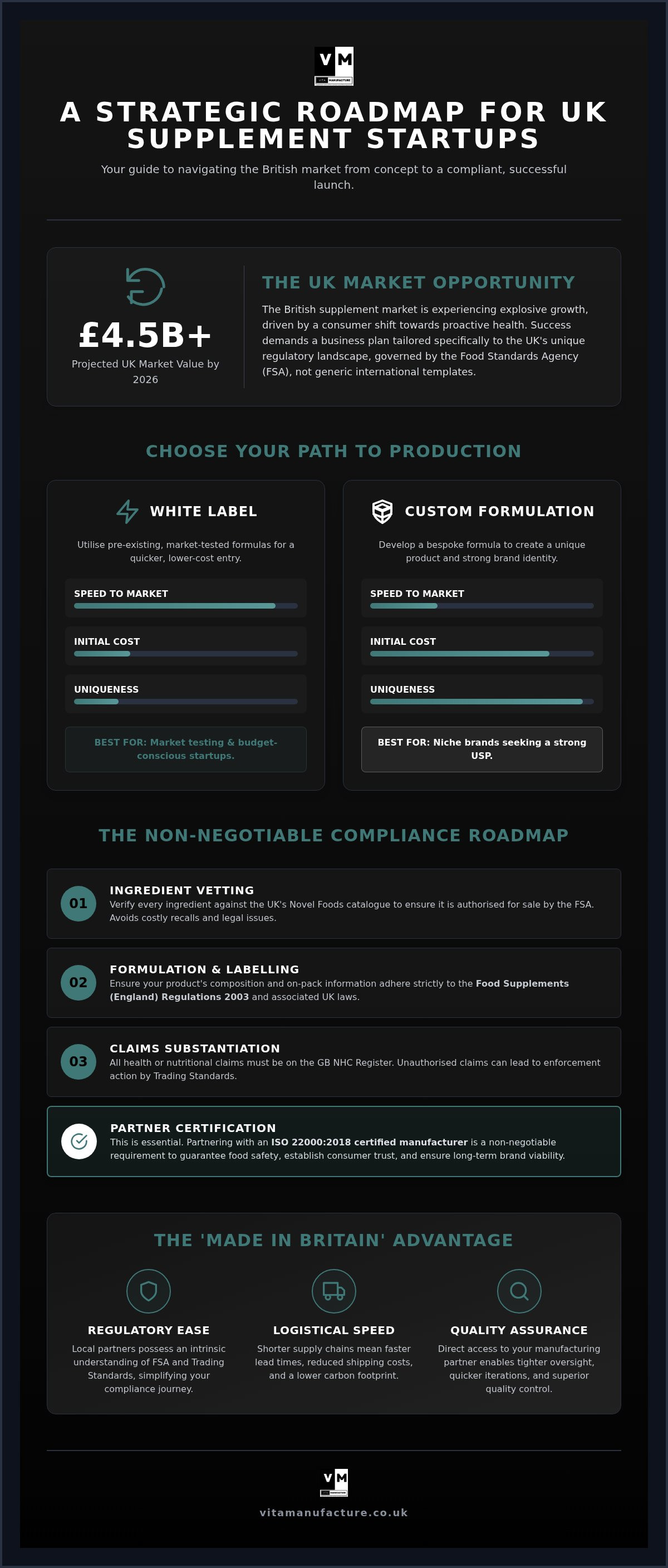
Why does local production matter? For a UK startup, "Made in Britain" is more than a patriotic label; it's a badge of quality that builds immediate consumer trust. Manufacturing your products at an ISO 22000:2018-certified facility in the UK, such as our site in Littleport, Ely, ensures your supply chain is both transparent and resilient.
Regulatory Ease: Local partners have a deeper understanding of FSA and Trading Standards, simplifying your compliance journey.
Logistical Speed: Shorter supply chains mean faster lead times and lower carbon footprints, appealing to the eco-conscious consumer.
Quality Assurance: Direct access to your manufacturing partner allows for tighter oversight and quicker iterations during New Product Development.
Strategic manufacturing isn't just an operational choice. It's a marketing differentiator that can define your brand's success in a crowded market. By prioritising local excellence, you secure a competitive edge that international competitors often struggle to match.
Core Components of a Supplement Business Plan for UK Startups
A business plan isn't just a document for potential investors; it's your operational compass. For many founders, the executive summary is where the vision takes shape, but the real value lies in articulating a unique selling proposition (USP) that survives the scrutiny of a competitive market. Why does your brand exist? Whether you're addressing a specific nutritional gap or pioneering a new delivery format, your "why" must be backed by a clear understanding of the Food Supplements (England) Regulations 2003. This ensures your initial concept is grounded in the legal realities of compositional and labelling requirements from day one.
Defining Your Niche: Beauty, Sport, or Longevity?
Choosing a niche requires a cold, hard look at market gaps. Don't try to be everything to everyone. Targeting a specific pain point, such as perimenopausal cognitive support or joint recovery for high-performance athletes, allows for sharper brand positioning and better customer loyalty. This is where bespoke packaging becomes a strategic asset. It's the first physical touchpoint for your brand, and it must signal the premium quality of what's inside. A focused supplement business plan for UK startups prioritises these high-intent niches over broad, saturated categories.
Competitive Analysis: Moving Beyond Amazon and Holland & Barrett
Many startups fail by trying to compete on price against giants like Amazon or Holland & Barrett. These incumbents often rely on generic white label formulas produced in massive quantities. To out-manoeuvre them, you need a "moat" built on superior formulation. By investing in New Product Development, you move away from commodity products and towards proprietary solutions that competitors can't easily replicate. This scientific R&D approach transforms your product from a simple tablet into a unique business asset.
Your choice of contract manufacturer is the most critical operational decision you'll make. You aren't just looking for a factory; you're looking for a strategic partner that can scale with you. This partnership dictates your lead times, your quality standards, and ultimately, your commercial viability. Finally, your marketing strategy must balance the high margins of Direct-to-Consumer (DTC) sales with the long-term credibility of retail partnerships. When these elements align, your startup moves from a concept to a scalable, professional organisation ready to capture a share of the UK's multi-billion pound wellness sector.
Operations and Supply Chain: Selecting Your Manufacturing Partner
Your manufacturing choice is the heartbeat of your operational strategy. Whilst the marketing vision gets you started, it's the supply chain that keeps you in business. A robust supplement business plan for UK startups must treat production as a strategic asset rather than a mere commodity cost. Are you looking for a vendor, or are you looking for a growth partner? The answer to that question will dictate your brand's trajectory over the next five years.
Private Label vs Custom Formulation: Which is Right for You?
Speed to market is often the deciding factor for early-stage ventures. Private Label Supplements allow you to launch with pre-validated formulas, significantly reducing R&D timelines and initial investment. This path is ideal for testing market appetite without the heavy lifting of bespoke chemistry. However, as your brand matures, you'll likely seek a unique market position. Custom formulation remains the gold standard for premium brands, allowing you to create proprietary blends that differentiate you from generic competitors. We support both paths, ensuring your brand has the flexibility to transition from white label speed to custom R&D equity as you scale.
The Importance of Quality Assurance and ISO Standards
Consumer trust is fragile. In the 2026 landscape, shoppers are hyper-aware of ingredient provenance and safety standards. This makes ISO 22000:2018 certification a non-negotiable requirement for your manufacturer. This global standard ensures rigorous food safety management throughout the production process, protecting your brand from the catastrophic reputational damage of a recall. Following the Food Standards Agency guidance is essential, but an ISO-certified partner goes beyond basic compliance to provide a framework for international excellence. Transparent supply chains, supported by high-quality bulk ingredient sourcing, are now a primary expectation rather than a luxury.
Many founders fall into the "Low MOQ" trap, prioritising the lowest possible entry point at the expense of long-term commercial viability. Whilst low minimum order quantities (MOQs) reduce initial risk, they often lead to poor margins that make scaling impossible. Instead, look for a partner who offers a transparent customer portal. This tool allows you to manage production cycles and logistics in real-time, providing the visibility needed to transition from a small-scale startup to a dominant market player. Strategic manufacturing is about finding that middle ground where quality, scalability, and profitability intersect.
Navigating UK Regulations: The Compliance Roadmap
Compliance isn't just a box-ticking exercise. It's a foundational pillar of your brand's commercial viability that protects you from legal action and consumer distrust. In a robust supplement business plan for UK startups, regulatory alignment must be integrated from the earliest R&D stages. Since the UK's departure from the EU, the regulatory environment has diverged, meaning you must look specifically to the Food Standards Agency (FSA) rather than relying on EFSA guidelines. This roadmap ensures your brand enters the market with total legal security.
Step 1: Verify the Novel Foods status of every ingredient with the FSA to ensure they're authorised for sale in Great Britain.
Step 2: Audit your health claims to ensure they're on the approved list and supported by scientific evidence.
Step 3: Design your labels to meet UK Trading Standards, including precise font sizes (minimum 1.2mm x-height) and bolded allergens.
Step 4: Implement a batch traceability system that tracks every raw material from the supplier to the finished bottle.
Step 5: Register your business as a food operator with your local authority's Environmental Health department.
FSA Novel Foods and Ingredient Restrictions
The "Novel Foods" classification is a frequent stumbling block for new founders. Ingredients like CBD or NMN have faced significant scrutiny, with the FSA frequently updating their permitted lists. If you're planning to use innovative botanical extracts, you must confirm they have a documented history of consumption in the UK prior to May 1997. An experienced manufacturing partner acts as a strategic ally here. We help you avoid costly labelling mistakes by identifying restricted ingredients before they reach the production line, ensuring your supplement business plan for UK startups remains realistic and compliant.
Health Claims and Trading Standards: What You Can and Cannot Say
Marketing your product requires a delicate balance. Whilst you want to highlight the benefits of your formula, the Advertising Standards Authority (ASA) and Trading Standards are incredibly strict regarding health claims. For example, you can state that Vitamin C "contributes to the normal function of the immune system", but you cannot claim it "cures a cold" or "prevents disease". Over-claiming is the fastest way to trigger a product recall or a damaging ASA ruling. If you're unsure about your formula's legality, our team provides the regulatory guidance needed to launch with confidence. We ensure your marketing claims are both persuasive and legally substantiated, protecting your brand's reputation as you scale.
Financial Planning: Costs, Margins, and Scaling Strategy
Financial precision is the difference between a passion project and a sustainable enterprise. Your Cost of Goods Sold (COGS) is more than just the price per capsule; it must encompass raw material sourcing, manufacturing fees, and the specific costs of your bespoke packaging. A realistic supplement business plan for UK startups also accounts for the "invisible" drains on your capital. Depending on your ambition, initial costs can range from £12,000 for a lean, home-based entry to over £50,000 for a premium, high-end launch. Don't let these figures intimidate you; they represent the professional standard required to compete in a USD 5.62 billion market.
How do you mitigate the risk of a full production run? Conducting Pilot Study and Market Research allows you to test market viability with a smaller batch. This provides the data needed to refine your formula and branding before committing your entire budget to a massive inventory run. It's a strategic move that protects your cash flow whilst you find your footing.
COGS: Raw materials, contract manufacturing fees, and primary packaging.
Regulatory and Compliance: FSA novel food checks, label audits, and local authority registration.
Operational Overheads: Product liability insurance and third-party logistics (3PL) fees; find out more about partnering with a dedicated UK fulfilment provider to keep your storage and dispatch costs predictable.
Margin Analysis: Profitability in the UK Market
Calculating your break-even point is a non-negotiable step. This figure is heavily influenced by your manufacturer's minimum order quantities (MOQs). Whilst it's tempting to compete on price, premium positioning often yields superior long-term results. Price-warring on platforms like Amazon is a race to the bottom that often ignores high customer acquisition costs. By focusing on high-margin, professional-grade formulations, you build a brand that values quality over volume. Keep in mind that VAT registration becomes mandatory once your taxable turnover reaches £90,000, a milestone that requires careful cash flow management from the outset.
Scaling from Prototype to Global Distribution
Once your hero product has gained traction, your focus shifts to range expansion and international growth. This is where your manufacturer’s logistics and distribution network becomes a primary asset. Efficient inventory management is essential to avoid "out of stock" scenarios that can damage your search rankings and customer trust. Transitioning from a single prototype to global distribution requires a partner who understands the complexities of international shipping and regulatory alignment across different territories.
Ready to turn your plan into reality? Partner with Vita Manufacture for end-to-end support.
From Concept to Capsule: Your Path to Market Leadership
Launching a successful brand in the British wellness sector requires more than just a vision; it demands a meticulous operational strategy. You've now seen how a robust supplement business plan for UK startups must integrate stringent FSA compliance, scientific R&D, and precise financial forecasting. Success hinges on your ability to move beyond generic formulas and establish a brand built on transparency and consumer trust. By prioritising local excellence and regulatory rigour, you ensure your startup is built to scale rather than just to survive.
Choosing the right production partner is the most critical decision in your founder journey. As a UK-based strategic partner, we provide the ISO 22000:2018 certified facility and end-to-end product development expertise needed to scale your venture from a single concept to a global range. We're here to ensure your supply chain becomes your strongest competitive advantage whilst you focus on growing your brand. Are you ready to bridge the gap between your entrepreneurial ambition and commercial reality? Start Your Supplement Journey with Vita Manufacture and turn your vision into a professional, market-ready reality.
Frequently Asked Questions
How much does it cost to start a supplement business in the UK?
Start-up costs depend on your scale. A home-based entry typically requires £2,500 to £12,000, whilst a premium launch can exceed £120,000. You'll also need to account for a £12 Companies House registration fee and VAT registration once your turnover hits £90,000. These figures should be central to any supplement business plan for UK startups to ensure long-term commercial viability and avoid cash flow issues during the initial launch phase.
Do I need a licence to sell supplements in the UK?
You don't need a specific "supplement licence", but you must register as a food business with your local authority at least 28 days before trading. It's also vital to ensure your products aren't classified as medicines by the MHRA. Your business plan must account for these regulatory registrations to ensure you operate legally within the UK market from day one, maintaining compliance with both local and national standards.
What is the difference between white label and private label supplements?
White label supplements are pre-formulated products that you simply rebrand, offering a rapid route to market. Private label supplements often involve a higher degree of exclusivity or slight formula adjustments tailored to your brand's specific needs. Whilst white label is ideal for testing a niche quickly, private label allows for greater differentiation. Both paths benefit from professional contract manufacturing to ensure the final product meets all British safety and quality requirements.
How do I find a reliable supplement manufacturer in the UK?
Reliability is found through rigorous certification and transparency. Prioritise manufacturers with ISO 22000:2018 certification, as this demonstrates a commitment to international food safety management systems. You should also look for partners who offer a transparent customer portal for real-time production tracking. A UK-based facility is often preferable, as it simplifies communication, reduces shipping lead times, and ensures your supply chain remains resilient against global logistical disruptions.
Can I sell my UK-made supplements internationally?
Yes, UK-made supplements can be sold globally, provided they meet the specific regulations of each target market. Different countries have varying rules regarding permitted ingredients and health claims. Working with a manufacturer that provides end-to-end logistics and distribution support can simplify this process. They can help navigate international shipping requirements whilst ensuring your British-made products maintain their high-quality status across diverse borders and regulatory landscapes.
How long does the product development process usually take?
Timelines depend on the complexity of your chosen path. White label products can often be ready for market in a matter of weeks since the formulas are already validated. In contrast, custom New Product Development typically takes several months. This longer period accounts for bespoke formulation, pilot studies, and essential stability testing. Your supplement business plan for UK startups should reflect these variations to manage investor expectations and launch schedules accurately.
What are the FSA requirements for new supplement brands?
The FSA requires that all supplements are safe for consumption and correctly labelled. You must verify that your ingredients aren't classified as "Novel Foods" without prior authorisation. Additionally, any health claims on your packaging must be substantiated and authorised under UK law. Labels must include specific information like dosage instructions, allergen warnings, and a full list of ingredients to comply with Trading Standards and protect consumer safety.
Is ISO 22000 certification necessary for supplement manufacturing?
Whilst not a legal requirement, ISO 22000:2018 is highly recommended for building brand authority. It goes beyond basic HACCP requirements by providing a comprehensive food safety management system that covers the entire supply chain. For a new startup, this certification acts as a powerful trust signal for both retailers and consumers. It ensures that your manufacturing partner adheres to the highest international standards for quality control and risk management.