UK ADHD Review: What It Means for Cognitive Health
Could people receive practical support for ADHD-related needs without a formal diagnosis, while still retaining access to appropriate clinical care? That’s the question behind ADHD Support Without Diagnosis? What the Government Review Could Mean for the Future of Cognitive Health. With NHS ADHD assessments under pressure, it’s understandable that people want clarity about what might change and what support could look like.
An independent government-commissioned review led by Professor Peter Fonagy published an interim report on 10 June 2026. Publication of the report does not, on its own, establish new access rules or make non-diagnostic support a replacement for specialist assessment and care. Those distinctions matter when everyday cognitive health approaches are discussed alongside ADHD treatment.
This article explains what the review establishes, how needs-based support differs from clinical ADHD care, and why evidence-led communication matters. It also considers what the discussion means for cognitive health product development. Responsible formulation and regulatory guidance can help brands explore supplement concepts without suggesting that supplements diagnose or treat ADHD. Clear evidence and careful claims are essential for building trust.
Table of Contents
What could the UK government review change, and what remains unconfirmed?
ADHD diagnosis, everyday cognitive health, and clinical care are not interchangeable
What the review could mean for cognitive health brands and product claims
A responsible next step: turn cognitive health insight into evidence-led development
ADHD support without diagnosis: what does the phrase mean?
Practical help for attention or organisation difficulties may be available before someone receives an ADHD diagnosis, depending on the setting and the support being discussed. The phrase “support without diagnosis” does not identify a single service or explain what help is included. To understand a particular proposal, check what it offers, who it is intended for and whether it is practical support or clinical care.
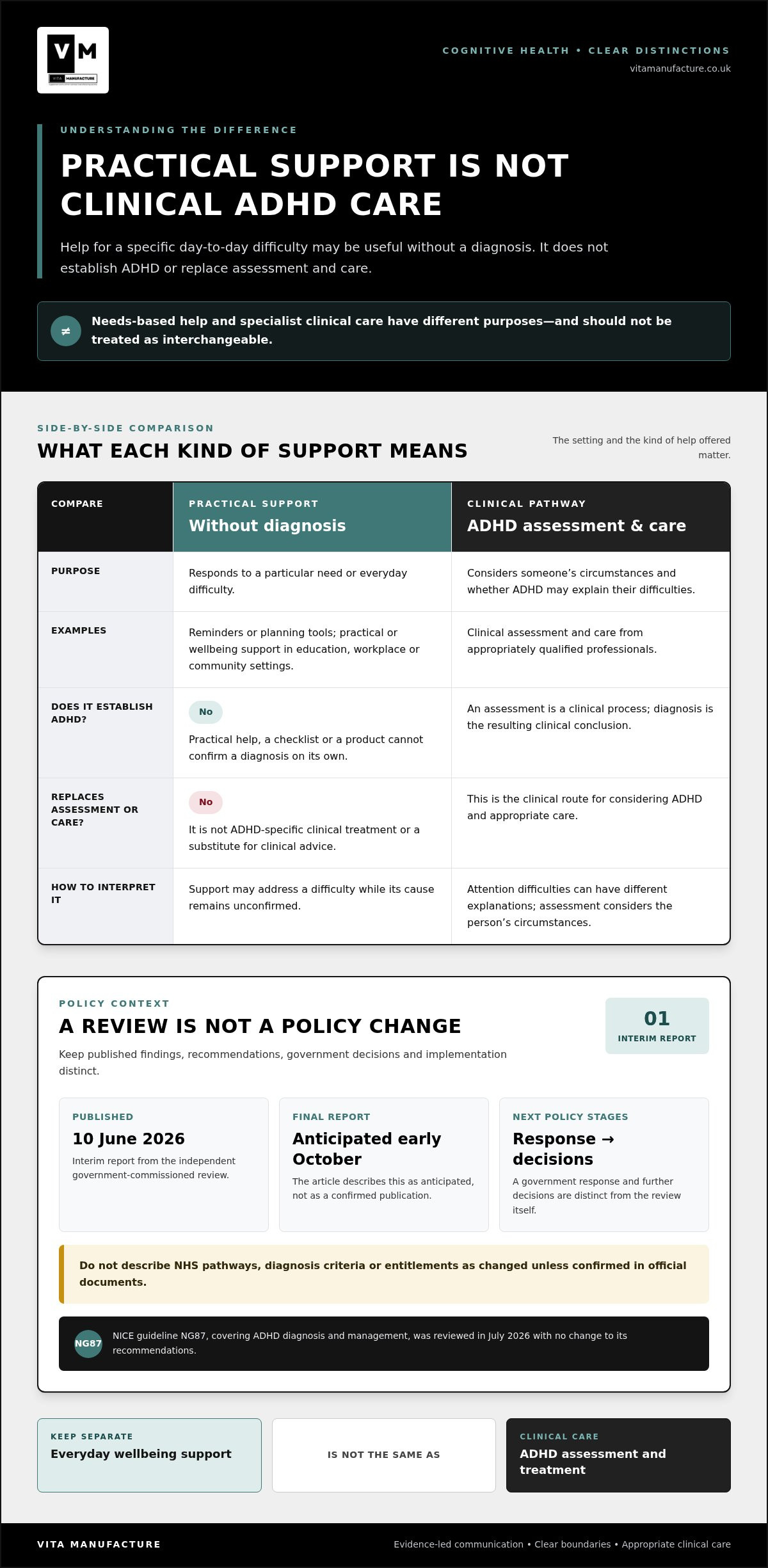
Support without diagnosis means practical help for a person’s needs without establishing that they have ADHD or providing ADHD-specific clinical treatment. It may address challenges someone experiences, but it is not a diagnosis and does not replace assessment or care from appropriately qualified professionals.
It helps to distinguish symptoms, functional difficulties, assessment and diagnosis. Symptoms are experiences or behaviours that may be associated with ADHD but can have other explanations. Functional difficulties are the effects those experiences have on everyday life. An assessment is a clinical process that considers someone’s circumstances and whether ADHD may explain their difficulties. A diagnosis is the resulting clinical conclusion. A checklist, product or description of symptoms cannot confirm it on its own. For a general introduction, see this overview of attention deficit hyperactivity disorder (ADHD); it is not a substitute for clinical advice.
What can support without a diagnosis refer to?
The phrase can refer to practical or wellbeing support offered in an education, workplace or community setting. This might focus on a specific day-to-day difficulty rather than its cause. For example, a person may use reminders or planning tools to help manage tasks. Such support does not establish an ADHD diagnosis and is distinct from clinical treatment. Supplements and self-help approaches should not be presented as substitutes for assessment or advice from a qualified health professional.
Why are people asking about ADHD support and access?
People want clarity because persistent attention or other difficulties can affect everyday life, and getting an assessment may take time. Public discussion about access can include proposals and possible changes, but discussion is not the same as confirmed government policy. The review’s published findings and any government response are the relevant documents for understanding what has been decided. While seeking appropriate clinical advice, people can also look for practical support suited to their circumstances without treating it as proof of ADHD or a replacement for assessment.
This distinction is central to ADHD Support Without Diagnosis? What the Government Review Could Mean for the Future of Cognitive Health. A needs-based approach, if formally adopted, could shape how some support is organised. It would not make non-diagnostic help equivalent to a formal diagnosis or clinical care.
What could the UK government review change, and what remains unconfirmed?
The review may inform future policy, but a review is not itself a policy change. Its findings need to be considered alongside the government’s formal response and any later decisions. Until those steps are clear, the review should not be described as having changed NHS pathways, diagnosis criteria or entitlements.
The independent review commissioned by the UK Government and led by Professor Peter Fonagy covers mental health conditions, ADHD and autism. An interim report was published on 10 June 2026. The final report was anticipated for early October. To understand the review’s current status and any government response, consult the latest official records. Use the published title and terms of reference when describing its scope.
Verified status: an interim report was published on 10 June 2026. Distinguish any final recommendations, government decisions or service changes from proposals and commentary unless they are confirmed in official documents.
How to read review findings, proposals and government responses
Keep the stages clear. A review can examine evidence and make recommendations. The government can then accept, reject or respond to those recommendations. Implementation requires further decisions. These stages are not interchangeable. Describe a needs-based model or support without diagnosis as a proposal or reported expectation unless it appears as a confirmed recommendation in the published report.
A review does not automatically revise clinical guidance. NICE guideline NG87, which covers ADHD diagnosis and management, was reviewed in July 2026 with no change to its recommendations. For current patient-facing information, consult the NHS guidance on ADHD diagnosis and clinical care. Changes to assessment arrangements or access need to be confirmed through relevant official policy and service information.
Which public bodies and clinical sources should inform the explanation?
For policy updates, look to GOV.UK announcements and publications from the Department of Health and Social Care. Check the publication date and whether a document is an interim report, final report or government response. For clinical context, use current NHS information and NICE guidance. Peer-reviewed research can help explain the evidence, but it cannot establish what ministers have decided.
The same distinction matters to cognitive health brands. Policy debate can prompt product development questions, but it does not prove that a supplement ingredient is effective or support an ADHD-related claim. Brands exploring product concepts can bring evidence review together with formulation and regulatory guidance through supplement product development.
ADHD diagnosis, everyday cognitive health, and clinical care are not interchangeable
Difficulty concentrating can affect work, study and everyday routines, but one experience or a cluster of attention difficulties does not establish ADHD. Sleep problems, stress, mental health concerns and other factors can also affect concentration. Assessment helps a qualified professional consider the wider context rather than assume a cause.
Keep three things distinct: an ADHD assessment considers a person’s history and difficulties; general wellbeing support aims to help with day-to-day needs; and cognitive health products are developed for a defined purpose and require evidence appropriate to that purpose. The interim report on the independent review is a policy source, not clinical guidance or evidence that a particular product works.
What makes ADHD assessment different from general wellbeing support?
NICE guideline NG87 covers ADHD diagnosis and management, with diagnosis made by a specialist following assessment. NHS information can explain the clinical pathway, but an online checklist or support with routines cannot confirm ADHD. Planning tools, reminders or adjustments may help someone manage everyday tasks, but they do not identify why those tasks are difficult.
If attention or related difficulties are persistent, distressing or affecting daily life, seek suitable clinical advice rather than trying to diagnose yourself. A professional can consider the wider picture and advise on appropriate next steps. Practical support can be useful in its own right, while assessment remains important where needed.
What can cognitive health research say about supplements?
Research findings need careful interpretation. Evidence about an individual ingredient does not automatically show that a finished supplement has the same effect. Studies may examine different amounts, combinations, populations or outcomes from those relevant to a product’s intended use. Results from one group or setting may not apply more broadly, and early findings can leave important questions unanswered.
For responsible product development, ask specific questions: what evidence supports the ingredient and formulation? Who was studied? What outcome was measured? Does the evidence support the way the product is described? Consumer interest in cognitive health is not proof of efficacy. Preliminary findings should not be turned into claims that a supplement improves ADHD symptoms or replaces clinical care.
This is the practical distinction at the heart of ADHD Support Without Diagnosis? What the Government Review Could Mean for the Future of Cognitive Health: support, diagnosis and products serve different purposes. The broader policy context is explored in UK ADHD Review: What It Means for Cognitive Health. Assess each form of help by its purpose and evidence, without treating one as a substitute for another.
What the review could mean for cognitive health brands and product claims
Policy attention can influence the questions consumers and brands ask, but it does not establish a market opportunity or validate a product. Any implications for cognitive health businesses depend on the review’s scope, recommendations and government response. Discussion of support without diagnosis is not evidence that a supplement can address ADHD or related needs.
For brands, a responsible response starts with evidence, not headlines. Consumer interest can help identify questions worth exploring, but it cannot demonstrate that an ingredient is effective, that a finished product produces a particular outcome or that a health claim is justified. ADHD Support Without Diagnosis? What the Government Review Could Mean for the Future of Cognitive Health is a policy question, not scientific substantiation for a product claim.
How can brands assess a cognitive health product concept responsibly?
Start by defining the intended audience and product purpose. Describe the need without assuming that consumers have ADHD or implying that a supplement can replace clinical care. Then assess three connected areas: the evidence for the ingredients and intended use, the feasibility of developing a suitable formulation and format, and relevant safety questions with qualified specialists.
Before publishing labels or marketing, review the proposed wording against current UK requirements for nutrition and health claims. Assess the overall impression created by the product name, packaging and promotional language, not just an individual sentence. Include regulatory review early if ingredient status raises questions. Novel Food Supplement Manufacturing UK is a relevant topic to investigate as part of this work.
Why are claim boundaries central to commercial trust?
Nutrition and health claims are not interchangeable with claims that a product treats a disease. Avoid wording that says or implies a supplement diagnoses, prevents, treats or cures ADHD. General language about focus or cognitive wellbeing should not imply an ADHD benefit that the evidence and applicable requirements do not support. Clear, accurate claims help consumers understand a product’s intended purpose without confusing it with diagnosis or treatment.
Vita Manufacture supports supplement new product development through formulation, regulatory guidance and manufacturing. Brands can explore a cognitive health concept with these development needs in view through supplement product development.
A responsible next step: turn cognitive health insight into evidence-led development
Policy discussion can raise important questions, but a strong product concept starts with evidence and a clearly defined need, not a trend headline or an assumed diagnosis. For brands considering cognitive health, the practical task is to move carefully from insight to development while keeping supplements distinct from ADHD diagnosis and clinical care.
A practical evidence-to-development sequence for brands
Use a clear sequence to decide whether an idea is ready to progress:
Verify the policy. Separate confirmed review findings and government decisions from proposals or commentary.
Define the need. Identify the intended audience and product purpose without implying that consumers have ADHD.
Review the evidence. Record what is known about relevant ingredients, the rationale for the proposed formulation and any limitations.
Assess claims. Flag label and marketing language for regulatory review before publication.
Develop responsibly. Consider formulation, manufacturing and logistics as connected workstreams. Revisit the concept if the evidence or feasibility does not support it.
This sequence gives teams a clear basis for decisions. An ingredient’s presence in research does not establish the effectiveness of a particular finished product. A promising concept still needs to be assessed for formulation feasibility and responsible communication.
How Vita Manufacture can support responsible product development
Vita Manufacture supports brands through supplement new product development, including formulation, regulatory guidance, manufacturing and logistics. These activities can be planned as part of one development pathway, with regulatory guidance informing decisions rather than guaranteeing market approval. ISO 22000:2018-certified operations relate to the company’s operational standards. The certification does not establish clinical efficacy or mean a product has been approved to make a health claim.
The question behind ADHD Support Without Diagnosis? What the Government Review Could Mean for the Future of Cognitive Health is ultimately about distinguishing practical support, clinical care and commercial product development. For a brand, the responsible next step is to define the consumer need, examine the evidence and assess proposed claims before moving towards manufacture.
For a supplement concept that needs formulation, regulatory guidance and manufacturing considered together, explore supplement product development with Vita Manufacture.
Build cognitive health products on evidence, not assumption
Practical support without diagnosis is not the same as ADHD assessment or clinical care. A government review, whether it recommends change or not, does not establish that a supplement can diagnose or treat ADHD. Keep policy, clinical evidence and product claims distinct.
ADHD Support Without Diagnosis? What the Government Review Could Mean for the Future of Cognitive Health comes down to careful interpretation: verify official decisions, define a genuine consumer need, assess the evidence and review claims before developing a product. Consumer interest can prompt useful questions, but it cannot replace substantiation or responsible formulation.
For brands ready to explore a concept, Vita Manufacture brings formulation, regulatory guidance, manufacturing and logistics support together through new product development. Its ISO 22000:2018-certified operations support manufacturing standards, but certification is not evidence of clinical efficacy or product approval.
Explore evidence-led supplement product development with Vita Manufacture and take the next step with a clear purpose, sound evidence and responsible communication. Thoughtful development can build a stronger foundation for consumer trust.
Frequently Asked Questions
Can you get ADHD support without a diagnosis in the UK?
Practical help may be available without an ADHD diagnosis, but what is offered depends on the setting and your circumstances. Support with everyday difficulties does not confirm ADHD or replace a clinical assessment. If attention-related concerns are affecting your life, speak to your GP or an appropriate health professional about advice and possible assessment. NICE guidance says ADHD diagnosis is made by a specialist following assessment.
What does the government review mean for people seeking ADHD support?
The review may inform future policy, but it does not itself create new support or change NHS access. The independent review led by Professor Peter Fonagy covers mental health conditions, ADHD and autism. Its interim report was published on 10 June 2026. Check GOV.UK for the latest final report and government response. Until recommendations and actions are verified, do not treat proposals or commentary as confirmed changes.
Can a government review change ADHD diagnosis criteria?
A review alone does not change clinical diagnosis criteria. It can make recommendations, but any changes need to be set out through relevant official policy or clinical guidance. NICE guideline NG87 was reviewed in July 2026 without changes to its recommendations. For current assessment information, distinguish published NICE guidance from proposals or media descriptions of what a review might mean.
Can supplements help ADHD symptoms without a diagnosis?
Do not assume that a supplement can help ADHD symptoms simply because it is marketed for cognitive health. Evidence about an ingredient does not automatically show that a finished product is effective for ADHD, and supplements are not a substitute for assessment or clinical care. If you are considering a supplement, particularly alongside medication or for a health concern, discuss it with a qualified health professional.
What is the difference between cognitive health and ADHD support?
Cognitive health is a broad term relating to areas such as attention, memory and thinking. It is not an ADHD diagnosis. ADHD support may involve practical help for specific difficulties, while clinical ADHD care involves assessment and appropriate professional management. A product developed for general wellbeing has a different purpose from diagnosis or treatment. Keep these distinctions clear in personal decisions and product communication.
What should supplement brands verify before developing a cognitive health product?
Start by defining the intended audience and product purpose. Then assess the evidence for the ingredients and proposed formulation, including study populations, outcomes and limitations. Consider formulation feasibility and safety with qualified specialists. Review ingredient regulatory status and proposed labels and marketing against current UK requirements before publication. Plan formulation, manufacturing and logistics together, and do not make claims that imply a supplement diagnoses or treats ADHD.
Does interest in ADHD support mean there is evidence for new supplements?
No. Consumer interest can point to questions worth exploring, but it does not establish ingredient efficacy or justify a health claim. Brands need evidence relevant to the ingredient, finished formulation, intended use and people the product is designed for. Describe preliminary research cautiously, and do not imply an ADHD benefit that the evidence and applicable UK requirements do not support.